
ASML 3Q25 Earnings Review: Strong EUV Bookings —What Does the 2026 'Floor' Really Mean for the Lithography Titan?
Is AI demand finally translating into a sustainable EUV supercycle for ASML, and what does the unexpected "2026 floor" really signal about the lithography titan's long-term resilience?


ASML 3Q25 Earnings Review: Strong EUV Bookings —What Does the 2026 'Floor' Really Mean for the Lithography Titan?
Core Insight: The Shift from Uncertainty to Structural Rebalancing
The core significance of ASML's financial results for Q3 2025 lies not in the quarterly revenue (Net Sales of €7.516bn, which met guidance), but in the major strategic reshaping of its future growth outlook, driven by the strong beat in Net bookings. The record EUV order volume confirms that the AI-driven semiconductor investment cycle is picking up, yet this should not be mistaken for a simple "supercycle." It must be viewed as a signal of cycle bottom rebound and structural rebalancing. Management's revised guidance for 2026 revenue—setting a floor of "not lower than 2025"—was a major "de-risking" event, but it was accompanied by candid warnings about the structural decline of its China DUV business and the complex timeline for High NA EUV volume adoption.
Consequently, this report illustrates not a carefree boom, but the intricate trade-off where structural growth forces (AI/EUV) must balance against cyclical and geopolitical headwinds (China/DUV).
Part I: Strong EUV Momentum Returns, Yet the Recovery Foundation Remains Unstable
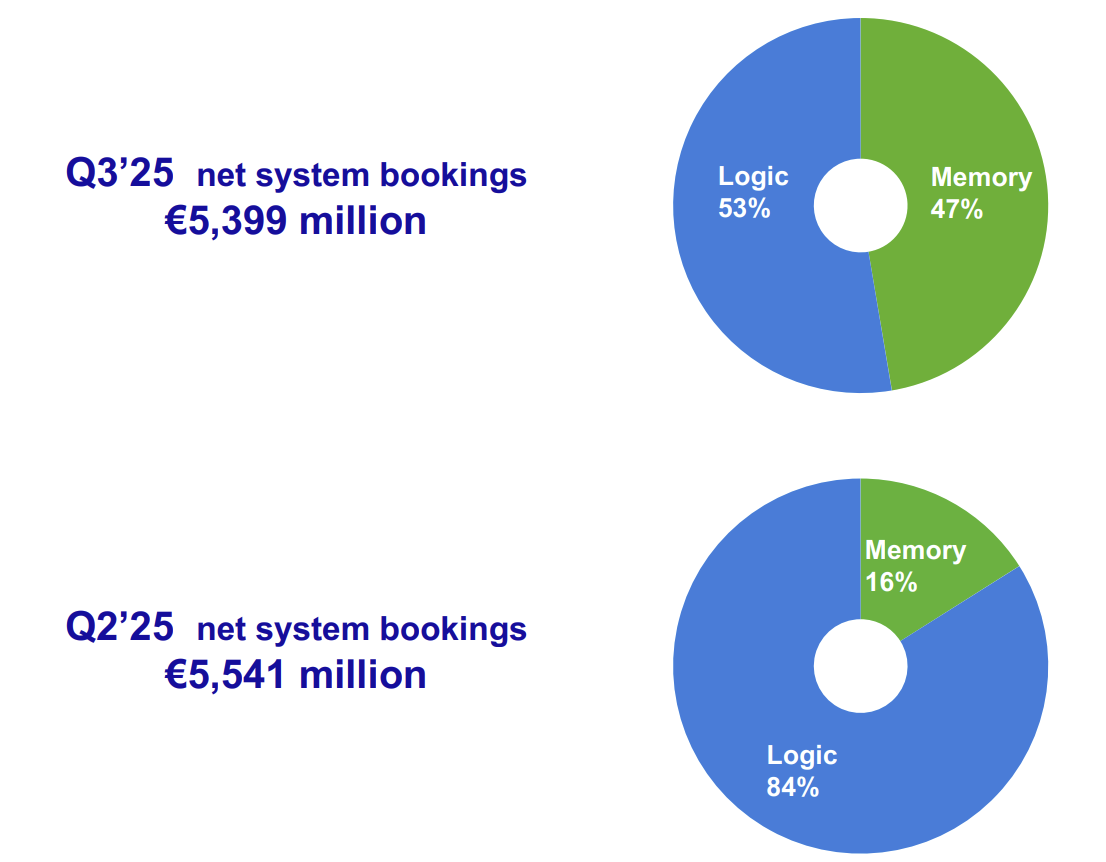
The strong order flow in ASML's quarterly report undeniably boosted market sentiment. The Q3 2025 Net bookings reached an impressive €5,399M, significantly exceeding sell-side consensus, thanks to a crucial structural shift in order composition:
1. EUV Order Rebound and the AI Catalyst
- Order Composition Shift: The momentum in Q3 explicitly shifted towards the higher-margin EUV lithography systems, with bookings soaring to €3.6bn. This contrasts sharply with the Q2 orders, which were primarily driven by DUV, signalling a definite return in advanced process investment demand.
- The Role of AI: Management confirmed that the AI-led resurgence in investment for advanced Logic chips and advanced DRAM is the primary market driver. Orders from Memory customers saw a substantial rebound, increasing from 16% in Q2 to 32% in Q3, underscoring the broad-based nature of this demand.
These figures strongly support ASML's resilience in the advanced process sector, partially answering the first part of the Excerpt's question: AI demand is translating into core EUV orders, but its sustainability must be weighed against structural headwinds.
2. Persistent Challenges in Non-Advanced Segments
While EUV orders rebounded strongly, caution is warranted regarding the broader market sentiment:
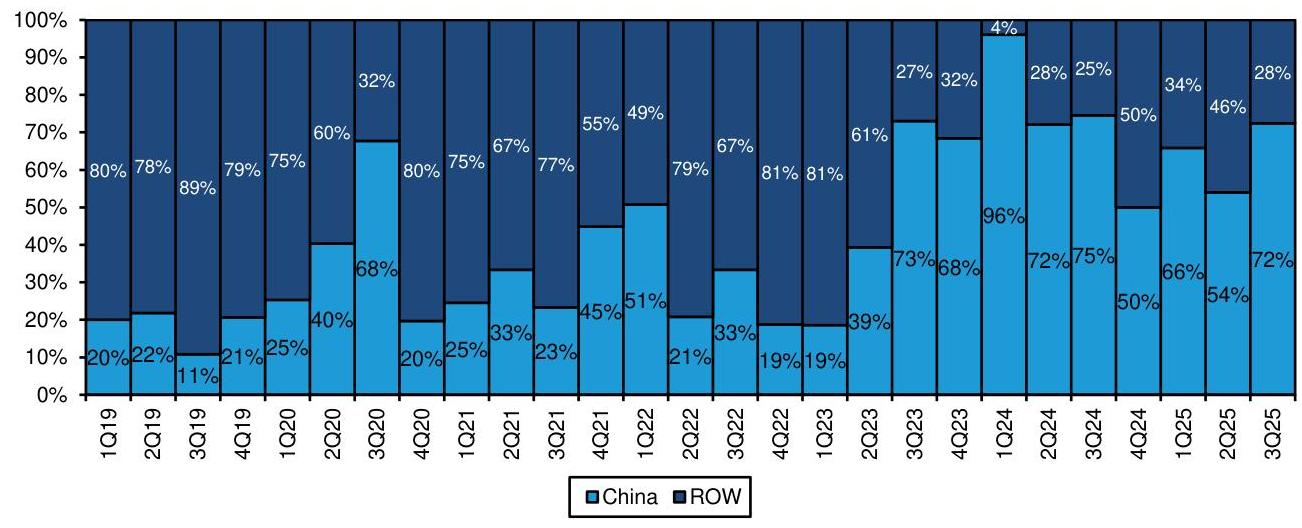
- DUV Weakness Signal: Analysis from firms like Bernstein indicates that the substantial increase in China's share of DUV sales in Q3 (rising from 54% in Q2 to 72%) strongly suggests particularly weak DUV revenue performance in non-China regions, indicating that capacity digestion continues across the market.
- WFE Contribution Concerns: Although customers continue to adopt more EUV layers in both Logic and DRAM, some analyses caution that as node migration drives up total capital expenditure, the proportional contribution of EUV to total Wafer Fab Equipment (WFE) capital expenditure could potentially decrease. This highlights that EUV growth is not limitless and must be assessed against its ability to drive the overall WFE market.
Net System Pre-Booking Activity by End-Use (Quarterly)
Source: ASML Investor Relations Presentation
Part II: The 2026 'Floor'—The Trade-off Between Geopolitics and Growth Resilience
The most significant strategic takeaway from this report is management's revised outlook for 2026 revenue: "We do not expect Total net sales in 2026 to be lower than 2025." This "growth floor" serves as a crucial "de-risking" event, effectively alleviating market anxieties over a potential severe revenue contraction post-Q2 earnings.
- Positive Market Interpretation: Analysts (such as BNP Paribas) view "flat as the new up" given the cyclical pressures, underscoring the company's powerful operational resilience in a complex global landscape. JPM suggested this move "cleared the decks" for significant growth in 2027.
1. The Risk Behind the Floor: Resetting the China DUV Business
The establishment of this floor, however, comes with a clear caveat. Management explicitly warned of a structural headwind in 2026: China business will significantly decline, reverting to a "normalized level" compared to the high levels seen in 2024 and 2025.
- The Risk in Q3 Data: In Q3, the Chinese mainland market accounted for a record 42% of ASML's system sales (and 72% of DUV sales). Management acknowledged that the high business levels over the past two years were due to capacity digestion and were unsustainable.
- The Necessity of the Hedge: This anticipated DUV decline must be primarily offset by the growth in EUV demand from non-China customers, driven by AI investment in advanced DRAM and leading-edge logic. Management's confidence in setting the "floor" is a testament to its belief in the efficacy of this EUV-hedging-DUV strategy.
EXHIBIT 7: DUV Sales Breakdown by Region (%)
Source: Bernstein
Part III: Long-Term Technology Strategy: Cautious High NA Rollout and New Growth Drivers
Regarding its long-term technology deployment, while ASML highlighted technical maturity, the pace of commercialization demands a cautious approach.
1. High NA EUV: Test Tool Deployment, Not Immediate Mass Production
ASML confirmed the delivery of 1 High NA system in Q3, emphasizing that its maturity far exceeds that of Low NA at a comparable stage. However, its commercialization timeline must be critically assessed:
- Technical Exploration Phase: Although SK Hynix announced the installation of the first production-ready High NA EUV system (EXE:5200B), this installation should be viewed as a "Phase 1" test tool deployment. Its primary goal is process exploration and yield optimization, not immediate, large-scale volume production.
- Profitability and Throughput Challenges: High NA systems currently generate "very low positive margins." Due to high costs and challenges with throughput (WPH is lower than newer Low NA models) and the reduced Mask Area, the next wave of orders supporting High Volume Manufacturing (HVM) is not expected until the second half of next year and beyond. Meaningful gross margin improvement is projected only around 2028 or 2029.
2. New Strategic Growth Drivers
- Entry into Advanced Packaging: The company shipped its first product for Advanced Packaging, the TWINSCAN XT:260. The CEO stressed the importance of 3D integration as an alternative path to pushing Moore’s law, noting that this tool offers up to 4x the productivity compared to existing solutions.
- AI Strategic Investment: ASML made a strategic investment of €1.3bn in Mistral AI, aiming to integrate AI into its holistic lithography solutions to enhance system performance and customer yield, underscoring its proactive stance on technological leadership.
Conclusion: A Clear Floor, But Challenges Remain
The ASML Q3 report successfully addresses the two core questions posed in the Excerpt:
- Is it an EUV Supercycle? AI demand has indeed translated into strong EUV momentum, but this is best defined as strong structural demand rebalancing rather than an unrestrained supercycle. EUV growth must accelerate continuously to offset the softness in non-China DUV and the inevitable reset of the China business in 2026.
- What does the 2026 floor signal? The floor guidance (not below 2025) is a crucial demonstration of the company's long-term resilience, significantly removing downside risk. It marks a shift to a more predictable phase of the growth story, allowing investors to focus clearly on the potential for 2027 growth.
Although Q4 2025 guidance is strong, and service revenue (Installed Base Management sales) grew by 27.3% year-over-year, ASML's valuation still reflects caution: Bernstein notes that ASML's P/E premium relative to the Philadelphia Semiconductor Index (SOX) has fallen to parity, trading at a historical low. This suggests the market maintains lingering concerns over growth deceleration and structural headwinds. Moving forward, ASML must consistently validate its structural growth thesis through sustained EUV delivery and stable margins.
I put my in depth review behind the paywall:


