
Ferrari's Y-Shaped V12 Patent: 12 Cylinders, Zero Mechanical Connection to the Wheels
If Ferrari's 12 cylinders no longer share a crankshaft, no longer drive the wheels, and produce a sound that's algorithmically orchestrated — at what point does a V12 stop being a V12?


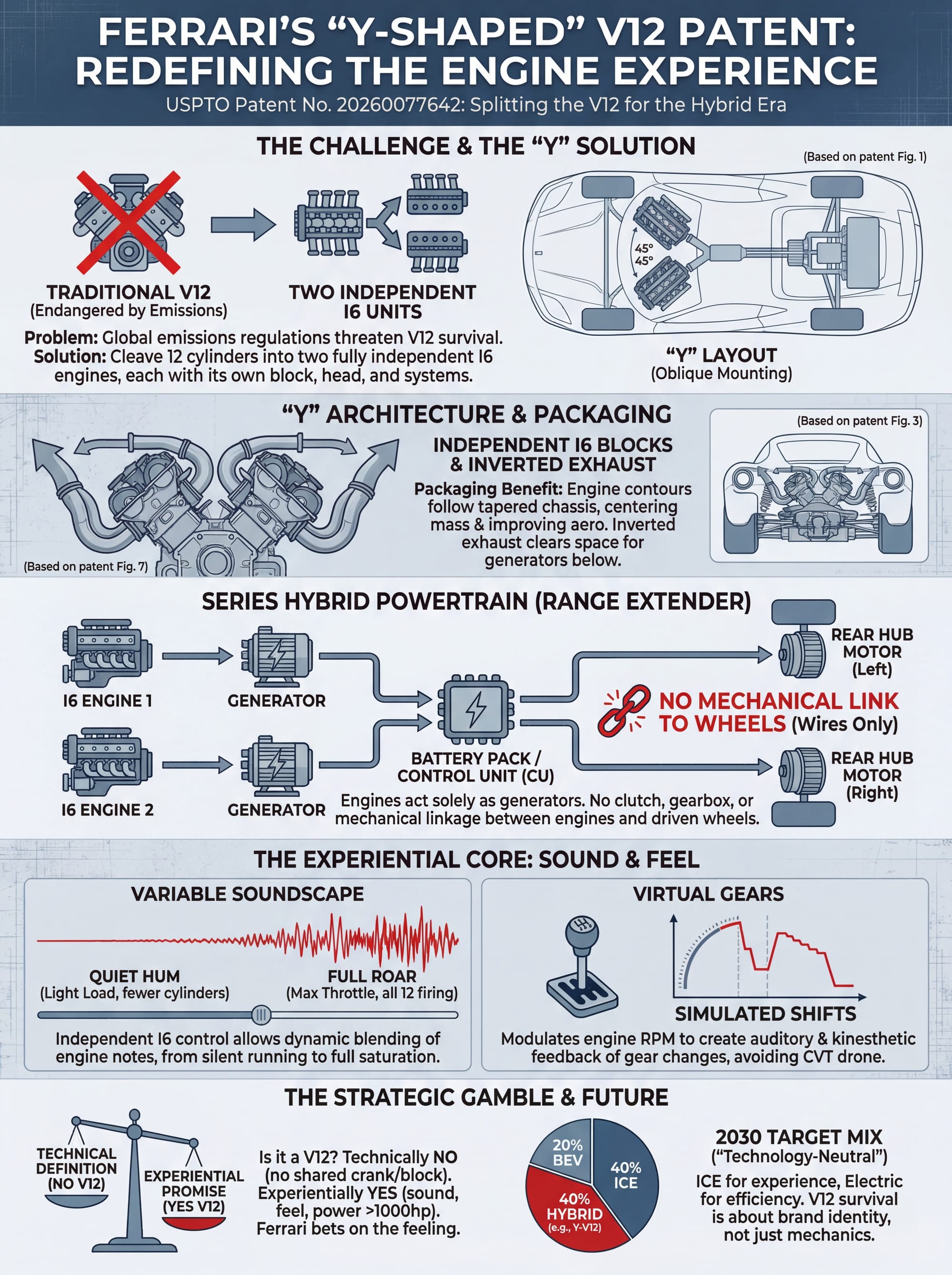
When the V12 Becomes an Endangered Species
Only six manufacturers in the world still fit V12 engines into production passenger cars: Aston Martin, Ferrari, Lamborghini, Cosworth (through Gordon Murray Automotive), Mercedes, and Rolls-Royce. A decade ago, that list was twice as long.
For Mercedes and Rolls-Royce, the V12 is a garnish — remove it, and the car is still the car. For Ferrari and Lamborghini, it is the reason the check gets written. Buyers of the 12Cilindri and the Revuelto aren't just paying for horsepower figures. They're paying for an acoustic signature that only 12 cylinders firing in a particular sequence can produce. Turbochargers can replicate power. Electric motors can replicate torque. But that sound — the high-frequency harmonic bloom that unfurls from idle to redline — has no substitute technology. Not yet.
The problem is that global emissions regulations are tightening the noose, year by year.
A recently surfaced patent filing, from the USPTO (No. 20260077642), reveals that Ferrari's engineers have proposed a radical solution: split the V12 apart and reassemble it into a "Y."
Cleaving 12 Cylinders in Half
The architecture of a traditional V12 is straightforward: two banks of six cylinders sharing a single crankshaft, arranged in the signature V angle. Ferrari's patent abandons this form entirely. It splits the 12 cylinders into two fully independent inline-six engines, each with its own block, cylinder head, and intake and exhaust systems.
Packaging two separate engines inside a single car isn't unheard of. The old BMW 8 Series V12 was essentially two inline-sixes sharing a housing, each running its own ECU and fuel pump. But Ferrari goes further: even the blocks themselves are completely decoupled.
What really turns heads is how these two engines are positioned inside the car. Rather than sitting parallel to the longitudinal axis like every modern V12, or transverse like the classic Miura, Ferrari mounts the two inline-sixes at roughly 45-degree angles, aligned with the tapering chassis rails. Viewed from above, with the exhaust routing traced out, the whole assembly resembles the letter "Y."
Ferrari "Y" engine chassis top view: two independent I6 units mounted at oblique angles, with the spatial relationship between generator sets, battery pack, and control unit clearly visible
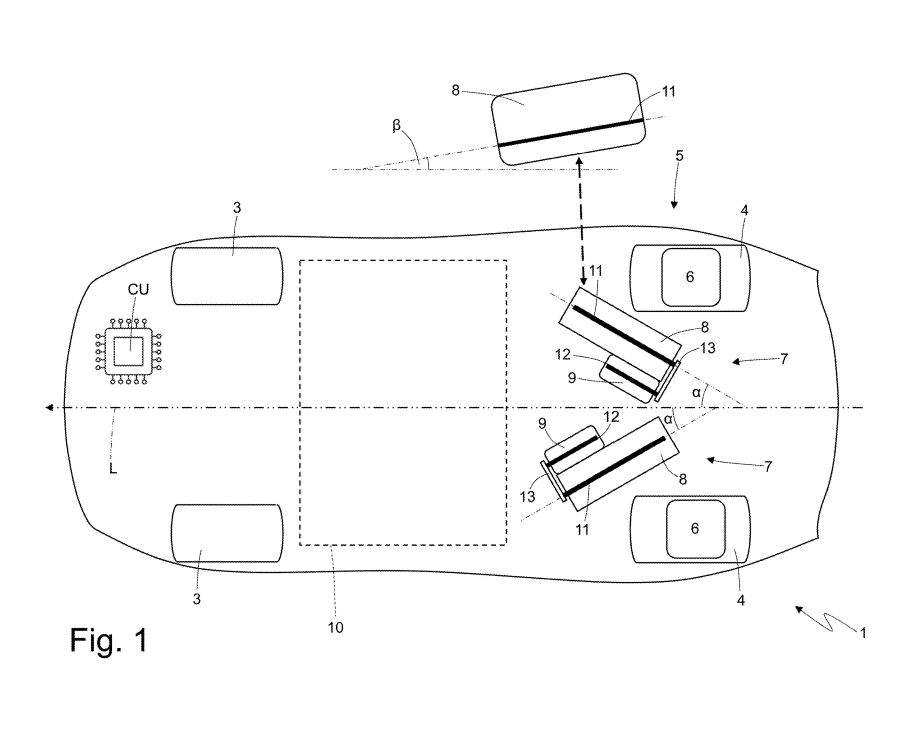
source: Ferrari USPTO Patent No. 20260077642
The patent filing offers a clear engineering rationale for this "oblique" placement: the engine contours can follow the chassis's tapered narrowing, pushing the powertrain closer to the vehicle's center of gravity and freeing up design latitude for the body shell. In practical terms, designers can make the car smaller, tighter, and more aerodynamically efficient, because the engine is no longer a rigid rectangular mass squatting in the middle of the rear bay.
Range Extender, Not Drivetrain
These two inline-sixes do not directly drive the wheels.
That sentence is worth reading twice, because it fundamentally redefines what "V12 Ferrari" means. The patent describes a series hybrid architecture: each I6 is coupled to its own generator, which feeds electricity to two hub-mounted electric motors on the rear axle. Between the engines and the driven wheels, there is no clutch, no gearbox, no mechanical linkage of any kind — only wires.
The patent language leaves no room for ambiguity: "Each internal combustion engine contains a drive shaft which is firmly connected to the shaft of the corresponding electric motor by means of a transmission having a fixed gear ratio. That is, between the drive shaft of each internal combustion engine and the shaft of the corresponding electric motor, no clutch and no gearbox or other type of transmission are provided."
Top view of the "Y" engine: the two independent I6 blocks and their respective intake and exhaust systems clearly visible
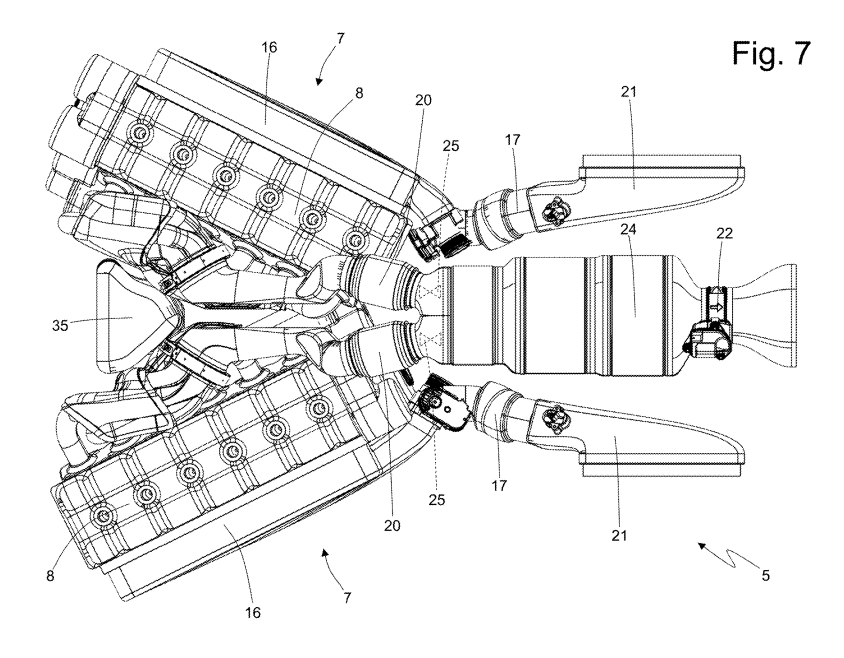
source: Ferrari USPTO Patent No. 20260077642
One engineering detail worth noting is the exhaust routing. Most engines duct exhaust downward and outward. In the Y layout, the exhaust pipes run upward and outward to clear space for the generator assemblies below. This inverted exhaust path is a critical piece of the packaging puzzle.
Sound as a Design Variable
If the story ended here, Ferrari's patent would be just another hybrid powertrain scheme. But Maranello clearly understands that for its clientele, an engine's purpose extends well beyond generating electricity. Sound is the ultimate reason these 12 cylinders exist.
The acoustic design passages are the most fascinating section of the entire filing.
Because the two I6 units have fully independent intake and exhaust systems, Ferrari can deliberately engineer different tonal characteristics for each. When the control unit chooses to fire up one engine, both simultaneously, or both at different RPMs, the vehicle can produce distinctly different acoustic profiles. The patent describes this as a "variable soundscape" capability — dynamically blending the layers and intensity of the engine note according to driving mode, throttle depth, and road conditions.
This means the car would not always sound like a V12. During light-load cruising, perhaps only six cylinders hum quietly along. The moment you bury the throttle, all 12 awaken and the sound surges to full saturation. Ferrari has essentially transformed sound from a physical byproduct into a programmable experience parameter.
The Virtual Gearstick
Series hybrid systems have a well-known experiential shortcoming: with no mechanical link between engine and wheels, the driver never feels a shift. The engine tends to drone at a fixed, efficient RPM band whether you're at full throttle or cruising. The sensation — if you've driven a CVT-equipped car, you know — is like stepping on an infinitely stretching rubber band.
Ferrari's answer is "virtual gears." The control unit modulates engine speed in response to the driver's upshift and downshift commands — or simulates automatic transmission logic on its own — to create the auditory and kinesthetic feedback of a gear change. Manual mode offers four to six virtual ratios; automatic mode increases that to six through ten, with tighter spacing to mimic the smoothness of a traditional multi-speed gearbox.
Rear chassis view of the Y engine: spatial integration of engines, exhaust system, and rear-wheel drive components
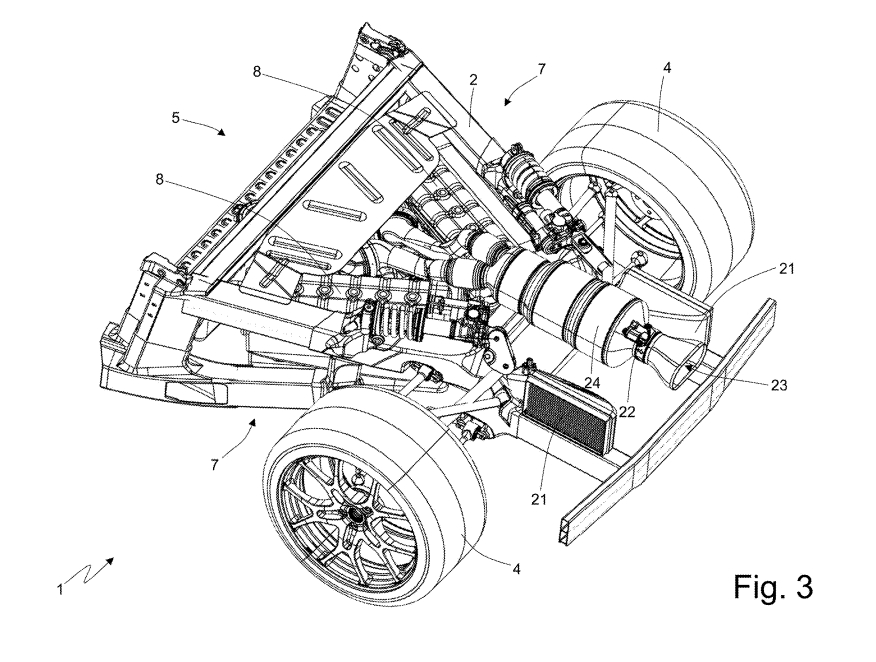
source: Ferrari USPTO Patent No. 20260077642
Honda has already done something similar with the new Prelude. But Ferrari's version has a unique advantage: with two independent engines whose speed and output can be individually controlled, its "acoustic palette" is theoretically far richer than any single-engine system.
So — Is It Still a V12?
This is the question that cannot be sidestepped.
By strict engineering definition, the answer is no. A V12 requires two cylinder banks sharing a crankshaft in a V configuration. Ferrari's Y layout has 12 cylinders but no V, no shared crankshaft, not even a shared block. As one commenter put it with disarming precision: this is less a V12 than a piece of "2×6" lumber.
But from the standpoint of experience? If 12 cylinders firing in concert produce a soundscape indistinguishable from a traditional V12; if virtual gears generate shift shock convincing enough to fool your vestibular system; if the shove in your back genuinely comes from north of 1,000 combined horsepower — then are those three characters, "V12," describing a mechanical configuration, or a promise about what it feels like to drive?
Ferrari is clearly betting on the latter.
The Bigger Canvas
This patent should not be read in isolation. It is another data point on a technology roadmap that Ferrari has been steadily clarifying over the past two years.
At the October 2025 Capital Markets Day, management halved its 2030 BEV volume mix target from 40% to 20%, replacing it with a "40% ICE / 40% hybrid / 20% BEV" split — what CEO Vigna called a "technology-neutral" approach. The market read it negatively at the time, and the stock dropped roughly 15% in a single session. In retrospect, the Y-shaped V12 patent reads like the technical footnote to that strategic pivot: Ferrari does not intend to abandon the combustion engine, but nor does it intend to let combustion engines survive in their traditional form. Hybrid architectures — or more precisely, architectures where ICE serves the experiential core and electric drive serves the efficiency core — are the middle ground Maranello is actually betting on.
Meanwhile, Ferrari's first full-electric model, the Luce, continues on schedule for Q4 2026 deliveries. Its Jony Ive-designed cockpit strips away virtually all touchscreens and plastic, substituting aluminum, glass, and leather — a pointed refusal to let electrification equal "consumer-electronification." The Y-shaped V12 patent and the Luce are philosophically isomorphic: regardless of how the power source changes, driving a Ferrari must remain a physical, sensory, irreplaceable experience.
A necessary dose of sobriety: patents are not products. A vast number of automotive patents never leave the page, and Ferrari may never actually build a car with a Y-shaped engine. But the sheer degree of engineering imagination a company is willing to invest at the patent stage tells you something — in Maranello's engineering halls, the survival of the V12 is not a question that can be answered with "just switch to a turbo V8."
These 12 cylinders carry more than the technical challenge of emissions compliance. They carry a brand's definition of itself.


