
Apple's AI: Not in the Models, But in the Orchestration Layer
What if the one question everyone brought to WWDC26 — has Apple finally caught up in the AI model race? — was the wrong question all along?


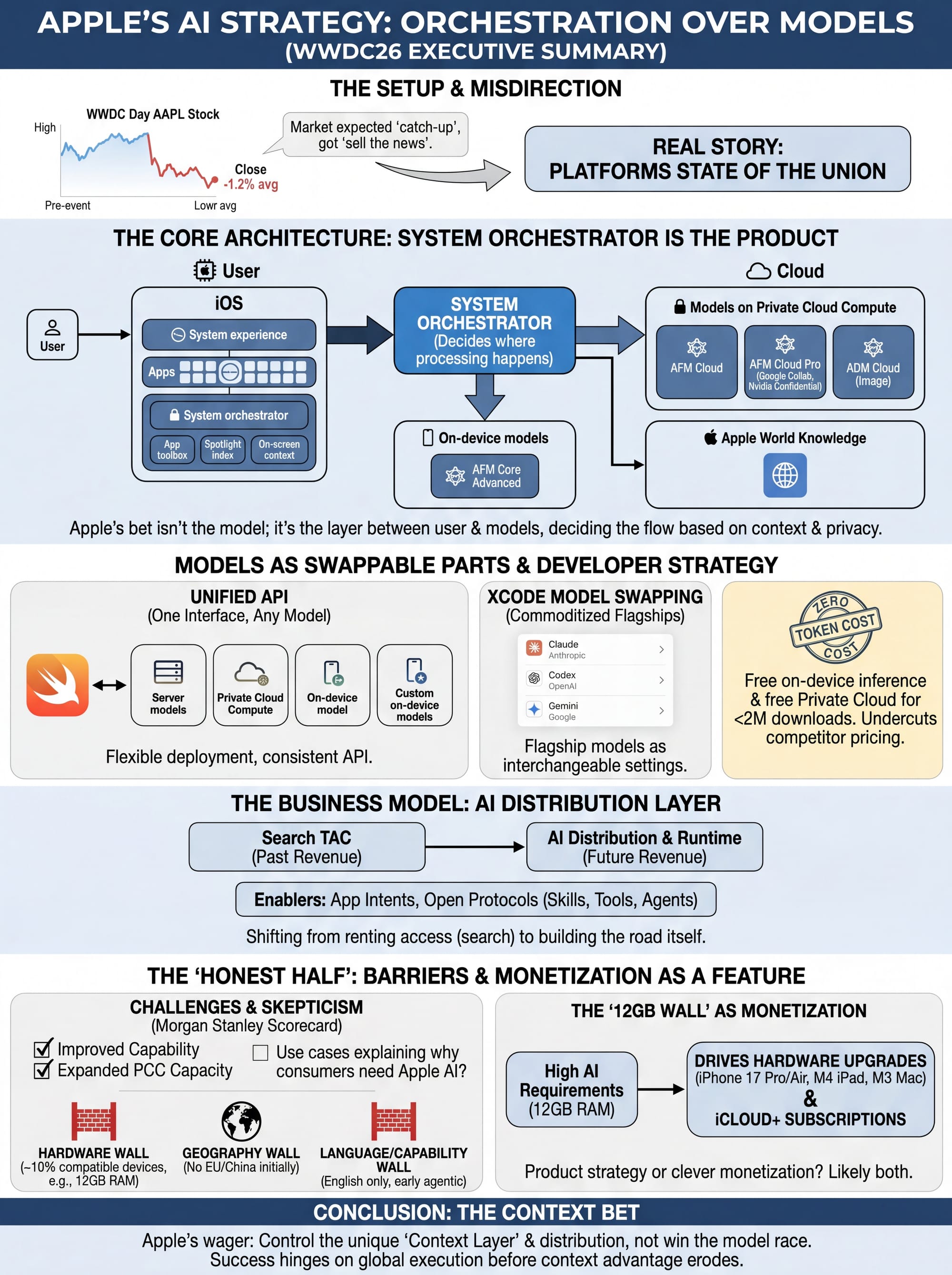
Apple's AI Isn't in the Model
— Another way to read WWDC26
Six weeks ago, writing about Apple's F2Q26 results, I left one loose end untied. The numbers that quarter were clean — clean the way a handover memo is clean: record revenue, a strong rebound in Greater China, R&D accelerating to +34% year over year, fully double the +17% growth in the top line. But the thing worth writing down was that Tim Cook, on the call, kept recasting AI from "a feature" into "a platform" — and, at the very moment he was spending faster on AI, quietly retired the net-cash-neutral target he'd set back in 2018, loosening the balance sheet. When a company speeds up its spending and unties the drawstring on its purse at the same time, it's usually preparing for something bigger than shipping one more feature. I ended that piece by writing: June's WWDC would be the first observable checkpoint on this thread.
Now the checkpoint is here.
On the day of the keynote, AAPL closed down about 1%. Stare at that number alone and you'd think nothing happened — and it is, almost exactly, the five-year script for AAPL on WWDC day (up 2.7% on average the week before, down 1.2% on the day itself, selling the news with the regularity of a clock). The market's expectation management around "a developer conference" has been rehearsed into something close to a reflex.
But the day's share price is the least important fact in this piece.
A Catch-Up Exam, Framed in Advance
Going into WWDC26, nearly every sell-side desk framed it as the same exam question: does Apple count as an "AI winner" or not? Behind that question sat a distinctly low bar. In Morgan Stanley's 2025 smartphone survey, the share of iPhone users willing to pay a monthly fee for Apple Intelligence had dropped ten percentage points year over year, to 68%; Apple Intelligence as a reason to upgrade had slid from 5th place in 2024 to 7th in 2025. A feature once carrying high hopes, then disappointing for more than a year, had ground appetites down close to the floor.
Low expectations have one virtue: the bar is low. The post-event verdicts mostly landed on "passed, but didn't dazzle" — Morgan Stanley slotted it into the low end of the middle of its own three-scenario table, meaning Apple said what it needed to say, but said nothing you could dream on.
If the story ended there, WWDC26 would be a passing catch-up paper, not worth a dedicated piece. The genuinely interesting part was tucked into a quieter session the same day — the Platforms State of the Union, the one made for developers.
First, the Headline Most Likely to Be Misread: Apple Went to Google
The biggest industry signal of that session was Apple admitting, in its own words, that the new generation of Apple Foundation Models was built together with Google, drawing on the technology behind Gemini.
Apple and Google, side by side: the signal behind the new-generation Foundation Models
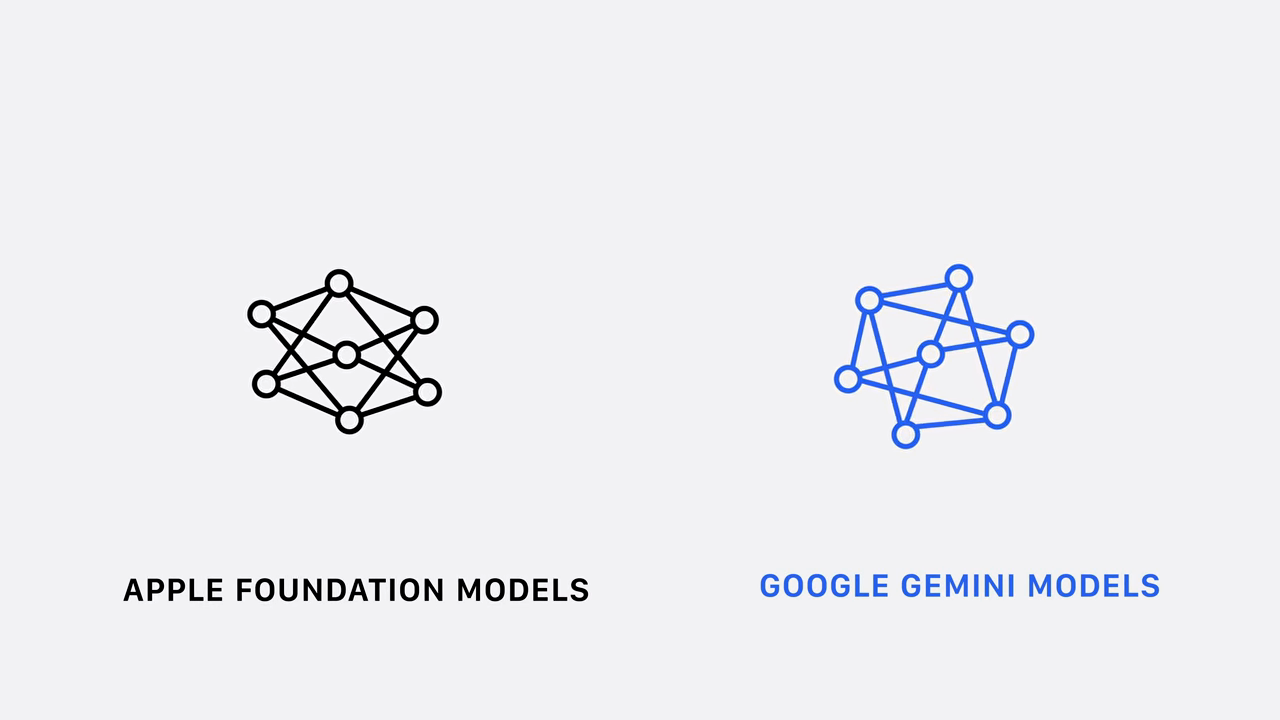
Source: Apple, WWDC26 Platforms State of the Union
Last November I wrote about Mark Gurman's scoop — that Apple planned to pay roughly $1 billion a year to use Google's 1.2-trillion-parameter Gemini as the new Siri's brain. The reasonable reading at the time: Apple's own models couldn't keep up, so it would rent one for now. Had WWDC26 confirmed exactly that, the word "catch-up" would have stuck.
But in the product briefings after the keynote, Apple dialed that framing back by one crucial notch — and the notch matters. It stated plainly that Apple Intelligence and Siri contain no Gemini client code, do not use the Gemini model sold to Google's cloud customers, do not rely on Google's infrastructure to deploy, and do not touch Google Search. What it used was Google's "domain expertise" — to co-train Apple's own third-generation Foundation Models.
Those two things sound alike and are worlds apart in practice. The first is renting someone else's engine; the second is hiring a consultant while keeping the blueprints and the engine in your own hands. Gurman's direction was right — Google was indeed deeply involved — but the shape it took in the product is far more favorable to Apple than "renting a Gemini": what it bought was know-how, what it kept was control. For the record, Apple also confirmed that the multibillion-dollar Google TAC tied to default-search rights is an entirely separate matter from this Foundation Models collaboration — the two don't touch.
The Real Protagonist Is an Architecture Diagram
If I could take just one image away from WWDC26, it would be this one.
What Apple Intelligence actually looks like on your device: a System Orchestrator routing between on-device and Private Cloud Compute
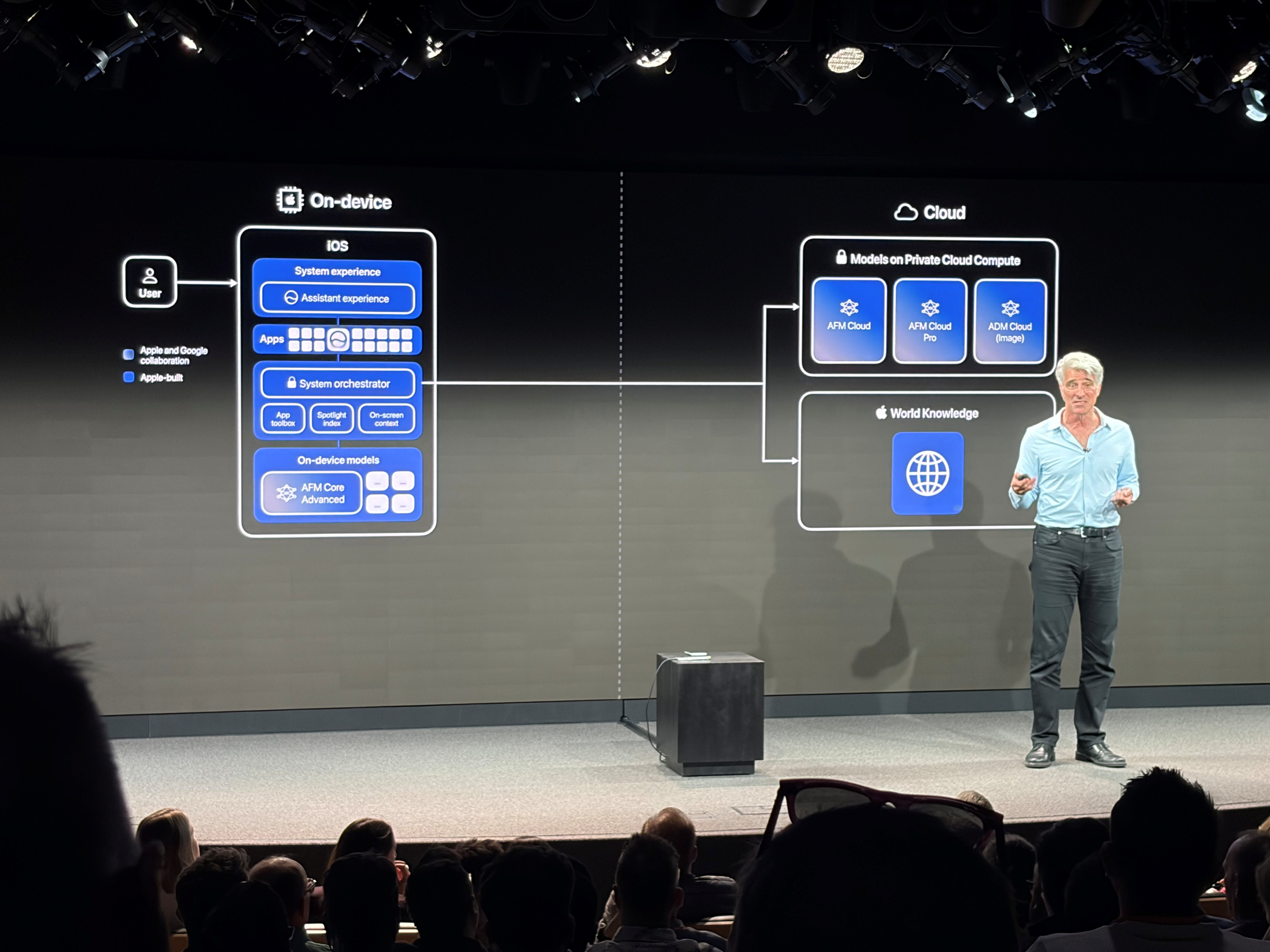
Source: Apple, Morgan Stanley Research
It draws the real shape of Apple Intelligence on your device. At one end are the AFM Core and AFM Core Advanced running on-device; at the other are AFM Cloud, AFM Cloud Pro, and the image-focused ADM Cloud running on Private Cloud Compute; off to the side hangs an Apple World Knowledge. Five Foundation Models in all — and the fifth, AFM Cloud Pro, is the curious one: it runs on Google Cloud, yet wears Nvidia's Confidential Computing security framework, effectively extending the walls of Apple's private cloud into someone else's data center.
But the thing to fix your eyes on is the unremarkable little box dead center: the System Orchestrator. Above it sit the App toolbox, the Spotlight index, and on-screen context — what your apps can do, your personal data, what you're looking at on screen; below it runs that whole row of models, large and small. Every time you speak to Siri, it's this orchestrator deciding in real time whether the sentence should be computed on the chip in your pocket or sent to the private cloud — and for most slightly complex requests, both ends get used at once.
So Apple didn't bet on "my model is smarter than yours." It bet on the routing layer that stands between you and the model and decides how everything flows. The model is a swappable part; the orchestrator is the product.
Turning "Swappable Parts" into Something Developers Can Use
This "models are parts" philosophy gets carried, quite thoroughly, into the developer-facing half.
For the past year, Apple's Foundation Models framework could only call the single model on the device. This year it becomes "one Swift API, into any model" — on-device, private cloud, or third-party cloud giants like Claude and Gemini, all through the same interface, swapped at will. In Apple's own words, this makes it "the best way to run any LLM in your app."
One interface, four deployment targets: Server, Private Cloud Compute, On-device, and Custom on-device
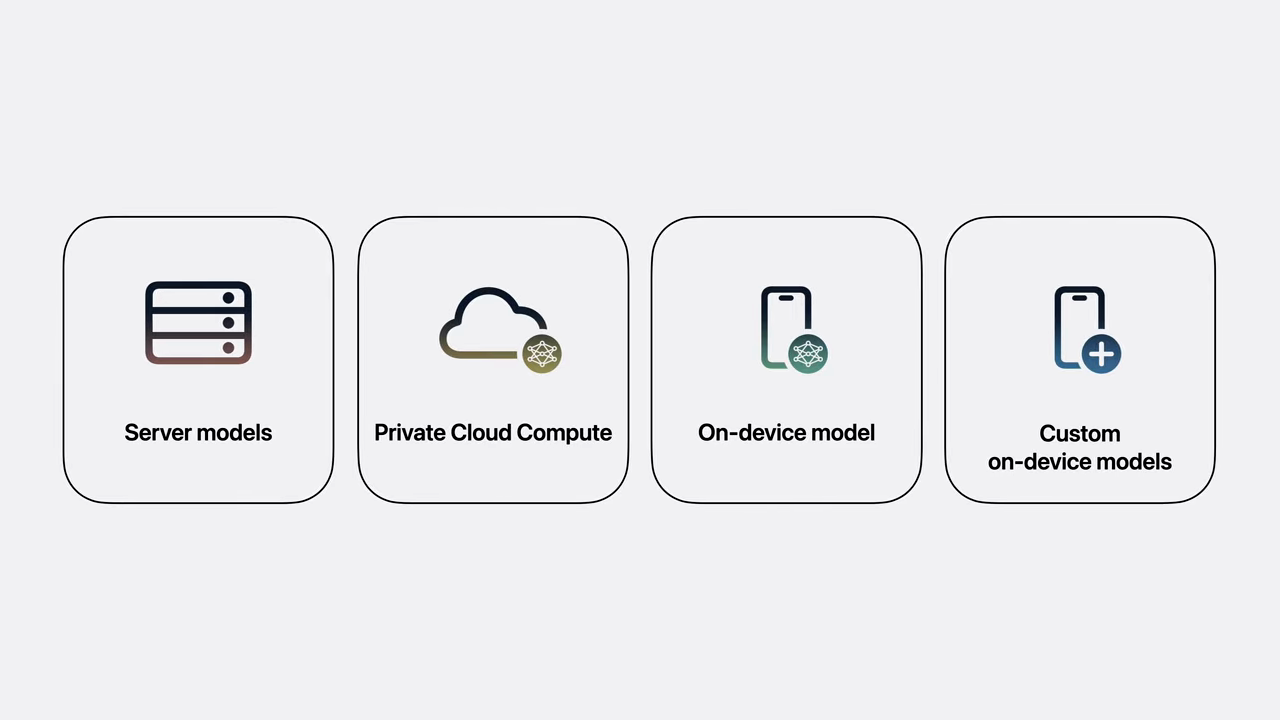
Source: Apple, WWDC26 Platforms State of the Union
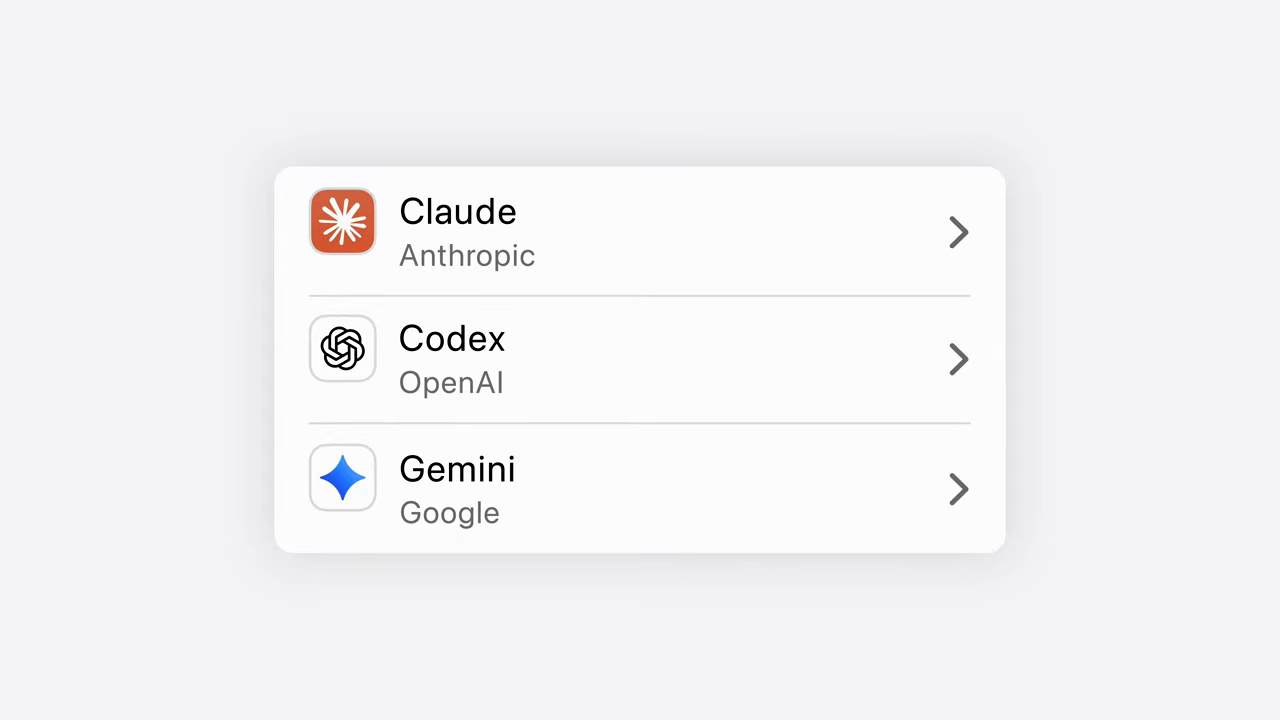
It even put this attitude inside its own most central developer tool. The AI agent that writes code in Xcode 27 can switch between Claude, Codex, and Gemini like flipping a setting — Anthropic, OpenAI, and Google lying side by side in a single list.
Inside Xcode 27, three frontier models become interchangeable dropdown options
Source: Apple, WWDC26 Platforms State of the Union
For a company famous for its control, this "any of them will do" posture is itself a statement. When you arrange rivals' flagship models as interchangeable dropdown items, you're saying: at the model layer, I'm not going to brawl with you; what I want is the position sitting above them all.
And Apple paired that position with a chip few others can replicate: cost. It kept harping on one phrase — "zero token cost." Inference run on-device costs not a cent in API fees; developers with fewer than two million downloads get even the private-cloud calls for free. The new Core AI framework puts it more bluntly still: whatever the device, whatever the model, it all runs on-device, with zero server dependencies and zero token cost. While OpenAI, Google, and Anthropic still meter every million tokens, Apple priced the marginal cost of "running inference across my two-billion-plus devices" at exactly zero.
This is the continuation of the very thread I chased last year in my piece on the Google antitrust ruling. Back then Apple was already making money from "distribution" — collecting roughly $23 billion a year in search TAC from Google (F2024, per Goldman's estimate), essentially renting out its position as the gateway to traffic; and the Gemini commercial agreements that surfaced in the court filings pointed the same logic at the next stop: the distribution of generative AI would become a new revenue line for Apple, much like search TAC. WWDC26 pushed that line forward — from "collecting tolls on someone else's road" to "I'll build the road myself." App Intents turn every third-party app into a limb Siri can call on; the Foundation Models framework will be open-sourced this summer and can even run on your own server. What Apple wants to become is the distribution layer and the runtime for AI applications themselves.
There's also a detail that will make anyone who builds agents smile knowingly: Xcode's plugin system splits into Skills (Markdown files that teach an agent new tasks), Tools (over the Model Context Protocol), and Agents (over the Agent-Client Protocol). Rather than minting its own closed standard, Apple plugged straight into the open protocols the industry is converging on. For a company raised on the walled garden, that's no small concession.
And Now the Honest Half: It's Still Far From There
Tell that story too smoothly and you've just written Apple's own keynote. So this next stretch is a stress test of every claim above.
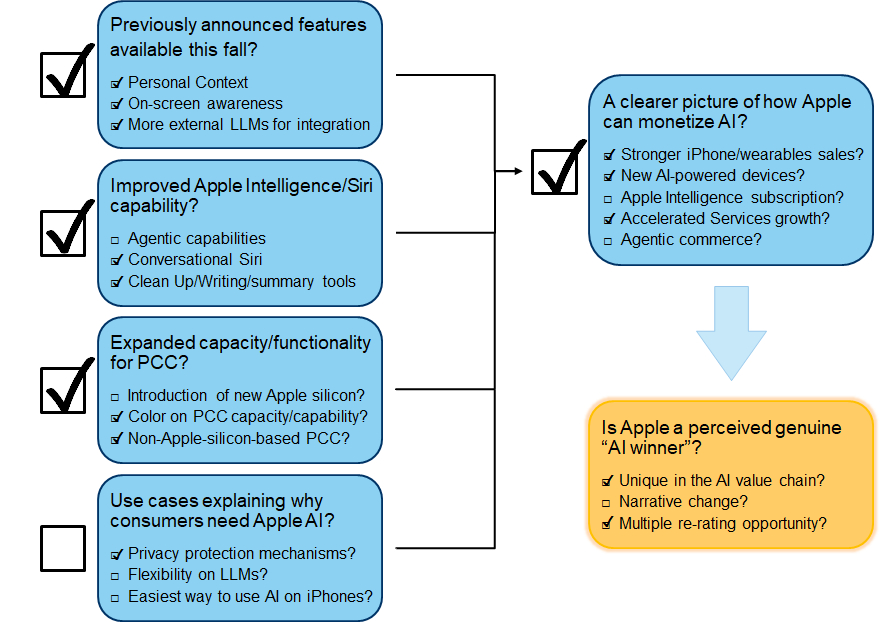
Morgan Stanley handed WWDC26 a report card after the event, and most of the boxes are ticked — the delayed features (personal context, on-screen awareness) confirmed for this fall, Siri / Apple Intelligence capability genuinely improved, private-cloud capacity expanded. But one box sits conspicuously blank.
The post-WWDC26 scorecard: most boxes checked, but "why consumers need Apple's AI" sits blank
Source: Morgan Stanley Research
The unticked question is this: "Did it make clear why consumers need Apple's AI?" — and beneath it, the sub-items "flexibility on LLMs" and "the easiest way to use AI on an iPhone" are both empty. Which is exactly where the whole distribution-layer story is most exposed: a distribution layer only works if users actually want to travel through it. Yet if a user is already paying for ChatGPT or Gemini, the reason Apple offers right now still stops at "it understands you better, and it protects your privacy" — there's no killer reason you simply can't do without. That one, WWDC26 didn't prove.
Against the optimistic call that "hardware upgrades are the clearest near-term monetization," there are a few harder walls still:
- The compatibility wall: more than 850 million iPhones can't even run basic Apple Intelligence, and over 1.3 billion can't run advanced Siri. The strongest on-device capabilities (the expressive voice, advanced dictation) need 12GB of unified memory, and today only the iPhone 17 Pro / Air, iPad M4, and Mac M3 tier qualifies — roughly 10% of the existing base.
- The geography wall: because of the DMA and regulatory approvals, Siri AI and the new Apple Intelligence won't launch in the EU or China at first — two markets that together made up 35% of Apple's iPhone shipments over the past twelve months.
- The language-and-capability wall: English only to start; and the genuinely agentic workflows — autonomously finishing multi-step tasks across first- and third-party apps — Apple itself admits are still "early," with only an "agentic foundation" laid.
So the skeptics aren't wrong. Barclays bluntly titled its recap "Another AI Attempt" — interesting, but hardly transformative for the strategy; ahead of the event, IDC's experts cast this year as "catch-up, not breakthrough." Those calls hold up.
That 12GB Wall: Bug or Feature?
On that compatibility wall, though, let me add one less charitable note.
Read it purely as a "technical limitation" and you may be underestimating Apple. Features that lean on big cloud models, like image generation, come with daily caps — exceed them, and please upgrade iCloud+; the strongest AI experience needs 12GB of memory, and the device in your hand isn't enough, so please buy a new iPhone. Seen from another angle, "your device can't run this AI" is not, on Apple's ledger, a problem to be solved — it's a finely engineered monetization machine, wired at one end to a multi-year replacement cycle and at the other to iCloud+ subscription upgrades.
Is this product strategy, or "sell more phones and storage" dressed up as AI? Probably both. Morgan Stanley itself concedes that, in its model, hardware upgrades are the clearest near-term path to monetization — "the accessibility of AI features" has now climbed into the top five reasons people upgrade a smartphone. A company long doubted on the premise that "selling hardware on software is hard" has found a way to sell hardware on the absence of software. You can admire the craft without applauding it.
Where I Land
Put it all together and my read is this: measuring WWDC26 with the "model race" yardstick measures the wrong thing.
The bet Apple placed in this event is more foundational, and more Apple — that in the age of AI, the scarce resource isn't the model, but distribution, context, and the runtime-and-privacy boundary that embeds models into a billion people's daily lives. That lines up neatly with a call I've kept making all year: the harness-and-model layer gets flattened fast by the incumbents, while the value that actually accrues sits in the context layer. Apple is the one player pushing that call to its limit at $4-trillion scale — renting others' capability (Google's expertise) while keeping an iron grip on control, the runtime, and the user relationship. Read it this way, and "going to Google" stops looking like surrender and starts looking like a cold-eyed division of labor.
But a bet is a bet, not a fait accompli. The whole thing rests on Apple actually rolling this distribution layer out — to the EU and China, to every language, into genuinely cross-app, autonomous agentic capability, and to the developers willing to plug in. And that is precisely where Apple has tripped most often before; the last Siri delay fell into this very hole. So the question worth watching over the next year is no longer "can Apple build AI features" — that one's been answered this time: yes — but "can Apple land this distribution layer worldwide before the sliver of context advantage it's counting on gets flattened too."
This call is falsifiable: if a year from now Siri still speaks only English, still can't enter China or the EU, and still can't pull off anything resembling autonomous cross-app work, then the "distribution layer" narrative deserves to be scrapped, and it really was just what Barclays called it — "another AI attempt."
What stayed with me from WWDC26 wasn't a model or a benchmark score. It was that quiet little box in the middle of the architecture diagram.
Every time you speak to your phone, it makes a call on your behalf that you'll barely notice: whether your words stay on the chip in your pocket, or get sent off to some data center. The contest in AI is, less and less, about who builds the smartest model, and more and more about who gets to stand between you and it — and the surest sign that Apple has nailed this role is exactly this: the better it plays it, the less you'll ever notice it's been standing there all along.


