
ASML 3Q26 Earnings Review : The Bottleneck Collects Its Rent Without an Auction
ASML now says its expansion plan can't meet demand through 2028, and customers are already asking to book 2029 and 2030 slots. So why is it holding those orders back, and saying the price hike won't come every year?


ASML 3Q26 Earnings Review: Customers Are Lining Up for 2030. The Price Hike Isn't Meant to Be Annual.
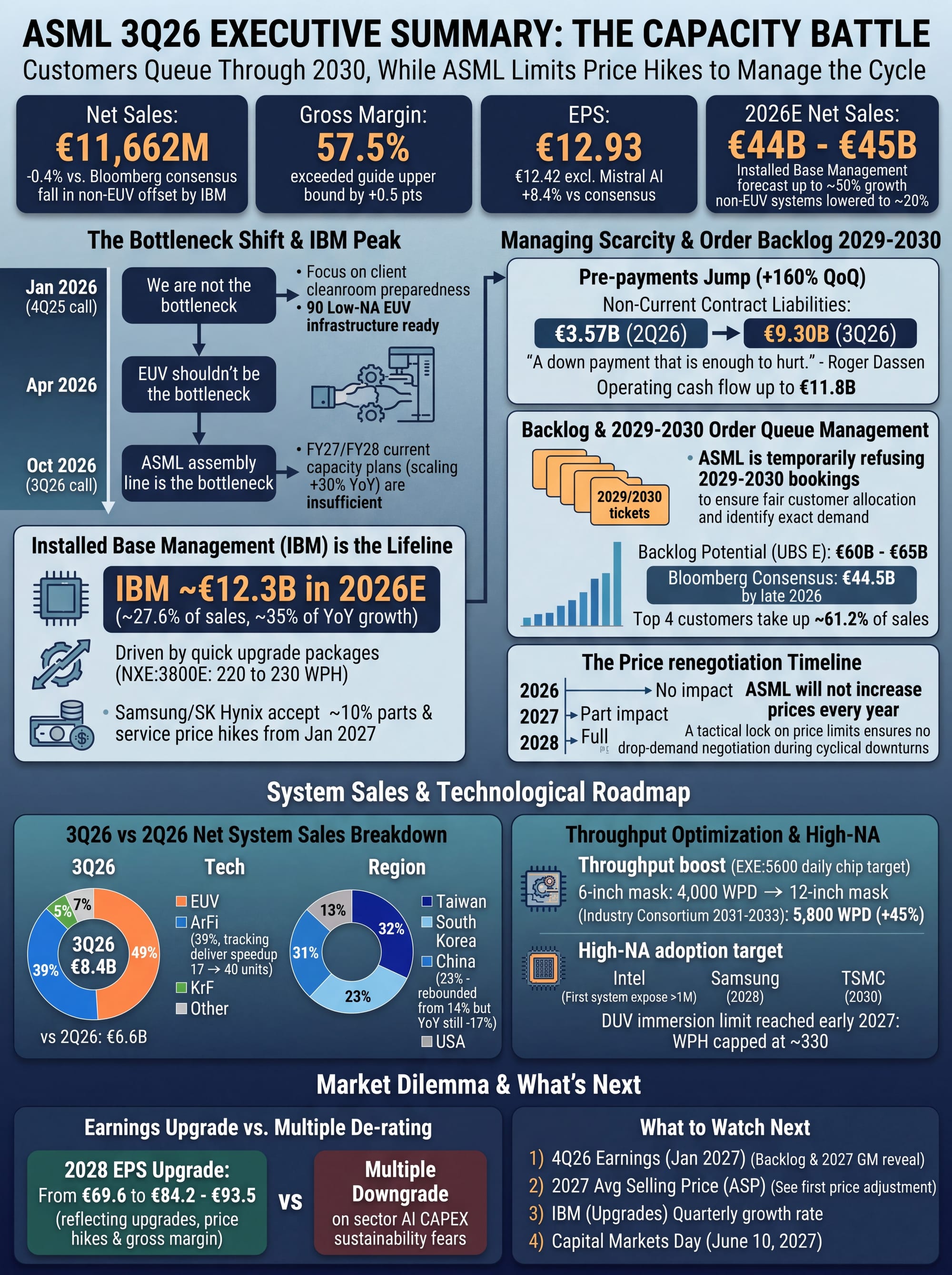
In January 2026, on the 4Q25 call, ASML addressed a worry it could sense in the room: that it might become its customers' bottleneck. "This is not the case, certainly not this year." Back then, what held expansion back was customers' cleanroom space, and the company stressed it already had the infrastructure for 90 Low-NA EUV tools a year (see my 4Q25 review).
In April, CEO Christophe Fouquet changed the wording: "We do not want EUV to be the bottleneck." On the 3Q26 call on October 14, the line moved one step further. The current plan, adding 30% of capacity in each of 2027 and 2028, will not meet what customers are asking for; customer cleanrooms now impose only what management called "tactical constraints."
In nine months, the bottleneck moved out of the customer's fab and onto ASML's own assembly floor.
In the textbook, a seller that can't keep up keeps raising its price until demand falls back to meet supply. ASML did something quite different this quarter. Customers want to place orders for 2029 and 2030, and ASML is holding off; asked whether it could raise prices every year, the CFO answered, "That is not the plan."
Economists call the premium that comes with a shortage a scarcity rent. In ASML's 3Q26 numbers, that rent arrives through four doors: upgrades sold to tools already in the field, customer down payments, a queue run on fairness, and a one-time value repricing.
In Line on Revenue, With Almost All the Upside Coming From the Installed Base
Total net sales came in at €11,662mn, 0.4% below the Bloomberg consensus and in the upper half of guidance. Underneath, new system sales were 4.7% below consensus. Installed Base Management (service plus upgrades, IBM for short) was 12.7% above it.
Profits beat across the board. Gross margin reached 57.5%, 0.5pts above the top of guidance, and roughly three quarters of the sequential revenue increase dropped through to operating profit. Diluted EPS of €12.93 includes a €509.7mn revaluation gain on the Mistral AI investment; strip it out and EPS still beat consensus by about 8.4%.
The shape of the guidance says more than its size. Full-year revenue guidance narrowed to €44-45bn, lifting the midpoint by only €0.5bn, yet inside sit two adjustments pointing in opposite directions. IBM growth was raised from more than 30% to about 50%, worth roughly €1.6bn; non-EUV system growth was cut from about 25% to about 20%, worth roughly €0.6bn less.
The Q4 revenue guidance midpoint sits 5.2% above consensus, and almost all of that gap is IBM. New tools sold a little light, and the increment was squeezed out of machines already sitting in customers' fabs. This is what the data of a capacity-constrained company looks like.
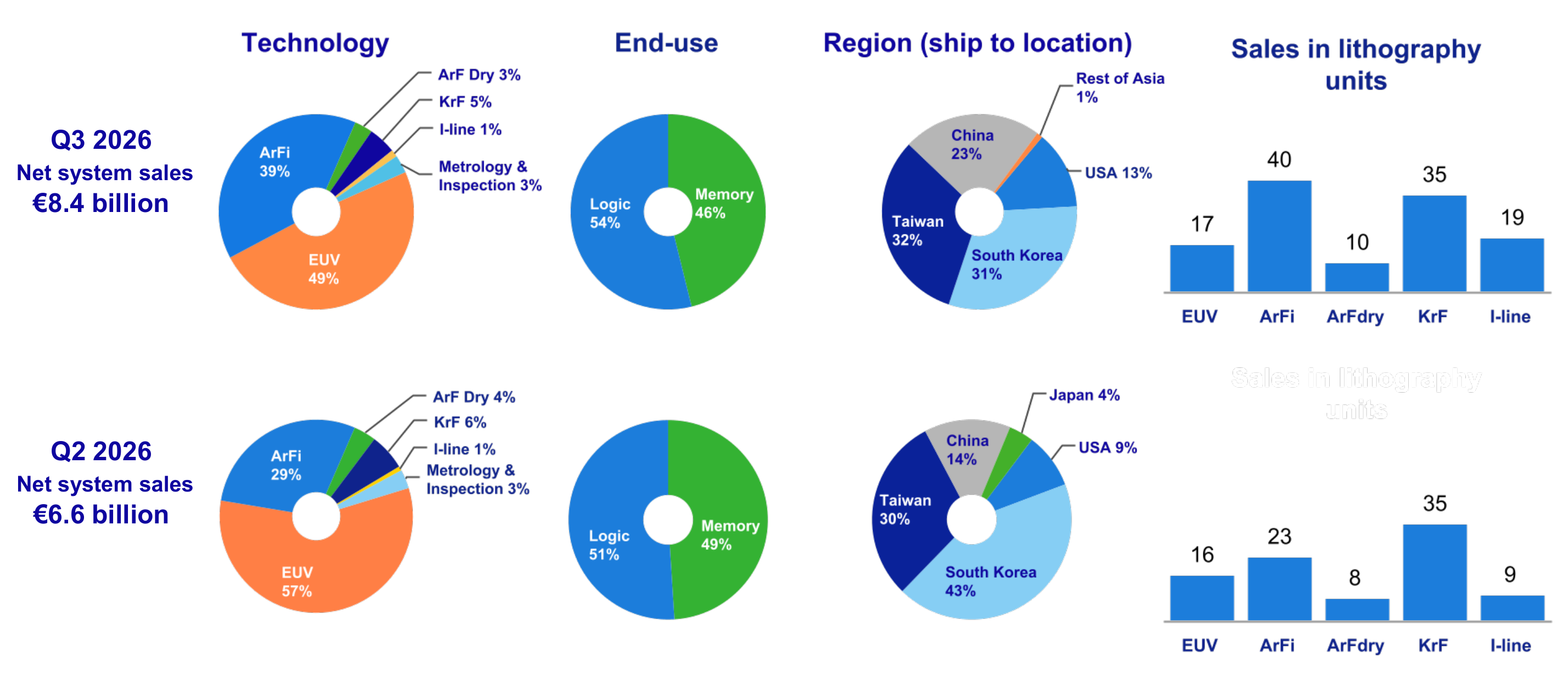
3Q26 vs 2Q26 net system sales breakdown (technology, end-use, ship-to region and lithography units)
source: ASML 3Q26 investor presentation
Two shifts in the chart are worth reading. Immersion (ArFi) shipments reached 40 units, 17 more than last quarter: the first reading on the second-half catch-up I flagged in last quarter's review. China's share of system sales climbed back from 14% to 23%; in euros it roughly doubled quarter on quarter, yet it is still about 17% lower than a year ago.
Upgrades: The Fastest Capacity Is Already Installed in the Customer's Fab
A new EUV tool takes more than a year from order to delivery. A productivity upgrade is often little more than a software switch plus a round of qualification.
That is how the upgrade package for the NXE:3800E lifted output from 220 to 230 wafers per hour. When capacity is tight, this is the capacity customers buy first, because it arrives fastest.
CFO Roger Dassen put this quarter's beat down to upgrade demand, on both EUV and DUV tools, roughly €400mn more than expected. Last quarter I wrote that when the same "one-off" shows up two quarters in a row, it needs a new name. This is the third quarter.
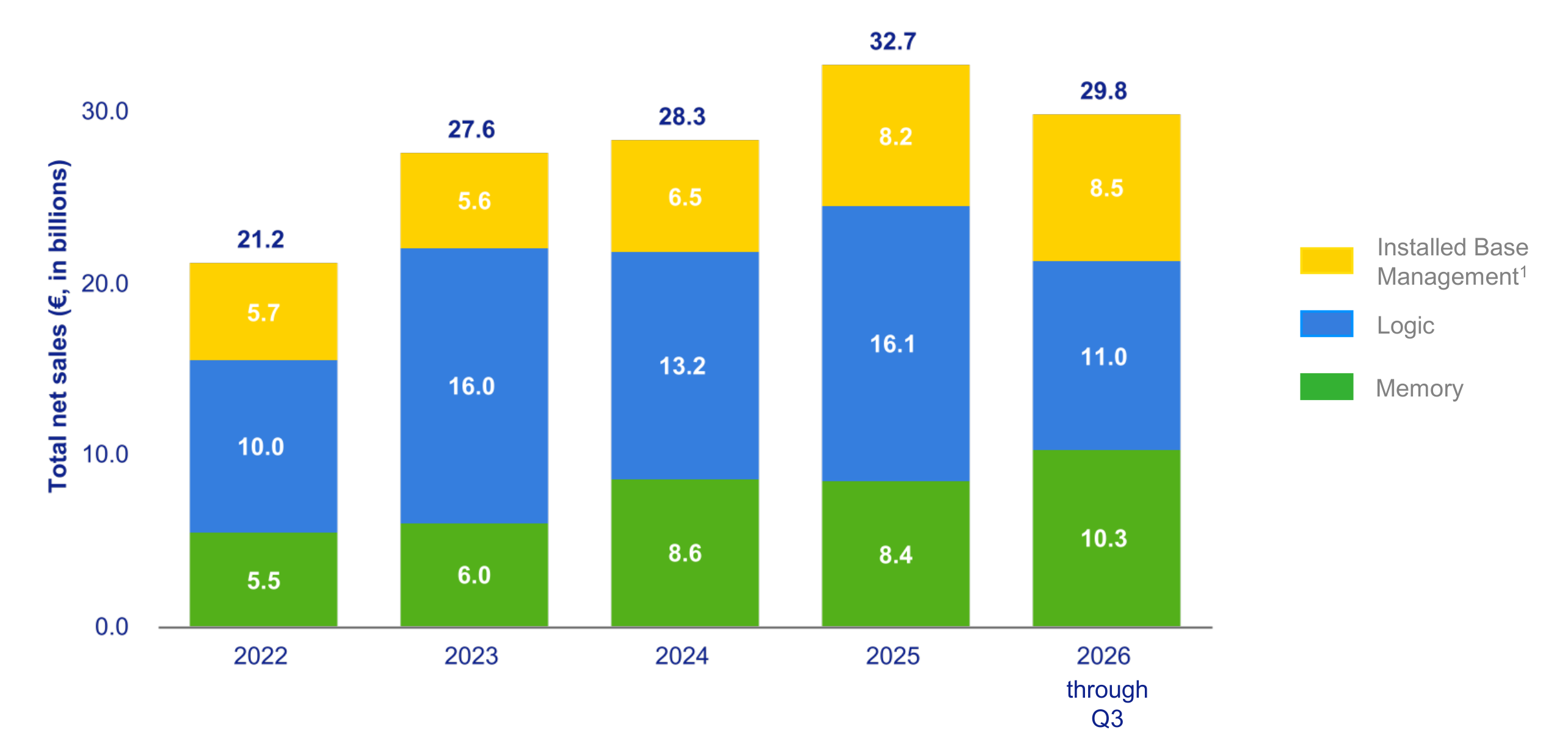
The scale has changed too. IBM revenue for the first nine months reached €8.5bn, already above the €8.2bn for all of 2025. At roughly 50% growth for the year, IBM lands at about €12.3bn: 27.6% of the revenue guidance midpoint, and about 35% of this year's revenue growth.
Total net sales by end-use, 2022 to 2026 year-to-date Q3 (Installed Base Management / Logic / Memory, € billions)
source: ASML 3Q26 investor presentation
Upgrades come with their own pricing lever. In the Q&A, the CFO said upgrade prices are closely tied to tool prices, so they will follow this round of increases.
Korean outlet The Elec reports that ASML has told Samsung Electronics and SK Hynix that replacement parts for maintenance will cost 10% more across the board from next January, and that both have accepted. The company has not commented on the report.
This is the revenue line that depends most on the shortage, which also makes it the line most exposed when the shortage ends. The CFO himself called upgrades "an important swing factor" for gross margin in 2027 and beyond, pointing to the many tools in the field that have not yet been upgraded and to new packages on the way. The sell side is split: Bernstein sees IBM compounding at 23% a year through 2030, while BNP Paribas has 2027 roughly flat on this year.
Once new tools catch up with demand, the urgency to buy extra output from old ones will fade.
Down Payments: Customers Are Funding ASML's Expansion
The biggest change on this quarter's balance sheet sits on the liabilities side. Non-current contract liabilities rose from €3,570mn to €9,301mn, up €5,731mn (+160%) in a single quarter. For the previous four quarters, the line had held steady at €3.4-3.6bn.
Operating cash flow followed, reaching €11.8bn, with free cash flow at 2.3 times net income. "Non-current" means the matching deliveries are more than a year away, so after late 2027. When Morgan Stanley's Lee Simpson asked whether this could be read back into an order figure, the CFO confirmed the line includes down payments; it is "a bit of a lagging indicator," he said, "but for lack of any PO numbers that you get from ASML, it's a nice proxy."
His description of those down payments was blunt:
"It's a down payment that is enough to hurt."
Last quarter I noted that ASML's down payments usually arrive in a Q4 rush and partly unwind in Q1, a seasonal pair. This jump came in Q3 and landed in the non-current line, outside that pattern. Bank of America estimates this line usually grows by only €1-2bn in a quarter.
Read from another angle, customers are using their own cash to pre-fund ASML's expansion. In the same quarter, ASML bought back €4.1bn of its own stock, about seven tenths of that increase.
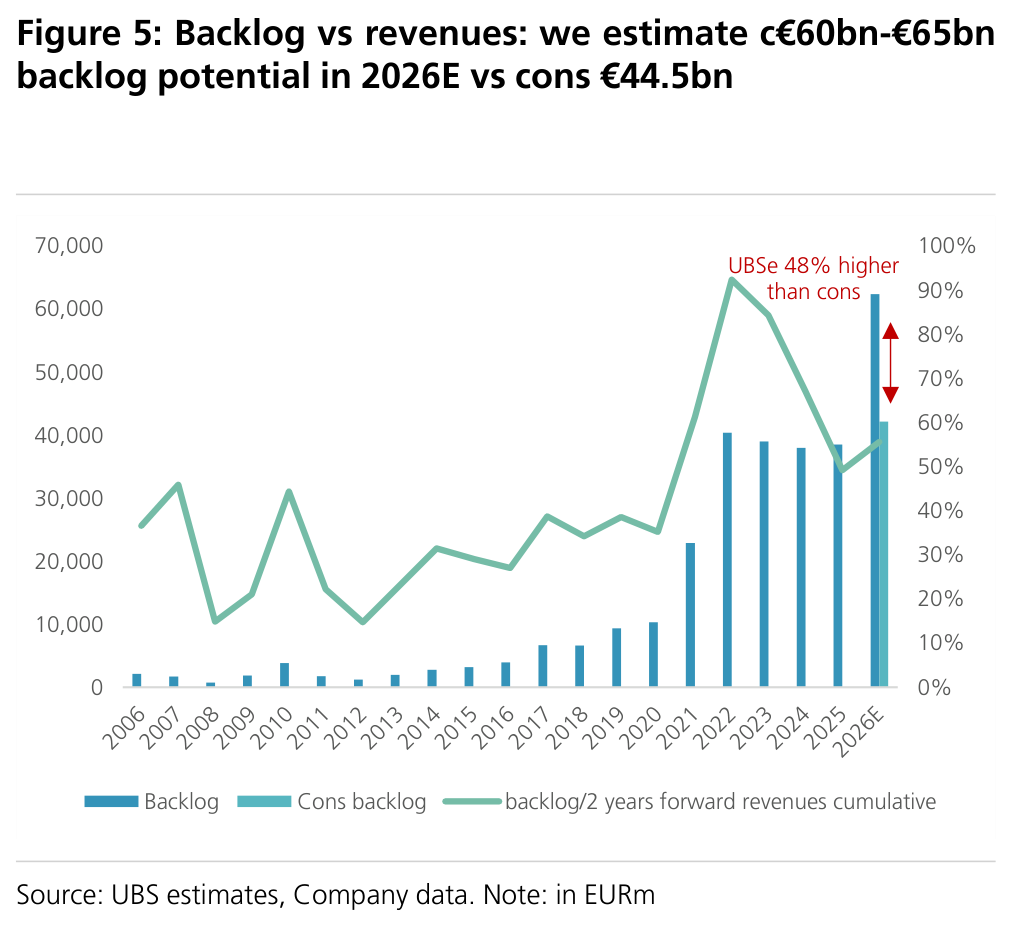
The company has now gone three quarters without disclosing orders. UBS estimates year-end backlog could reach €60-65bn against a consensus of €44.5bn, and expects ASML to disclose the year-end figure with Q4 results. The estimate rests on one premise: 2027 shipments stay capacity-constrained, so new demand settles into backlog.
UBS: backlog vs cumulative revenue for the next two years (2006-2026E)
source: UBS, ASML: Raising estimates, backlog and High-NA next (2026-10)
The Queue: ASML Is Not Yet Taking 2029 and 2030 Orders
Customers have asked ASML to accept purchase orders for 2029 and 2030. The company has not accepted them yet. The CFO's reason was fairness:
"We don't want now to accept orders from customer A, B, and C, and then to tell customer D, who hasn't given orders yet for 2029 and 2030, 'Sorry, we're sold out.'"
His plan is to first map total customer demand for those two years, set it against the capacity ASML expects to have by then, and only then start taking orders. Clear the market by price, and the highest bidder walks away with the capacity. Clear it by queue, and every long-standing customer keeps its place in line.
Behind that choice sits the arithmetic of the customer base. ASML's four largest customers accounted for 61.2% of 2025 revenue (see my FY2025 annual report deep dive). My reading: with a base that concentrated, the customer told "sold out" today is the same one sitting across the table at the next industry trough.
On capacity itself, the company gave a direction but no number. Management said the current plan falls short for both 2027 and 2028, and that it is studying growth of more than 30% for 2028, but it declined to give new unit counts. Going into the print, the market had hoped for 2027 to be lifted to 90-95 units or more, and that hope went unmet; BNP Paribas's verdict is that for 2027, the train has largely left the station.
The first set of levers sits inside the existing buildings. ASML plans to turn most of its assembly floor space over to output, shorten cycle times, and bring its supply chain along at 30% a year.
The CEO said, "We do not see Zeiss today as a bottleneck." The new Brainport Industries Campus will not add output until after 2029.
The second set of levers is output per machine. The NXE:3800F moves from 230 to 260 wafers per hour (+13%), contributing meaningfully from 2028. Every immersion DUV model will move to 330 wafers per hour early next year.
I have written about that 330 before, in From Photons to Pricing Power. The Bernstein roadmap cited there shows immersion wafer-stage speed capped by the surface tension of the water layer, with throughput topping out at roughly 330 wafers per hour. This quarter, the CEO said DUV value, too, scales with throughput.
Put the two together and my inference is this: 330 may be the last big step immersion can take along the throughput-pricing formula. Beyond it, DUV value growth will have to be charged for along dimensions other than output.
Pricing: A One-Time Value Repricing
On last quarter's call, the CFO said the line "The pricing dynamic does exist." Three months later, that sentence has become a contract.
Price negotiations that only began in July are complete. They cover "the most critical products," the high-end, high-volume manufacturing tools that bring customers the most value in the current environment. Bernstein reads that as EUV and ArFi.
The timeline has three stages: no impact in 2026, a partial effect in 2027, the full effect from 2028. The size of the increase was not disclosed. Part of it, the CFO said, will cover the extraordinary ramp the company is going through, including parts of the supply chain that ASML has to support, but "a significant part of it is directly accretive to the gross margin."
When management described the increase, they used the language of distribution. Given everything the ecosystem is going through, the CFO said, "we thought that we were entitled to a higher percentage." The CEO said there was "a clear acceptance that maybe the overall value in the ecosystem is shifting," triggered by AI, and that this kind of negotiation is something ASML had never done before.
Then came a self-imposed limit. Berenberg's Tammy Qiu asked whether ASML could push through price increases every year if the tightness lasts. The CFO answered twice: "That is not the plan." His reason:
"We don't want to be in a position that if the market goes down, that we're actually having discussions with customers on price decreases."
ASML is pricing for the whole cycle. Take a little less in the shortage, and keep a floor that spares it from negotiating price cuts in the downturn.
The same discipline applies to High-NA EUV. At an investor conference in September, management told Bernstein it does not plan to cut prices to speed up High-NA adoption, because cutting prices today would make price discipline much harder to hold later.
With no size disclosed, the sell side has to estimate. BofA offers a rule of thumb: every 5% increase in average selling prices across tools and services, assuming input costs rise 2.5% at the same time, adds roughly 8% to EPS. Its 2028 model bakes in 5%, an assumption it calls conservative.
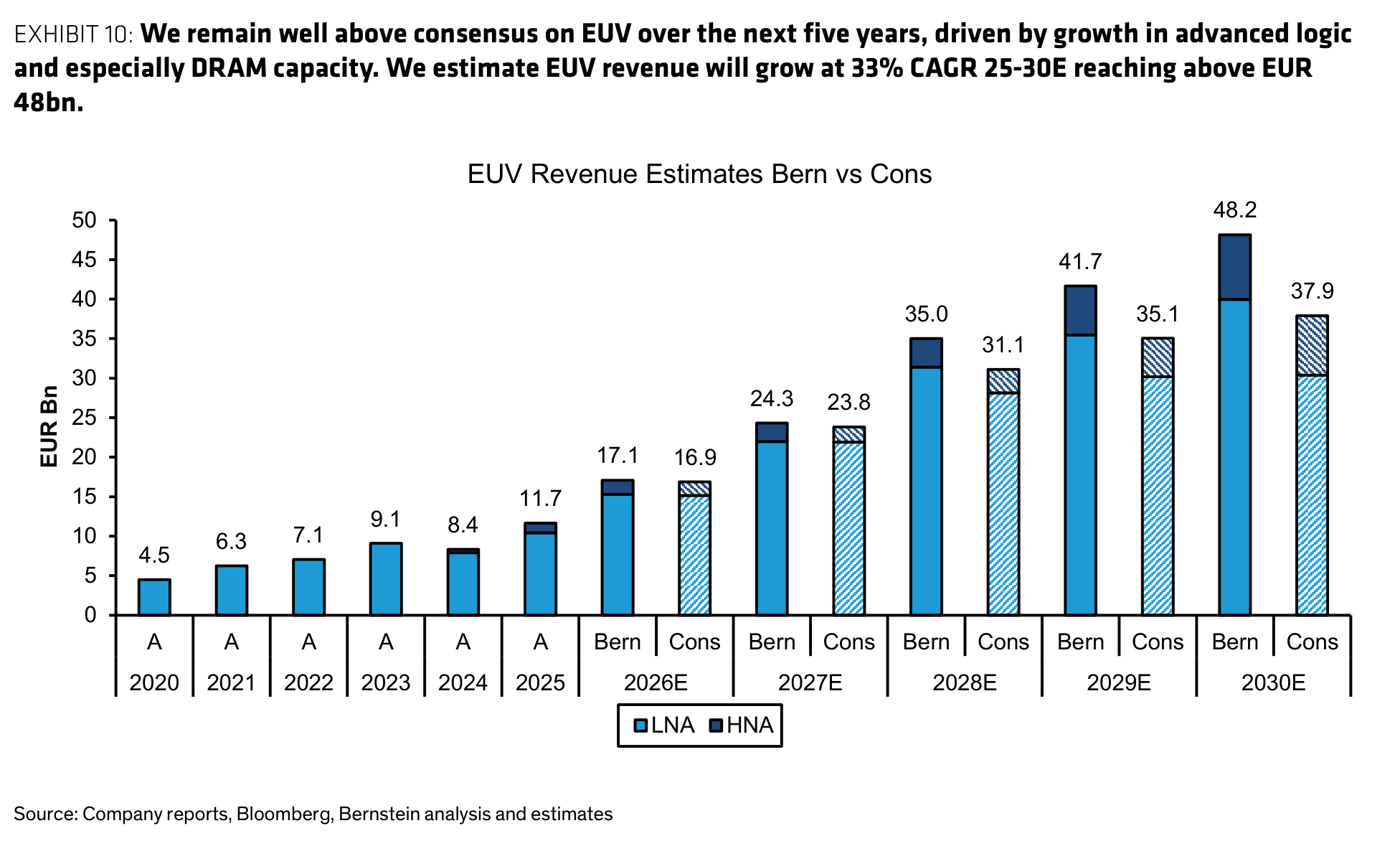
Bernstein left its EUV unit counts unchanged; its EUV revenue upgrades from 2028 onward come entirely from price, lifting its 2028 gross margin from about 57.0% to 58.9%.
Last quarter, holding average selling prices flat on the official capacity path, I arrived at a 2028 EPS bull case of €69.6. After this print, the four banks that updated their models sit at €84.2-93.5, 21%-34% above it. Their 2028 Low-NA unit counts range from 110 to 120, not far from the official path.
What opens the gap is price, upgrades and margin. Those are precisely the items ASML declines to quantify.
Bernstein vs consensus: EUV revenue forecasts (2020-2030E, Low-NA and High-NA split, € billions)
source: Bernstein, ASML Q3 2026: Pricing powers the next upgrade cycle (2026-10)
High-NA: A Slow Cadence, but the Mask Supply Chain Is Rerouting Around It
Intel's High-NA systems have now exposed more than 1 million wafers, while Samsung and TSMC plan to bring High-NA into volume production in 2028 and 2030 respectively. Availability across the installed High-NA fleet is close to 90%.
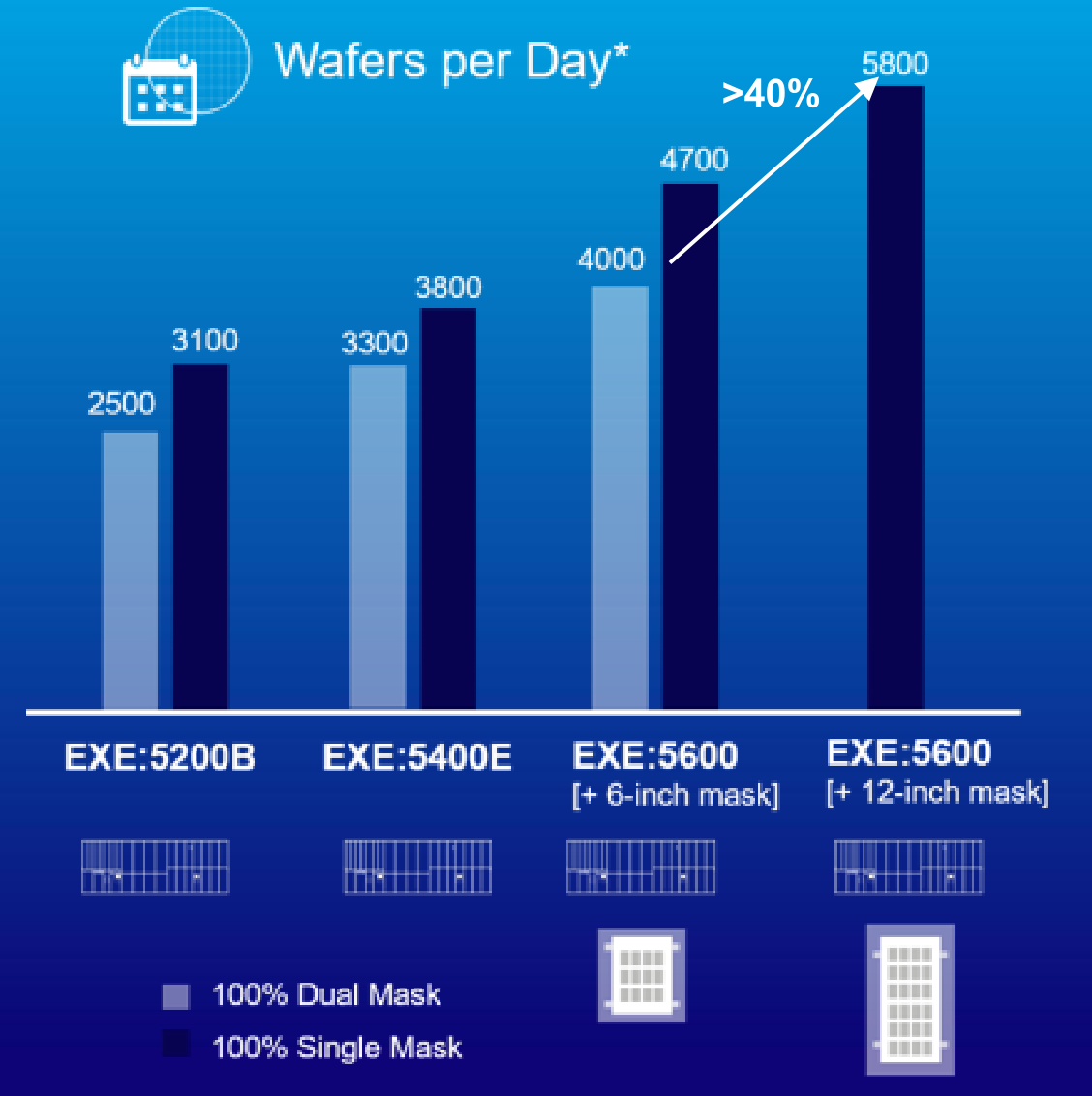
This quarter's new development is in masks. In September, ASML and TSMC launched an industry consortium to move High-NA to 12-inch masks, targeting a pilot line in 2031 and volume production in 2033. On ASML's numbers, an EXE:5600 running 12-inch masks can produce 5,800 wafers a day, 45% more than the 4,000 it manages with 6-inch masks in dual-mask mode.
High-NA wafers per day by tool (dual-mask, single-mask and 12-inch mask)
source: ASML 3Q26 investor presentation
The CEO's logic is simple: if customers were not planning to use more High-NA, nobody would change the entire mask format for it. He also conceded that with customers focused on capacity right now, High-NA adoption could speed up or slow down.
In From Photons to Pricing Power, I judged that High-NA would mature somewhat later, and a 2030 date at TSMC is consistent with that call. What changed this quarter is that an entire mask supply chain has started replanning around High-NA's needs.
Earnings Up, Multiples Down
Sell-side earnings estimates went up almost everywhere; price targets did not keep pace. All four banks that updated their models raised EPS, but only UBS raised its target. BofA cut its target from €2,557 to €2,507 because sector multiples moved lower; Bernstein trimmed its target multiple and left its target unchanged.
That contrast is the market's quote on how long the scarcity rent will last. BofA notes that generalist investors' biggest worry is how AI capex gets financed. If roughly US\$2.0tn of AI demand in 2028 comes into question, its forecast of \$270-280bn in 2028 wafer fab equipment spending is at risk.
UBS puts the stock at roughly 24x 2027 and 16x 2028 earnings, against a historical average of about 30x.
Several questions went unanswered this quarter. Management gave no explanation for the non-EUV cut; sell-side models place it in this year's pricing and lower-end tools, and UBS expects China DUV revenue to fall 13% this year. Q4 gross margin is guided to about 57%, 0.5pts below Q3, which the CFO attributed to ramp costs, and those costs will absorb part of the benefit from higher prices.
Morgan Stanley is the most cautious on 2027, with revenue 1.5% below consensus and gross margin at 55.6%. On China, Berenberg asked about the threat from domestic immersion tools. The CEO's answer: as long as ASML keeps market access, the chance of serious competition is low, and this is a conversation the industry has been having "for the last 25 years."
What to Watch Next
- The 4Q26 results in January 2027: whether year-end backlog is disclosed (UBS estimates €60-65bn), 2027 gross margin guidance, and whether 2028 capacity gets raised (BofA expects 120 units).
- Average selling prices in 2027: the first partial year of the price increase, and the first place its size will show up, in EUV and ArFi unit prices.
- The quarterly growth rate of IBM: until new-tool capacity catches up with demand, it is the most sensitive reading of the shortage.
- The Capital Markets Day on June 10, 2027: the update to the 2030 framework.
In January, ASML said it would not be the bottleneck this year. In October, it admitted its current plan cannot keep up with demand, and then, at the tightest point of the shortage, chose to take a little less. The scarcity rent is spread across upgrades, down payments, a queue and a one-time repricing, and in return ASML gets its customers' trust and a price floor for the downturn.
It is a bet on duration: the longer the shortage lasts, the more today's trust is worth. Falling multiples say the market is currently betting the other way. Those 2029 and 2030 orders, still waiting at the door, will show which side did the math right first.
Earnings Call Recap
I will now share a more detailed analysis on this earnings result behind the paywall:


