

Jason - Finding Value in a Stochastic World: Constructing an Investment Framework
Navigating a stochastic investment world requires a fresh perspective. How can we reconcile traditional valuation models with inherent market volatility, and what truly drives long-term value in an "uncertain yet predictable" environment?

Finding Value in a Stochastic World: Constructing an Investment Framework
The world of investment is fraught with uncertainty, resembling a vast Stochastic Process. Stock prices and economic trends are not driven by a single, deterministic factor. Recognizing that "the world is Stochastic" serves as the cornerstone for building our investment theory. Under this assumption, we can better scrutinize market behavior and economic cycles, and make insightful predictions about the future.
Re-examining Discounted Cash Flow Valuation: The Discrepancy Between Discrete and Continuous
When we discuss valuation, the DCF model is frequently mentioned across business schools, sell-side, and buy-side reports. However, is the DCF model truly effective?
The traditional DCF model is inherently a discrete model, projecting and discounting future cash flows on a quarterly or annual basis. This fundamentally mismatches the continuous, stochastic world we inhabit. The input parameters for DCF, such as growth rates and profit margins, implicitly carry complex probability distributions, yet the model demands single, deterministic values. While Scenario Analysis can simulate multiple possibilities, this often resembles a "shotgun approach" and its predictive power, especially in sell-side reports, tends to be perfunctory. Such reports typically present a Bear Case (below current stock price), a Base Case (slightly above current stock price), and a Bull Case (significantly higher). This type of forecasting often lacks genuine insight.
However, this does not mean the philosophical underpinning of DCF is entirely flawed. In certain contexts, particularly when viewed as a Perpetual Growth Model, the DCF concept aligns with a stochastic worldview.
Core Elements of a Stochastic World: Drift and Volatility
To comprehend that "the world is Stochastic," it is crucial to understand the two core components of random motion: Drift and Volatility. While precisely distinguishing Drift and Volatility and assuming fixed parameters might be an oversimplification in practice, this simplification is effective as a tool for understanding the world.
- Drift: At the individual company or security level, Drift represents the organic growth of its intrinsic value. For value investors or quality-focused investors, Drift primarily refers to a company's earnings growth, encompassing both the organic growth of its core business and potentially strategic M&A-driven growth as part of its business model. In essence, Drift is driven by intrinsic factors such as the company's business model and competitive landscape, representing earnings growth that the company can largely control or influence. It signifies the long-term trend of the company's value appreciation.
- Volatility: Volatility, conversely, represents fluctuations caused by unexpected, external shocks or unplanned internal disruptions. For instance, changes in tariff policies, unforeseen management changes, shifts in market narrative, or macroeconomic factors like interest rate hikes and cuts can all trigger stock price fluctuations. Volatility is a neutral concept; we tend to believe its mean tends to be mean-reverting to zero in the long run, meaning positive and negative shocks will eventually cancel each other out. This validates the classic adage in value investing: "In the short run, the market is a voting machine, but in the long run, it is a weighing machine." Because Volatility eventually cancels itself out over the long term, what remains is the intrinsic value growth, or Drift, of the company.
Valuation and Company Quality: The Deeper Meaning of R-G
Under a stochastic worldview, we can express the simplest form of the Perpetual Growth DCF model as:
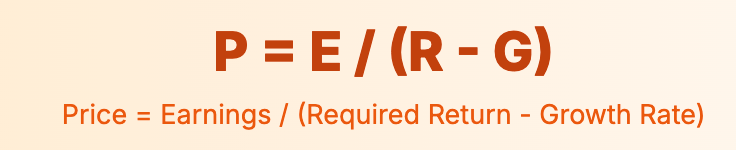
Where P is Price, E is Earnings Per Share (EPS), R is the Required Rate of Return for investors, and G is the company's Perpetual Growth Rate.
This formula reveals the essence of valuation:
- (G: Growth Rate): Can be understood as the Compound Annual Growth Rate (CAGR) of the company's intrinsic value growth over its entire lifecycle. While G is not constant in the real world, we can conceptualize its long-term trend by using the geometric mean growth rate in a company's entire life cycle.
- (R: Required Rate of Return): Represents the minimum return an investor expects from this investment. Since G can be considered a relatively stable intrinsic growth, the true variable in the formula is R.
The difference of R-G directly determines the company's valuation multiple. For example, if is 6% and the investor's Required Rate of Return and G is 5%, then R-G is 1%, leading to a valuation multiple as high as 100x.
So, how is an investor's R for a company determined? It must be greater than G, as no one would invest in a company with an expected return lower than its intrinsic growth. The premium between R and G reflects investors' confidence in the company's future Visibility and Certainty, which is precisely the embodiment of Company Quality.
Take Costco as an example:
- Costco's Same-Store Sales growth might only be around 5% over the long term. Taking new store expansion into account, the overall growth might be around 10%, or you can even consider it as a company with low single-digit growth rate.
- However, Costco commands a high P/E valuation of around 50x. This is not due to its rapid growth, but because its business model (membership-based, warehouse club format, owned real estate) provides extremely high visibility. Consumers demand its high-quality, low-priced products in any economic environment, and its strong customer stickiness and high repurchase rates make it resilient to economic cycles.
- This extremely high visibility allows investors to accept a lower Required Rate of Return. If Costco's long-term growth rate is 5%, investors might only require a 7% return, making R-G just 2%, corresponding to a 50x valuation multiple.
Therefore, valuation does not exist in isolation; it is inextricably linked to a company's intrinsic growth (Drift) and the stability/visibility of that growth (Quality). Under the stochastic assumption, valuation and earnings are inseparable.
Investment Guidance: Selecting High-Drift Companies and Managing Volatility
Now that we understand this framework, what investment guidance does it offer?
- Select High-Drift Companies: Within one's acceptable range of Volatility, investors should strive to choose companies with higher Drift. Over the long term, a portfolio holding a significant number of high-Drift securities will demonstrate superior weighted average returns. While some companies may underperform due to external shocks or misjudging Drift, others might achieve outsized returns due to good fortune or underestimation of their Drift.
- Manage Volatility: Although Volatility tends to cancel itself out over the long term, as John Maynard Keynes famously quipped: "In the long run, we are all dead." Short-term external shocks or Volatility spikes can lead investors to be forced out. Therefore, effectively managing Volatility is crucial.
- Buy Low, Sell High: When a company's stock price falls due to Volatility shocks, deviating from its intrinsic value (Drift), it presents an excellent buying opportunity. This is because, in addition to returns from Drift, investors will also gain additional returns from Mean Reversion.
- Judicious Selling: When the market is overly optimistic, and the stock price is significantly above company fundamentals, while selling might generate short-term gains, a cautious decision is needed from a long-term perspective if the company's Drift remains unchanged.
- Limitations of Crisis Alpha: In a broad market downturn, relying on company quality to resist shocks and generate Crisis Alpha is challenging. High-quality companies often command premium valuations and may experience larger declines during market downturns. Therefore, managing Volatility and generating Alpha through buying low and selling high is more feasible in non-broad market downturns.
Core Factors Determining the Speed and Stability of Drift
The speed and stability of Drift, meaning the magnitude and persistence of a company's intrinsic value growth, primarily depend on two core factors:
- Supply and Demand:
- If a company's services or products address a structural inelastic demand or operate in a supply-constrained environment over the long term, its Drift will be more secure.
- In such cases, the company's growth is primarily limited by capacity. Sometimes, companies should even proactively limit capacity to achieve healthier, more sustainable growth.
- Competitive Landscape:
- Competition is the sole adversary of excess returns (Alpha) and economic profit. The less competition, the higher the company's Alpha and the greater the stability of its growth.
- The concept of economic profit in economics, similar to Alpha in securities markets, refers to excess returns after deducting all costs, including opportunity costs. In a Perfect Competition industry, even if profitable, margins might be thin and profits are merely a kind of salary income (far less than the appropriate level of compensation given the risk) , making it difficult to generate economic profit.
- True Alpha and economic profit stem from the scarcity of competition, meaning for its customers, the company's product/services offer the lowest level of opportunity costs.
- Competition in a Broader Sense: Competition is not only evident at the product and service level but, more importantly, at the business model level.
- For example, Costco, in the highly competitive supermarket industry, has forged a unique competitive advantage through its membership-based and warehouse club business model, differentiating itself from traditional supermarkets like Target or Walmart.
- Apple, in the smartphone market, despite not having a dominant market share in terms of shipments, has captured the lion's share of industry profits. Its competitive advantage is not solely reliant on the phone product itself but on a powerful ecosystem built through services like iCloud, which significantly enhances user stickiness.
- If a company creates value in a distinctive way and maintains sustained profitability, its intrinsic value growth (Drift) will be more assured.
A Dynamic Investment Mindset: Long-Term Holding is Not Immutable
Warren Buffett's philosophy of long-term holding is correct in most cases, but we also need to approach investing with a more open and dynamic perspective.
- Fundamental Changes: A company's fundamentals can change significantly in a short period. If the initial investment thesis is disproven, or if the company's Drift undergoes a fundamental shift due to policy, competitive landscape, or other factors, then timely selling is entirely appropriate. Long-term holding does not imply blindly adhering, but rather is based on a continuous assessment of the company's Drift.
- Balancing High Growth and High Volatility:
- High-growth, high-Volatility companies (such as many IT or semiconductor companies) often provide entry opportunities in terms of valuation. When external shocks cause a sharp decline in the stock prices of such companies, it often presents an excellent buying point.
- Low-growth, low-Volatility companies (like Costco), while growing slowly, exhibit high stability. Their valuations may remain high over the long term, with valuation compensating investors for returns.
Conclusion
In a stochastic world, successful investing requires us to understand and embrace uncertainty. By distinguishing Drift and Volatility, scrutinizing the intrinsic link between valuation and company quality, and adopting dynamic investment strategies, we can better navigate the market and achieve long-term value growth. Investing is not merely about prediction; it is an ongoing process of identifying trends amidst randomness, seizing opportunities amidst volatility, and flexibly adjusting strategies based on continuously evolving fundamentals.
在随机世界中寻找价值:构建我的投资框架
投资的世界充满了不确定性,如同一个巨大的随机过程(Stochastic Process),股票价格和经济走势并非由单一确定性因素驱动。认识到“世界是Stochastic”是我们构建投资理论的基石。在这样的假设下,我们才能更好地审视市场行为、经济周期,并对未来进行有用的预测。
重新审视DCF估值:离散与连续的矛盾
当我们提及估值,DCF模型常常被挂在嘴边,无论是商学院、卖方还是买方报告。然而,DCF模型真的有效吗?
传统DCF模型本质上是一个离散(Discrete)模型,它将未来的现金流按季度或年度进行预测和折现。这与我们所处的连续(Continuous)随机世界存在根本性的不匹配。DCF的输入参数,如增长率、利润率等,背后都隐含着复杂的概率分布,但模型却要求我们填入单一确定性的数值。尽管可以通过情景分析(Scenario Analysis)来模拟多种可能性,但这更像是一种“散弹射击”,其预测能力,尤其是在卖方报告中,往往流于形式——总是呈现一个低于当前股价的熊市情景(Bear Case)、一个略高于当前股价的基准情景(Base Case),以及一个显著高于的牛市情景(Blue Case)。这种预测缺乏真正的洞察力。
然而,这并非意味着DCF的哲学基础完全错误。在某些场景下,尤其是当我们将其视为一个永续增长模型(Perpetual Growth Model)时,DCF的理念与随机世界观是互通的。
随机世界的核心要素:Drift与Volatility
要理解“世界是Stochastic”,关键在于理解随机运动的两个核心组成部分:漂移(Drift) 和波动性(Volatility)。虽然在实际中精确区分Drift和Volatility,并假设其参数固定可能过于简化,但作为理解世界的工具,这种简化是有效的。
- Drift(漂移):在一个公司或证券的维度上,Drift代表了其内在价值的有机增长。对于价值投资者或高质量风格投资者而言,Drift主要指公司的盈利增长,这包括其核心业务的内生增长,也可能包括作为商业模式一部分的战略性并购增长。简而言之,Drift是公司商业模式、竞争格局等内在因素驱动的,公司自身能够大部分掌控或施加影响的盈利增长。它代表了公司长期价值增长的趋势。
- Volatility(波动性):Volatility则代表了一切意外的、外部的冲击(External Shock)或非计划的内部变故所导致的波动。例如,关税政策变化、管理层意外变故、市场叙事(Market Narrative)转变、加息降息等宏观因素,都可能引发股价的波动。Volatility是一个中性概念,我们倾向于认为其均值长期趋近于零(Mean Zero),即好的冲击和坏的冲击会相互抵消。这印证了价值投资中的经典论断:“短期市场是投票机,长期市场是称重机”——因为Volatility长期会自我抵消,最终留下的是公司内在价值增长的Drift。
估值与公司质量:R-G的深层含义
在Stochastic世界观下,我们可以将最简化的永续增长DCF模型表示为:
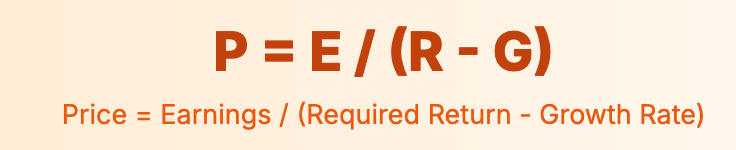
其中,P是价格(Price),E是每股收益(Earnings), R是投资者要求回报率(Required Rate of Return), G是公司的永续增长率(Perpetual Growth Rate)。
这个公式揭示了估值的本质:
- (G: 增长率):可以理解为公司全生命周期内内在价值增长的复合年增长率(CAGR)。虽然现实世界中并非恒定,但我们可以取一个平均化的常数值来概念化其长期趋势。
- (R: 要求回报率):代表投资者对该投资所期望的最低回报。由于G可以作为一个参数被视为相对稳定的内在增长,那么公式中真正的变量便是R。
R-G的差值直接决定了公司的估值倍数(Multiple)。例如,如果是5%,投资者要求回报率是6%,则为1%,估值倍数将高达100倍。
那么,投资者对一个公司的"R"究竟是如何决定的?它必须大于"G",因为没有人会投资一个预期回报低于其内在增长的公司。R与G之间的溢价(Premium)反映了投资者对公司未来可见性(Visibility)和确定性(Certainty)的信心程度,这正是公司质量(Quality)的体现。
以Costco为例:
- Costco的同店销售(Sim Store Sales)长期增长可能仅为5%左右,加上开店扩张,整体增速可能在10%左右,甚至可以被视为一个低个位数增长的公司。
- 然而,Costco却能享有50倍左右的高估值。这并非因为其高速增长,而是因为其商业模式(会员制、仓储一体、自有物业)带来了极强的可见性。消费者在任何经济环境下都对其物美价廉的产品有需求,其会员粘性强,复购率高,不受经济周期波动影响。
- 这种极强的可见性使得投资者愿意接受较低的要求回报率。如果Costco的长期增长率为5%,投资者可能仅要求7%的回报率,R-G那么仅为2%,对应的估值倍数便是50倍。
因此,估值并非孤立存在,它与公司的内在增长(Drift or G)和其增长的稳定性、可见性(Quality)是密不可分的。在Stochastic的假设下,估值与盈利是无法分割的。
投资指导:选择高Drift与管理Volatility
既然我们已经理解了这个框架,那么它对投资有何指导意义?
- 选择高Drift的公司:在个人可接受的Volatility范围内,投资者应尽量选择那些Drift较高的公司。长期来看,持有大量高Drift的证券组合,其加权平均回报将表现出色。尽管部分公司可能因外部冲击或对Drift判断失误而表现不佳,但也有可能因好运或低估Drift而获得超预期回报。
- 管理Volatility:虽然长期来看Volatility会自我抵消,但正如凯恩斯所言:“In the long term, we are all dead。” 短期的外部冲击或Volatility尖峰(Volatility Spike)可能导致投资者“出局”。因此,有效地管理Volatility至关重要。
- 低买高卖:当公司因Volatility冲击而股价下跌,偏离其内在价值(Drift)时,是很好的买入机会,因为除了Drift带来的回报,还将获得均值回归(Mean Reversion)的额外收益。
- 审慎卖出:当市场过度乐观,股价显著高于公司基本面时,虽然卖出可能带来短期收益,但从长期角度看,若公司Drift未变,则需审慎决策。
- 危机阿尔法(Crisis Alpha)的局限性:在市场普遍下跌时,依赖公司质量来抵抗冲击并产生危机阿尔法是困难的。高质量公司通常估值不便宜,在市场下跌时跌幅可能更大。因此,在非普遍下跌的市场环境中,通过低买高卖来管理Volatility并获取阿尔法更为可行。
决定Drift快慢与稳定性的核心因素
Drift的快慢和稳定性,即公司内在价值增长的幅度和持续性,主要取决于两个核心因素:
- 供需关系(Supply and Demand):
- 如果公司提供的服务或产品具有结构性刚需,或长期处于供不应求(Supply Constraint)的状态,那么其Drift将更有保障。
- 在这种情况下,公司的增长主要受限于产能(Capacity)。有时,公司甚至应主动限制产能,以实现更健康、更持久的增长。
- 竞争格局(Competitive Landscape):
- 竞争是超额收益(Alpha)和经济利润(Economic Profit)的唯一敌人。竞争越小,公司的Alpha和增长的稳定性越高。
- 经济学中的经济利润(Economic Profit)概念,类似于证券市场中的Alpha,指的是扣除所有成本(包括机会成本)后的超额收益。在一个完全竞争(Perfect Competition)的行业中,即使能赚钱,利润也可能微薄,难以产生经济利润, 仅相当于高级管理人员的劳务收入。
- 真正的Alpha和经济利润来自于竞争的稀缺性,即对客户来说公司所提供的产品/服务具有最低的机会成本。
- 广义的竞争:竞争不仅体现在产品和服务层面,更体现在商业模式层面。
- 例如,Costco在超市这个高度竞争的行业中,通过会员制和仓储一体的商业模式,形成了独特的竞争优势,使其与传统超市如Target或Walmart产生差异化。
- Apple在智能手机市场中,尽管出货量占比不高,却攫取了行业大部分利润。其竞争优势并非仅靠手机产品本身,而是通过iCloud等服务构建的强大生态系统(Ecosystem),极大地增强了用户粘性。
- 如果一个公司创造价值的方式与众不同,且能持续盈利,那么其内在价值增长(Drift)将更具保障。
动态的投资心态:长期持有并非一成不变
巴菲特关于长期持有的理念在大多数情况下是正确的,但我们也需要以更开放、更动态(Dynamic)的视角来看待投资。
- 基本面(Fundamental)变化:公司的基本面可以在短时间内发生重大变化。如果最初的投资假设被证伪,或者公司因政策、竞争格局等因素导致其Drift发生根本性改变,那么及时卖出是完全正确的。长期持有并非意味着盲目坚守,而是基于对公司Drift的持续评估。
- 高增长与高Volatility的平衡:
- 高增长、高Volatility的公司(如许多IT或半导体公司)在估值上通常会提供“上车”机会。当外部冲击导致这类公司股价大幅下跌时,往往是很好的买点。
- 低增长、低Volatility的公司(如Costco)虽然增长缓慢,但其稳定性高,估值可能长期保持较高水平,并以估值补偿投资者的回报。
总结
在一个Stochastic的世界里,成功的投资需要我们理解并拥抱不确定性。通过区分Drift和Volatility,审视估值与公司质量的内在联系,并采取动态的投资策略,我们才能更好地驾驭市场,实现长期价值的增长。投资并非简单的预测,而是在随机中寻找趋势,在波动中把握机会,并根据不断变化的基本面灵活调整策略的持续过程。


