From the Dishwasher to the Cosmos: AI's Great Debate on the Nature of Intelligence
Is the path to Artificial General Intelligence paved with ever-larger language models, or does true intelligence demand a completely different architecture grounded in physical reality?


The Great AI Divergence: AGI on the Horizon, or a Dead End for LLMs?
To be in the world of Artificial Intelligence (AI) right now is to feel a constant cognitive tug-of-war. On one side, the capabilities of Large Language Models (LLMs) like ChatGPT and Gemini are expanding at a breathtaking pace, making it feel as if the dawn of Artificial General Intelligence (AGI) is just around the corner. On the other, some of the sharpest minds in the industry are calmly reminding us: we might be getting fooled by the fluency of LLMs, and the current, much-hyped technological path could soon hit a wall.
At the heart of this great debate are two figures at the center of the storm: Meta's Chief AI Scientist and Turing Award laureate, Yann LeCun, and Research Scientist at Google DeepMind, Adam Brown. In a deep-diving conversation, they offered starkly different answers to the fundamental question: "Do LLMs truly understand the world?"
Their disagreement is more than just an academic clash; it points to where trillions in capital might flow and defines the ultimate shape of AI's future.
The Chasm of Understanding: "Yes" vs. "Sort of"
When asked directly, "Do LLMs understand the meaning of the conversations they are having?" the two experts instantly drew their battle lines.
Adam's answer was a straightforward: "Yes."
Yann's was more cautious: "Sort of."
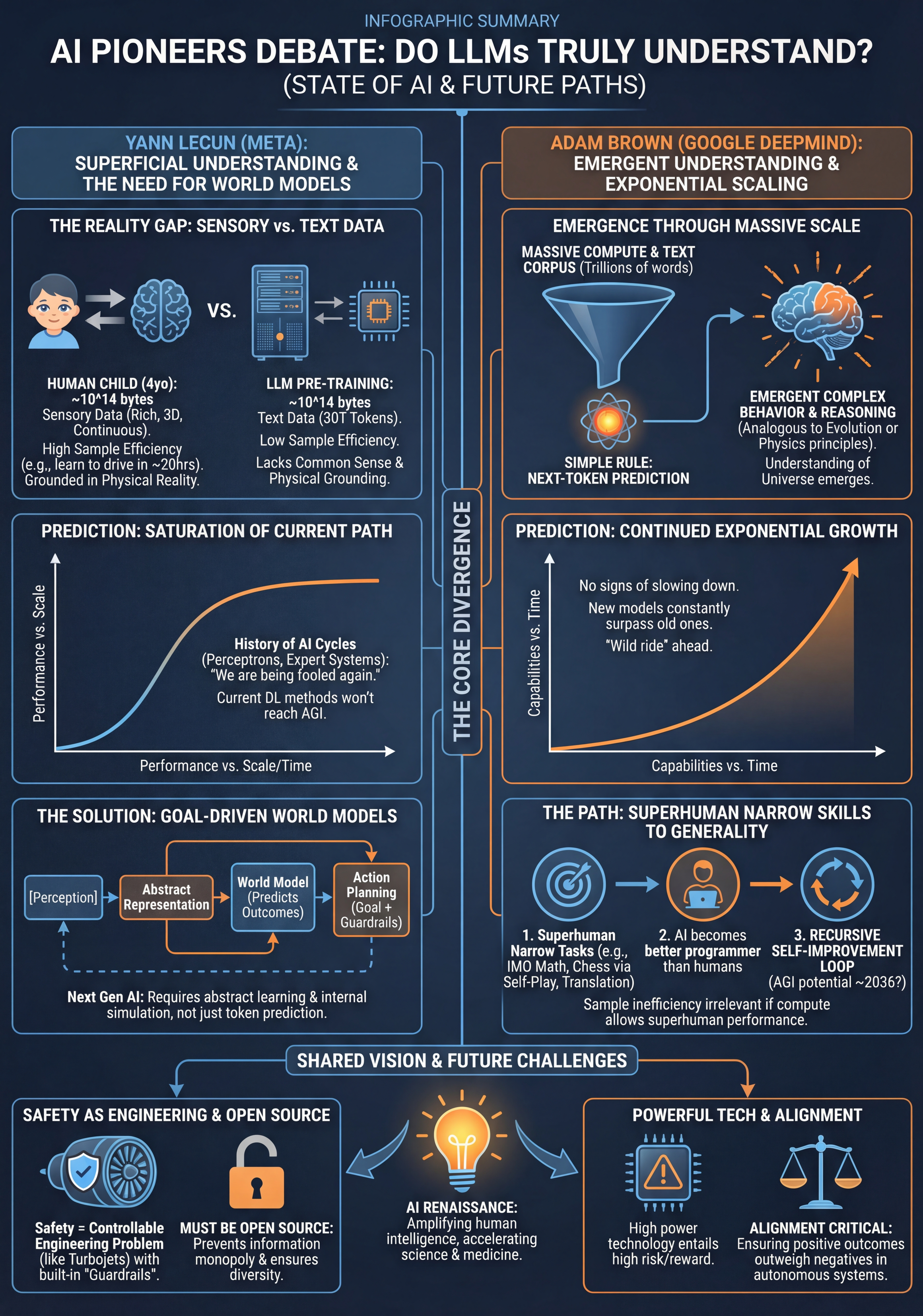
This seemingly minor difference conceals two fundamentally opposed worldviews. Adam believes that through the seemingly simple task of "predicting the next word" on a massive dataset, true understanding has begun to show emergent behavior in LLMs. Yann, however, argues that this understanding is ultimately "shallow" because it lacks the most critical component: a genuine connection to the physical world.
LeCun's Warning: Data, Reality, and the Lessons of History
Yann LeCun's skepticism is not unfounded. He presented a powerful piece of evidence—a comparison of data volume—to dissect the fundamental limitations of current LLMs.
A top-tier LLM "reads" roughly 30 trillion words (tokens) during its training, encompassing nearly all publicly available text on the internet. For a human to read this much, it would take 500,000 years of non-stop reading.
However, what is the sensory input of an ordinary human child?
Yann points out that by the age of 4, the total amount of data a child has received through vision alone is in the same order of magnitude (around bytes) as the entire text dataset used to train a top-tier LLM.
The sheer difference in informational dimensions is staggering.
The implication of this comparison is far-reaching. It means the sensory information a child acquires by interacting with the real world is far more complex and multi-dimensional than pure text. Information from the real world is more intricate, noisy, high-dimensional, and continuous.
"Human intelligence is connected to and grounded in an underlying reality," Yann explained. "LLMs have no concept of this underlying reality, so their understanding is relatively shallow. They do not have what we understand as common sense."
This perhaps perfectly explains the classic Moravec's Paradox in computer science: why can AI ace the bar exam, yet fail at a task a child can easily perform—like clearing a dinner table and loading a dishwasher?
"We don't even have Level 5 self-driving cars," Yann added. "And we certainly don't have autonomous cars that can learn to drive in 20 hours of practice like any teenager can."
Yann believes we are in the midst of another AI hype cycle, deceived by the impressive linguistic capabilities of LLMs. He recounted the history of AI, from the Perceptron of the 1950s to the Expert Systems of the 1980s. Each generation of technology was hailed as the ultimate ticket to human-level intelligence, only to eventually fade into silence.
"We are going through the same cycle again," Yann asserted. "We are being fooled again."
The pendulum of history swings once more.
Adam's Faith: Scale, Emergence, and Self-Improvement
Faced with Yann's reality-grounded caution, Adam Brown displayed a distinctly different faith, born from the digital realm. He acknowledged that LLMs are far less sample efficient than humans, but argued that this isn't the only metric of capability.
He used the chess program AlphaZero as an example. AlphaZero trained through a massive number of self-play games, far exceeding what any human grandmaster could play in a lifetime. In the end, it not only reached but far surpassed the level of human grandmasters.
"They are less sample efficient," Adam said, "but that doesn't mean they are worse at chess. They are demonstrably much, much better."
Adam believes it's a mistake to view the core task of an LLM—"predicting the next word"—as simple pattern matching. He argues that when computation reaches an extreme scale, this simple task gives rise to astonishing complexity.
"To be able to reliably predict the next word, you really need to understand the universe. And we've seen the understanding of the universe emerging as we do this."
He likened this process to Evolution: a simple objective—"maximize the number of offspring"—repeated over vast timescales, eventually creating all the magnificent life forms around us.
To prove that LLM capabilities are not plateauing but are engaged in genuine abstract reasoning, Adam cited the example of the International Maths Olympiad (IMO). When faced with entirely new problems it had never seen, Google DeepMind's AI achieved a score that was "better than all but the top twelve human competitors in the world."
"I think that's pretty impressive intelligence," Adam concluded.
He is confident that the improvement in LLM capabilities shows no signs of slowing down. The real tipping point, he believes, will come when AI surpasses humans in programming ability.
"Once it's better at programming than almost all of our best programmers, it can start improving itself, and then we are really in for a wild ride."
For the faithful, the curve only goes up.
The Ultimate Challenge: "The Dishwasher" and "2036"
The debate ultimately zeroed in on a concrete and vivid challenge.
When asked, "What is a concrete task that an LLM will never be able to do?" Yann LeCun gave a simple answer: "Clear the table and fill the dishwasher." He emphasized that this wasn't a claim that robots could never do it, but that the current LLM algorithmic approach is not the right path to achieve it.
"You will never have a plumber that's powered by an LLM. It just doesn't understand the real world. It just can't."
Adam, on the other hand, sees this leap in capability as merely a matter of time. Prodded by the host, he even offered a bold prediction for when AI might possess consciousness: "If progress continues, 2036."
Safety, Open Source, and Two Philosophies
Despite their vast differences on the technological path, both experts agree that AI safety is a solvable engineering problem, not an inevitable doomsday scenario. Yann advocates for building controllable AI systems by setting clear objectives and "guard rails," much like engineers design reliable turbojets.
More interestingly, Yann LeCun is a staunch advocate for Open Source. He argues that the real danger lies not in open source, but in an information monopoly. If our future access to information is mediated entirely by the proprietary AI systems of a few companies, it would pose a massive threat to culture, language, and democracy.
"We need a great diversity of AI assistants, just like we need a diverse press."
This fascinating debate ultimately boils down to two distinct paths:
One is the path represented by Adam Brown, a belief in the supreme power of scale. It wagers that with enough data and computation, intelligence will emerge as naturally as a law of physics, eventually achieving self-improvement and leading to AGI.
The other is the path championed by Yann LeCun, a quest for a world model. It holds that true intelligence must be grounded in an understanding of the physical world, requiring a new architecture to learn abstract representations of reality, not just manipulate linguistic symbols.
In the end, this isn't just a race between two technologies. It's a philosophical wager on the very nature of intelligence itself. And the path we choose will define everything that follows.


