
ASML 2Q26 Earnings Review: A Miss in Boxes, a Beat in Wafers
ASML guided 2027 Low-NA EUV capacity to roughly 85 "boxes", below the 90-unit bar the street had drawn before the print. So why did all six covering banks raise their targets the same day?


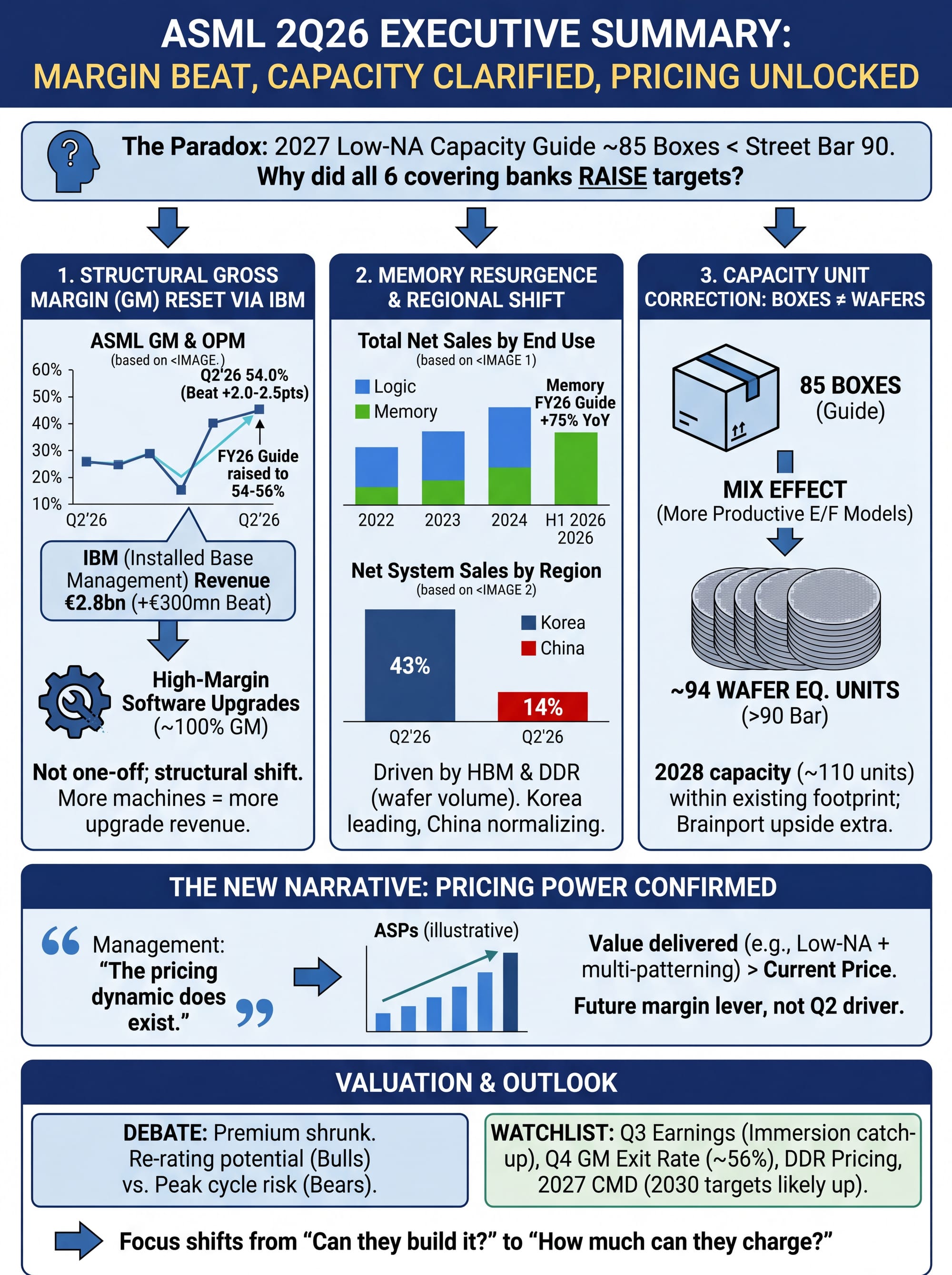
ASML 2Q26 Earnings Review: The Margin Arrived Early, the Street Counted the Wrong Unit
ASML raised the midpoint of its 2026 revenue guidance by €6bn in a single quarter.
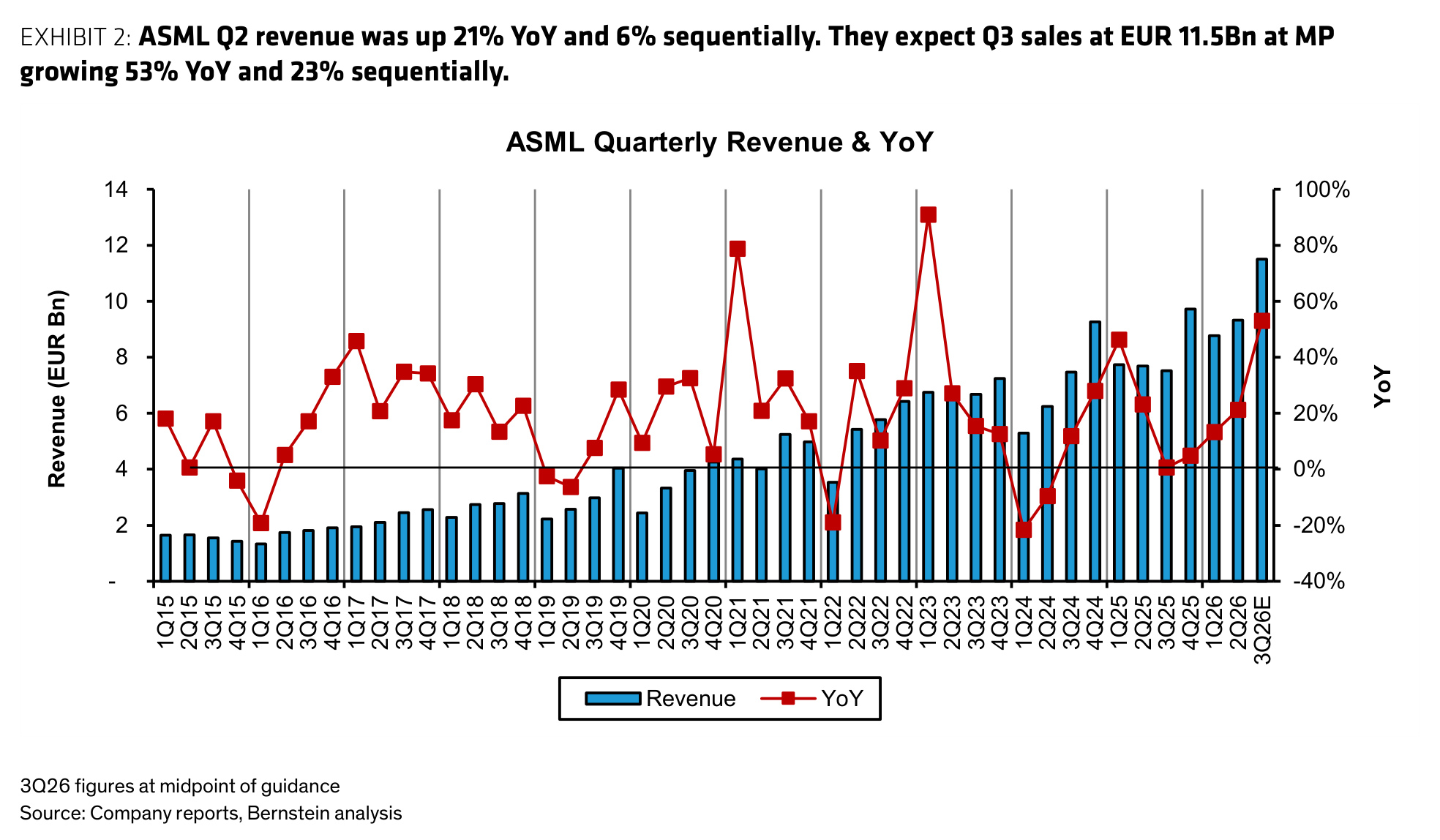
When I wrote the 1Q26 review three months ago, the story was one of restraint: the company lifted its revenue midpoint by €1.5bn yet declined to move the gross margin range, and the CFO's explanation was that ramp costs land first, benefits later. I summed up that choice as buying tomorrow's capacity with today's margin. 2Q26 delivered the verdict: the capacity is still on its way, but the payback window on the margin turned out shorter than anyone expected. Gross margin came in at 54.0%, 2.5pts above the top of the company's own guidance range and 2.0pts above consensus; full-year gross margin guidance was rewritten from 51%-53% to 54%-56%. Revenue: €9,326.5mn, up 21.3% YoY, 5.3% above consensus; full-year guidance moved from €36-40bn to €43-45bn, the midpoint implying 34.6% growth for the year; the Q3 guidance midpoint of €11.5bn implies 53% YoY. Zoom out and the arc is starker: in July 2025 management was still saying it was "unable to confirm growth" for 2026. Four quarters later, the FY26 guidance midpoint has climbed by a cumulative €7.5bn.
ASML quarterly revenue and YoY growth (3Q26E at guidance midpoint)
source: Bernstein, ASML 2Q26 review (2026-07-16)
Heading into the print, the sell side had flagged 2027 Low-NA EUV shipments as the single variable that would decide the stock, and had drawn the lines: 90 units would count as mildly positive, 90-100 as clearly positive. Management's official wording was "adding 30% to our 2026 Low-NA EUV capacity of around 65" for 2027. The arithmetic lands at 84.5 units. Below the bar.
That same day, all six covering banks (Jefferies, BofA, JPMorgan, Bernstein, UBS, Morgan Stanley) raised their estimates and price targets.
The real information in this print sits in three layers: the quality of the margin beat, the unit in which capacity gets measured, and a pricing comment that was years overdue.
Where the 54% Gross Margin Came From
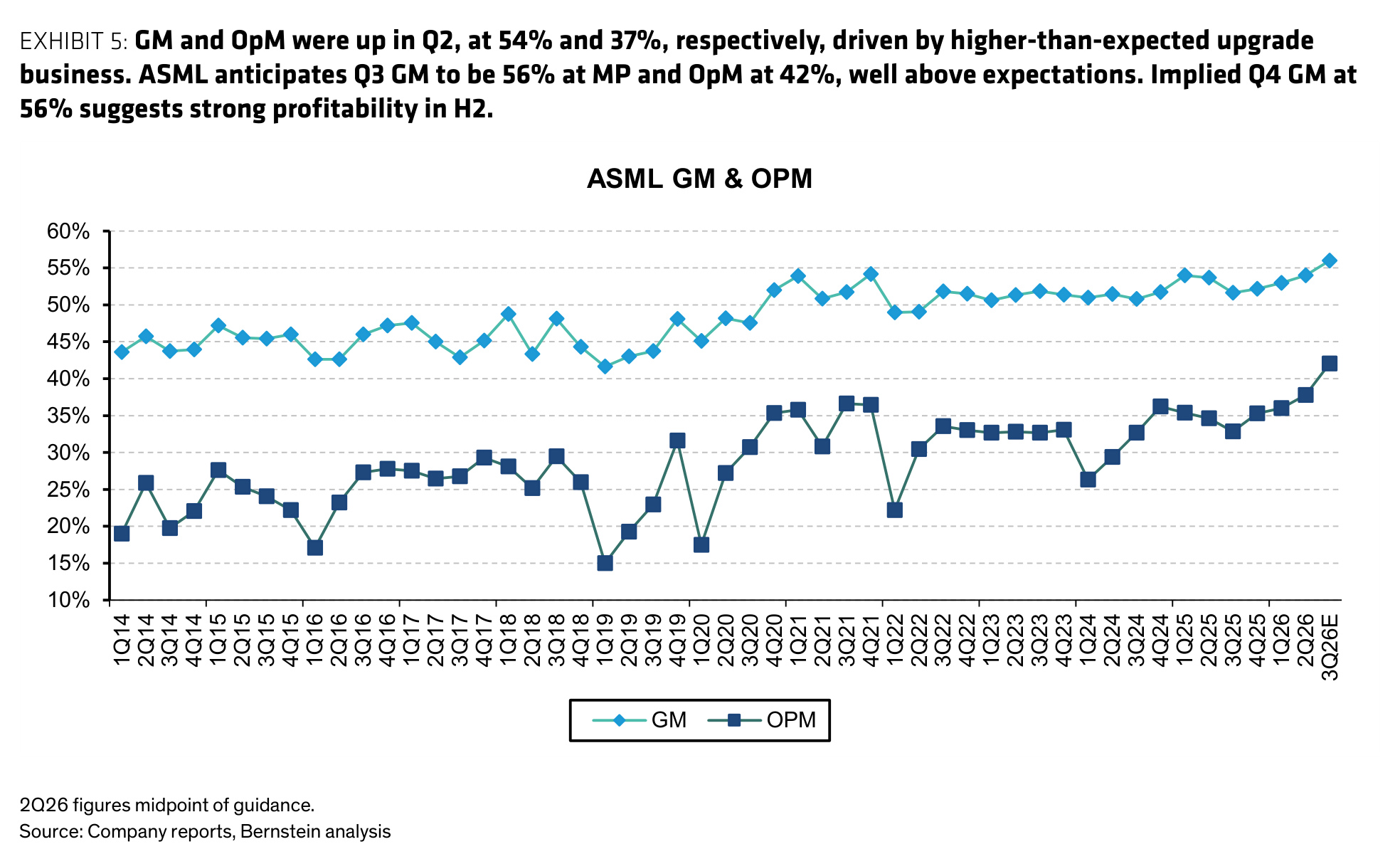
On the revenue beat, CEO Christophe Fouquet and CFO Roger Dassen told the same story: Installed Base Management (service plus upgrades) reached €2.8bn, €300mn above plan, driven by customers' appetite for productivity upgrades on tools already in their fabs. The margin beat traces to the same place. The CFO spoke of "very high margin parts" inside IBM; Jefferies translated the phrase into numbers: most of the upside came from software-based productivity upgrades carrying gross margins close to 100%, worth roughly 200+bps of gross margin on their own.
This isn't the first time. Inside 1Q26's 53% margin sat the PEP-E upgrade package for the NXE:3800E (lifting throughput from 220 WpH to 230 WpH, "most of the time" just a software switch plus qualification), which the CFO explicitly labeled one-off and unrepeatable, guiding Q2 gross margin down to 51%-52% on that basis. It landed at 54.0%. When the same "one-off" shows up two quarters in a row, it needs a new name: this is a structural revenue line, the software monetization of the installed base. The other half of the story was already told on the 1Q26 call: EUV service margins were "bleeding money" four or five years ago and have since converged to the corporate average. The installed base grows every year, the upgrade packages cover every version of Low-NA and immersion tools in the field, more such products are planned for 2027 and 2028, and IBM is guided to grow more than 30% this year. The more machines ASML ships, the thicker this line gets.
ASML gross margin and operating margin (1Q14 to 3Q26E)
source: Bernstein, ASML 2Q26 review (2026-07-16)
One boundary needs nailing down: none of this quarter's margin jump came from price increases. Jefferies, Morgan Stanley and JPMorgan each took the beat apart independently and reached the same conclusion: the drivers were software upgrade sales and product mix (a higher share of Low-NA EUV and immersion), and even if ASML pushed through like-for-like price increases over the next 12 months, the effect would be far smaller than these two items. Pricing is a separate story, and it gets its own section below.
The lower half of the P&L is improving too. Operating margin reached 37.1%, up 2.5pts YoY. Cantor Fitzgerald's CJ Muse did the math on the call: full-year guidance implies roughly 35% revenue growth against roughly 6% OpEx growth, an incremental operating margin of about 60%. The CFO declined to guide on that ratio but confirmed that, given the post-restructuring R&D organization, operating leverage "will get better in the quarters and years to come." Morgan Stanley worked backwards from the Q3 guide and arrived at an implied operating margin of roughly 42%, about 5pts above what the market had penciled in.
Cash flow gets its own ledger entry: H1 operating cash flow was negative €481.5mn (against positive €1,287.4mn a year earlier), mainly because accounts receivable ballooned from €3,023mn to €7,252.6mn. On a single-quarter basis Q2 already recovered to positive €1,703mn with free cash flow of €1,317mn, and ASML's Q4 prepayment surges and Q1 givebacks have always been a seasonal pair, so one quarter should not be extrapolated. Still, in a print that beat almost everywhere, this is one of the few line items that needs watching.
Memory: A Thesis Four Quarters in the Making
If you keep only one number from this entire print, make it the Memory line in the FY26 product guidance: revenue up 75%.
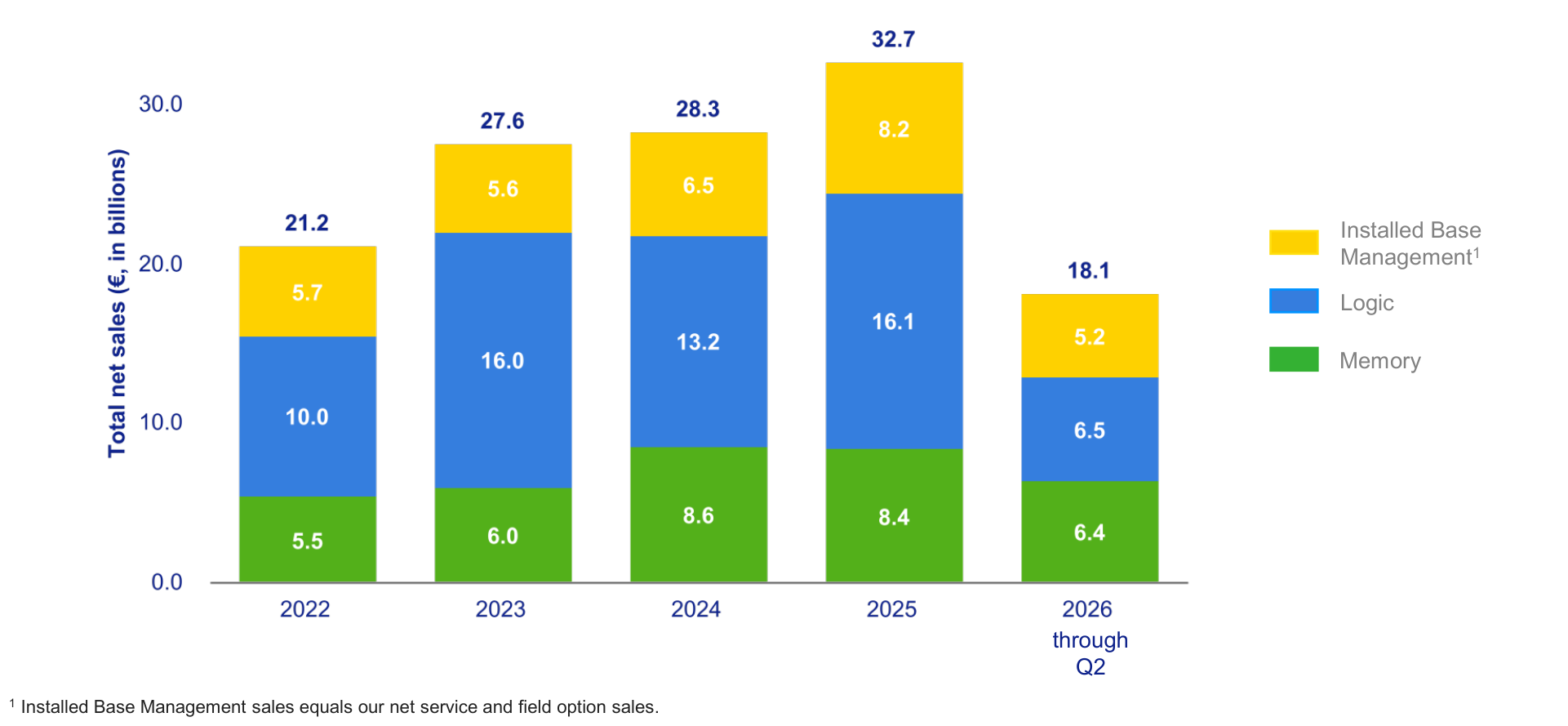
That number has a full paper trail. In September 2025, news broke that SK Hynix planned to double its EUV fleet within two years and Micron pushed FY26 capex toward ~$18bn. I argued in a piece at the time that a memory capex wave could rewrite ASML's cautious outlook, while flagging one gap: HBM growth had yet to offset the decline in conventional DDR. The path since: in 4Q25, Memory took 56% of bookings, overtaking Logic for the first time; in 1Q26, Memory reached 51% of system revenue and Korea hit an all-time-high 45% of single-quarter ship-to sales; this quarter, H1 Memory revenue of €6,401.5mn (up 53.2% YoY) pulled almost exactly level with Logic's €6,442.7mn (down 10.0% YoY), where a year ago Logic led by nearly €3bn. Hypothesis, orders, revenue, guidance. The loop closed in four steps.
Total net sales by end-use, 2022 through 2026 H1 (Installed Base Management / Logic / Memory, € billions)
source: ASML 2Q26 investor presentation
And the gap I flagged back then has now been filled head-on. When ODDO BHF's analyst pressed on how much of the +75% came from HBM versus plain volume growth, Fouquet answered in two layers. First, the demand is fundamentally both HBM and DDR scaling in volume at the same time; DDR pricing is currently strong, and customers are optimizing allocation between the two. Second, he admitted he could not give a precise split, and argued the split barely matters to ASML: the underlying lithography is identical, and HBM simply consumes more wafers. Layer on the rising EUV and immersion layer counts at high-volume nodes like 1c and 1b, and you have what he calls the "perfect storm" in DRAM for this year and the years ahead (a phrase he coined on the 1Q26 call and reused this quarter). "Can't give you the split" sounds like a dodge. It is the sturdiest part of this guidance: when the lowest common denominator of demand is total wafer volume rather than any single end product, no single product's wobble can hurt the equipment maker. BofA's long-run numbers point the same way: DRAM customers' share of Low-NA EUV purchases climbs from 17% in 2021 (7 tools) to 46% by 2028E (51 tools).
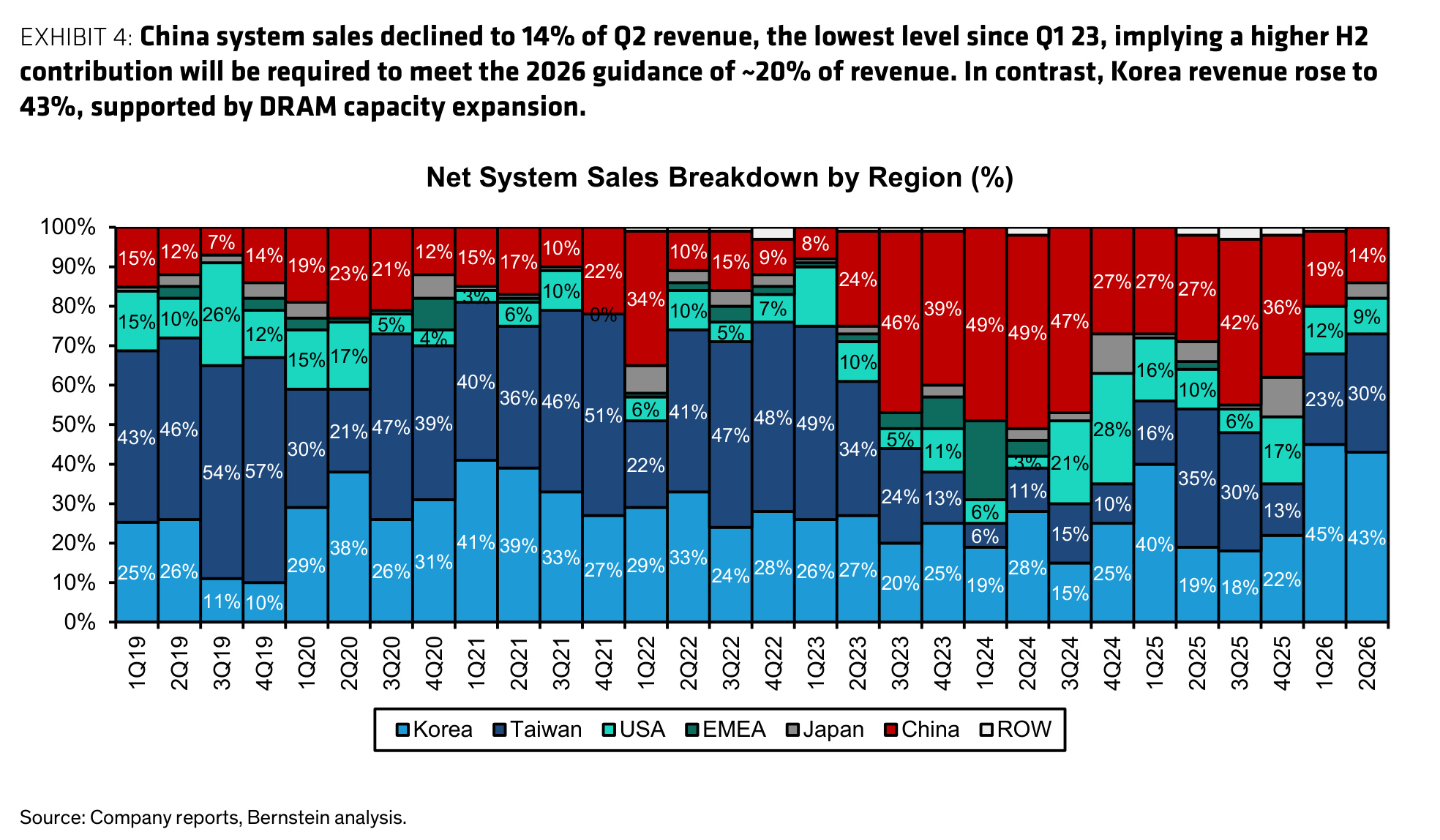
The regional data is the second independent reading on the same chain. South Korea's H1 revenue reached €7,085.5mn, up 60.5% YoY, lifting its share of total sales from 28.6% to 39.2%; on a single-quarter ship-to basis it stood at 43%, which Bernstein flags as the second-highest on record (behind only 1Q26's 45%). The mirror image is China: an H1 share of 15.9% (versus 24.1% a year earlier), down 22.3% YoY, with the single-quarter share of 14% the lowest since Q1 2023. Management kept the ~20% full-year China guidance unchanged and attached a qualifier that had never appeared before: the incremental Chinese demand is mainstream Logic, not leading-edge. From the single-quarter peak of 42% in 3Q25 to here, normalizing China revenue took three quarters, and the growth engine has fully swapped sides. One small piece of arithmetic to track: a ~20% full-year share mathematically requires China's share to tick back up in H2.
Net system sales by region (1Q19 to 2Q26): Korea 43%, China 14%
source: Bernstein, ASML 2Q26 review (2026-07-16)
Boxes and Wafers: A Unit-of-Measure Problem
84.5 units sits, on its face, below the 90-unit bar. Why did nobody treat it as a miss? Because the earnings call Q&A delivered three clarifications, and each one corrected how the market was counting.
The first clarification was the unit itself. The CFO was explicit that the 30% refers to box count, and next year's boxes are not this year's boxes: 2026 shipments mix B/D models with E models; the NXE:3600D is essentially sold out by year-end; from 2027 the line runs E and F models only (the F aimed at 1.4nm, the E being, in his words, the tool customers really want right now). Adjust for the output difference between models and the actual new wafer capacity for 2027 comes to roughly +45%, not +30%. Run the ratio and 65 × 1.45 ≈ 94 box-equivalents (my arithmetic, not company disclosure), just past the 90-unit bar the street had drawn. JPMorgan independently reached the same conclusion: the mix effect of higher-productivity tools adds roughly 10% of capacity, and if revenue capture scales with capacity, EUV revenue growth should reach 45%.
The trap is not new. From Photons to Pricing Power walked through the linear relationship between ASML's ASPs and throughput (a slope of roughly €0.9mn per WpH), and on the 1Q26 call the CEO already said the wafer output of 80 tools in 2027 would be roughly double that of 44 tools in 2025, on the strength of 230 WpH factory specs. Boxes were never this company's unit of supply. Wafers are. The 90-unit passing grade was drawn on the wrong axis.
The second clarification concerned the ceiling. Wells Fargo asked whether 85 units marks the capacity limit. The CFO's answer, in full:
"At this stage, given the conversations we have, the 85 is a nice representation of the balance between what customers are asking of us and what we've been asking ourselves in the supply chain to do. But if more is needed, we're going to roll up our sleeves and see if more can be done."
The third clarification corrected an assumption almost everyone, myself included, had taken for granted. The further +30% under investigation for 2028 (roughly 110 units) had been widely read as depending on the new Brainport Industries Campus coming online. The CFO said no: the 110 comes entirely out of the existing footprint (freeing up cabins, compressing cycle times, drawing on earlier investments in long-lead-time materials); Brainport only breaks ground in Q3 this year, and its capacity lands after 2028, on top of the 110. Morgan Stanley confirmed the same read from the construction timeline. Which means the 2028 capacity number carries no discount, and holds a layer of headroom nobody has yet modeled in.
The order book points the same way. The CEO said 2027 EUV orders are close to fully received; when TD Cowen asked whether ASML waits for customer POs before adding capacity, the CFO pushed straight back: they are plainly not waiting for orders. The 110-unit scenario is not yet backed by matching orders, but the customer signals are strong enough, and if customers thought 110 was an absurd number, ASML would not be investigating it at all. He added a rare note of satisfaction: being able to discuss 2028 order intentions two years in advance is a situation ASML has not enjoyed in many years. To state it plainly: the company has now gone two consecutive quarters without disclosing hard bookings or backlog figures, so all of the above is qualitative. Jefferies seized on exactly that, noting the company has yet to receive orders for all 85 of the 2027 tools, and that buyers and sellers alike may be overestimating demand. The same fact reads as "nearly all booked" on one side and "not yet booked" on the other. That is the smallest unit of disagreement between bulls and bears this quarter.
The scale of the revisions can be quantified. Three months ago, in the 1Q26 review, BofA's model was still worried about a 2028 air pocket (DRAM customers transitioning to the 4F² architecture, Low-NA shipments easing back to 75 units); after this print, the same bank's 2028E stands at 110 units, 47% above its assumption of three months ago. The 4F² technology risk has not gone away (Morgan Stanley still flags High-NA adoption as a possible mix headwind in 2028, though it expects margins to plateau rather than fall); the air pocket has not been falsified. What got rewritten is its timing and its depth. The DUV-side revision is larger still: immersion implies 169 units in 2027 and around 220 in 2028, which Bernstein calls the biggest update this quarter. Immersion is also where execution risk is most concentrated: of the 130-unit full-year target, H1 delivered just 40, leaving 90 for H2 (up 125% half-over-half), because in 2025 the company had told ZEISS to prepare for much lower demand, and output is now re-accelerating. Whether that catch-up lands is a question Q3 shipment data will answer directly.
Pricing: Stepping Outside the Formula
"Price increases" have always carried a specific meaning at ASML. From Photons to Pricing Power took apart the value-based pricing machinery: ASPs move along a throughput regression line; the machines keep getting more expensive while the customer's cost per wafer keeps falling; movement along that line counts as value share, not a price hike. The real question has always been whether ASML dares to charge more for the same machine at the same throughput.
This quarter's call gave the first direct answer. UBS invoked TSMC's public comment that High-NA is "too expensive" and turned it around: if customers can get there with Low-NA plus triple patterning at competitive cost, is Low-NA priced below the value it delivers? The CFO responded in three steps: ASML keeps raising Low-NA productivity, which builds a substantial runway for future pricing; customers are getting more value from ASML today than at any other time, which gives pricing "more flexibility than in the past"; and, pressed on timing, he said the sentence that will get quoted for quarters:
"The pricing dynamic does exist."
The qualifiers were just as clear. Order lead times are long, so the flexibility "will not show up as a price increase tomorrow"; pressed by Wolfe Research on a like-for-like basis, the CFO's version was not tomorrow, but over time you should see improvement there. Morgan Stanley asked whether the NXE:3800F's overlay and imaging gains could be priced as well; the CFO was candid about the historical pattern: customers have effectively paid for throughput, image-quality improvements have always been thrown in for free, and there is no reason to expect that to change dramatically. Even when prices do move, they will most likely travel the old throughput channel. The sell side has already begun writing the option into its models: BofA sees Low-NA ASPs rising from €220-230mn in H1 to €245mn in 2H26E and lifted its 2027E ASP by 8.7% to €256.6mn; JPMorgan sees the largest pricing potential in the F tool.
Put the sentence back in its valuation context and its weight becomes clear. One of the biggest divides heading into this print was whether ASML's valuation discount to its US equipment peers could re-rate, and management had never before supplied ammunition in that direction. "The pricing dynamic does exist" is the first round. It changes nothing about this quarter's margin (nailed down above: this beat owed nothing to pricing), but it turns the path to the 2030 gross margin target of 56%-60% from a pure mix story into a mix-plus-price story.
After the Premium Vanished: Two Readings of the Same Numbers
The valuation facts themselves are not in dispute. JPMorgan calculates ASML's premium to the US trio (Applied Materials / KLA / Lam Research) at just 1%, against a historical average of 84%; UBS's own method yields a 4% discount (versus an average historical premium of 82%); Bernstein adds that ASML now trades below parity with the equipment-peer median for the first time. JPM further notes the stock trades at just 21.9x its 2028E EPS, below the bottom of ASML's own five-year range.
The disagreement is entirely in the reading. JPM and UBS read it as re-rating room: demand and capacity trends show no sign of rolling over, Y+2 consensus EPS sits at just €49.9 against JPM's own FY28 estimate of €70.7, and consensus should re-rate upward from here. Jefferies, the lone Hold among the six, reads it as the shadow of a cycle peak: the market will spend the next one to two years pricing in the risk of downward revisions; very strong growth only increases cyclicality rather than reducing it; if industry tightness eases in 2028, the upgrade revenue propping up this quarter's margin fades, and its model has gross margin falling from 57% in 2027 to 55.2% in 2028; layer the MATCH Act's progress over the next 6-12 months on top, and the multiple could stay suppressed.
I hold the cyclical argument in genuine respect, because I used to be that bear. In the 2Q25 review in July 2025, my subtitle read "litho intensity may have peaked." Four quarters and €7.5bn of cumulative guidance-midpoint increases later, that call is thoroughly dead. The lesson from the post-mortem was not that caution itself was wrong; it was that I had misread a temporary order lull as a structural inflection. Which is exactly why I will not wave Jefferies away: the defining feature of the cyclical argument is that it is always right eventually. The only question is when.
So on earnings day I ran my own bottom-up scenarios off the official numbers, deliberately holding ASPs flat (to isolate pure capacity elasticity from mix and price): with both official 30% steps fully delivered and everything sold out, 2028E EPS comes out around €69.6; haircut the "investigating" second step by half and it is €61.2. Two observations. First, the marginal elasticity of the capacity assumption is modest: every 5pp change in the two-year capacity CAGR moves EPS by only 6%-7%. What stretches the valuation range is the multiple assumption (20x to 45x) and the extrapolation beyond 2029, which has zero official support: EUV optics come solely from ZEISS, expansion cycles run in years (ASML carries roughly €1.9bn in prepaid loans against that ramp), and no capital-goods company compounds capacity at 30% indefinitely. Second, after the print, every 2028E EPS on the street except Morgan Stanley's (€56.4) came in above my flat-ASP Bull case of €69.6, at €70.7-€77.5. Unit counts do not explain the gap (everyone runs the same two official 30%s); price and software assumptions do. From this quarter on, the main battleground of variant perception in this stock has moved from "can the capacity be built" to "how much can each machine, and each upgrade package, be charged for." That is why "the pricing dynamic does exist" carries the weight it does, and it is a sentence that will have to prove itself in ASP data over the coming quarters.
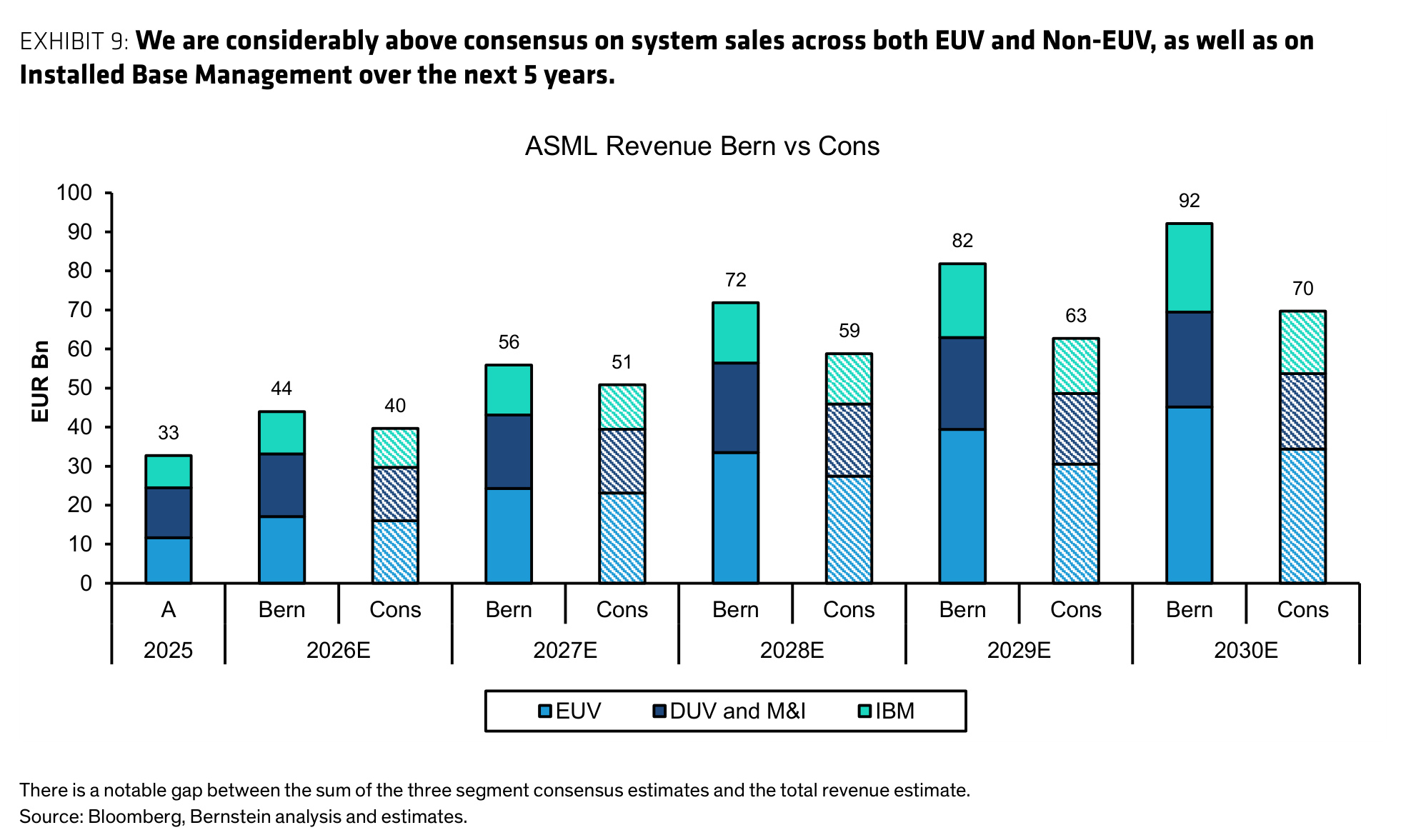
Bernstein vs consensus: ASML segment revenue forecasts (2025A to 2030E)
source: Bernstein, ASML 2Q26 review (2026-07-16)
The long-term coordinates are also waiting to be redrawn. The official 2030 framework (€44-60bn in revenue) went untouched this quarter, but Bernstein's 2030E now sits at €92.1bn and BofA's at €90bn, both roughly 50% above the official ceiling; the company has scheduled its next Capital Markets Day for June 10, 2027. In all likelihood the official framework has already been overtaken by fundamentals. What remains is the formal ceremony.
What to Watch Next
The checkpoints this print leaves behind are more specific than the questions it answers:
- October 14, 2026, Q3 results: delivery against the €11.5bn midpoint (up 53% YoY) and the 55%-57% gross margin guide; the first reading on the immersion H2 catch-up (90 units needed).
- The Q4 gross margin exit rate of roughly 56%: the CFO's own arithmetic in the Q&A, and the bridge that carries this year's margin into next year's.
- DDR pricing: the price leg under the Memory +75% guide. The CEO said outright that customers are optimizing between HBM and DDR because "the DDR price point is very strong right now," and that premise is itself a cyclical variable.
- The US Affiliates Rule taking effect in November 2026 and the MATCH Act's legislative progress: the observation window for Jefferies' multiple-suppression argument.
- The Capital Markets Day on June 10, 2027: the formal rewrite of the 2030 framework, and, if the ASP data starts to cooperate, the first official pricing of the pricing story.
The market graded ASML in boxes; the company answered in wafer-equivalents. The market is waiting for proof of price increases; the company says the flexibility exists but has to work through delivery lead times. Both mismatches share one root cause: ASML's supply cadence has, for the first time, outrun the market's measuring tools. Jefferies says strong growth only amplifies cyclicality, and history has yet to prove that statement wrong; but this quarter's evidence (order conversations running two years ahead, expansion that does not wait for POs, a pricing runway acknowledged for the first time) points to a narrower, newer question. The question has shifted from "is this time different" to "how many years does different last." October 14, the next reconciliation.
Earnings Call Recap
I will now share a more detailed analysis on this earnings result behind the paywall:


