
Memory Capex Surge Led by SK Hynix and Micron May Rewrite ASML's Cautious 2026 Outlook
Just two months after ASML's cautious 2026 outlook sent ripples through the market, a memory capex tsunami led by SK Hynix and Micron is here. Is this AI-driven memory boom powerful enough to rewrite the narrative and dispel the clouds of uncertainty?


SK하이닉스, EUV 장비 2배 늘린다…2년 내 20대 추가 - 전자신문
A Shifting Tide: From Cautious Outlook to a Demand Tsunami, ASML's 2026 Narrative Is Being Rewritten
Just two months ago, the semiconductor industry's attention was fixed on the Q2 2025 earnings report from lithography giant ASML. Despite strong results for the quarter, the core message from management was one of caution. For the first time, the company publicly stated that due to growing uncertainties from macroeconomic and geopolitical factors (particularly potential tariff issues), it "cannot confirm" growth for 2026 at this stage. This statement, compounded by market concerns over the prospects of key Logic customers like Intel and Samsung, cast a shadow over ASML's medium-term growth.
However, the semiconductor industry evolves at a breakneck pace. Recently, memory giants, led by SK Hynix and Micron, have successively announced capital expenditure plans far exceeding market expectations. An investment wave in memory, driven by AI, is now surging forward. Is this powerful new demand strong enough to dispel the clouds of uncertainty hanging over ASML's 2026?
Under a Cloud: Recapping the Reasons for ASML's Earlier Caution
To understand the significance of the current shift, we must first revisit the context behind ASML management's caution two months ago. Their concerns stemmed primarily from two areas:
- The Specter of Geopolitics and Tariffs: ASML's CEO, Christophe Fouquet, explicitly stated during the conference call that the tariff issue (specifically the U.S. Section 232 review) was making customers more cautious about their capital spending decisions. This uncertainty was not unfounded. Analysis indicated that high tariffs would significantly increase the cost of building fabs on U.S. soil. For example, some models showed that equipment costs alone would be approximately 15% higher for a fab built in the U.S. compared to one in Taiwan. This forced customers relying on government subsidies (like the CHIPS Act) to build in the U.S. to re-evaluate the timing and pace of their investments, thereby affecting their demand for ASML's equipment.
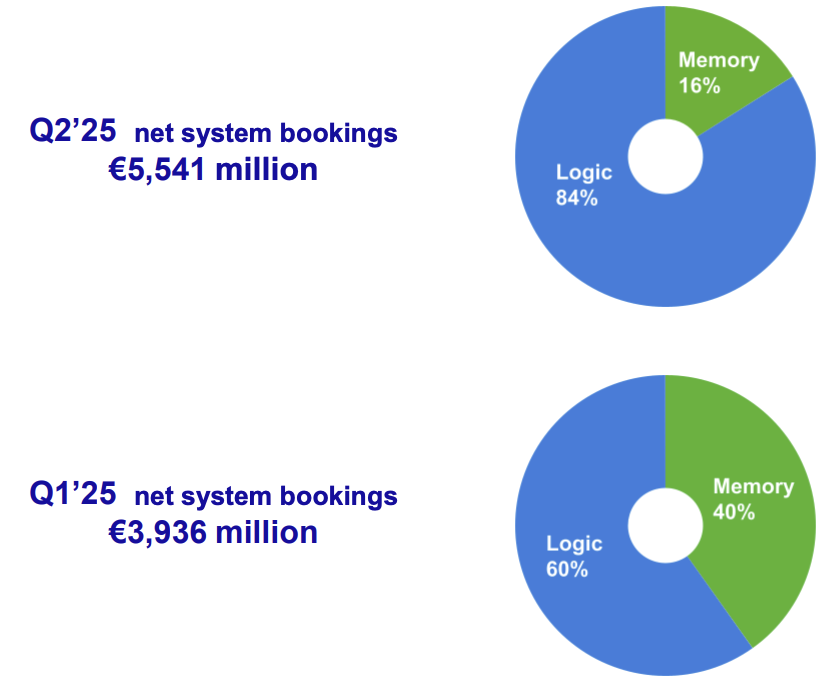
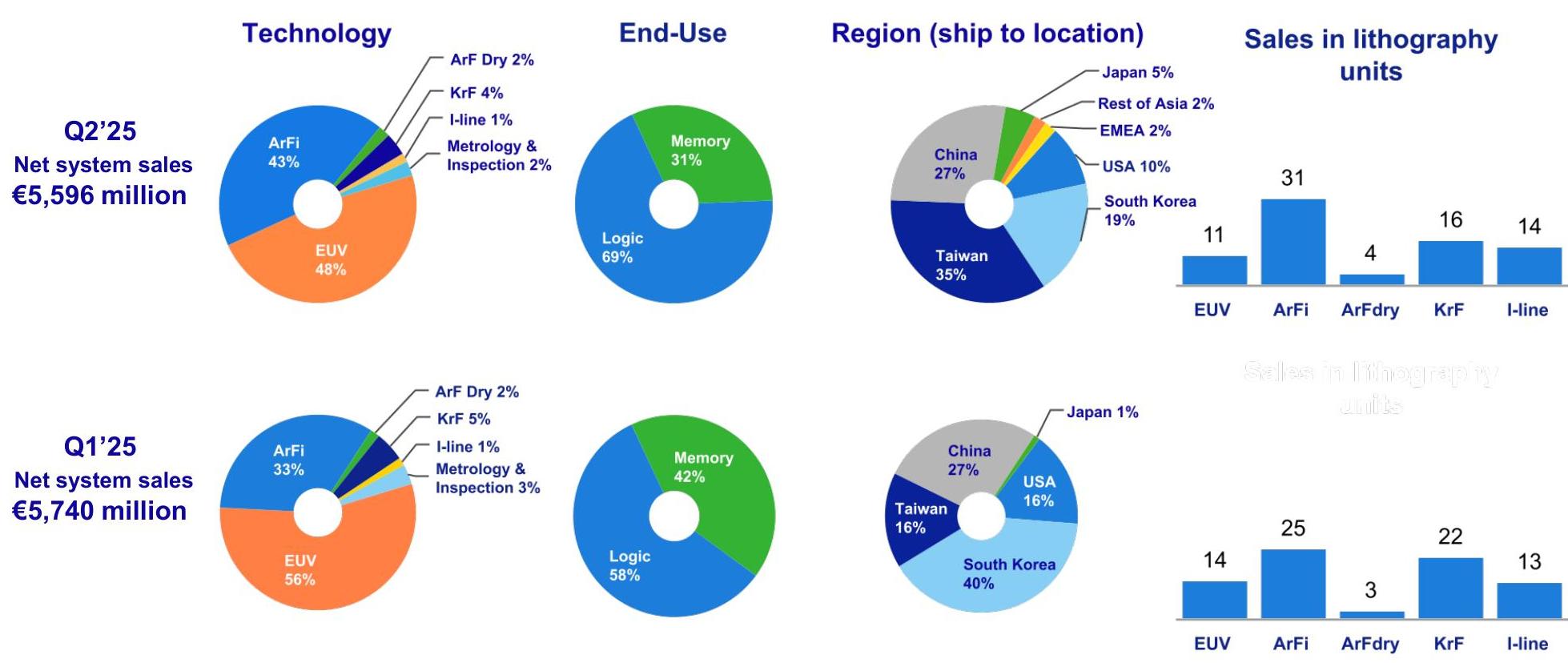
- The Predicament of Logic Giants: In ASML's Q2 2025 results, the Logic business was the absolute pillar, accounting for 69% of total net sales and 84% of net system bookings. However, two of its main customers, Intel and Samsung, are facing their own challenges. Multiple sell-side reports have pointed out that both companies' foundry businesses are underperforming, and they have already been cutting capital expenditures. These signals of weakness from its core customer base naturally led ASML to worry about future growth drivers. Some analysts even pessimistically predicted that Intel might not purchase any EUV tools in 2025 or 2026, after all, Intel had cut its capex for 2025 and postponed plans for its factory in Germany.
Net systems bookings¹ activity by End-use (Quarterly)
Source: ASML Q2 2025 Earnings Review
ASML Quarterly Net System Sales Composition (by End-Use)
Source: ASML Q2 2025 Earnings Release
The Tide Turns: The Powerful Resurgence of Memory Capex
Just as the market was digesting ASML's cautious signals, a completely different tune emerged from the memory sector.
According to a report from South Korean media outlet ETNews, SK Hynix plans to double its number of EUV lithography machines by 2027, procuring an additional 20 units, with a total estimated investment exceeding 6 trillion KRW (approximately \$4.5bn). In a similar vein, a J.P. Morgan report also noted that Micron revealed an extremely strong capex plan in its Q4 2025 earnings report: an investment of \$13.8bn for FY2025 and an even higher framework of around \$18bn for FY2026.
The core driver behind this series of moves points directly to the hottest area today: AI and the High-Bandwidth Memory (HBM) it requires.
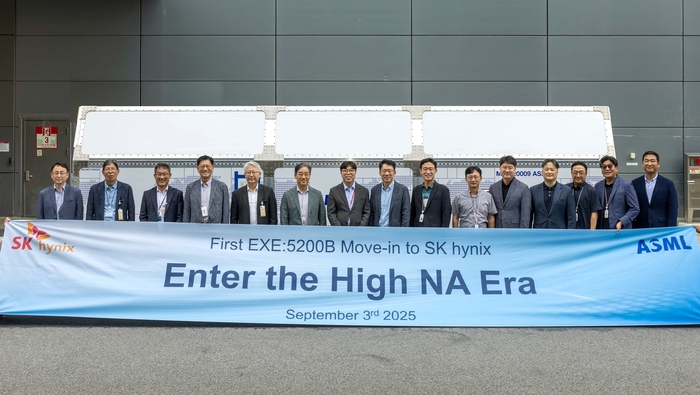
SK Hynix event commemorating the introduction of High-NA EUV equipment
Source: ETNews
Clearing the Clouds: Re-evaluating ASML's 2026 Growth Prospects
This wave of demand from the memory industry is more than just a few large orders; it could fundamentally alter ASML's growth prospects and risk balance.
First, from the perspective of order volume, this new demand is massive. ASML received EUV orders for approximately 11 units in all of Q2 2025. SK Hynix's procurement plan for the next two years alone is nearly double that figure. As J.P. Morgan pointed out, SK Hynix's expansion plan is already higher than the institution's previous shipment estimates for ASML to the company in 2026 and 2027. This implies that demand from memory customers is sufficient to fill, and even exceed, any potential order cuts from logic customers.
Second, industry demand may be starting to resonate. SK Hynix is not an isolated case. Its competitor, Micron, also announced an aggressive capex plan yesterday, with projected investments of \$13.8bn for FY2025 and around \$18bn for FY2026, respectively, with most of the spending allocated to support HBM and advanced DRAM.
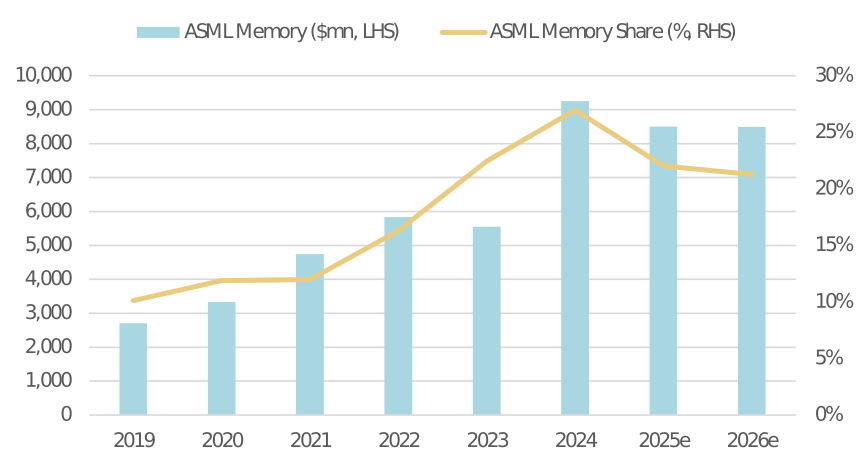
Finally, this represents a structural optimization of demand drivers. In the past, the market worried about ASML's over-reliance on a few logic giants. Now, memory, especially the more lithography-intensive (litho intensity) HBM, is becoming an equally important growth engine. Analysts have long pointed out that the shift in industry growth drivers from the less litho-intensive NAND to the more litho-intensive HBM is a long-term structural tailwind for ASML. The manufacturing of HBM, especially the future HBM4, has a strong dependency on EUV lithography. Morgan Stanley also stated bluntly in a recent report that the memory market is entering a new 'super-cycle' thanks to AI, and consequently upgraded ASML's rating to 'Overweight'. ASML management's explanation for the quarterly volatility in memory orders in the Q2 2025 earnings call, describing it as 'lumpy,' now seems more like the brief calm before the arrival of a new, powerful cycle.
ASML's Share in Memory WFE
Source: Morgan Stanley Research
However, it should also be noted that the conversion from HBM demand to equipment orders is not instantaneous. Despite positive factors like AI demand and HBM shortages, the DRAM-related revenue for most semiconductor equipment suppliers has remained flat or slightly declined. This suggests that, looking back from the current point in time, the growth in HBM may not have yet fully offset the decline in traditional DDR.
Conclusion
Although ASML management's caution two months ago was based on well-founded and reasonable justifications at the time, the new wave of memory capex, with its intensity, certainty, and scale, has introduced a new, positive variable. For ASML, this large order from SK Hynix signifies more than just the deal itself; it reveals two key takeaways:
- A Safety Net for the 2026 Outlook: Strong, multi-year orders from the memory market provide a solid demand 'safety net' for ASML's 2026 performance. Even if the recovery in the logic market falls short of expectations, growth in the memory market will be largely sufficient to offset the negative impact. This makes the management's statement of "cannot confirm growth" appear potentially too conservative.
- A Temporary Shift in Growth Engines: In the short term, ASML's growth story may temporarily shift from being primarily 'logic-driven,' as it has been for the past few years, to a phase where 'memory-driven' becomes more critical. Investors will need to re-evaluate the weighting and growth elasticity of the memory business in ASML's revenue and profitability mix.


