
Apple 1Q26 Earnings Review: When "Simply Staggering" Demand Collides with a Capacity Ceiling
When Apple delivers record revenue, record EPS, and a gross margin that silences its loudest bears — all in one quarter — should investors celebrate the arrival of a genuine iPhone super cycle, or prepare for the supply-side reckoning that comes next?


Apple 1Q26 Earnings Review: When "Simply Staggering" Demand Collides with a Capacity Ceiling
Apple just handed Wall Street a report card that leaves little room for complaint.
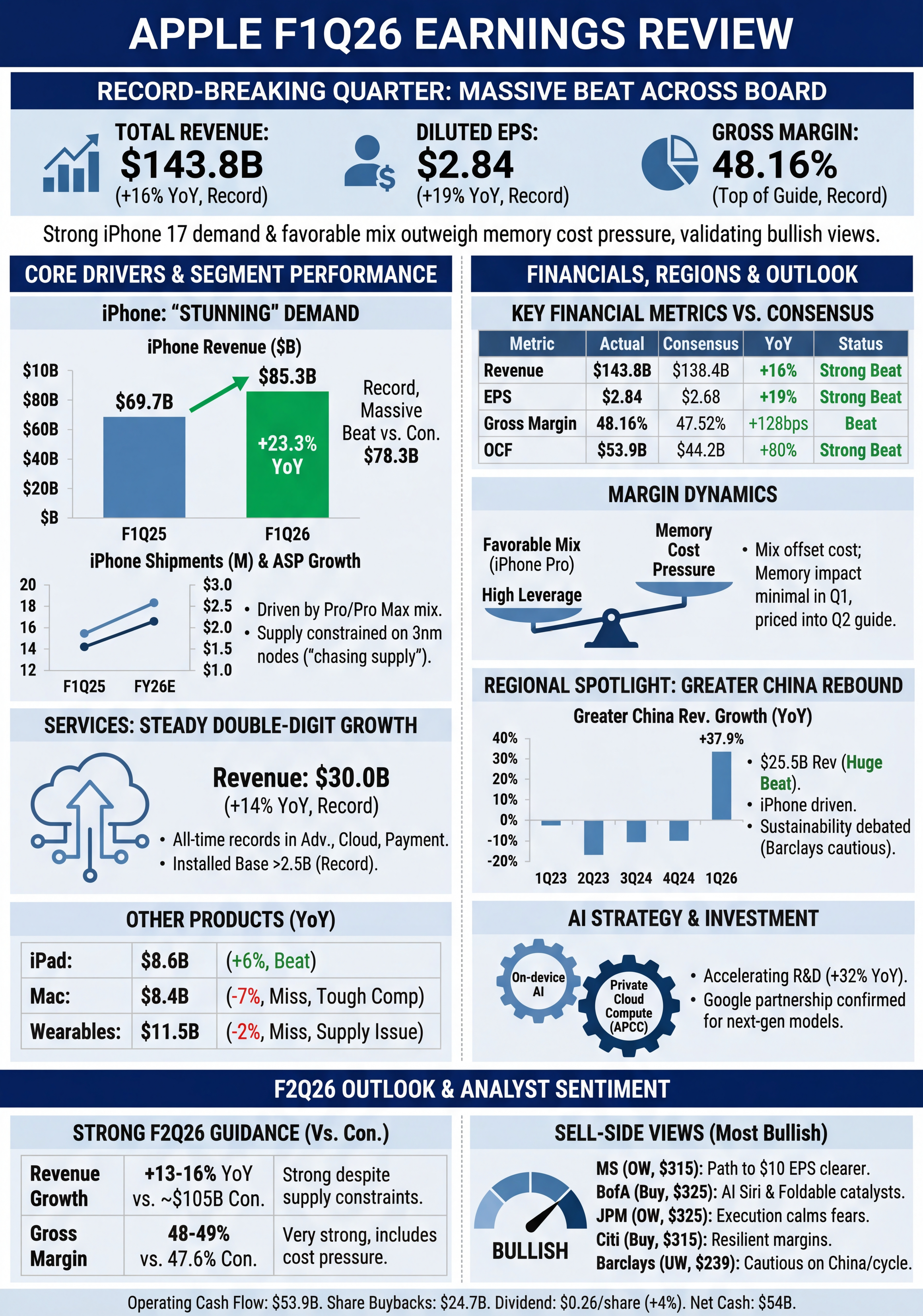
In F1Q26 (the December 2025 quarter), total revenue reached $143.8 billion (up 16% YoY) while Diluted EPS hit $2.84 (up 19% YoY) — both all-time records, decisively exceeding both market consensus and the company's own guidance. For a company approaching $4 trillion in market capitalization, a beat of this magnitude across the board is anything but routine.
Yet what makes this quarter truly noteworthy isn't just the size of the numbers. It's that a single quarter simultaneously answered at least three unresolved questions that had been weighing on investor sentiment: How strong is the iPhone 17 product cycle, really? Can Greater China demand stage a meaningful recovery? And will rising memory costs erode profitability?
The answers, respectively: remarkably strong, already recovering, and not yet.
But as old questions recede, a new — and perhaps thornier — one emerges: Can supply keep pace with demand?
iPhone: A Quarter the CEO Called "Simply Staggering"
iPhone revenue came in at $85.27 billion, surging 23.3% YoY, well above the $78.31 billion consensus and management's own "double-digit growth" guidance. This stands as the strongest single-quarter iPhone performance in history. Full stop.
CEO Tim Cook used an uncharacteristically emphatic phrase to describe the demand environment — "simply staggering." Apple's leadership typically speaks in measured terms. The departure from that norm is itself a signal.
The drivers were not one-dimensional. J.P. Morgan noted in its post-earnings report that consumers gravitated toward Pro and Pro Max models at a rate exceeding expectations, creating an exceptionally favorable product mix. In other words, not only were volumes climbing — average selling prices were moving higher in tandem.
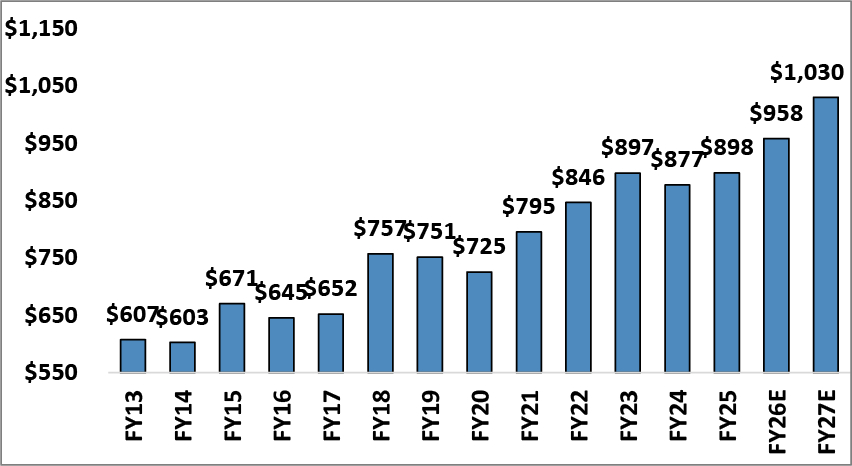
iPhone Blended Average Selling Price (USD)
Source: J.P. Morgan
Looking back at our earlier analysis in iPhone 17 Launch Preview, Morgan Stanley had projected FY26 iPhone ASP growth of 5%, four percentage points above the Street's estimate. The actual results have firmly validated that call. J.P. Morgan's data now suggests iPhone ASP is on track to reach approximately $958 in FY26 and could break through the $1,030 threshold in FY27 — a trajectory from roughly $600 a decade ago to nearly $1,000 today. This curve reflects not merely a successful pricing strategy, but the pricing power Apple has built in the premium segment.
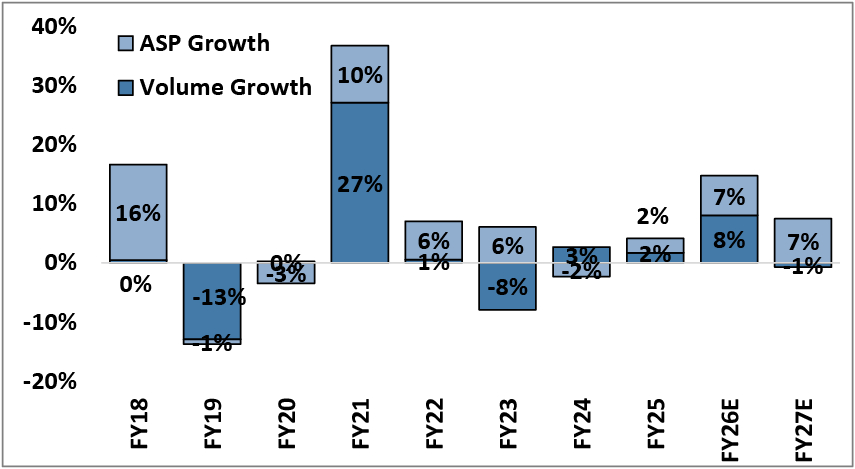
What deserves special attention is FY26's revenue growth composition. J.P. Morgan's decomposition reveals that FY26 is shaping up to be a rare "dual-driver" year — with shipment volume contributing approximately +8% and ASP adding another +7%. The last time a similar two-engine growth dynamic materialized was during the FY21 5G upgrade cycle.
iPhone Revenue Growth Composition (YoY Decomposition)
Source: J.P. Morgan
Greater China: A 37.9% Surge Met with Both Applause and Skepticism
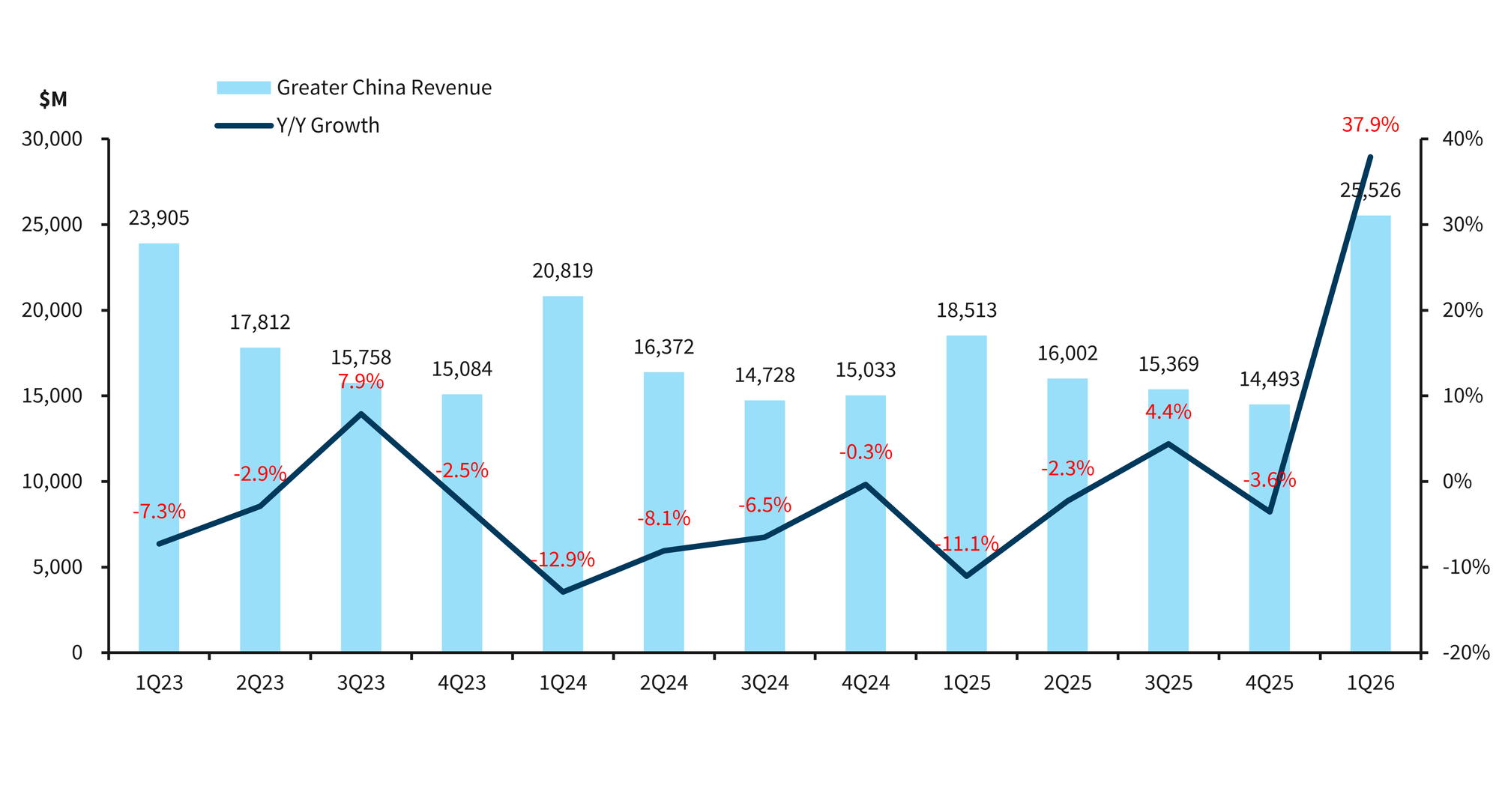
If the overall iPhone story was "strong," the Greater China numbers can only be described as explosive. Regional revenue reached $25.53 billion, up 37.9% YoY, far surpassing the $21.82 billion consensus.
Context matters enormously here. Over the preceding nine quarters, Greater China posted negative YoY growth in eight of them, with the trough reaching -12.9%. A near-40% rebound following such prolonged weakness is the kind of swing that caught most of the Street off guard.
Greater China Revenue and YoY Growth Trend
Source: Barclays
Management attributed the growth to iPhone — with both upgraders and switchers hitting record levels. Tim Cook confirmed on the call that, according to Worldpanel data, iPhone ranked among the top three urban smartphone brands in China during the quarter.
Not everyone is persuaded, however. In its post-earnings note, Barclays posed a sobering question: when a region has declined YoY in eight of the last nine quarters, should a sudden 40% surge be read as a genuine inflection, or as an anomalous pulse? Barclays argues that until several consecutive quarters of sustained improvement materialize, investors should resist treating this as a structural turning point.
The skepticism is not unreasonable. A single-quarter spike — particularly in the first full quarter of a major product cycle — can indeed contain a concentrated release of pent-up demand. But J.P. Morgan offered a counterpoint: the iPhone 17 cycle's momentum is broadly resonant, with double-digit growth across the U.S., Latin America, Western Europe, India, and Southeast Asia. This is not a China-only story.
Our view is that the truth likely falls somewhere between the two positions. China's growth probably does carry some cyclical rebound characteristics, but the product appeal of the iPhone 17 lineup — particularly the differentiation of its high-end models — is earning market validation on a global scale. That cannot simply be dismissed as a one-off.
The Margin Debate: The Bulls Win This Round
If one core point of contention received a decisive answer this quarter, it was gross margin.
Heading into the report, the market's primary concern centered on whether rising DRAM and NAND prices would meaningfully compress Apple's product margins. The cautious camp — led by Barclays — had argued that surging memory costs would exert real pressure on profitability this quarter.
The result: a blended gross margin of 48.16%, above the 47.52% consensus and touching the upper bound of management's 47%–48% guidance range. Product gross margin expanded an impressive 450 basis points sequentially, which CFO Kevan Parekh attributed to a very favorable product mix and stronger seasonal leverage.
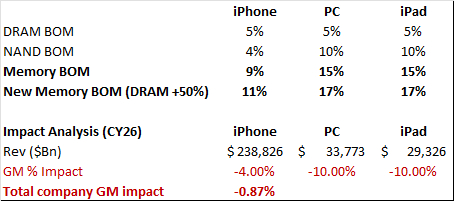
Estimated Impact of CY2026 Memory Pricing on Apple's Gross Margin
Source: Citi
In short, robust demand for Apple's premium iPhone lineup generated enough mix tailwind to effectively offset memory cost headwinds. Both Morgan Stanley and J.P. Morgan emphasized in their post-earnings reports that this favorable offset had been systematically underappreciated by the market. Citi's quantitative analysis shows that even if CY26 DRAM prices rise 50%, the total company gross margin impact would be only about 90 basis points — a digestible figure for a company running near 48% margins.
The forward guidance is even more telling: F2Q26 gross margin is guided at 48%–49%, above market expectations, with management confirming that memory cost inflation has already been factored in. Bank of America further noted that this quarter's margin strength was achieved despite absorbing approximately $1.4 billion in tariff-related headwinds.
Tim Cook also reiterated on the call the strategic significance of Apple Silicon as a long-term margin driver — custom chips deliver not only cost savings but also product differentiation and greater control over the technology roadmap. As we discussed in our Apple M5 chip analysis, this vertical integration advantage continues to manifest on the income statement.
The Supply Bottleneck: The Elephant in the Room
The earnings call surfaced a risk the market had not yet fully priced in: a capacity bottleneck at the leading-edge process node.
Because iPhone demand dramatically exceeded internal forecasts (a 23% growth rate clearly overshoot management's own "double-digit" guidance), channel inventory fell to extremely low levels by quarter-end. Tim Cook used a telling phrase: Apple is currently in a mode of "chasing supply."
Where exactly is the constraint? The production of Apple's SoCs requires 3-nanometer wafer capacity that is simply insufficient to meet current demand. This isn't a memory issue or an assembly issue — it's a bottleneck at the most upstream, least substitutable link in the chain: foundry capacity. J.P. Morgan was particularly emphatic in its post-earnings note: leading-edge foundry supply is a more pressing concern for investors than memory costs.
When pressed repeatedly during Q&A on when supply and demand might rebalance, Cook's response was candid but hardly reassuring: the company cannot predict. This means the F2Q26 revenue guidance of 13%–16% YoY growth is itself a best estimate under supply-constrained conditions. Put differently, if not for the supply bottleneck, actual demand could be even higher.
Notably, this is not Apple's first encounter with supply-side challenges. In our Apple 4Q25 Earnings Review, we discussed similar supply tightness affecting the iPhone 16 and iPhone 17 (particularly the iPhone Air) last quarter. Management had expressed confidence in capturing deferred demand during F1Q26 — and by the numbers, they delivered. But the bottleneck itself hasn't been resolved; if anything, the demand overshoot has made it more acute.
This raises a question investors must wrestle with: Is the supply constraint a temporary disruption or a medium-term structural condition? If Apple's custom silicon strategy and iPhone premiumization trend continue driving demand for leading-edge capacity, while foundry expansion remains constrained by physics and capital, the "chasing supply" dynamic could persist longer than many expect.
Services, R&D, and the Ecosystem: The Engine Running Quietly
Services revenue reached $30.01 billion, growing 14.0% YoY, essentially in line with consensus. While not the quarter's headline, a 14% growth rate on a base of this scale remains formidable. Advertising, music, payments, and cloud services all posted record results. J.P. Morgan pointed out that while third-party data had hinted at a potential App Store slowdown, the earnings report offered no supporting evidence — App Store revenue also set a record in the December quarter.
R&D spending, meanwhile, merits a closer look: $10.89 billion, up a striking 31.7% YoY and well above consensus. Management confirmed the incremental investment is primarily directed toward accelerating AI initiatives. Tim Cook also publicly confirmed for the first time a "collaboration" with Google on next-generation Apple Foundation Models — though he declined to disclose financial terms.
This aligns with the Apple-Google AI partnership trajectory we explored in our Mark Gurman coverage analysis. Apple is deploying Google's Gemini model as a transitional solution to bolster Siri while developing its own trillion-parameter cloud model in-house. Cook's on-the-record confirmation moves this collaboration from rumor to established fact.
The active device installed base has surpassed 2.5 billion units, providing a robust foundation for continued Services growth. Cook further announced that Apple has committed to investing $600 billion over four years into advanced manufacturing, silicon engineering, and AI — a figure substantial enough to reshape the company's trajectory for years to come.
Forward Guidance: Strong, but with an Asterisk
The F2Q26 (March quarter) outlook:
- Revenue: 13%–16% YoY growth (including a slightly-over-one-percentage-point FX tailwind)
- Gross margin: 48%–49% (memory cost inflation already embedded)
- Services: Growth rate similar to the current quarter (approximately 14%)
- OpEx: $18.4 billion to $18.7 billion
The gross margin guide is particularly significant. A 48%–49% range left some analysts "shocked" — it not only exceeds consensus but signals that Apple's profitability is migrating to a structurally higher plateau. Morgan Stanley, Bank of America, and J.P. Morgan all noted that this substantially improves the visibility of a FY27 EPS path toward $10.
But every piece of guidance carries an important footnote: it was issued under the assumption of constrained iPhone supply. This means the upside risk to guidance is directly tied to the pace at which supply-chain bottlenecks ease. Should 3nm capacity constraints loosen during Q2, actual performance could exceed the midpoint; should they persist, results may land closer to the lower bound.
Our Assessment
Apple's F1Q26 is a near-flawless earnings report — if you set the supply issue aside.
Where it excels: The iPhone 17 cycle has confirmed itself as a genuine super cycle, with the volume-plus-ASP combination representing the strongest growth mix in recent years. Greater China's dramatic rebound defused the most bearish narrative. Gross margin performance effectively falsified the "memory costs will crush margins" thesis. Operating cash flow of $53.9 billion (up 80% YoY) underscores the sheer cash-generating power of the business model.
Where it hangs in the balance: The 3nm leading-edge capacity bottleneck is real and unresolved. Barclays' skepticism regarding the sustainability of China's growth, while perhaps overly conservative, isn't without merit — the data series needs more proof points. The replacement cycle has already normalized to approximately 5.2 years (pre-pandemic levels), leaving limited room for further compression.
What remains opaque: The AI monetization pathway is still unclear. Despite a significant ramp in R&D spending and the confirmed Google partnership, when Apple can translate these investments into quantifiable revenue contributions remains an open question. Bank of America and Citi point to the AI-enhanced Siri (Advanced Siri) planned for 2026 and the foldable iPhone expected in September 2026 as the next wave of catalysts — but these remain expectations, not realities.
Taken together, this quarter delivers a clear message: Apple's product-cycle engine is running at full throttle, and the ecosystem flywheel is accelerating. At this juncture, demand is not the problem. Supply is. And for a company capable of delivering record results even under capacity constraints, that may well be the best kind of problem to have.
Earnings Call Recap
I will now share a more detailed analysis on this earnings result behind the paywall:


