
A Costly Education: Apple's Pivot from Banking Dream to Financial Reality
Why did Apple's ambitious foray into finance with Goldman Sachs crumble, and what does its pivot to the establishment stalwart JPMorgan Chase truly signal for the future of Big Tech in banking?


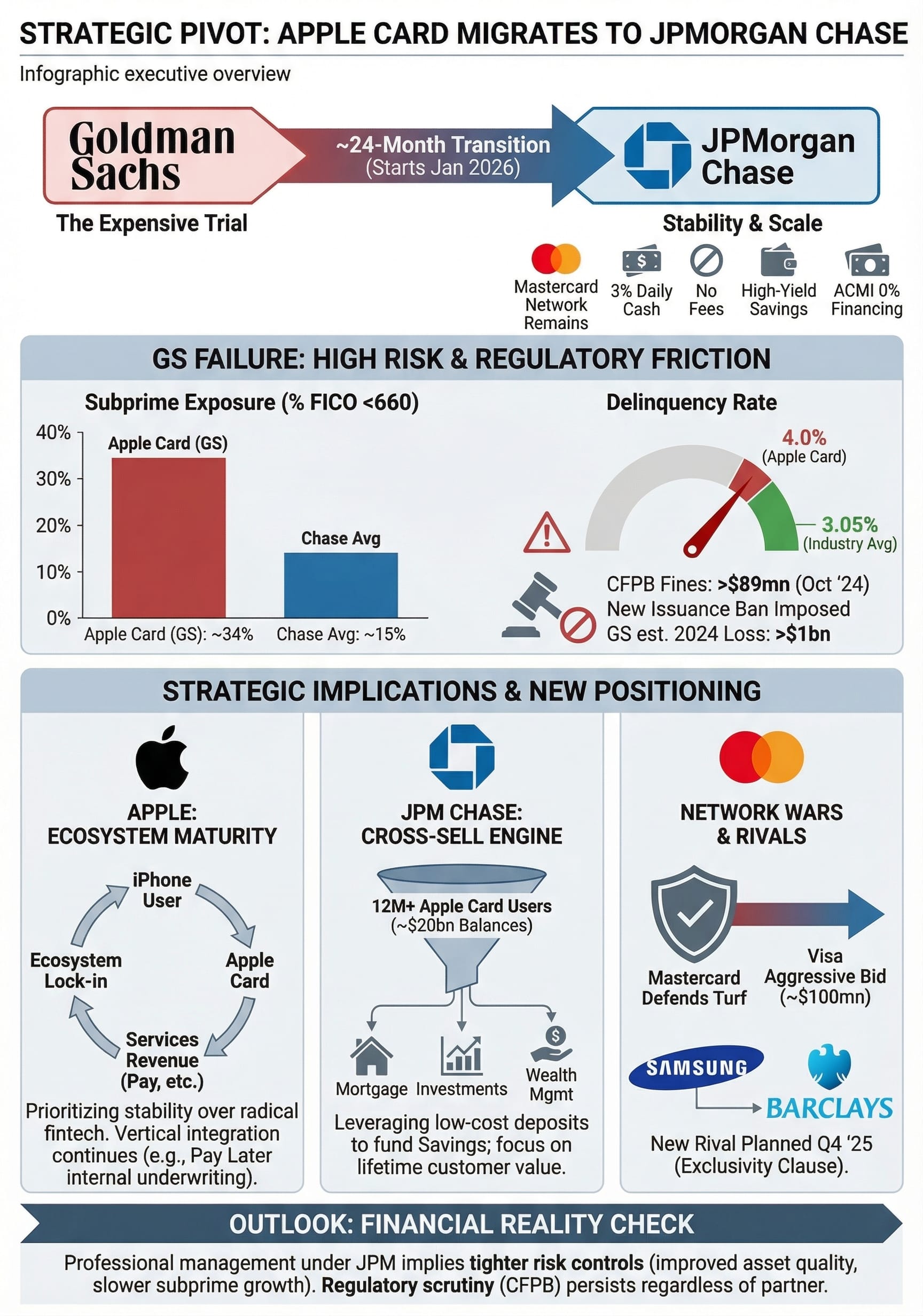
Apple Card's New Chapter: From Radical Experiment to Financial Reality
For years, the Apple Card felt like a dispatch from the future. It boasted a sleek titanium body, an elegantly simple app experience, and seamless integration into the Apple ecosystem. This wasn't just another credit card; it was a statement: a tech company could reinvent the financial experience, making it more graceful and humane.
Behind this beautiful vision, however, a financial storm was quietly brewing.
Recently, the other shoe finally dropped. According to a January 7, 2026 announcement, Apple has found a new home for its financial flagship. JPMorgan Chase will take over from Goldman Sachs as the new issuer for the Apple Card.
This signifies more than a simple changing of the guard. It marks a profound strategic pivot for Apple in financial services—a clash between tech idealism and financial realism.
In the end, reality prevailed.
A Costly Misstep
Goldman Sachs's partnership with Apple began in 2019. For the storied Wall Street investment bank, it was a bold foray into the heart of consumer finance. But the cost of this experiment far exceeded expectations.
The problems began with asset quality. To meet Apple's stringent demands for user experience and its goal of rapid customer acquisition, the Apple Card had a relatively low approval bar. The result was a user profile that was a far cry from that of traditional prime credit card customers. Data showed that roughly 34% of Apple Card borrowers had FICO scores below 660, a category that falls into subprime lending in the banking industry. For comparison, this figure is only 15% for JPMorgan Chase's own credit card user base.
The physical Apple Card and its mobile management interface
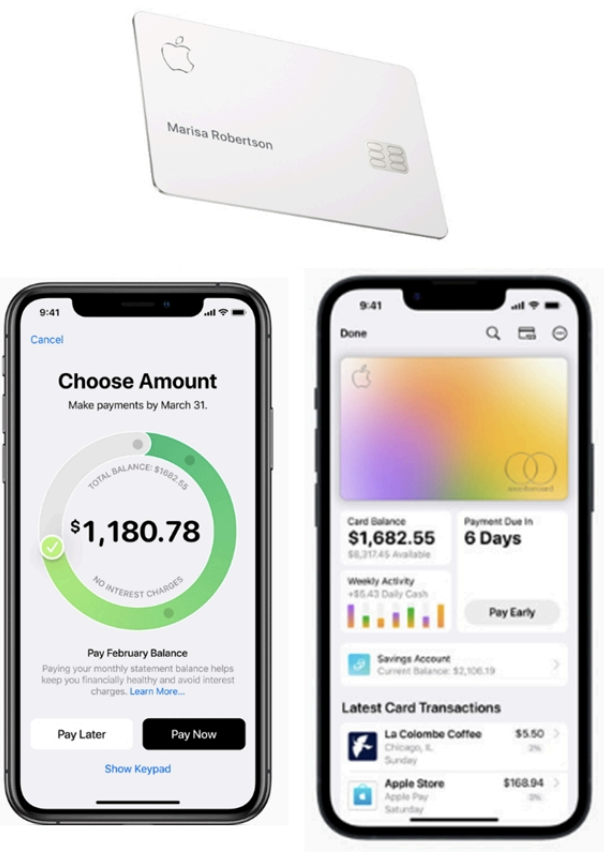
Source: Apple
A high-risk customer base led directly to soaring credit losses. The delinquency rate for the Apple Card once climbed as high as 4%, significantly above the industry average of 3.05%. This forced Goldman Sachs to repeatedly book massive provisions for credit losses, placing immense financial pressure on its consumer finance division, which was projected to lose over $1 billion in 2024 alone.
To make matters worse, the regulatory hammer fell. In October 2024, the U.S. Consumer Financial Protection Bureau (CFPB) hit Apple and Goldman Sachs with a fine of over $89 million for compliance failures in handling customer billing disputes and other services. More fatally, regulators outright banned Goldman Sachs from issuing any new credit cards until its compliance issues were resolved. This was effectively a death sentence for the partnership.
To facilitate this "divorce," Apple also made compromises, agreeing to modify the unified "statement-at-the-start-of-the-month" design that had once created immense pressure on customer service systems. Ultimately, Goldman Sachs transferred the loan portfolio of approximately $20 billion at a price below book value. A spectacular cross-industry marriage came to an ignominious end, marked by staggering losses and regulatory penalties.
A Return to Stability: The Pull of the Establishment
With the flames of idealism doused by cold reality, Apple's choice became clear and pragmatic.
Choosing JPMorgan Chase means entrusting the future of the Apple Card to one of the world's most powerful and stable consumer banks. This signals a coming-of-age moment for Apple's financial strategy, where stability, scale, and sustainability have triumphed over the former obsession with "disruption." As part of the deal, Apple has ensured product continuity: core benefits like 3% Daily Cash and no annual fees, as well as the high-yield Savings account, will be preserved.
For JPMorgan Chase, the deal holds profound strategic value as well. While the Apple Card itself may have limited profitability, it brings over 12 million highly-engaged iPhone users into its orbit. JPMorgan Chase's real goal is to convert these users into customers for its broader financial services, such as mortgages, wealth management, and investment products, unlocking powerful cross-selling effects. Furthermore, with its vast low-cost deposit base, JPMorgan Chase can comfortably absorb the funding costs associated with the Apple Card's high-yield savings account.
This handover is, in essence, an admission by Apple of a simple truth: managing money is a job for the experts.
The New Battlefield: Ecosystem, Networks, and Competition
The impact of this partnership change extends far beyond Apple and the two banks.
First is the intense battle at the payment network layer. During the bidding process, Visa reportedly offered an upfront payment of around $100 million in an attempt to snatch the Apple Card's network service rights from Mastercard, but ultimately failed. For Mastercard, this was a crucial defensive win. Especially after Capital One's announced acquisition of Discover, holding onto a key client like Apple Card is vital for solidifying its market share in the United States.
Competition for the Apple Card Network Provider
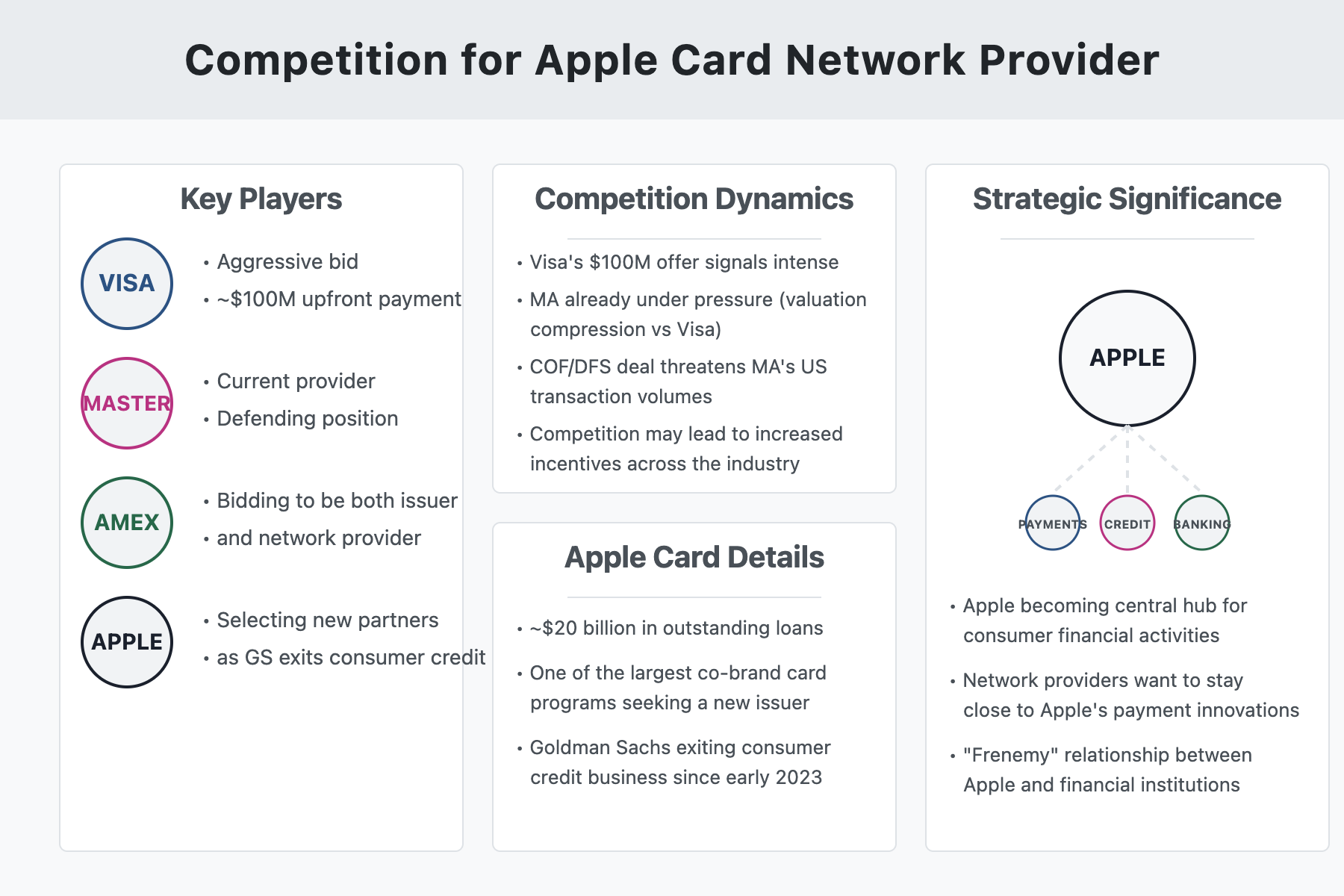
Source: Jason
Second, the financial ecosystem competition among tech giants is heating up. Just as Apple finalized its deal with JPMorgan Chase, its old rival Samsung was in deep negotiations with Barclays to launch a rival credit card product by the end of 2025. According to reports, Samsung even demanded an exclusivity clause from Barclays, prohibiting it from partnering with Apple. Top-tier banking resources are becoming a scarce commodity fiercely contested by tech behemoths.
For Apple itself, its financial ambitions extend far beyond a single card. Although the payments business accounts for less than 1% of its massive services revenue, Apple Pay and Apple Card are indispensable "glue" for its ecosystem. By continuously expanding its suite of financial services and gradually internalizing core functions like underwriting, Apple is building an ever-deeper financial moat. According to an analysis by Bernstein, the foundation of this moat is deeply rooted in hardware: Apple's control over its custom silicon allows it to embed an independent "Secure Element," which, combined with NFC and Tokenization technology, creates a security and integration barrier that is difficult for rivals to replicate.
Apple's Growing Suite of Financial Services
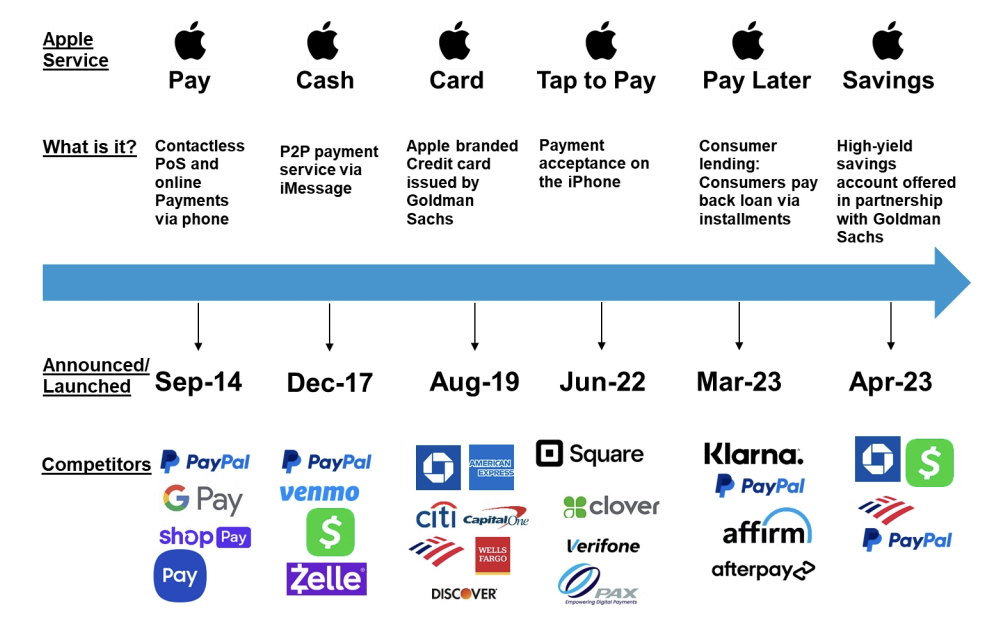
Source: Bernstein
The Core Technology Stack of Apple Pay
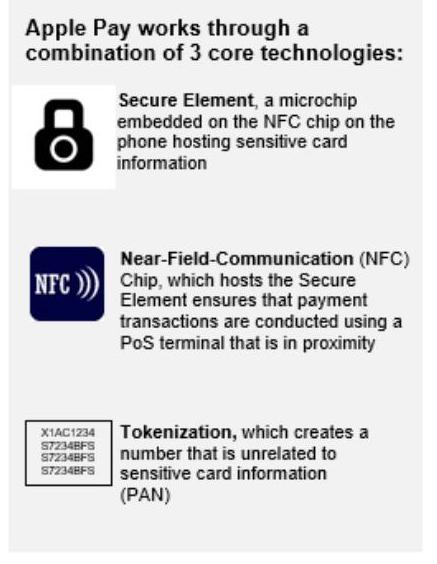
Source: Bernstein
Conclusion: From Visionary to Pragmatist
The migration of the Apple Card from Goldman Sachs to JPMorgan Chase is a coming-of-age story. It teaches us that financial services are not just about code and user interfaces; at their core, they are the age-old business of risk, trust, and capital.
In the short term, Apple has neutralized imminent operational and regulatory risks, while JPMorgan Chase has gained a valuable gateway to new customers. In the long term, JPMorgan Chase's stricter risk controls may temper the Apple Card's user growth rate, but they will undoubtedly improve its asset quality, transforming it into a truly sustainable financial product.
Of course, the road ahead is not without its bumps. The lengthy 24-month data migration period could reintroduce chaos in bill processing, and regulatory scrutiny of the "closed ecosystems" of tech giants has never waned.
But regardless, Apple has made its choice. It has abandoned the radical fantasy of becoming a "bank" and has chosen instead to be a tech company that partners with the strongest bank. It might be less sexy, but it's far more stable. And for a financial business that needs to endure economic cycles, that is what matters most.


