
Every Roadblock Cleared, Now What — Tim Cook's Two Quiet Wills Inside Apple's F2Q26
If F2Q26 was the "clearing event" the Street had been waiting for, why did Tim Cook spend half the call telling you about the storm in 3Q26 — and why did he choose this exact moment to hand the keys to John Ternus?


Every Roadblock Cleared — Now What? Apple's Two Quiet Wills Inside F2Q26
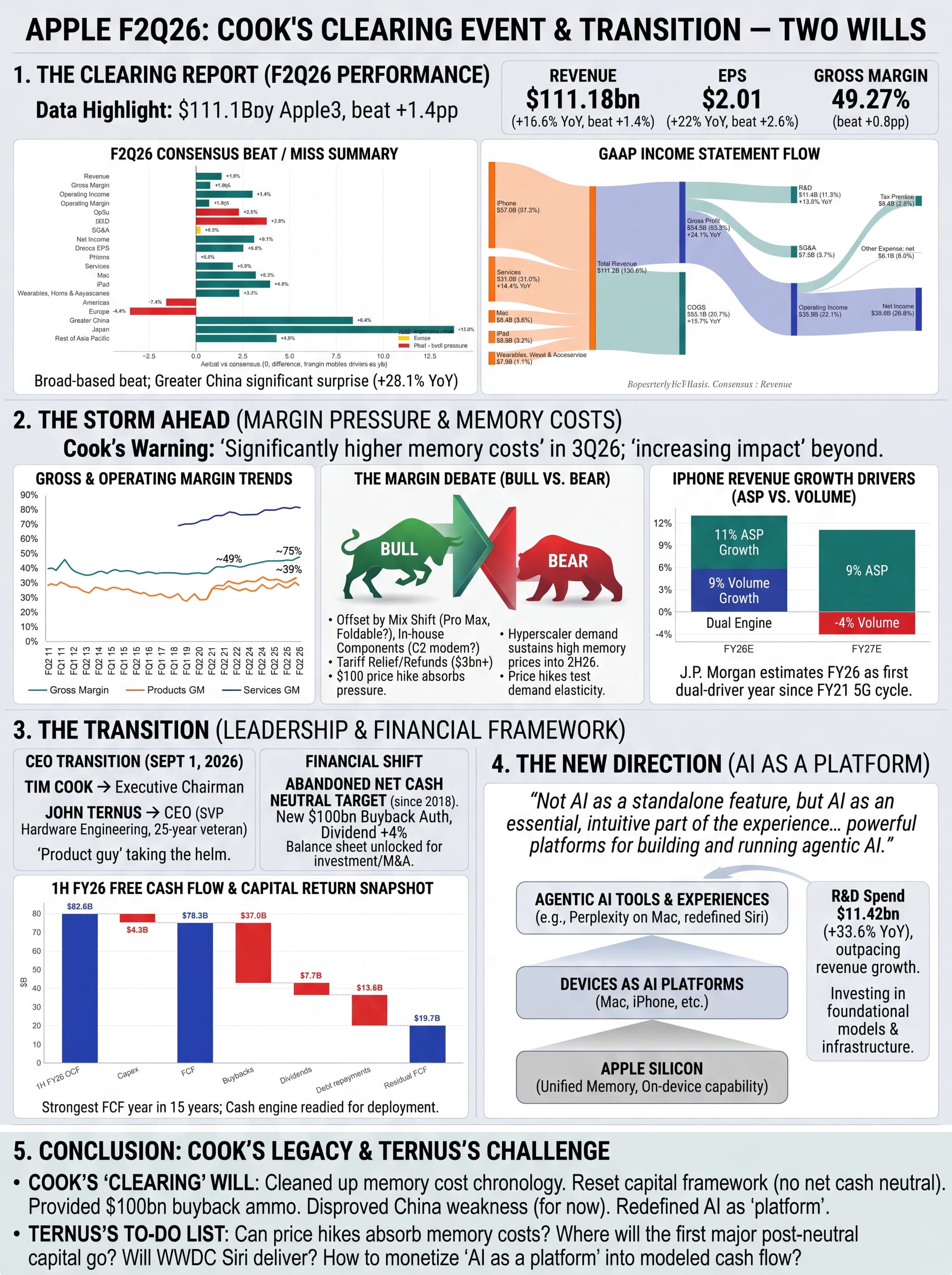
Apple's F2Q26 (the quarter ended March 28, 2026) is the kind of report that leaves the sell-side with very little to argue about. Revenue of \$111.18bn, up 16.6% YoY, landed at the top end of the company's own +13% to +16% guide. Diluted EPS of \$2.01 was up 22% YoY. Gross margin came in at 49.27%, punching another 27bps through the upper bound of Apple's own 48%–49% guide. It was a March-quarter record on total revenue, on iPhone, and on EPS, and Services hit an all-time high. All five geographic segments grew double-digits. All five product lines beat consensus.
Apple F2Q26 GAAP P&L Sankey
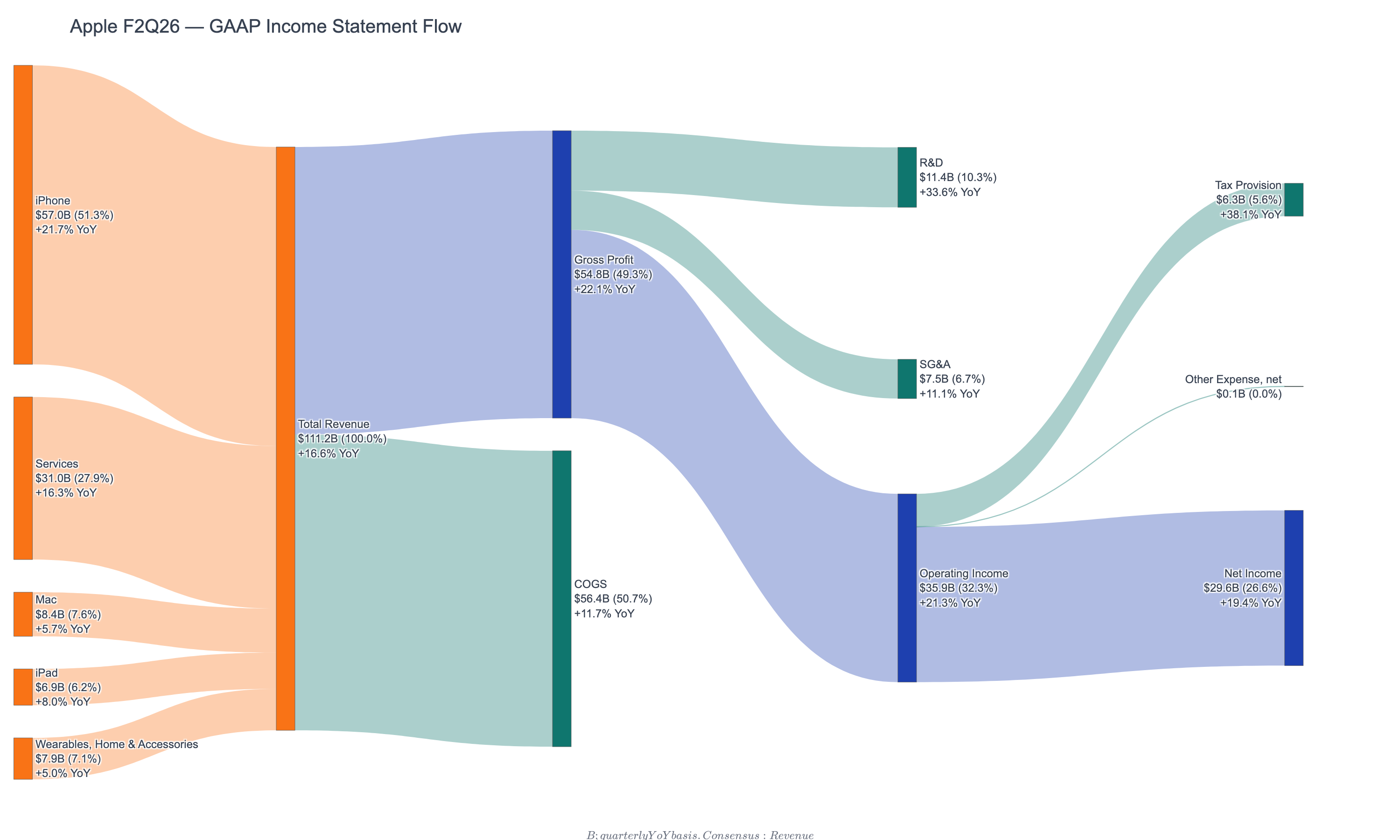
source: Jason and Jarvis (data from Apple's F2Q26 10-Q)
What's strange is that Tim Cook spent a meaningful share of the call not celebrating but pre-warning. Memory costs, he said, will be "significantly higher" in 3Q26, and beyond that "will drive an increasing impact on our business." On the same call, he also announced his own transition out of the CEO seat on September 1, 2026, into the Executive Chairman role, with hardware-engineering SVP John Ternus stepping up. And — easy to miss but heavier than it looks — Apple formally retired the net cash neutral target it had been running toward since 2018.
Read those three things together and the real F2Q26 narrative does not fit inside the phrase "earnings beat." This is the last clean clearing report of the Cook era. He used it to tidy up the loose ends of his own tenure, and then handed off a re-engineered balance sheet and a new leadership team.
I. Take "clearing event" literally
In last quarter's note, I argued that report had answered three long-standing overhangs in a single quarter: how strong is the iPhone 17 cycle, can Greater China actually come back, and will memory costs break gross margin. The 1Q26 answers were: very strong, yes, and not yet. But that same print introduced a new question — capacity.
F2Q26 is essentially the sequel, and it scores higher on every line:
Apple F2Q26 consensus beat/miss summary
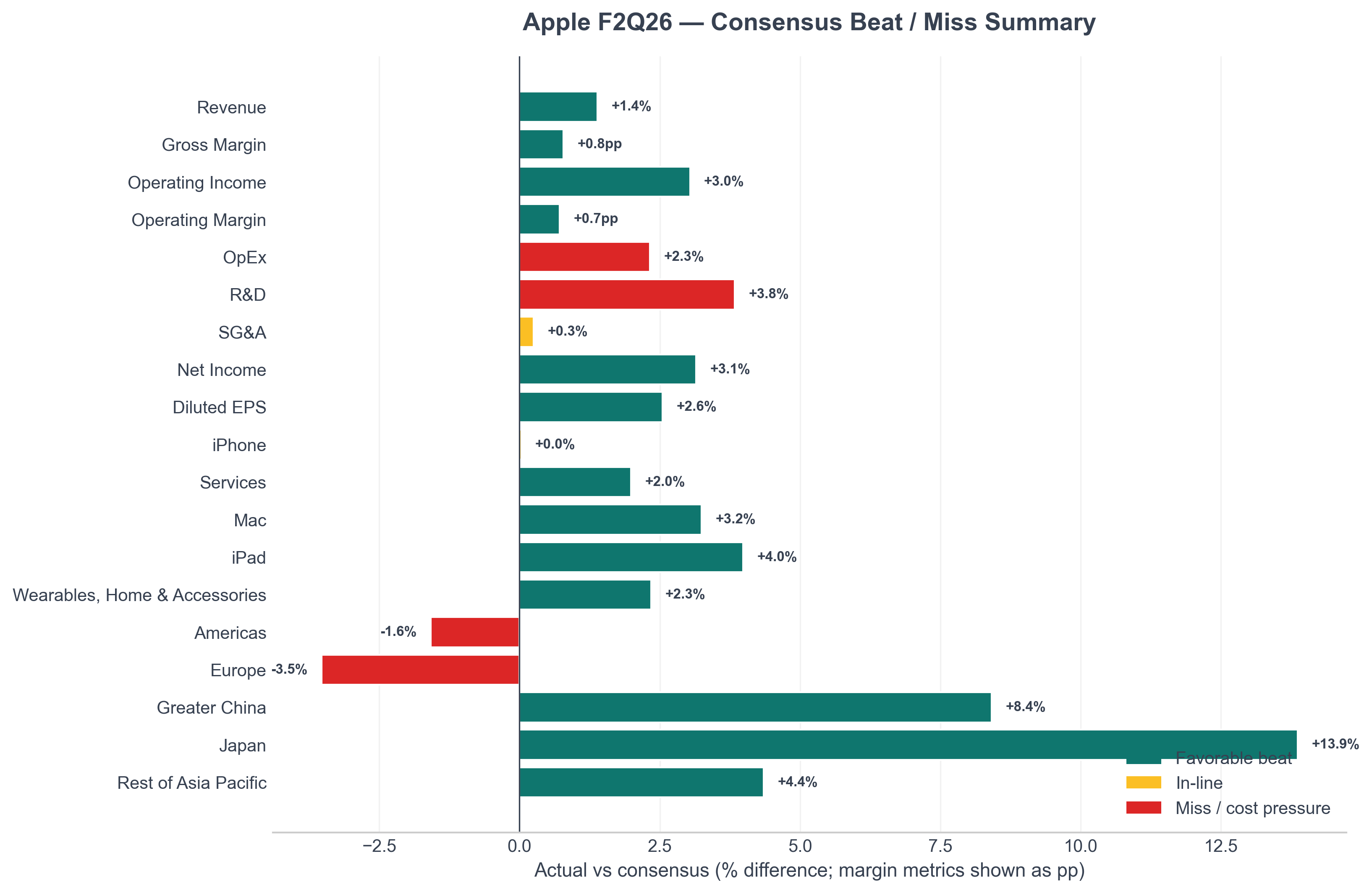
source: Jason and Jarvis
Greater China revenue of \$20.50bn was up 28.1% YoY and beat consensus by 8.4% — the largest single upside surprise of the quarter. 1H FY26 cumulative growth in the region is now +33%. Worth noting: relative to F1Q26's +37.9%, China actually decelerated this quarter. But two consecutive quarters of roughly +30% to +40% YoY growth, after eight of the prior nine quarters were negative, is hard to read as anything other than a structural normalization rather than a one-off pulse. Tim Cook personally visited China in March and used the unusually emphatic word "thrilled," noting that iPhone is the top-selling smartphone in urban China, Mac mini is the top-selling desktop, and MacBook Air is the top-selling laptop. That kind of category-wide leadership is no longer comfortably explained by a demand pulse.
On gross margin, 49.27% punched through the top of guidance and very neatly demolished the consensus pre-print worry that memory costs would compress margin. Implied Products gross margin was 38.69%, +277bps YoY, against a sell-side consensus that was only willing to model 36.4%–37.5%. Morgan Stanley's read: a three-part chord made up of a positive product mix shift, a carry-over of low-cost memory inventory, and pressure on non-memory component suppliers.
II. The problem is that two of those three are borrowed
Which is precisely why Tim Cook bothered to pre-warn.
Carry-over inventory runs out. The 3Q26 gross margin guide of 47.5%–48.5% implies sequential compression of roughly 80bps to 180bps, and management explicitly attributed it to "significantly higher memory costs." Beyond the June quarter, Cook's color was restrained but unambiguous: "memory costs will drive an increasing impact on our business." When BofA's Wamsi Mohan asked the obvious follow-up — will you raise prices, or will you concede share — Cook sidestepped it with a single line: "We'll look at a range of options."
BNP Paribas — gross margin (company, products, services) and operating margin
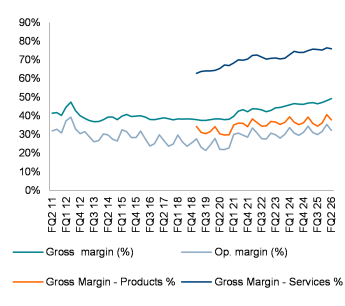
source: BNP Paribas
In my 1Q26 review, I cited a Citi estimate that even a 50% DRAM price increase would translate to only roughly 90bps of gross-margin pressure for Apple overall. That number bought the bulls a quarter of comfort. The chronology Cook laid out in F2Q26 — December "minimal impact," March "slightly higher but partly offset by carry-in inventory," June "significantly higher, still partly offset," and beyond that "increasing" — effectively stretches that 90bps stress test across four sequential quarters, with the inventory buffer's offsetting power decaying each step.
The sell-side disagreement here is sharp. The bulls (Goldman Sachs, J.P. Morgan, BofA) are betting on four offsets: high-end mix shift (folding iPhone, Pro Max ASP step-ups), component insourcing (the C2 modem in the iPhone 18 family), tariff headwinds easing, and over \$3bn in tariff refunds — the last of which lands as a COGS credit and is genuinely hard margin support. The cautious side (Barclays) worries that hyperscaler demand is absorbing memory capacity, that pricing pressure persists into 2H26, and that this starts to test demand elasticity. That is the spine of BCI's UW rating and \$253 PT.
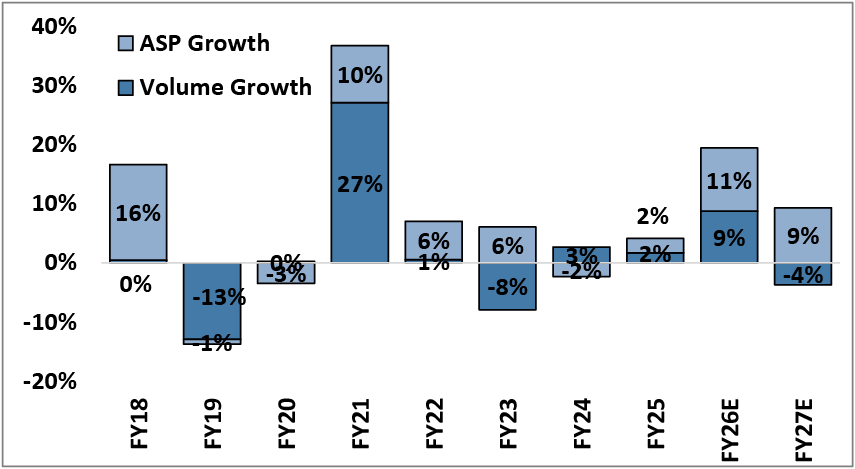
How you compute iPhone price elasticity is the heart of this debate:
J.P. Morgan — iPhone revenue growth decomposition (ASP vs Volume)
source: J.P. Morgan
J.P. Morgan's FY26E iPhone growth decomposition is ASP +11% and Volume +9% — the first dual-driver iPhone year since the FY21 5G super-cycle. Implied iPhone ASP this quarter was already \$941. The sell-side consensus argument is that a \$100 step-up in ASP does not meaningfully reshape the iPhone demand curve, but it does absorb most of the memory-related margin pressure. If that assumption holds, the 2H26 story is "raising prices to absorb rising prices." If it doesn't, Cook's "range of options" sentence starts to read as a little tighter than it sounded.
III. Cook reshaped the balance sheet, then handed over the chair
If you only read the segment lines, F2Q26 is a beautiful but conventional report. What turns it into a clearing event in the literal sense are the two corporate actions announced on the same evening.
First, the CEO transition. On September 1, 2026, Tim Cook formally moves to Executive Chairman; John Ternus becomes CEO. Cook's framing was direct: "There is no one on this planet I trust more to lead Apple into the future than John Ternus." Ternus has been at Apple for 25 years, climbing from hardware engineering up to SVP. BNP's read is the cleanest: this "may signal that the company will lean further into product innovation." Putting a hardware-grown CEO in charge of the roadmap, at a company that has built Services into a \$31bn-per-quarter business but still rides on \$80bn of hardware revenue every quarter, is a deeply Apple form of succession — pick someone who knows how the product gets built, not someone who knows how it gets sold.
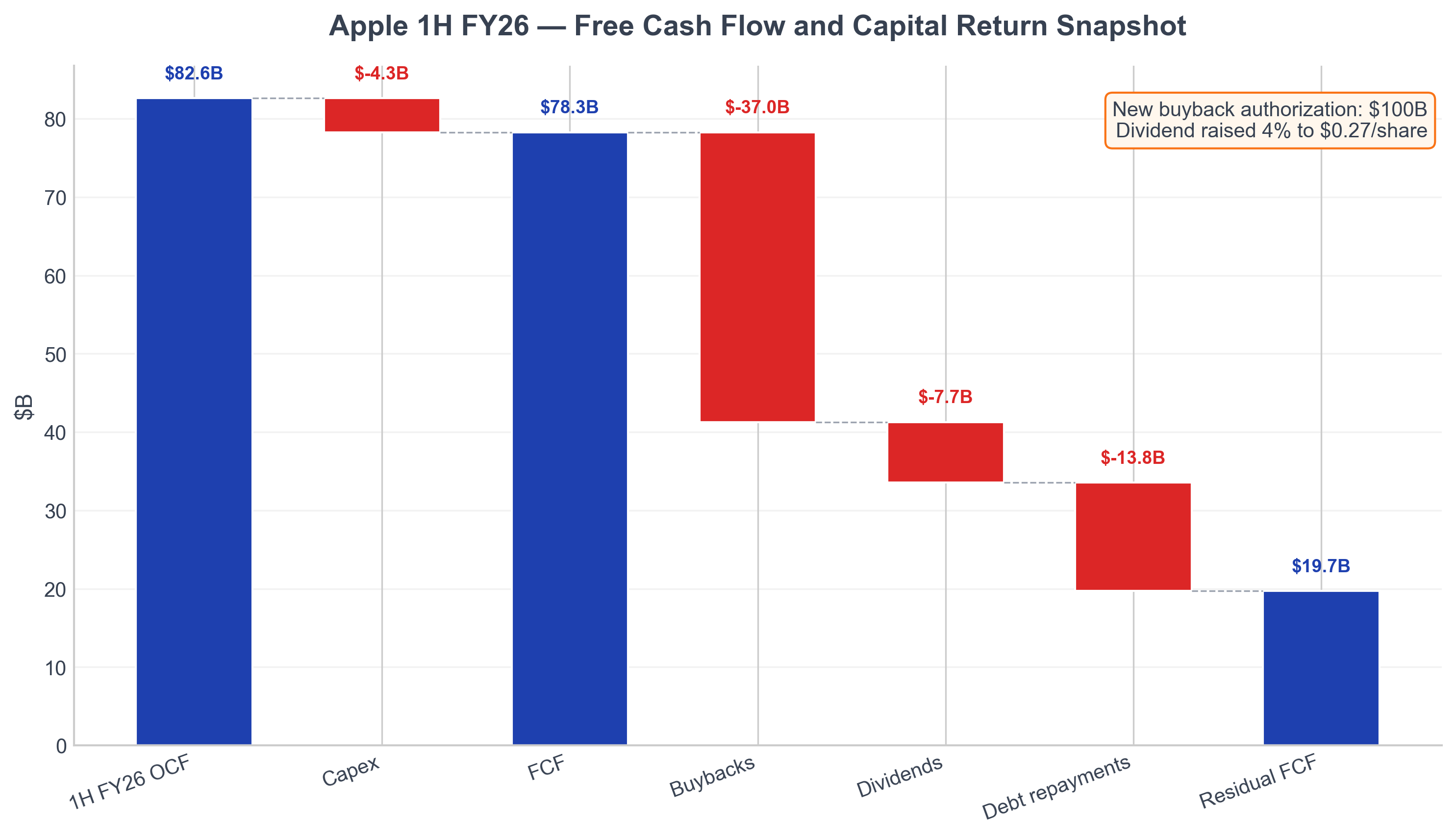
Second, quieter but more consequential. Apple has formally retired the net cash neutral framework it had been running toward since 2018. Kevan Parekh's exact wording: "We are no longer providing net cash neutral as a formal target, and we will independently evaluate cash and debt." On the same call: \$100bn in new buyback authorization and a 4% dividend increase.
This deserves a beat to think about. In the eight years since 2018, Apple shrank net cash by more than \$100bn and returned more than \$1tn to shareholders — over \$850bn of which was via repurchase. The framework was, in effect, a promise: our balance sheet doesn't need to hold reserves for investment, because our investment intensity doesn't require those reserves.
Retiring it means: those reserves may now need to come into play.
To be clear, dropping net cash neutral doesn't automatically imply a megadeal or a massive capex pivot. But it does mean that, at minimum, management has structurally prepared the balance sheet for some future scale of capital deployment — AI infrastructure? Owned data centers? More aggressive M&A? Setting up Apple silicon's "AI gateway" path inside data centers? Nobody knows yet. Morgan Stanley speculates that M&A optionality has gone up, while honestly noting that Kevan Parekh — a protégé of former CFO Luca Maestri — has historically been on the conservative side, with the largest acquisition still being the \$4bn Beats deal.
Read those two announcements alongside Cook's farewell call, and the conclusion is almost literal: Cook is not retiring. He is handing over a re-engineered balance sheet and a financial framework that's now allowed to spend. That sentence, by itself, is the gift to Ternus.
Apple 1H FY26 free cash flow and capital return snapshot
source: Jason and Jarvis
The cash-flow engine that backs that gift was already in place. 1H FY26 operating cash flow was \$82.63bn, up 53% YoY. Free cash flow grew 64% YoY — the strongest FCF year in 15 years. Capex intensity is still strikingly low (FY26 full-year capex is around \$9bn). The 2.5bn+ active device install base — at all-time highs across every product category and every geographic segment — keeps converting hardware sales into long-tail Services cash flow. This is a steady-state cash machine. Cook tuned it up. What he's leaving for the next CEO isn't a fix-it list; it's a how-do-you-spend-it list.
IV. The question Ternus has to answer: AI is not a feature, it's a platform
Which brings us to the most interesting and most under-appreciated part of the F2Q26 call.
Cook used a line repeatedly: "This is not AI as a standalone feature, but AI as an essential, intuitive part of the experience across our devices." It sounds like a marketing line, but it points to a verifiable, specific claim: Apple's differentiation is not about having a smarter model, it's about running models smarter on-device — supported from the silicon up by Apple silicon, designed from the ground up around privacy.
The more notable thread is something Cook hit twice: Apple's platforms are now becoming "powerful platforms for building and running agentic AI." The enterprise example was Perplexity choosing Mac as its preferred platform for enterprise-grade AI assistants, with the keywords being unified memory architecture combined with on-device capabilities. Mac mini and Mac Studio are supply-constrained heading into 3Q26, and Cook's reason was that "customers recognized them as amazing platforms for AI and agentic tools faster than we predicted." That is a new product positioning — one I don't recall hearing in calls before 1H FY26.
I've written before about the internal Apple AI tug-of-war, the Lynnwood/Glenwood dual-track, and Federighi's candid "we weren't able to achieve the reliability" line (in "Apple's AI Evolution"). And I covered Mark Gurman's reporting on the ~$1bn-per-year Gemini deal to power Siri, where Cook had already, with characteristic pragmatism, moved "use the best tool to build the best product" onto the AI battlefield. F2Q26's Q&A update was short: collaboration with Google is "going well," in-house foundation model work is proceeding in parallel, and R&D acceleration is "much higher than the company is." This quarter's R&D was \$11.42bn, up 33.6% YoY, well ahead of the 16.6% top-line growth. Cook didn't disclose the trade-off between the two AI tracks, and when BofA's Wamsi Mohan tried to drill into "infrastructure," the answer stayed deliberately fuzzy.
But dropping net cash neutral makes that fuzziness suggestive. When a company simultaneously (a) materially accelerates R&D, (b) tells you Mac is becoming a development platform for agentic AI, and (c) removes the constraint on its balance sheet — odds are it is preparing for something larger than "ship one more feature." WWDC 2026 in June — where Citi expects a redefined Siri — is the first observable checkpoint on this thread.
V. Closing: a very Cook-style farewell
One last set of numbers is worth pausing on. F2Q26 was the 89th earnings call of Cook's 15-year run as CEO. The company hit March-quarter revenue records in emerging markets, opened its 6th store in India, and ran simultaneous Apple 50th-anniversary celebrations in Chengdu, New York, and Paris. 2.5bn+ active devices. 1H FY26 FCF up 64% YoY. The strongest FCF year in 15 years. These numbers will go into Cook's tenure summary.
But the genuinely Cook-style element of F2Q26 is that, on the surface, it's a clean clearing report — and underneath, it's a tidy handover packet: spell out the memory-cost chronology, swap the capital framework for a more flexible version, hand the next CEO \$100bn of buyback ammunition, retire the China overhang for a second time after nine quarters of debate, and reframe the AI narrative from "feature" to "platform." Then walk away.
Cook's parting advice to Ternus carried strong Steve Jobs notes: "Don't ask what I would do, just do the right thing." That was Steve's line to Tim, passed forward word-for-word, with one Cook addition: "Never forget the North Star — making the best products in the world that really enrich other people's lives."
It sounds like marketing copy. But on the last page of an earnings report that has cleared every roadblock in front of it, it reads, unexpectedly, like a will.
The list of unanswered questions is short: Will memory cost pressure actually be absorbed by price? Where does the first big capital deployment go now that net cash neutral is gone? Will the Siri promised at WWDC actually ship? And — the
Earnings Call Recap
I will now share a more detailed analysis on this earnings result behind the paywall:


