
Apple M5 Chip Unveiled, Delivering Massive AI Performance Leap Across iPad Pro, MacBook Pro, and Vision Pro Ecosystems
How will Apple's new M5 chip empower the iPad Pro, MacBook Pro, and even the Apple Vision Pro to deliver intelligent experiences? And how does this move cement Apple's strategic position in the future of the personal computing ecosystem?


The Monumental Arrival of the M5 Chip: A New Chapter for Apple in On-Device AI
As the wave of AI sweeps across the globe, the technology giant Apple unveiled its latest-generation M5 chip on October 15, 2025, aiming to redefine the boundaries of AI capabilities in personal computing devices. Built on cutting-edge third-generation 3-nanometer technology, this chip not only elevates the performance of Apple silicon to new heights but also deeply empowers its three core product lines—the iPad Pro, MacBook Pro, and Apple Vision Pro. This launch heralds a more intelligent, efficient, and immersive era of computing. The core of this upgrade is undeniably the massive leap in the M5 chip's AI performance, representing not just a pure increase in processing power but a crucial component in Apple's strategy to build its unique on-device AI ecosystem.
The M5 Chip: The Cornerstone of an AI Performance Leap
Apple Senior Vice President Johny Srouji emphasized that the M5 chip brings the next major generational leap in AI performance to Apple silicon. This is no exaggeration, as the comprehensive upgrade to its underlying architecture is key.
The chip features an advanced 10-core CPU, comprising four performance cores and six efficiency cores. Apple officially states that its multithreaded performance is 15 percent faster than the previous generation M4 chip, positioning it as an industry-leading micro-processor core. Even more notable is its next-generation 10-core GPU architecture, where each core cleverly integrates a dedicated Neural Accelerator, ensuring every compute unit within the chip is deeply optimized for AI tasks.
This explosive growth in AI capability is reflected in the hard data: peak AI compute performance is a stunning 4x higher than the M4, and a remarkable 6x higher when compared to the M1 chip. Graphics performance is equally robust, being 45 percent higher than the M4 and 2.5x faster than the M1. It also integrates Apple's third-generation ray-tracing engine, which delivers up to 45 percent better graphics in supported applications.
Internal Architecture of the M5 Chip

Source: Apple Newsroom
Furthermore, the M5 chip is equipped with a faster 16-core Neural Engine, which works synergistically with the Neural Accelerators in the CPU and GPU to provide the most power-efficient performance for on-device AI applications. The unified memory bandwidth has also been boosted by nearly 30 percent, reaching over 150GB/s (specifically 153GB/s). This allows devices to run larger AI models and supports up to 32GB of unified memory capacity, effortlessly handling demanding creative suites like Adobe Photoshop and Final Cut Pro.
iPad Pro: AI Creative Power in an Ultra-Thin Design
The all-new iPad Pro, powered by the M5 chip, pushes the performance, design, and connectivity of the tablet to an unprecedented level. Its generative AI capabilities, in particular, are highly impressive, designed to empower creative professionals.
iPad Pro Demonstrating AI Image Generation

Source: Apple Newsroom
In terms of AI and graphics processing, the new iPad Pro's AI performance is 3.5x faster than the M4-equipped iPad Pro and 5.6x faster than the M1 model. This translates to significantly enhanced efficiency in complex tasks such as on-device diffusion-based image generation in Draw Things and AI video masking in DaVinci Resolve. 3D rendering speeds (including ray tracing) are up to 1.5x faster compared to the M4 and an astonishing up to 6.7x faster than the M1.
The design is a major highlight, with the iPad Pro setting new standards for thinness: the 13-inch model measures just 5.1 mm thick, and the 11-inch model is 5.3 mm—thinner than many smartphones.
The Ultra-Thin Design of the iPad Pro

Source: Apple Newsroom
Its Ultra Retina XDR display utilizes groundbreaking tandem OLED technology, offering 1,000 nits of full-screen brightness and 1,600 nits of HDR peak brightness. It also features an optional nano-texture display glass to effectively reduce glare.
Connectivity sees a major upgrade, with the debut of Apple-designed C1X cellular modem and N1 wireless networking chip, resulting in cellular data performance that is up to 50 percent faster than its predecessor. It also supports Wi-Fi 7, Bluetooth 6, and Thread technologies, ensuring lightning-fast and stable network connections.
iPad Pro with C1X and N1 Chips During a FaceTime Call

Source: Apple Newsroom
Storage read/write speeds are boosted by up to 2x, and the starting unified memory capacity for the 256GB and 512GB models is now 12GB. Additionally, the iPad Pro supports the Apple Pencil Pro and the redesigned Magic Keyboard, and can drive external displays at refresh rates up to 120Hz.
iPad Pro Connected to an External Display for Work

Source: Apple Newsroom
MacBook Pro: The AI Accelerator for Professional Users
The 14-inch MacBook Pro, powered by the M5 chip, provides professional users with unparalleled AI performance and battery life. It redefines the standard for mobile workstation performance, offering immense value, especially for those due for an upgrade.
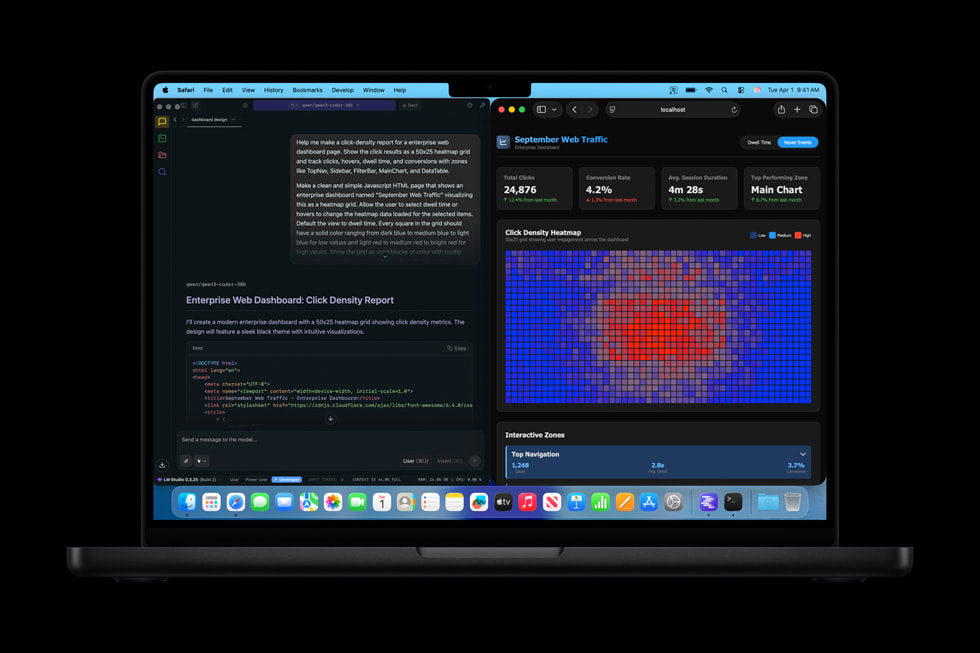
LLM Application Demonstration on MacBook Pro
Source: Apple Newsroom
The M5 chip accelerates AI performance by up to 3.5x (compared to M4) and 6x (compared to M1), significantly speeding up daily AI workflows, whether a student is transcribing lectures or running local LLMs via webAI. Professional performance gains are also substantial: AI video enhancement (with Topaz Video) is up to 1.8x faster than the M4; 3D rendering (with Blender) is up to 1.7x faster than the M4; and code compilation (in Xcode) is up to 1.2x faster than the M4. This means data analysts querying large databases and product designers switching between multiple applications will experience unprecedented smoothness and efficiency.
MacBook Pro Displaying Adobe Premiere Pro Screen

Source: Apple Newsroom
For users upgrading from older machines, the value proposition of the M5 chip is particularly stark: compared to legacy Intel systems, AI performance is up to 86x faster, GPU performance is up to 30x faster, and CPU performance is up to 5.5x faster. Even compared to the M1 chip, AI performance is up to 6x faster.
Regarding hardware and endurance, the MacBook Pro boasts a total battery life of up to 24 hours, representing up to 14 hours longer for former Intel users. Crucially, the MacBook Pro delivers consistently powerful performance whether plugged in or running on battery. It features the industry-leading 14-inch Liquid Retina XDR display, with 1,600 nits of HDR peak brightness and 1,000 nits of SDR content brightness, and is now upgraded to support connection to up to two high-resolution external displays.
Apple Vision Pro: Immersive AI Upgrade for Spatial Computing
The Apple Vision Pro, upgraded with the M5 chip, achieves deeper levels of immersion and intelligence in the spatial computing realm. The new Dual Knit Band also significantly enhances wearing comfort.
The integration of the M5 chip optimizes the display quality of the Apple Vision Pro, rendering 10 percent more pixels on its custom micro-OLED displays and increasing the refresh rate to 120Hz, effectively reducing motion blur. Its 16-core Neural Engine makes AI-driven system functions (such as capturing a Persona or converting photos into spatial scenes) 50% faster, and third-party apps run up to 2x faster than the previous generation.
Generating a Spatial Persona on Apple Vision Pro

Source: Apple Newsroom
The Vision Pro also works in concert with the dedicated R1 chip, which streams new images to the display within 12 milliseconds, ensuring an ultra-smooth visual experience.
M5 and R1 Chips in Apple Vision Pro

Source: Apple Newsroom
To enhance user experience, Apple has introduced the Dual Knit Band for the Vision Pro. This band features a 3D-knitted unibody structure with built-in tungsten inserts that provide cushioning and breathability while also adding counterweight. This significantly improves comfort, balance, and stability.
The visionOS 26 ecosystem continues to expand, with over 1 million total apps available and over 3,000 apps built specifically for visionOS. It also adds support for the PlayStation VR2 Sense controller. In terms of enterprise applications, the Vision Pro shows huge potential. For instance, CAE uses it for pilot training simulations, the Visage app offers high-quality 3D medical imaging, and JigSpace leverages the M5 chip's powerful on-device AI capabilities to help corporate users analyze complex datasets.
CAE Using Apple Vision Pro for Flight Training Simulation

Source: Apple Newsroom
Visage App Providing 3D Medical Imaging via Apple Vision Pro

Source: Apple Newsroom
Apple Intelligence and Four Operating Systems: Building a Seamless Smart Ecosystem
The launch of the M5 chip is not merely a hardware iteration; it is the solid foundation Apple is laying to realize its cross-platform Apple Intelligence vision. It provides a unified hardware base for Apple's four major operating systems (the newly announced macOS Tahoe, iPadOS 26, visionOS 26, along with iOS and watchOS, which were not part of this specific announcement), allowing Apple Intelligence features to be implemented seamlessly and efficiently across all devices.
Core functions of Apple Intelligence include powerful Writing Tools for rewriting, proofreading, and summarization; Live Translation integrated into Messages, FaceTime, and the Phone app; and Shortcuts made smarter through direct calls to Apple Intelligence models. Additionally, the on-device AI tool Image Playground runs more swiftly, thanks to the faster Neural Engine and unified memory.
Apple Intelligence Writing Tools Demonstrated on Mac

Source: Apple Newsroom
The operating systems also see innovation. iPadOS 26 introduces a new, powerful, and intuitive windowing system, menu bar, and an enhanced Files app. macOS Tahoe brings significant updates to Spotlight and enables the use of the new Phone app and Live Activities via Continuity. visionOS 26 allows Widgets to be seamlessly integrated into the user's space and enhances the realism of Persona. These system-level optimizations collectively form a seamless, intelligent ecosystem centered around the M5 chip.
Commercial Considerations and Commitment to Sustainability
Alongside the new product releases, Apple has once again reiterated its firm commitment to environmental sustainability. All new products—the M5 chip, MacBook Pro, iPad Pro, and Apple Vision Pro—support the Apple 2030 carbon neutral goal. In terms of materials, the product enclosures use 100 percent recycled aluminum, all magnets contain 100 percent recycled rare earth elements, and the batteries contain 100 percent recycled cobalt. For example, the MacBook Pro and iPad Pro contain 45% or 30 percent recycled content by weight, respectively. Furthermore, the use of 55% renewable electricity in the supply chain and 100% fiber-based packaging demonstrates Apple's continuous investment in environmental protection.
Regarding pricing and availability, most new products will begin shipping or be available starting October 22, 2025. The 14-inch MacBook Pro (M5) starts at $1,599 USD; the iPad Pro (M5) 11-inch Wi-Fi model starts at $999 USD, and the 13-inch Wi-Fi model starts at $1,299 USD; the upgraded Apple Vision Pro starts at $3,499 USD.
Conclusion: Apple's AI Ecosystem Strategy and Future Outlook
Apple's latest product matrix update, centered around the M5 chip, clearly outlines its strategic blueprint for the on-device AI era. Through deep, synergistic optimization of software and hardware, the M5 chip not only delivers revolutionary AI performance and user experience upgrades to the iPad Pro, MacBook Pro, and Apple Vision Pro, but also further solidifies the integration foundation of Apple Intelligence across the entire ecosystem. This move not only reinforces Apple's leadership in the high-end personal computing market but also grants it a first-mover advantage in spatial computing and the rapidly expanding field of AI applications. Moving forward, we have every reason to expect that Apple will continue to lead technological innovation with its unique 'Chip-Software-Hardware-Service' integration strategy, bringing ever deeper intelligent experiences to users.


