
Ferrari 1Q26 Review: When a Strong Quarter Loses to a Single Phrase About Pacing
How does a textbook mix-driven beat trigger a -4% sell-off the same morning Ferrari posts its largest FCF surprise of the year — and what does the company's quiet rerouting of Middle East deliveries reveal about a business model that may be more flexible than its scarcity narrative suggests?


Ferrari 1Q26: When a Strong Quarter Lost to a Single Phrase About Pacing
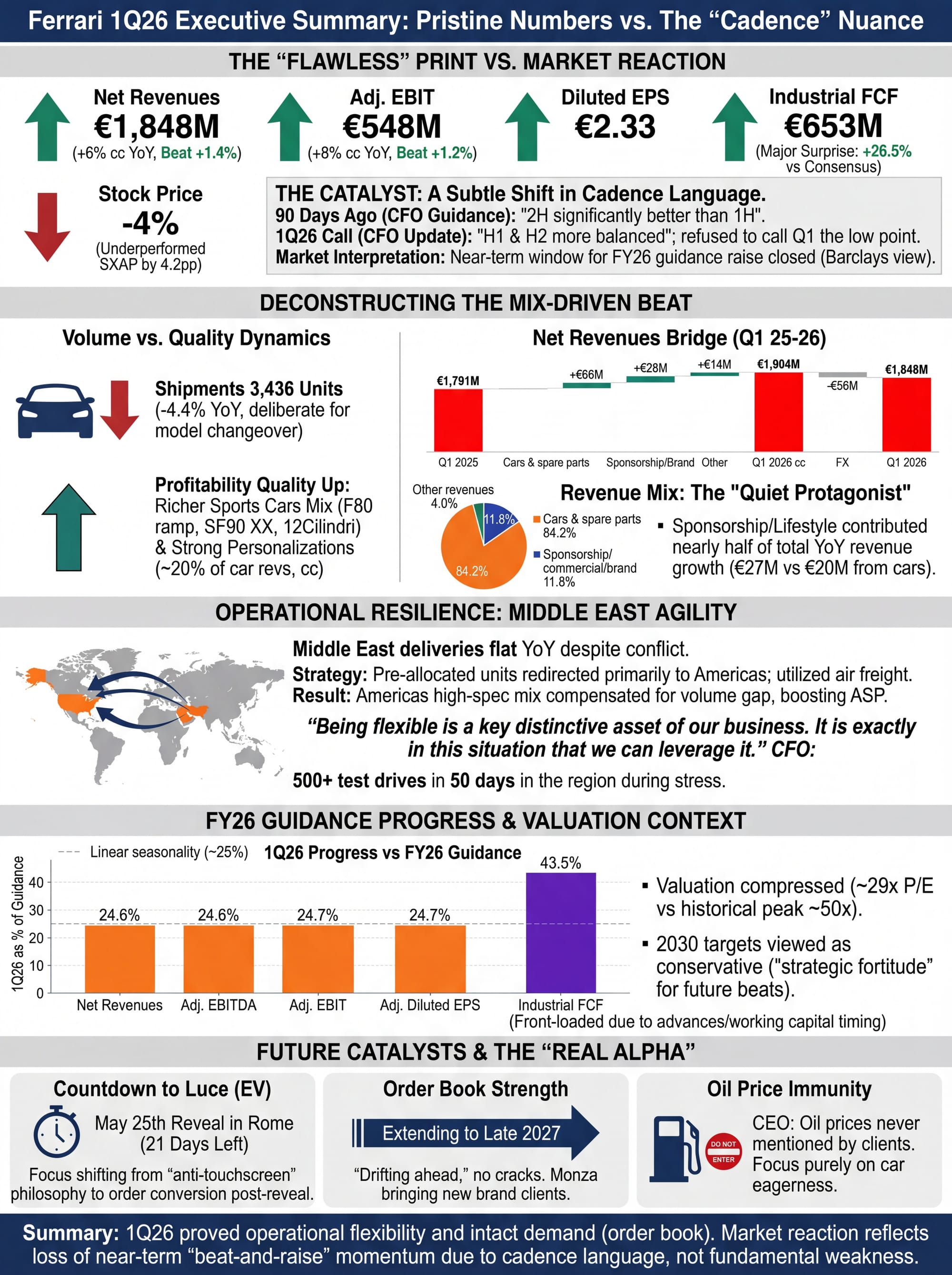
Ferrari's 1Q26 print is hard to fault. Net revenues of €1,848M (cc yoy +6%, beat +1.4%), Adj. EBIT of €548M (cc yoy +8%, beat +1.2%), Diluted EPS of €2.33, and Industrial FCF of €653M — running +26.5% ahead of consensus and the largest single surprise of the quarter. EBIT margin came in at 29.7%, -60bps yoy on a reported basis, but still expanding once you strip out FX.
And then the stock fell 4% on the day, underperforming the SXAP by 4.2pp.
This is not a numbers problem. It is a phrasing problem. Ninety days ago, when guiding FY26, CFO Antonio Picca Piccon described the path as "2H materially better than 1H." This time he recast absolute EBIT/EBITDA as "more balanced" between H1 and H2, while declining to label Q1 as the trough of the year. The sell-side reached a fairly straightforward conclusion: the near-term window for an FY26 guidance upgrade just closed.
Barclays put it most bluntly — the change "removed any near-term scope for raising earnings expectations." Bank of America took the opposite view, arguing that if Q2 prints equally strong, a guide-up post-H1 remains the base case. Whichever side you land on, the market reaction is no longer about this quarter's earnings power. It is about whether Ferrari's classic playbook — the "4Q25 style" beat-and-raise I covered in Ferrari 4Q25 Earnings Review: The Scarcity Dividend, the one that drove a single-day +10% rally — shows up again in Q2.
Anatomy of a mix-driven beat: shipments down -4.4%, profit quality up
Start with the skeleton. Shipments came in at 3,436 units, -4.4% yoy and below the consensus of 3,520. The CFO framed this as "deliberately designed to be slightly lower than the previous year" to make room for executing a dense model change-over. That is fully consistent with the sell-side preview view — soft volume, strong unit economics — and continues a narrative thread the past two quarters have been hammering.
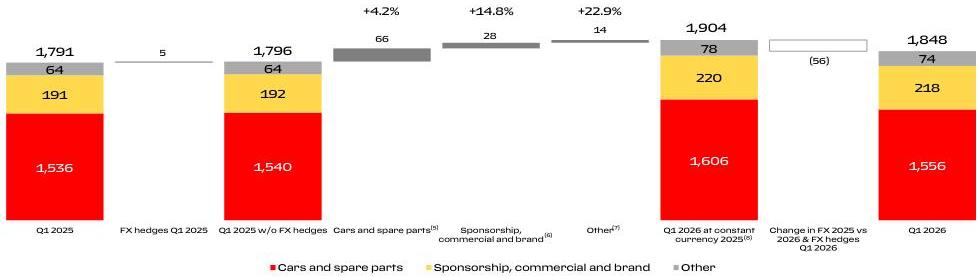
Net revenues bridge — Q1 2025–2026
Source: Ferrari
The four revenue drivers are not complicated: a richer sports cars mix (F80 ramp + SF90 XX family + 12Cilindri family + the net effect of the Daytona SP3 phase-out), a strong country mix led by the Americas, a non-auto contribution from F1 sponsorships and lifestyle, and a negative FX drag from USD and JPY. The CFO offered one number worth committing to memory — personalizations now account for roughly 20% of cars & spare parts revenue (at constant currency), driven by the adoption of carbon and special paints, with the SF90 XX family and Purosangue particularly prominent.
Goldman Sachs decomposed price/mix and volume separately: price/mix at +€81M, volume at -€17M — which lines up cleanly with the four-part narrative of "highly personalized F80 + 296 Versione Speciale shipments + elevated personalization rates + favorable country mix."
Sponsorship and lifestyle: the quiet protagonist of growth
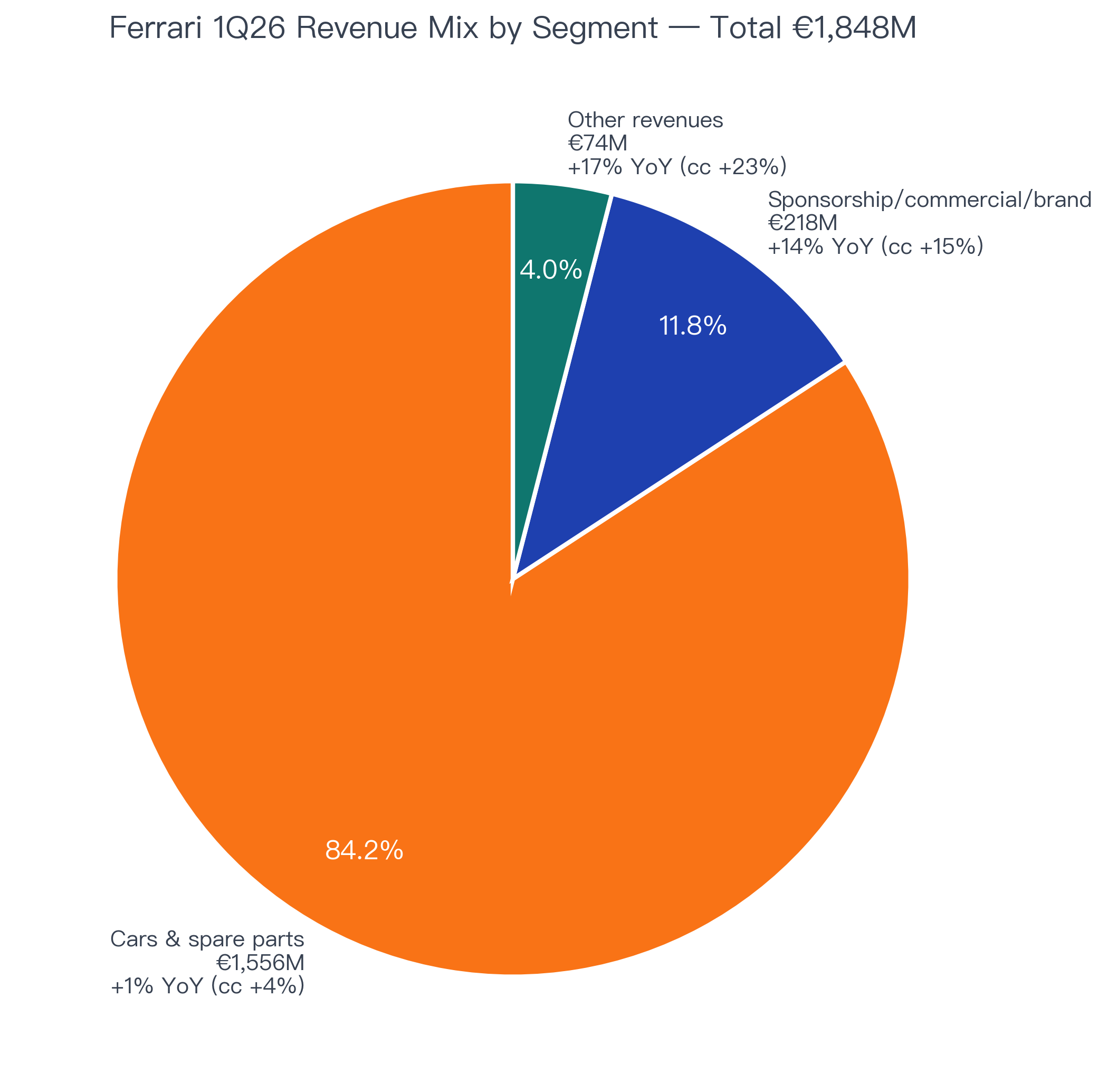
Revenue grew +€57M yoy. Of that, sponsorship/commercial/brand contributed €27M, nearly half. Cars & spare parts contributed only €20M. The growth structure of this quarter is no longer purely "the money from cars." Sponsorship revenue lifted by Ferrari's improved F1 standings, the London Old Bond Street flagship, the fashion show, and the "The Greatest Hits" exhibit at the Modena museum are quietly becoming the fastest-growing sub-lines on the P&L. Within Other revenues, F1 engine rentals (helped by the Haas renewal and the new Cadillac contract) grew +23% cc, reinforcing the lifestyle/racing through-line.
Revenue Mix by Segment
Source: Ferrari 1Q26 release; Jason's calculations
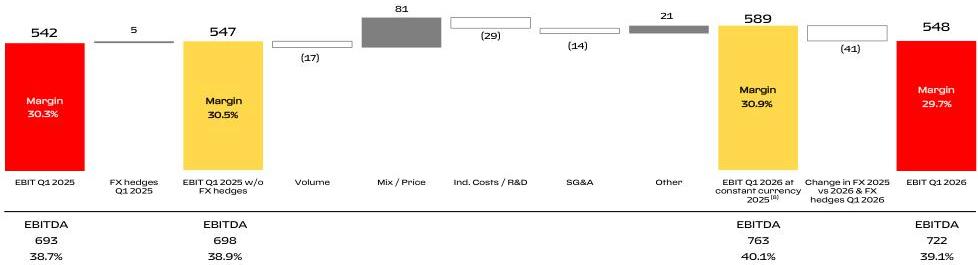
EBIT bridge: D&A and marketing are the real costs beyond FX
EBIT rose only €6M yoy, while EBITDA rose €29M. The €23M gap is entirely explained by higher D&A (€151M→€174M) — management's words: "reflecting start of production of new models." SG&A was up +8% because 1Q concentrated marketing spend across the second-step Luce reveal, the Amalfi Spider launch, and the London flagship opening. In other words, the -60bps margin contraction is not a sign that operating leverage broke — cc EBIT still grew +8% — but a one-off accounting result of FX absorbing the optical margin.
EBIT Bridge — Q1 2025–2026
Source: Ferrari
In the Q&A, the CFO confirmed the full-year FX headwind assumption of ~€200M remains intact. The 1Q net FX impact was -€56M on revenues / -€41M on EBIT, which on a linear extrapolation implies roughly -€164M EBIT for the year — slightly below the €200M assumption. Barclays therefore reads conservatism still buried in this line.
The detail worth pausing on: how quietly the Middle East was managed
According to the call, Middle East deliveries came in flat yoy in Q1. That is not the striking part. The striking part is how it was achieved.
After the escalation, Ferrari rerouted vehicles originally planned for the Middle East to other regions — primarily the Americas. CEO Benedetto Vigna shared a few operational numbers worth holding onto: with 1 regional office, 11 direct employees, 7 dealers, and 200+ dealer staff, the company completed 500+ test drives in the region over the past 2 months. The order book in the Middle East "remains in good shape, with no abnormal cancellations" — the second half of that sentence was repeated multiple times.
The logistical response ran on two parallel tracks: shifting some Middle-East-bound shipments to other regions early in the conflict, while rerouting sea freight and adding air freight to keep serving the region. Asked again by ODDO BHF, Vigna restated: "500+ test drives in 50 days." He also quoted a customer's WhatsApp: "This morning I got a WhatsApp from a client that was extremely happy to have received the car for his birthday."
The CFO distilled all of this into the single most-quoted sentence of the call:
"Being flexible is a key distinctive asset of our business. It is exactly in this situation that we can leverage it."
In Ferrari Deep Dive Report, I argued that Ferrari's scarcity is an actively managed product, not a passive byproduct — management adjusts supply market by market (the FY25 decision to cut UK new-car shipments by ~-30% to defend residual values is a textbook case). The Middle East rerouting is empirical evidence in another dimension: under acute geopolitical stress, the company absorbed the volume gap with country mix and made up the ASP with more highly personalized cars in the Americas.
The CFO's wording deserves a slow read: "It's a mix of country and personalization that matters." The vehicles that got reallocated were themselves more personalized — which is why the press release's phrase "exceptionally strong country mix" really means: ASP uplift more than offset volume.
The H1=H2 debate: how a single phrase ate a beat
Which brings us back to the -4%.
From "2H materially better than 1H" ninety days ago to "H1 and H2 more balanced, with Q1 not the trough" this time — technically, this is not a guidance change. The CFO repeatedly clarified it is product mix and country mix being redistributed within the year, not 2H growth being pulled forward, and the full-year guide is fully intact. But what the market heard was a different question. Evercore ISI and Bernstein both pressed on whether 1H had eaten 2H. Michael Binetti pushed further on whether Q1 would still mark the steepest yoy unit decline of the year. The CFO declined: "No, I will not go into that detail."
This communication line is best read against a wider backdrop.
The single-day +10% rally after 4Q25 rested on a textbook beat-and-raise — guidance lifted, all five FY25 metrics beaten. Management slipped "2026 is a growth year" into the narrative, neutralizing the -15% Capital Markets Day shock (see Ferrari 2025 CMD Review). 1Q26 is a different setup. Operationally, execution is on plan. Bookings are "drifting ahead" toward late 2027. Industrial FCF posted a sizable surprise. The order book shows no cracks. But the near-term catalyst window was closed by a single phrase about pacing.
The BofA and Barclays reactions are the two faces of this same fact. BofA: if Q2 is equally strong, an FY26 guide-up post-H1 is still on the table. Barclays: what just disappeared is the near-term scope for raising earnings expectations, while fundamentals are unchanged. Both readings agree on one thing — what was lost this quarter was not in the numbers.
Progress to plan, and the gravity of valuation
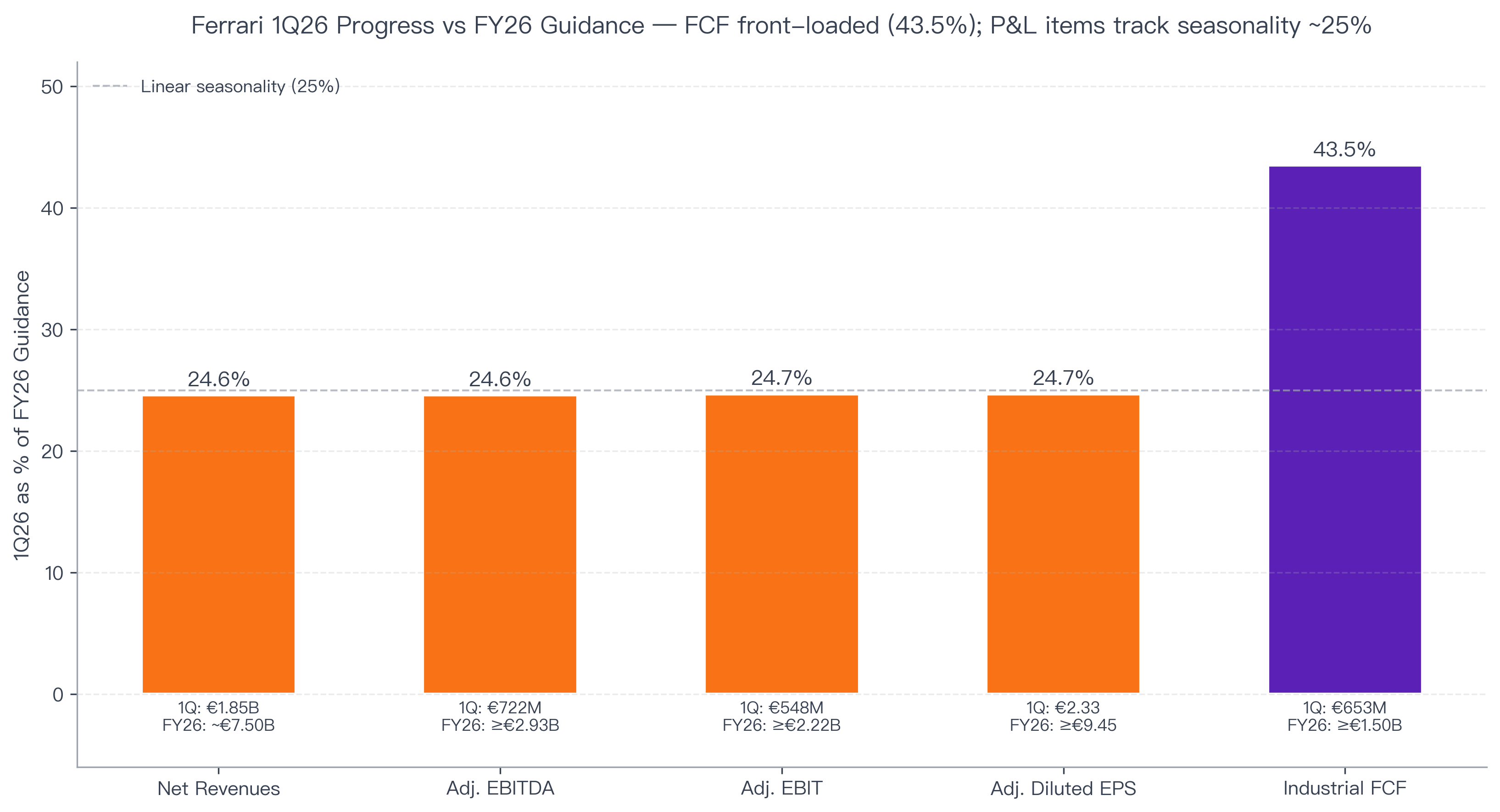
1Q26 completion against FY26 guidance: Net revenues 24.6%, EBIT 24.7%, Industrial FCF 43.5%. The first two are in line with historical Q1 seasonality. The third is front-loaded, but the timing of advances and working capital makes it unwise to annualize linearly.
FY26 Guidance Progress
Source: Ferrari 1Q26 release; Jason's calculations
On valuation, the 2026E 29x P/E is materially compressed from the 12M-fwd peak of ~50x, and the discount to Hermès sits at 16% — comfortably inside the historical range of ~5–35%. The 2030 long-term guide still carries multiple layers of conservatism in the Barclays framework: a higher tax rate assumption, a lower personalization mix assumption, FX headwinds left unoffset by pricing, and an EPS base built on the pre-buyback share count from June 2025 (adjusting for the €3.5B buyback would imply ≥~€12.20 EPS and ≥6.8% 25–30 EPS CAGR, vs. the headline ≥5.5%).
In my CMD review, I read the 2030 guide as "strategic fortitude" rather than "growth fatigue" — management leaving cushion for a future beat-and-raise. 1Q26 adds another data point in support: when J.P. Morgan's José Asumendi pressed on whether mix and pricing could fully offset industrial cost, R&D, SG&A, and FX, the CFO answered almost reflexively — "That's already baked in our guidance."
A 21-day countdown
A line near the end of the call almost slipped past — the CEO promised that this would be the last earnings call where he refused to discuss Luce in detail: "Just 21 days more of patience."
On May 25, 2026, the world premiere takes place in Rome — historically rhyming with May 25, 1947, when Franco Cortese drove the 125 S to Ferrari's first race victory in Rome. BofA estimates a Luce price of approximately €550k. The launch is already overbooked by existing and new customers, and an additional 100 attendance requests came in on the morning of the call, prompting Ferrari to extend the event across May 25–26. 60+ patents have been filed covering electric engines, inverters, vehicle dynamics, battery integration into the chassis, the steering wheel, displays, the user interface, glazing, and wipers. The CEO put it directly: "There is not a single dimension of the car that has not been rethought by the team in innovative way."
In Ferrari Luce: After Building the Touchscreen World, Ive Designs Its Antithesis, I covered the anti-touchscreen philosophy that five years of Ive/LoveFrom collaboration brought to the cockpit — aluminum, glass, leather, virtually no plastic, a Nardi-tribute steering wheel made of 19 CNC-machined parts, the three independently moving aluminum hands of the Multigraph. Coming out of Q1, the sell-side's focus on Luce has quietly migrated from "is this really anti-touchscreen?" to a more economic question — order conversion. Order intake begins after May 25, 2026. That is where the next catalyst line actually starts.
An order book stretching to late 2027, and a car not running on gasoline
Two details worth pausing on at the close. Neither shows up in the P&L.
The first is the order book. Asked by Henning Cosman, the CEO described it as "holding very nicely, drifting ahead" — extending toward late 2027. Bookings are growing across "all models." Some are sold out; others are expanding alongside introduction. The CEO added one more sentence: "Ferrari Monza brings in a lot of new customers, some migrating from other specific brands."
The second is fuel prices. When BofA's Horst Schneider asked whether higher gasoline prices in March and April were affecting customer behavior, the CEO's answer was almost austere — across his client conversations globally, the topic of fuel prices has not come up once. Customers' actual mileage usage is "very marginal." The conversation is entirely about new models, eagerness for the next car, and interest in Luce.
This is Ferrari's actual alpha. Customers are not buying transportation. The 4Q25 "Scarcity Dividend." The 3Q25 "Resilience of Exclusivity." The 1Q26 "four wheels on the ground." Three quarters, three different metaphors — all standing on the same business model.
1Q26 reads more like the byproduct of a stress test. Geopolitical stress walked in; FX walked in; shipments fell -4.4% yoy. But on a constant-currency basis operating leverage is intact, the order book is extending, FCF beat consensus by €137M, and net cash flipped to €388M. What the market lost was a near-term guidance raise. What the company demonstrated is that flexibility is a distinctive asset, not a marketing line.
21 days. See you in Rome.
Earnings Call Recap
I will now share a more detailed analysis of this earnings result behind the paywall


