
Ferrari 2025 Capital Market Day Review
Did Ferrari's calculated conservatism—cutting its 2030 EV target while guiding for just a 5% EPS CAGR—signal growth fatigue or a brilliant, "less is more" strategy to preserve its luxury moat against the backdrop of a 15% stock drop?


Recap of the full event:
Ferrari's "Prudent" Enigma: Strategic Fortitude or Growth Fatigue Behind the 15% Stock Plunge?
The Overture: Market Shock vs. Strategic Conviction
The Capital Markets Day (CMD) hosted by Ferrari on October 9, 2025, was, for investors, a dramatic rollercoaster ride. Despite the company commencing the event by announcing an upgrade to its near-term 2025 financial guidance, effectively delivering on its profit promises ahead of schedule, the subsequent release of its long-term 2030 targets poured cold water on the market's enthusiasm. Following the announcement, Ferrari's stock price plunged by approximately 15% on the day, marking its worst single-day performance since its listing.
The core of the contradiction lies in the numbers: Ferrari's 2030 EPS target (≥€11.5) implies a Compounded Annual Growth Rate (CAGR) of only 5% from FY25 to 2030. This stands in stark contrast to the average growth rate of 21% achieved over the past 3 years and significantly misses the market's consensus expectation, which was generally above 7%. Faced with such “difficult to comprehend” conservative figures, the market almost universally interpreted this as a signal that the ultra-luxury automaker's growth momentum is slowing down.
However, if we shift our focus from short-term volatility to the long-term strategy, we might find that the message delivered by management is not one of “fatigue,” but rather a demonstration of strategic fortitude aimed at the ultimate preservation of brand scarcity amid industry upheaval. The leaders of Ferrari, CEO Benedetto Vigna and CFO Antonio Picca Piccon, repeatedly emphasized in the Q&A session that their plan is "balanced" and "prudent," designed to leave ample room for future outperformance (beat-and-raise).
The Core Conflict: Near-Term Outperformance vs. Low Long-Term Guidance
The biggest conflict at this CMD emerged from the stark difference between the confidence in near-term performance and the restraint in long-term vision.
I. 2025 Guidance Upgrade: Over-Delivery on Short-Term Commitments
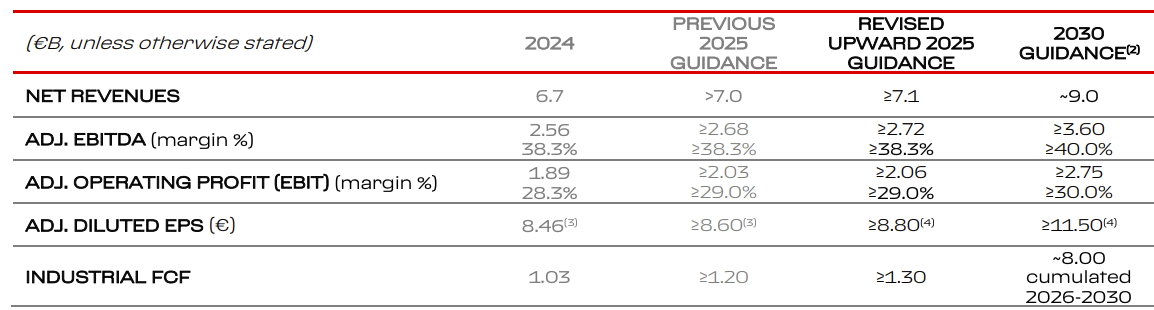
Based on a stronger product mix, higher personalization, and lower-than-expected industrial costs, the company upgraded its 2025 financial guidance. This implied that Ferrari would exceed the upper end of its 2026 profitability target a year early. However, it is crucial to note that even the upgraded guidance—with Adjusted EBITDA (≥€2.72B) and EPS (≥€8.80)—was generally flat or slightly below the market consensus (Bloomberg), setting the stage for the disappointment caused by the long-term targets.
II. The 2030 "Restrained" Blueprint: Profit Targets Significantly Below Consensus
The long-term financial targets announced by Ferrari for 2030 were universally lower than the Bloomberg consensus for key profitability metrics, which was the central reason for the negative market reaction:
- Net Revenues: Target of ~€9.0 billion, below the market's typical expectation of ~€10.0bn.
- Adjusted EBITDA: Target ≥€3.6 billion, which was a massive shortfall of approximately 20% compared to the market consensus of €4.5bn reported by BNP Paribas Exane.
- EPS CAGR: Only about 5%, which severely lagged historical performance.
This series of conservative figures reflects the management's extreme caution in setting long-term goals. As argued by Morgan Stanley, the guidance was "too conservative," suggesting it was a low benchmark set by management to allow for easy over-delivery in the future.
Ferrari 2030 Financial Targets vs. Market Consensus
Ferrari Financial Target Overview (Source: Ferrari CMD Presentation)
Strategic Pivot: Halving the EV Mix to Preserve Scarcity
The conservative 2030 guidance is underpinned by Ferrari's strategic adjustment to the pace of electrification and its unwavering commitment to the "Scarcity" business model.
I. The Prudent "Deceleration" of Electrification
At this CMD, Ferrari announced a significant revision to its powertrain mix outlook for 2030, considered the most signal-heavy part of the strategy:
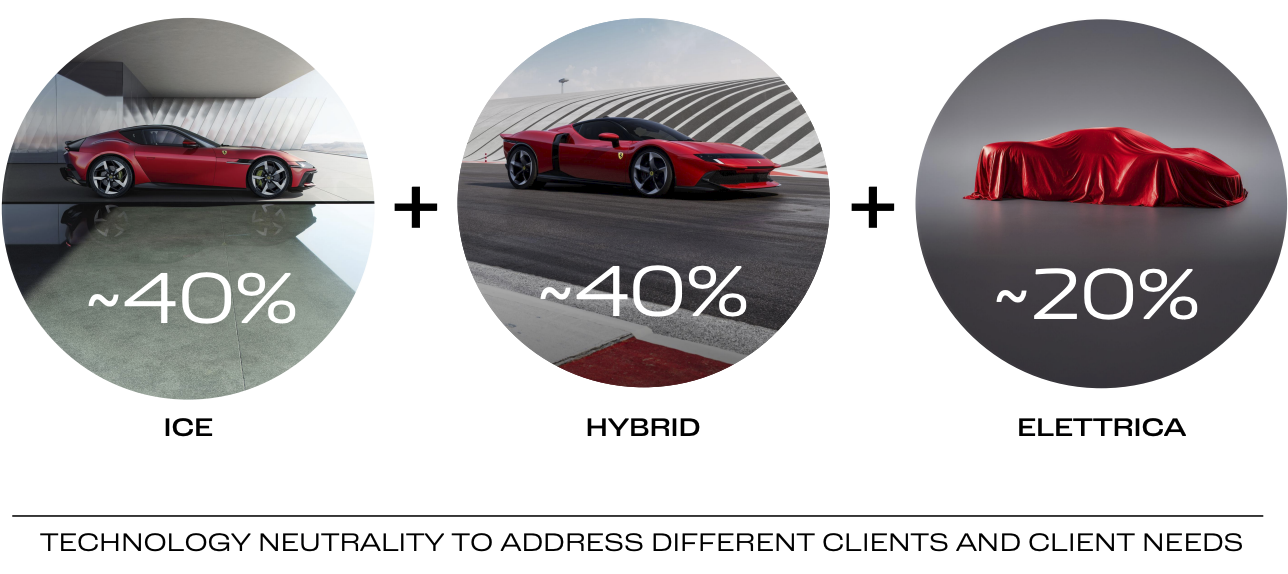
- New Target: 40% ICE / 40% Hybrid / 20% EV.
- Old Target (2022 CMD): 20% ICE / 40% Hybrid / 40% EV.
Ferrari halved its pure EV sales proportion target. Management explained that this adjustment was based on a deeper understanding of its “horizontal diversification” strategy—that is, launching a higher number of models but with lower volumes per model, to better satisfy customer personalization demands and maintain scarcity. This move not only confirmed the expectations of investment banks like Morgan Stanley but also demonstrated Ferrari's "technology-neutral" and pragmatic approach in the face of uncertainty regarding pure electric supercar acceptance.
2030 Sports Car Product Line Mix (Source: Ferrari CMD Presentation)
II. The Unyielding Scarcity Model
The core of Ferrari's business model is "less is more," achieved by strictly controlling supply to ensure high product added value and brand desirability.
- Volume Management: CEO Vigna explicitly stated that the optimal waiting period is between 20 and 24 months, as anything longer frustrates new clients, but anything shorter undermines scarcity. Since its founding, Ferrari has produced a total of 330,000 cars, which some competitors produce in a single year.
- Personalization and Pricing: The company emphasized that 100% of customer cars are unique, and the personalization business is a core driver of profit growth. Even with the electrification transition, its first EV model, the Ferrari Elettrica, will be positioned as an ultra-high-end product, safeguarding its unparalleled performance and value through five unique in-house developed technologies (such as the Full Active Corner system and internally designed battery systems).
- Residual Value Protection: Management maintained that controlling volume and adhering to scarcity effectively protects the product's residual value, which is crucial for maintaining customer loyalty and long-term product worth in the ultra-luxury segment.
Generous Shareholder Returns: The Sweet Compensation for Conservative Guidance
Despite the conservative long-term growth guidance, Ferrari demonstrated generosity towards its shareholders in terms of capital allocation.
- Capital Allocation Strategy: Adjusted to 40% for Capex and 60% for shareholder returns.
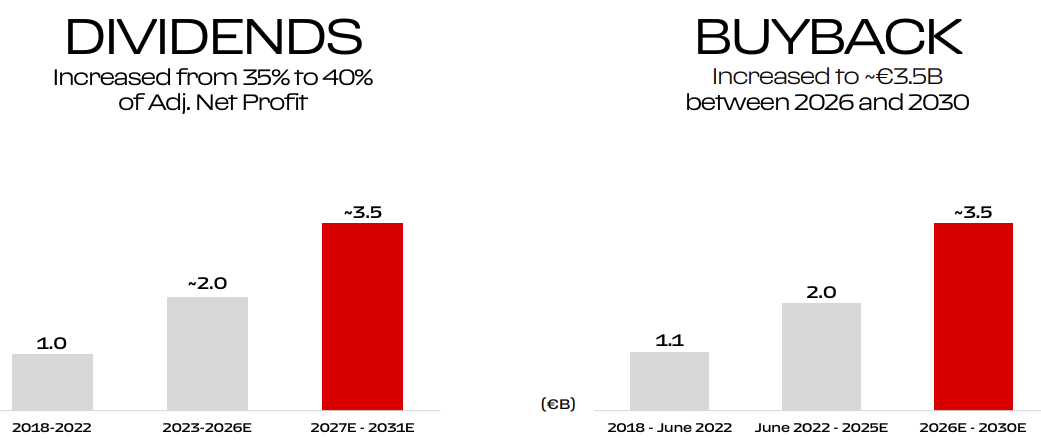
- Dividend Increase: Starting with the 2025 annual results, the dividend payout ratio will be raised from 35% to 40% of adjusted net profit.
- Share Buyback: A new, substantial share buyback program of approximately €3.5 billion is planned between 2026 and 2030.
- Total Return Commitment: A cumulative total of approximately €7.0 billion is planned to be returned to shareholders during the period.
This total return plan of €7.0 billion largely met market expectations. Furthermore, CFO Piccon confirmed that once the company achieves a net cash position, it will be able to reassess its distribution strategy (such as accelerating buybacks or additional returns), hinting at potential future upside for shareholder returns. The strong Industrial FCF generation capability (cumulative projected at about €8.0 billion) provides the solid foundation for this generous return policy.
Increased Shareholder Return Program (Source: Ferrari CMD Presentation)
The Final Verdict: Did the Market Misread Ferrari's Long-Term Philosophy?
The market's immediate reaction to the low guidance was a sharp drop in share price, but the perspectives of top sell-side analysts were more nuanced and critical:
- Strategic Intent of Conservative Guidance: Morgan Stanley leaned towards the view that Ferrari's management adopted an extremely conservative strategy in setting the long-term P&L targets, aiming to build a significant "cushion" for the next five years. This is a sophisticated way of managing expectations, creating the possibility of continuous future beat-and-raises.
- The "Less is More" Luxury Philosophy: Bank of America interpreted this as a prudent "less is more" move, where the core message is: The company prefers to sacrifice short-term revenue scale expansion rather than compromise profitability (with an EBITDA margin target ≥40%) and the preservation of scarcity.
- China Market Considerations: The company acknowledged that the future product mix will be more favorable to the Chinese market (e.g., lower tax burden on EVs), yet its sales target for Greater China will remain below 10%, once again underscoring Ferrari's commitment to maintaining global scarcity.
In conclusion, this CMD was less a signal of Ferrari's "growth fatigue" and more a reflection of its philosophy of "not following the crowd" in the electrification wave, prioritizing its identity as a "luxury goods" house over that of a "car manufacturer." While the short-term stock volatility reflects investor anxiety about slowing growth, in the long run, this ultimate defense of scarcity and commitment to generous shareholder returns solidify Ferrari's status as an "n of 1" ultra-luxury brand and create a potential entry point for long-term value investors.
Behind the paywall I will discuss Ferrari's 2025 CMD in details


