
The $20 Billion "Peace of Mind" Premium: Nvidia's Gambit to Both Tame a Rival and Defend Its Throne
How does Nvidia's perplexing $20 billion deal with Groq function as both a strategic masterstroke to neutralize a future rival and a crucial offensive play to dominate the next frontier of AI?


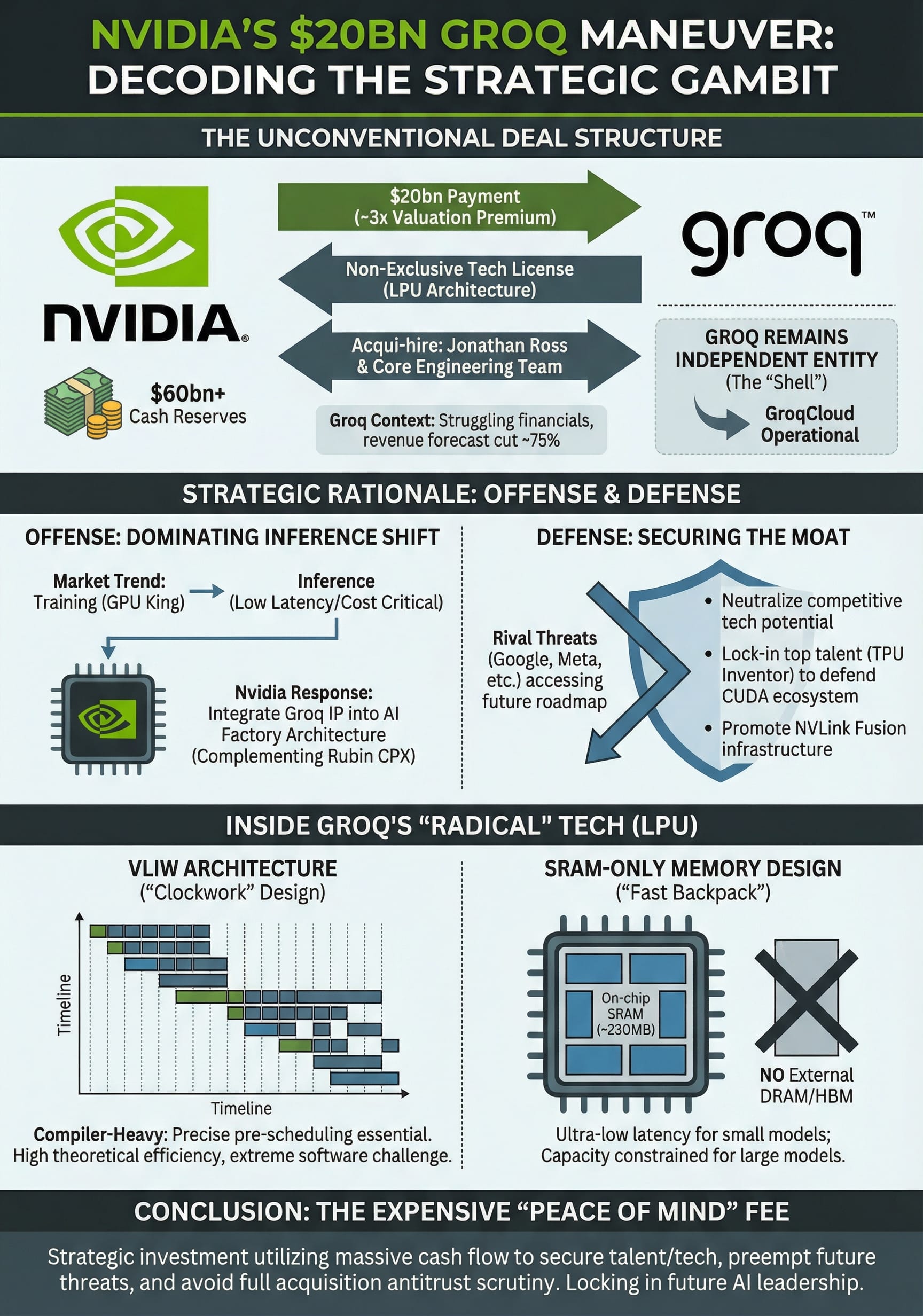
Nvidia's $20 Billion Groq Gambit: The Strategic Depth Behind a Puzzling Deal
A recent decision by Nvidia has left the entire capital market perplexed.
The AI chip giant announced a non-exclusive technology licensing agreement with the startup Groq, valued at a staggering $20 billion, while also absorbing its founder, Jonathan Ross, and his core team. The price is nearly three times Groq's recent valuation of approximately $6.9 billion, yet Nvidia stopped short of a full acquisition.
They bought the technology and the brains, but left behind an independent "shell." What is the strategy behind this maneuver? Peeling back the layers of this deal reveals a well-thought-out strategic play by Nvidia—one that is both a precision offense and a meticulous defense.
An Expensive Deal to "Buy the Brains, Leave the Shell"
This was no traditional acquisition. Nvidia's intention was not to swallow Groq's business but to surgically acquire its most valuable assets: top-tier talent and core technology.
The key terms of the transaction make this crystal clear:
- Nvidia will pay approximately $20 billion for a non-exclusive license to Groq's AI Inference technology.
- As part of the agreement, Groq's founder Jonathan Ross, President Sunny Madra, and the core engineering team will join Nvidia.
- Groq will continue to exist as an independent company, and its cloud service, GroqCloud, will remain operational.
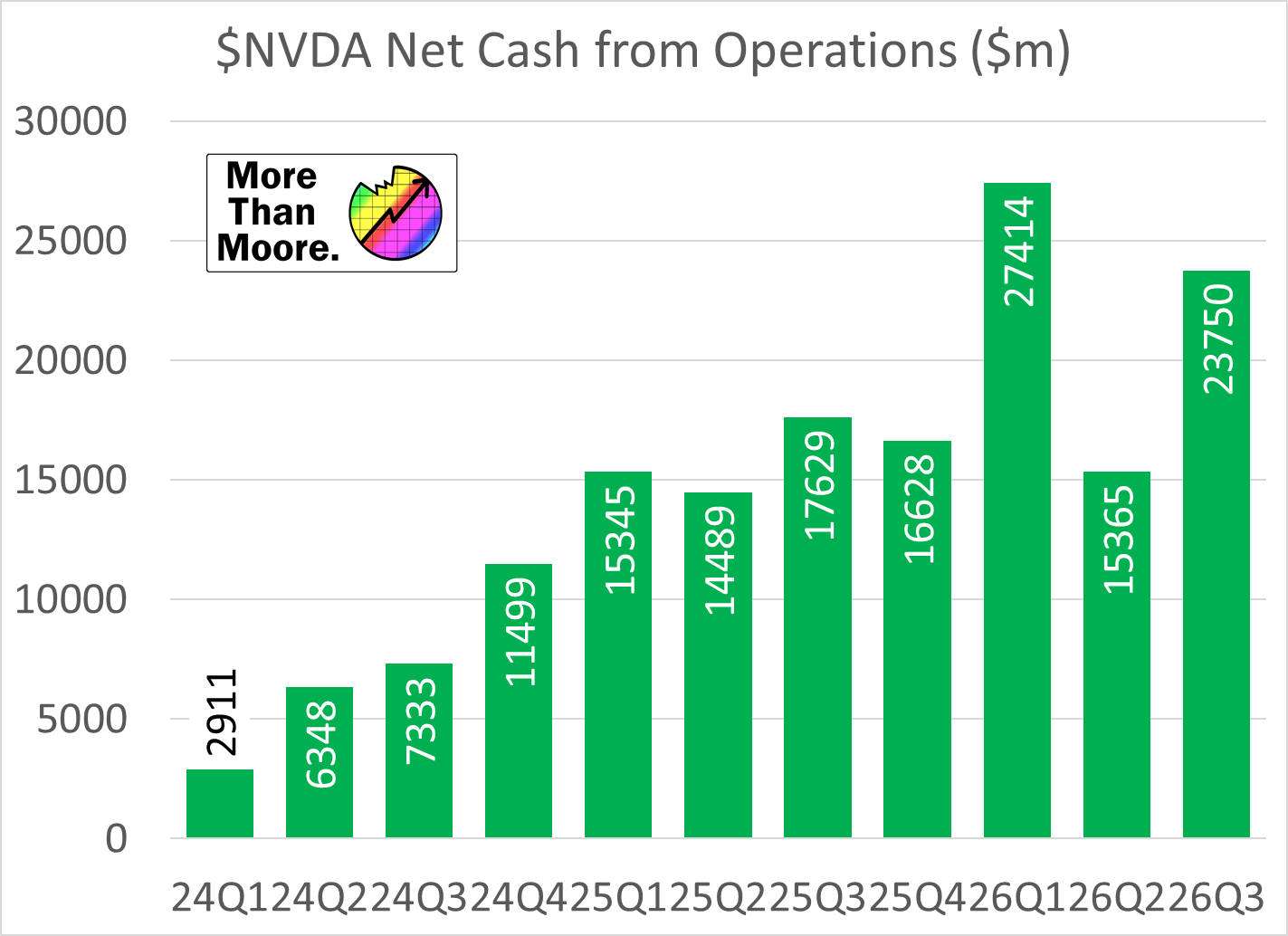
For a company that, according to a report by The Information, was recently in poor financial shape and had even slashed its 2025 revenue forecast by about three-quarters, this is an astronomical price. But for Nvidia, it might be money well spent. As of the end of October, the company was sitting on $60 billion in cash with extremely strong operating cash flow, fully capable of supporting such a strategic move.
Nvidia's Net Cash from Operating Activities (in millions of dollars)
Source: More Than Moore
The essence of this transaction is more of a hybrid between an "acqui-hire" and a strategic investment. What Nvidia bought is a critical piece of the puzzle to secure its future moat.
The Strategic Calculus: Consolidating Dominance in AI Inference
Nvidia's move is, first and foremost, a frank acknowledgment of the evolving trends in the AI market. For a long time, Nvidia's GPUs have been the undisputed kings of model training. However, as AI applications become more widespread, the demand for model inference—the actual running of AI models—is rapidly growing. Inference scenarios prioritize low latency and low cost, which are not the absolute strengths of general-purpose GPUs.
Analysts from firms like Bank of America believe this move suggests Nvidia concedes that the rapid shift toward inference may require more specialized chips. In an internal email, Nvidia CEO Jensen Huang also stated his plan to integrate Groq's low-latency processors into the Nvidia AI factory architecture to serve a broader range of AI inference and real-time workloads.
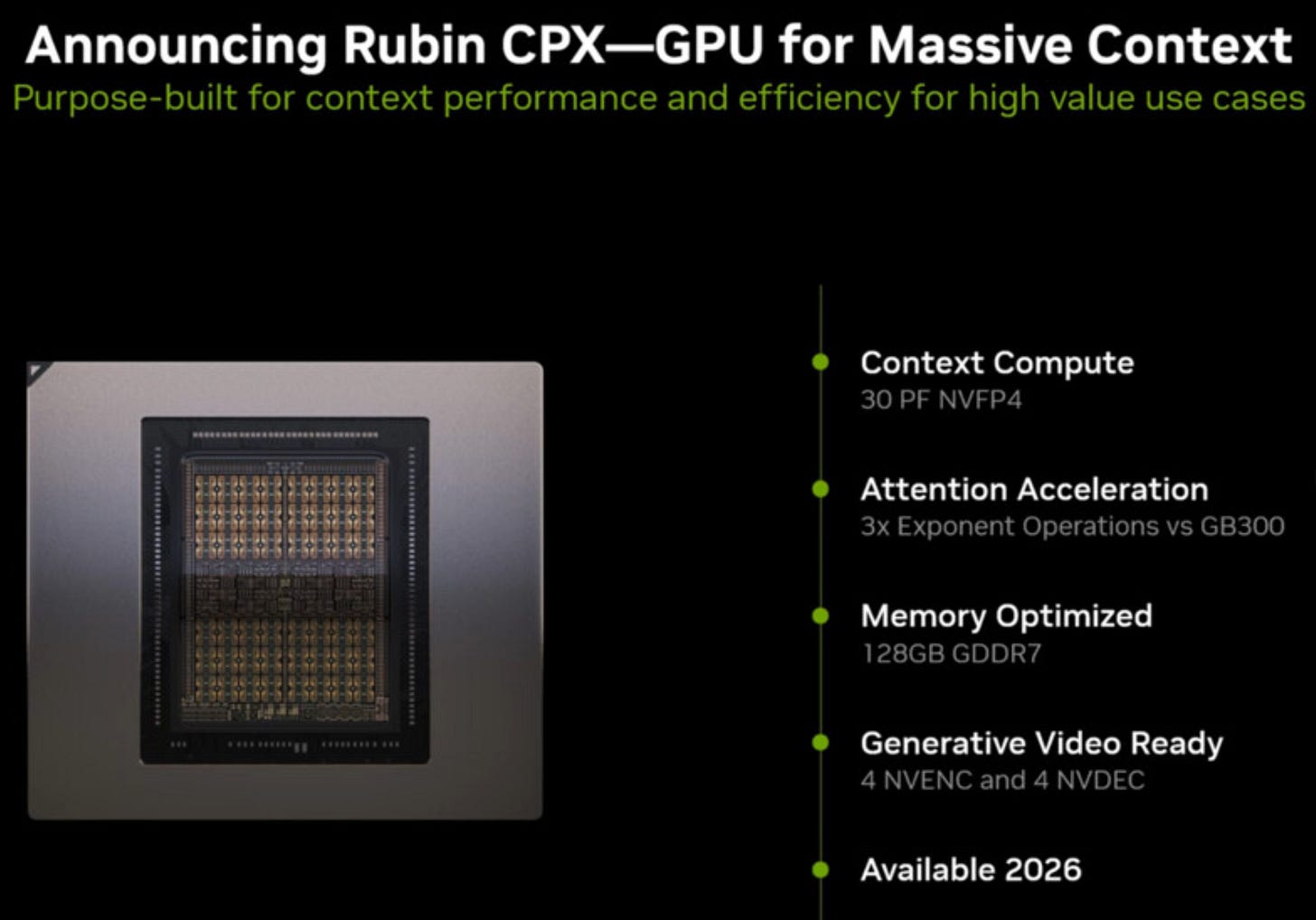
In fact, Nvidia had already begun making its move. In December 2025, the company announced the Rubin CPX chip, specifically targeting inference scenarios. It uses cheaper GDDR memory instead of expensive HBM, aiming to reduce inference costs. Groq's technology will significantly accelerate this process.
Nvidia unveils the Rubin CPX GPU, designed for large-scale contexts
Source: Nvidia
A deeper, and more defensive, motivation for the deal is to neutralize a potential competitive threat. Dylan Patel, chief analyst at SemiAnalysis, pointed out that Groq's future chip roadmap might contain technology that made Nvidia "uncomfortable." Rather than letting that potential fall into the hands of competitors like Google or Meta, it was better to strike first and bring them into the fold.
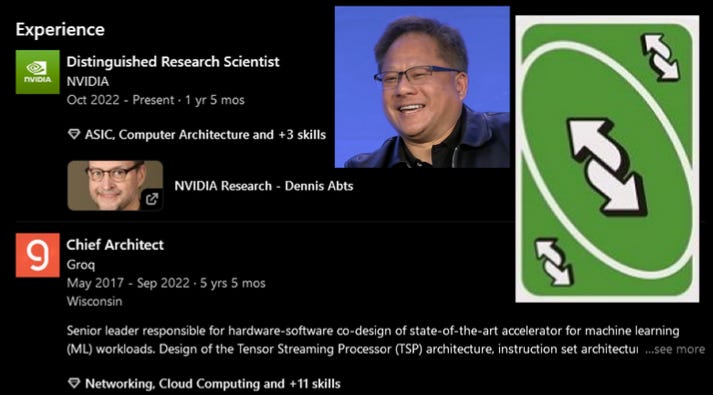
By bringing top talent like Jonathan Ross (who was also a key inventor of Google's TPU) under its roof, Nvidia not only gains invaluable expertise but, more importantly, prevents competitors from leveraging Groq's technology and talent, thereby defending its massive CUDA ecosystem. As the resume of Groq's former Chief Architect, Dennis Abt, reveals, he had quietly joined Nvidia in late 2022, perhaps laying the groundwork for today's deal.
The resume of Groq's Chief Architect, Dennis Abt, shows he had already joined Nvidia
Source: LinkedIn, Irrational Analysis
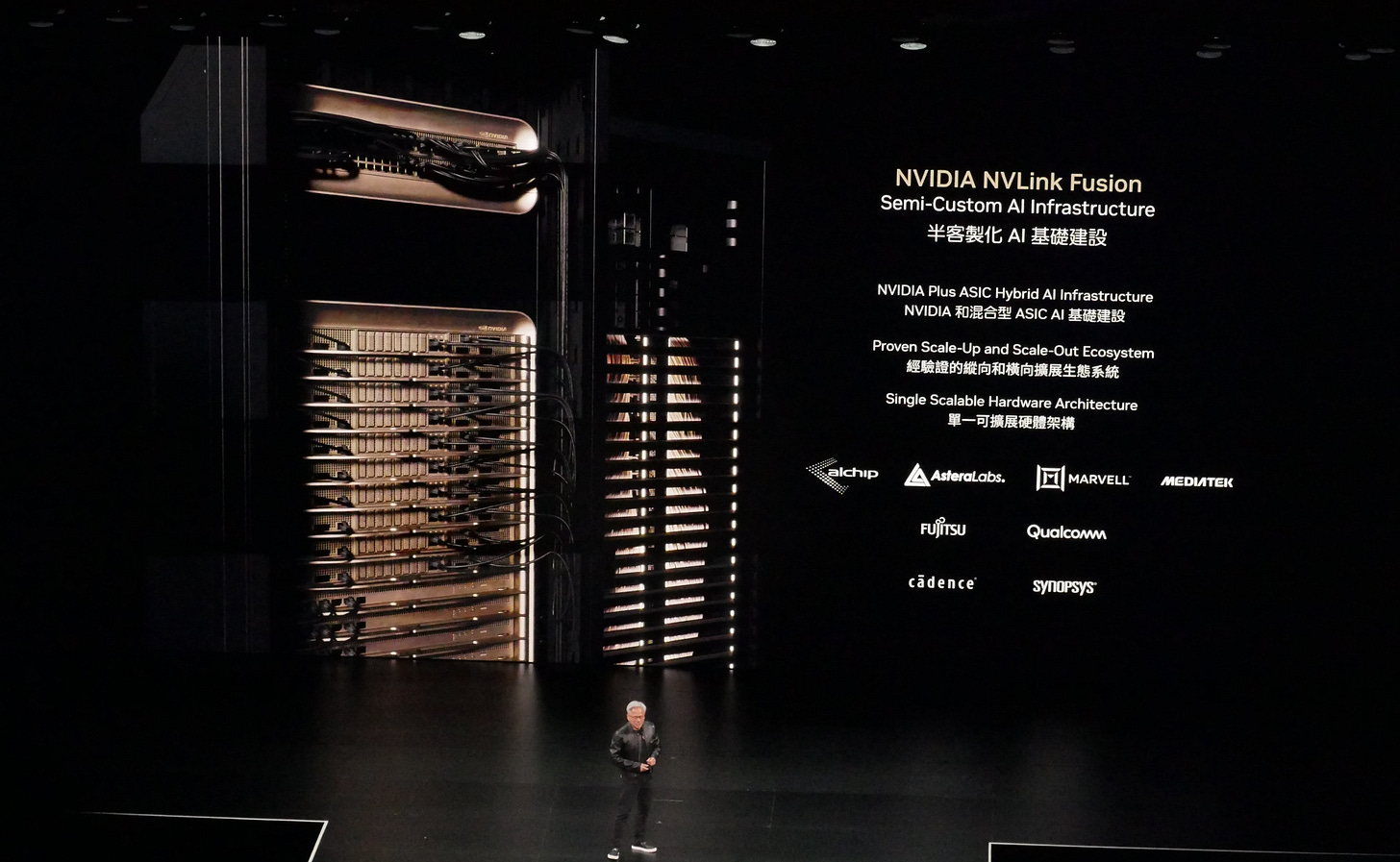
Furthermore, the move may also be intended to promote Nvidia's NVLink Fusion semi-custom infrastructure to a wider range of customers, further solidifying the dominance of its hardware ecosystem.
Nvidia's NVLink Fusion semi-custom AI infrastructure
Source: Nvidia
A Tech Deep Dive: What Exactly is Groq's "Radical" Architecture?
The reason Nvidia places such a high value on Groq's technology lies in its unique design. At its core is a chip called the LPU (Language Processing Unit), which employs a design philosophy radically different from mainstream GPUs.
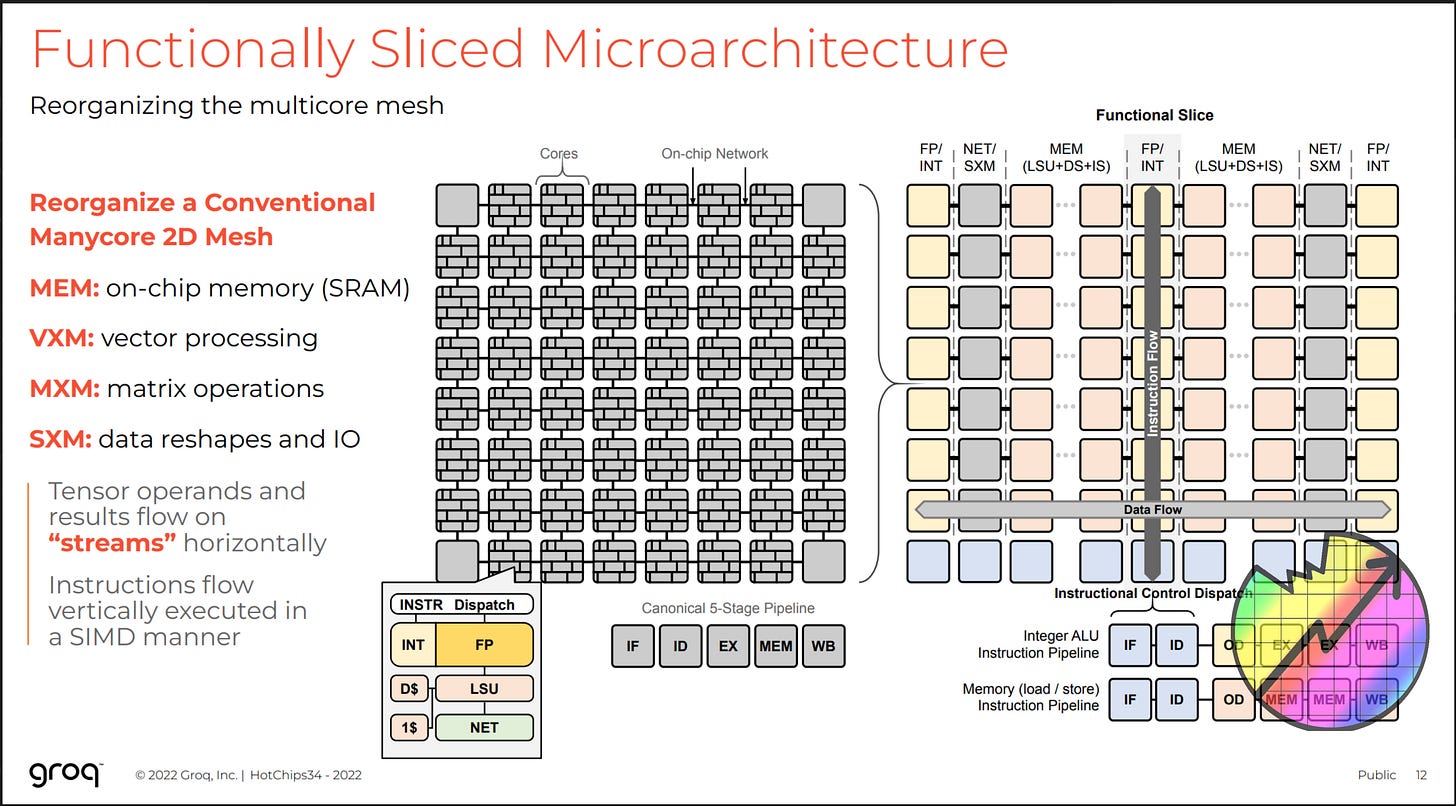
- Core Architecture: VLIW (Very Long Instruction Word): Groq's chip design is like a precisely choreographed "Swiss watch." It requires the compiler to plan out every single operation in advance before execution. The advantage is the theoretical potential for extremely low latency and high efficiency, but the disadvantage is equally fatal—it places immense demands on the compiler, creating a "hellishly difficult" software problem. Historically, many VLIW architectures, including Intel's Itanium, failed for this very reason. The functionally layered microarchitecture shown below visually reveals the complexity of its instruction and data flow.
Groq's functionally layered microarchitecture
Source: Groq / HotChips34
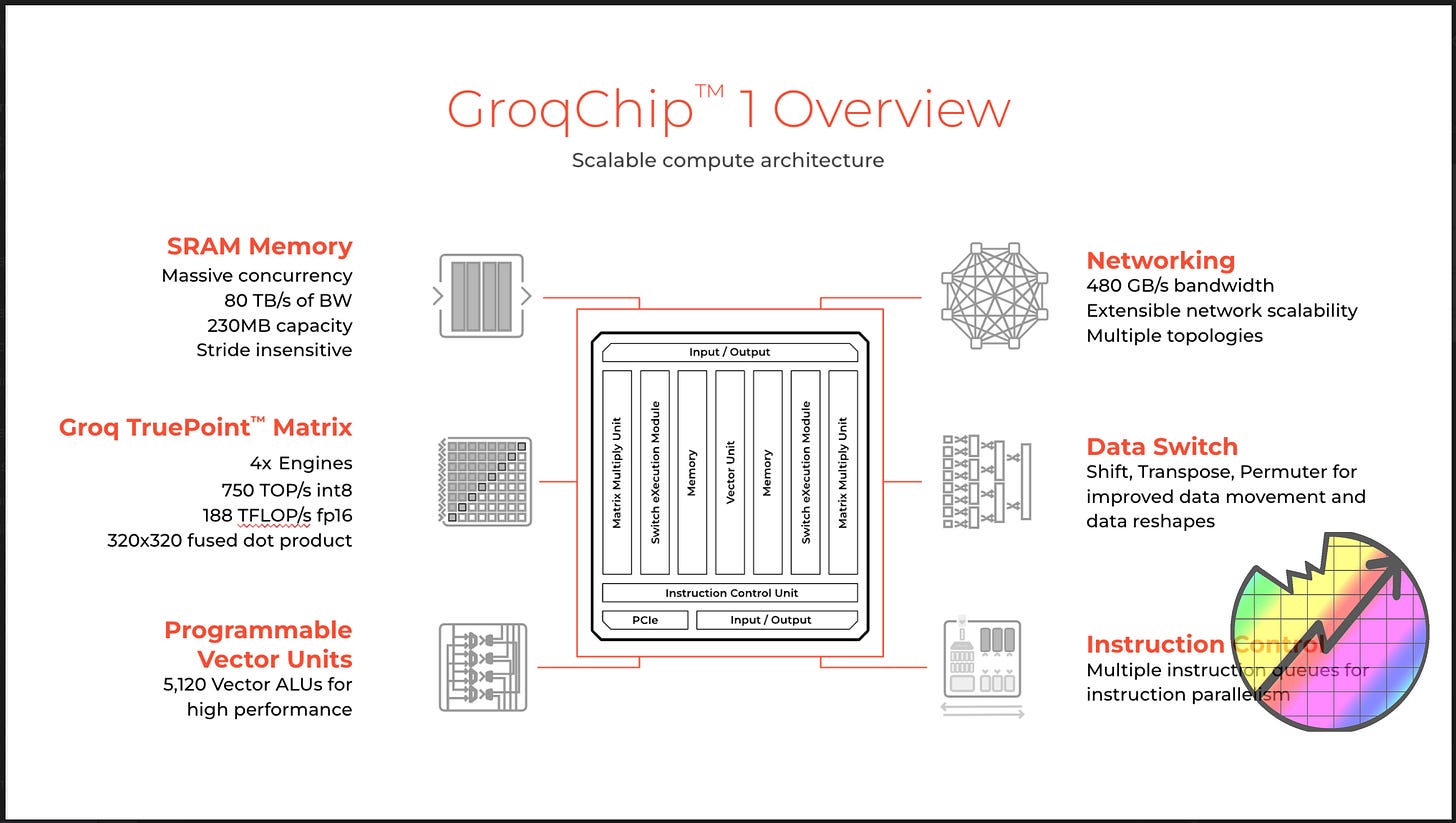
- Memory Design: On-Chip SRAM Only: The GroqChip 1 uses no external memory at all, relying solely on its 230MB of on-chip SRAM. This is akin to having only a lightning-fast but limited-capacity "backpack" (SRAM) without a massive but slightly slower "warehouse" (HBM). This design makes it incredibly fast when processing small models but less power-efficient when running larger ones.
Overview of GroqChip 1
Source: Groq
This radical design is a double-edged sword. It offers unparalleled performance in specific scenarios but also introduces enormous engineering challenges and application limitations. What Nvidia likely sees is the immense potential of this design, believing that with its own powerful software and engineering capabilities, it can tame this "wild horse."
An Expensive Insurance Policy
Returning to the original question: why did Nvidia make such a seemingly perplexing deal?
The answer is now clear. This was not an impulsive splurge but a far-sighted strategic investment. Nvidia used its vast cash reserves to buy itself an expensive "insurance policy." This policy not only shores up its shortcomings in the specialized inference market (offense) but also preemptively defuses a "technical time bomb" that could threaten its dominance (defense), all while cleverly sidestepping the antitrust scrutiny a direct acquisition might have triggered.
Although the future of the independent Groq, having lost its founder and core engineers, remains uncertain, for Nvidia, that may no longer be important. They have already gotten what they wanted: the talent, the technology, and more importantly, a more secure future.
In the high-stakes game of AI chips, Nvidia has once again demonstrated its determination and boldness as the market leader: not just to win the present, but to lock down the future.


