
A Tale of Two Headwinds: Sizing Up the Manageable Threat and Existential Gambit in Trump's Credit Card Proposals
Can the global payments duopoly weather Trump's two-front assault on credit cards—and which threat should investors actually fear?


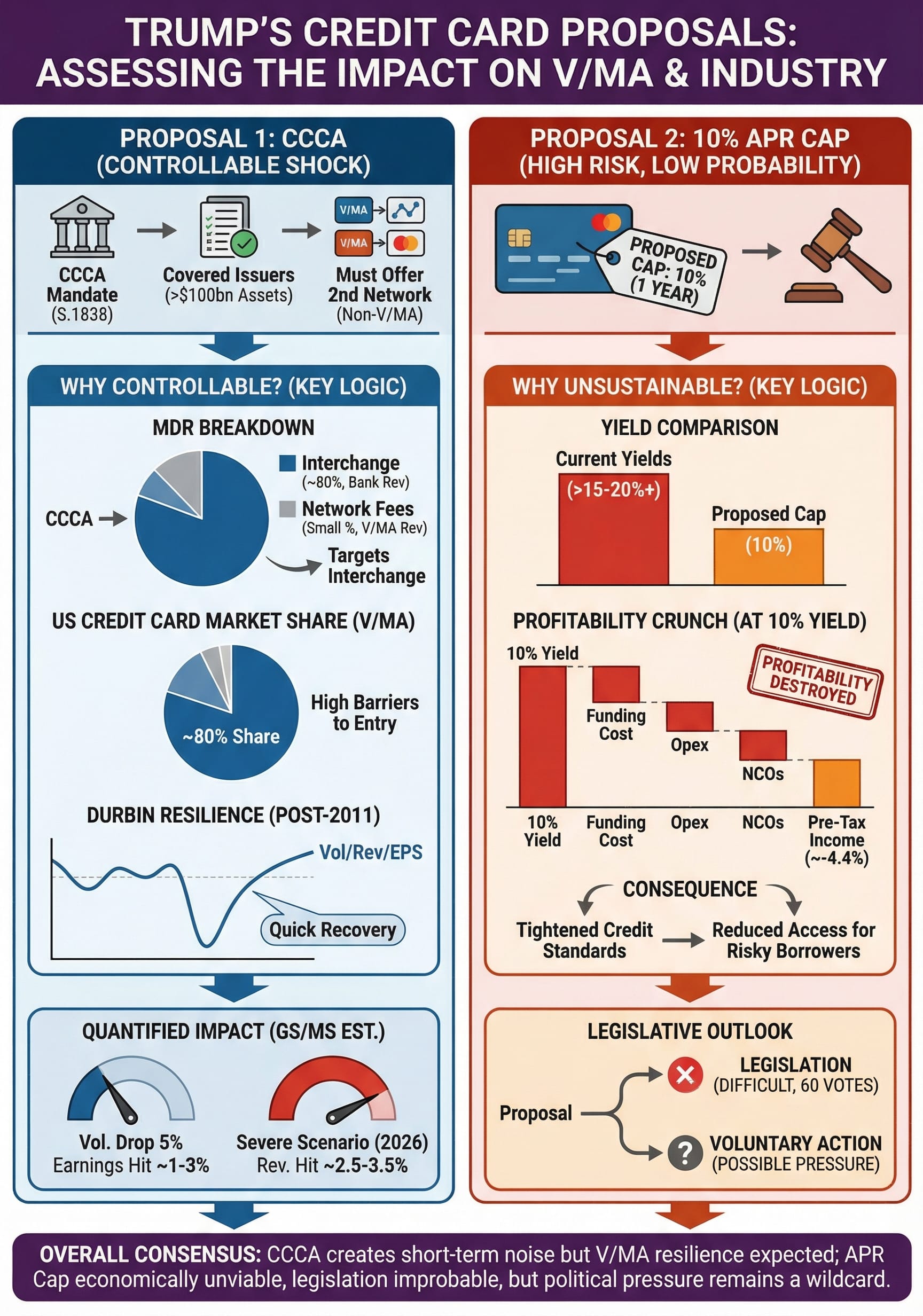
A Tale of Two Headwinds: Sizing Up the Manageable Threat and Existential Gambit in Trump's Credit Card Proposals
When Donald Trump took to Truth Social to fire consecutive shots at the credit card industry, Wall Street analysts reached for their calculators. Two policy proposals—the Credit Card Competition Act (CCCA) and a 10% annual interest rate cap—may appear to be aimed at the same target. In reality, they tell two fundamentally different stories. One might trigger short-term stock volatility. The other, if actually implemented, could shake the very foundations of American consumer credit.
Understanding the distinction between these two headwinds is essential for assessing the investment case for Visa and Mastercard.
The First Headwind: The Credit Card Competition Act—Déjà Vu of "Durbin 2.0"
The core logic of CCCA is straightforward: mandate that large card-issuing banks with assets exceeding $100 billion offer at least two unaffiliated payment networks on every credit card, with one network that cannot be Visa or Mastercard. This mirrors the Durbin Amendment enacted in 2011 for debit cards—designed to introduce competition and compress the swipe fees merchants pay on each transaction.
A critical distinction deserves clarification here. Merchant swipe fees break down into two components: interchange fees, collected by issuing banks and accounting for roughly 80% of the total; and network fees, flowing to Visa and Mastercard, which represent the smaller slice. CCCA's artillery is primarily aimed at the former, not the latter. This means that even if the bill passes, the direct financial impact on the two card networks would be limited.
Goldman Sachs estimates the U.S. credit card swipe fee ecosystem generates approximately $223 billion in annual revenue. Within that pie, Visa and Mastercard's share is not the dominant portion.
Components of the Swipe Fee Revenue Ecosystem
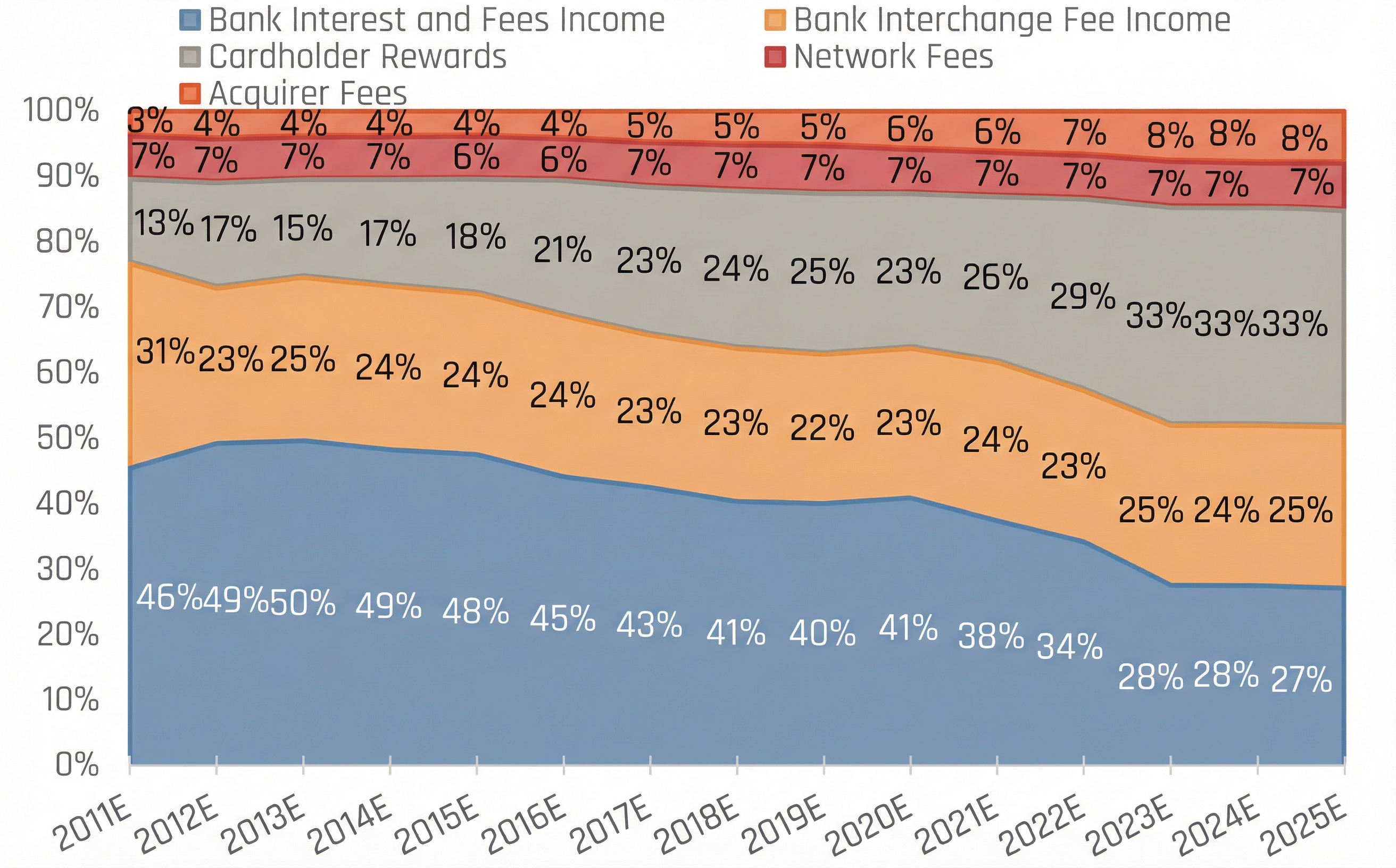
Source: Goldman Sachs, Jarvis
History as the Best Reference Point
Investors are not without experience navigating this type of regulatory shock. Following the Durbin Amendment's implementation in 2011, Visa and Mastercard did lose approximately 5% of debit card transaction volume. But the story did not end there.
Morgan Stanley's research shows that after the initial pain, both card networks stabilized quickly, leveraging their scale advantages and pricing power. Debit transaction volume growth resumed its trajectory after a brief slowdown. EPS growth regained momentum within a few quarters.
V/MA Debit Transaction Volume Growth Post-Durbin
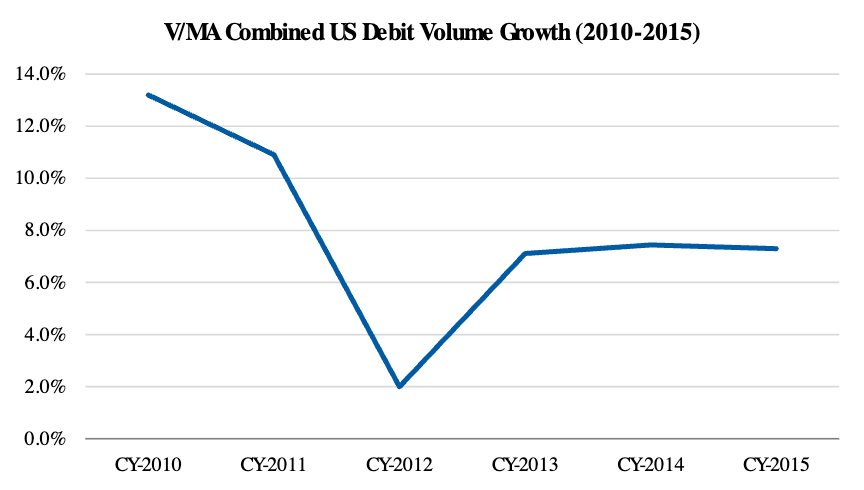
Source: Morgan Stanley
More importantly, today's Visa and Mastercard are far more diversified than their 2012 selves. Value-added services, cross-border payments, and B2B flows provide a thicker safety cushion. Under a pessimistic scenario assuming 10% volume migration and 25% fee pressure, Morgan Stanley estimates the revenue impact on Visa's FY2026 at around 3.5%, and on Mastercard at roughly 2.5%—not insignificant, but far from fatal.
Visa FY26 Scenario Analysis: Potential Impact from Volume Migration and Fee Pressure
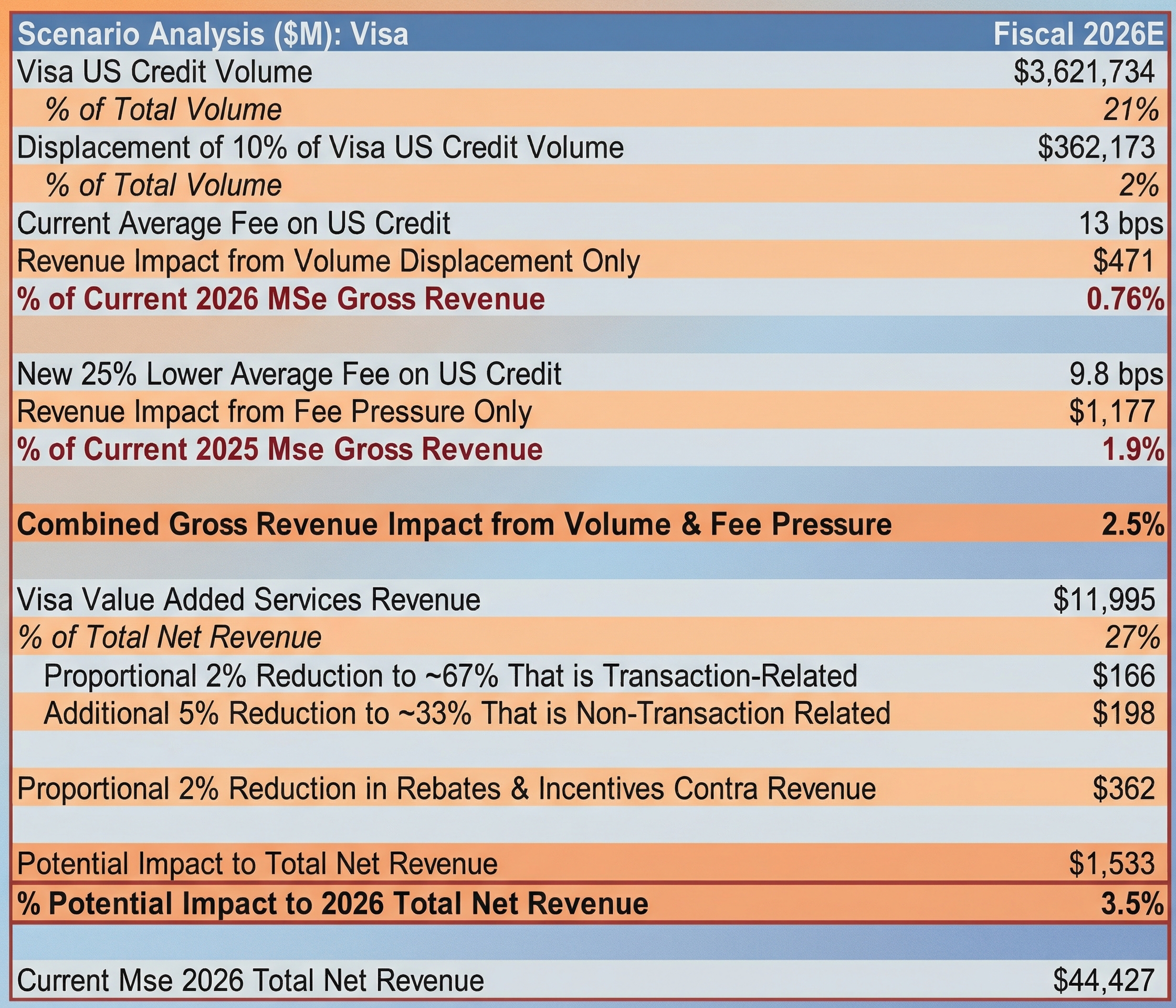
Source: Morgan Stanley, Jarvis
Citi's recent report highlights a historical pattern worth noting: when markets panic-sell payment network stocks on policy fears, those moments often prove in hindsight to be entry opportunities. This is not an endorsement of catching falling knives—rather, a reminder not to let short-term sentiment drive long-term decisions.
The Second Headwind: The 10% Interest Rate Cap—A Dud Bomb with Dubious Economic Logic
If CCCA represents a quantifiable, predictable regulatory skirmish, Trump's proposed 10% APR cap is more like an unexploded bomb—tremendous potential force, but a questionable fuse.
The current average yield on U.S. credit cards sits well above 15%, with revolving balance rates commonly exceeding 20%. What would a hard cap at 10% actually mean?
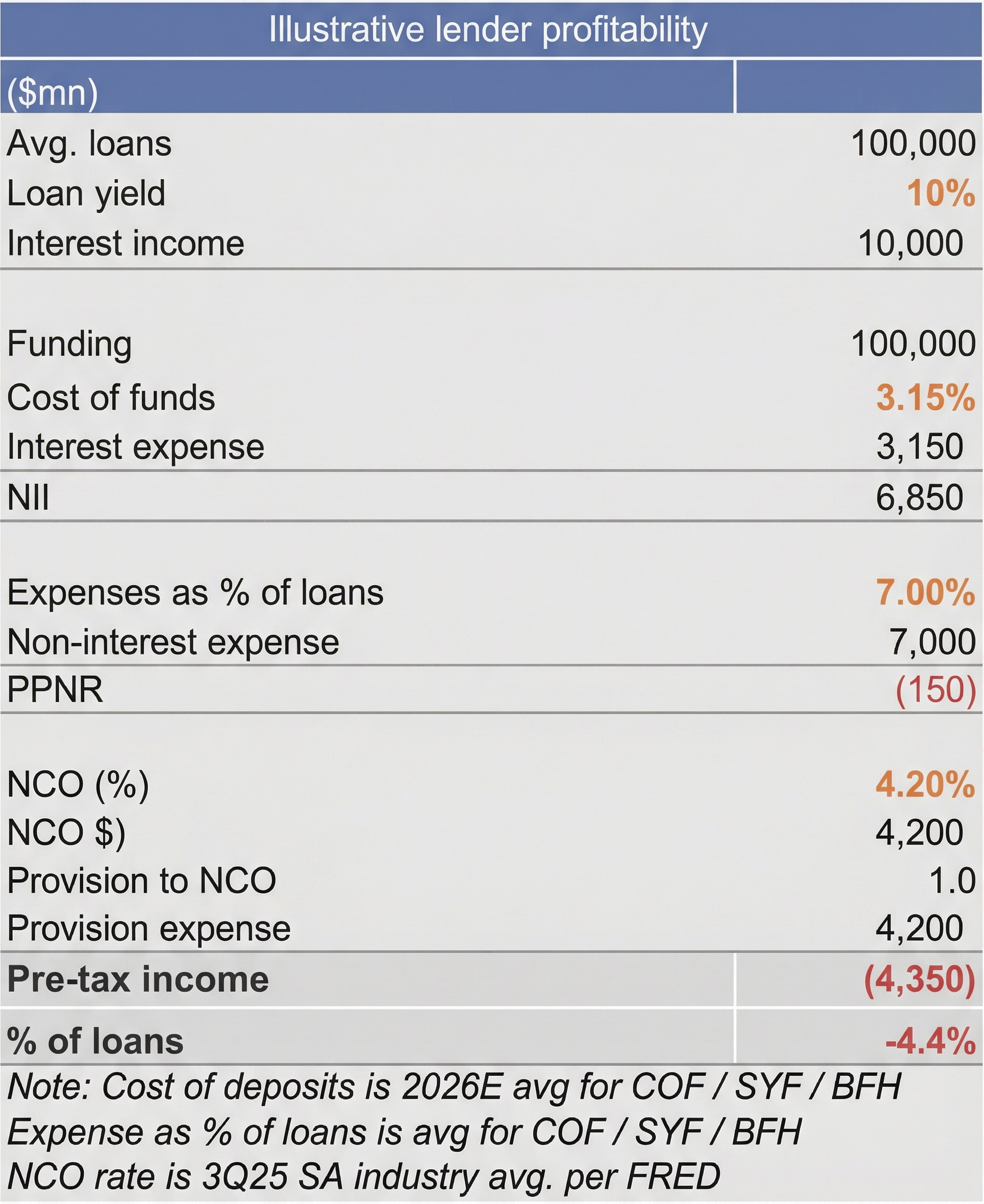
Goldman Sachs ran the numbers: at a 10% loan yield, after deducting funding costs, operating expenses, and charge-offs (industry net charge-off rates currently range from 4-7%), a typical card issuer's pre-tax income would plunge to -4.4% of total loans. In other words, the credit card business would operate at a direct loss.
Credit Card Profitability Under a 10% Yield Scenario
Source: Goldman Sachs, Jarvis
This is not a question of fine-tuning. It is a question of whether the business model can exist at all.
Under such a scenario, banks would almost certainly tighten credit standards dramatically. The first casualties? Borrowers with weaker credit profiles—precisely the population that interest rate cap policies claim to protect. This policy "blowback effect" has a classic name in economics: adverse selection.
Low Probability, But Not Zero
For these reasons, Wall Street broadly views the proposal's chances of becoming law as slim. The legislative process itself presents a high bar—60 votes in the Senate, a simple majority in the House. Although bipartisan lawmakers have previously co-sponsored similar bills (such as the Sanders-Hawley version), these efforts stalled before gaining meaningful traction.
Yet the story may not end at the legislative level.
Goldman Sachs reminds investors to watch for a "soft implementation" pathway: voluntary industry action. This is not idle speculation. In pharmaceuticals, Trump previously urged drug companies to voluntarily reduce Medicaid prices. Subsequently, major pharma players did reach agreements with the administration. If similar political pressure transmits to the banking sector, we could see large card issuers make concessions on rate pricing—though the extreme target of 10% is nearly impossible to achieve through voluntary means.
This is the "gray rhino" investors should watch: the bill may not pass, but the industry's preemptive concessions to deflect political risk could themselves affect earnings expectations.
Conclusion: Distinguishing Noise from Signal
Two policy proposals. Two entirely different risk landscapes.
CCCA is a quantifiable, predictable, and historically comparable regulatory battle. Even if it ultimately passes, Visa and Mastercard possess sufficient resilience to absorb the impact—just as they demonstrated in the aftermath of the Durbin Amendment.
The 10% interest rate cap is an extreme hypothesis whose economic logic can barely hold together. It functions more as a political signal than an executable policy framework. But "low probability" does not equal "zero impact"—the industry's self-adjustment under political pressure is itself a variable worth tracking.
For long-term investors in Visa and Mastercard, the task at hand is maintaining clarity: neither panicking over short-term price swings nor dismissing potential tail risks. After all, in the history of the payments industry, what truly changed the game was never any single piece of legislation—but the deeper evolution of technology and consumer behavior.


