
arXiv - Can We Achieve Zero-Error Performance on Million-Step Tasks?
As AI models grow ever larger, is building a singular 'super-brain' the only path to solving ultra-complex problems? Or could the answer lie in shattering intelligence into a million tiny, perfectly coordinated pieces?


Solving a Million-Step LLM Task with Zero Errors
When Intelligence is Shattered into a Million Pieces
Imagine a scenario: you assign a delicate task to an exceptionally brilliant intern who occasionally makes "foolish mistakes." The task is to assemble a complex machine with a million steps. Even if their accuracy for each step is an astonishing 99.9%, the occurrence of a single error over the entire process is a near mathematical certainty. And that one tiny mistake is enough to bring the entire project to ruin.
This is the immense dilemma facing today's Large Language Models (LLMs) on their path toward higher intelligence. They excel in single-step conversations or reasoning, but once the task chain lengthens, requiring hundreds or thousands of consecutive, error-free steps, their reliability plummets. A recent paper points out that even the most advanced LLMs see their success rate drop to zero when solving the classic "Tower of Hanoi" problem as the number of disks—and thus the steps—increases beyond a few hundred.
This raises a fundamental question: how can we possibly build an AI system capable of completing ultra-complex tasks with millions of steps at nearly 100% accuracy? Should we continue to bet on the path of "bigger, stronger, smarter," or is there another, overlooked road?
A paper titled "Solving a Million-Step LLM Task with Zero Errors" offers a distinctly different answer. Its core insight is resounding: perhaps we shouldn't be fixated on creating an omnipotent "super-brain." Instead, we should do the opposite—shatter a colossal task into countless, extremely simple micro-tasks, and then leverage a vast number of "micro-agents" through a clever collaborative mechanism to ensure the absolute correctness of every single step.
This framework is called MDAP (Massively Decomposed Agentic Processes), and MAKER is its first stunning implementation.
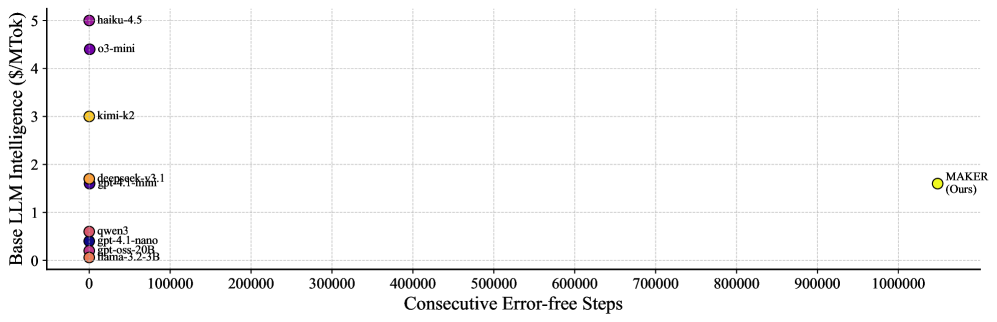
The chart below clearly reveals the uniqueness of this new path. The traditional approach (vertical axis) focuses on continuously increasing a single model's "intelligence," but this yields diminishing returns in extending the number of consecutive error-free steps (horizontal axis). The MAKER system, however, charts a new course, achieving a massive breakthrough along the horizontal axis. It proves that by changing the method of organization, rather than relying solely on the power of the components, we can achieve an unprecedented level of reliability.
Two Orthogonal Paths to Scaling AI Capabilities
Source: arxiv.org/html/2511.09030v1
The Three Pillars of MAKER: A New Paradigm of Collaboration
The success of the MAKER system is no accident. It is built upon three interconnected and indispensable pillars. The design philosophy behind this combination reflects a wisdom that is worlds apart from the mainstream "brute-force" approach.
1. Maximal Agentic Decomposition (MAD): The Art of Extreme Simplification
This is the cornerstone of the entire system. The concept of MAD is simple yet radical: to break down a complex, long-chain task to its finest possible granularity—where each agent is responsible for executing only one single step.
This might sound counter-intuitive, but it is rooted in profound logic. It's like a modern assembly line in a massive factory, where each worker only needs to perfectly tighten the single screw in front of them, without needing to understand the complex blueprint of the entire product. This "focus" brings three major benefits:
- Simplicity and Focus: Each agent only needs to process the minimal amount of information required for the current step, drastically reducing cognitive load and preventing them from getting lost in a lengthy context.
- Lower Cost and Barrier to Entry: Because individual tasks become extremely simple, the system no longer relies on the most powerful and expensive "GPT-4 level" models. Many smaller, more economical models are sufficient for the job, making large-scale application economically viable.
- Enabling Error Correction: Only by modularizing the task into discrete steps can we insert verification and correction mechanisms between each one. If the entire task were completed by a single agent in one go, a mistake midway would be like spilled water—nearly impossible to locate and fix.
2. First-to-ahead-by-k Voting: Using Statistics to Combat Randomness
Since each step is isolated, we can leverage "collective intelligence" to ensure its correctness. MAKER employs a "first-to-ahead-by-k" voting rule. For example, the system can dispatch 3 or more agents to solve the same step simultaneously. If k is set to 2, then when one answer receives 2 more votes than any other, that answer is adopted as the final decision for that step.
The power of this mechanism lies in its clever use of statistics to eliminate the inherent random errors of LLMs. A single model might occasionally make a "silly mistake," but the probability of multiple independent models making the exact same "silly mistake" on the same step at the same time is vanishingly small. Through voting, these random, inconsistent wrong answers are effectively filtered out.
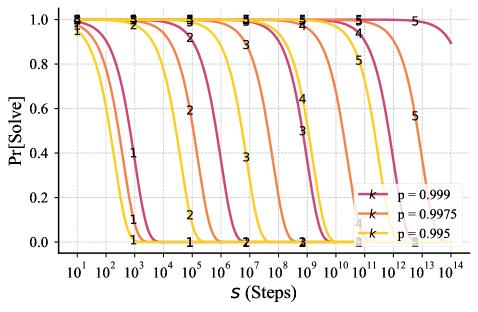
The paper's mathematical derivations lead to an exhilarating conclusion: as long as a single agent's one-step accuracy is greater than 50%, we can theoretically approach 100% success for each step by simply increasing the voting threshold k.
The chart below visually demonstrates the power of this error-correction capability. Even if the base model's single-step accuracy is only 90% (meaning a 10% error rate), by setting k high enough (e.g., k=4), the probability of achieving zero errors in a million-step task can approach 100%.
MAKER Scaling Law for Zero-Error Solve Rate
Source: arxiv.org/html/2511.09030v1
3. Red-Flagging: Decisive Rejection, Not Reluctant Repair
This is an elegant and highly efficient quality control valve within the system. If an agent's output shows obvious "danger signals"—such as being too long, incorrectly formatted, or nonsensical—the system doesn't try to "understand" or "fix" it. Instead, it directly shows that vote a "red card," treating it as invalid and resampling a new voter to join the process.
This seemingly simple mechanism solves one of the trickiest problems in voting systems: "Correlated Errors." On certain specific steps, models can fall into a kind of systemic confusion, causing multiple votes to converge on the same wrong answer. The paper found that when an LLM begins to produce overly long or chaotically formatted content, the probability of its reasoning being flawed also increases significantly. By identifying these early signals of a confused state, the red-flagging mechanism ejects these "bad votes" before they can form a consensus, effectively breaking the correlation between wrong answers and greatly enhancing the robustness of the voting system.
The Surprising Discovery: The Most Reliable is Also the Most Economical
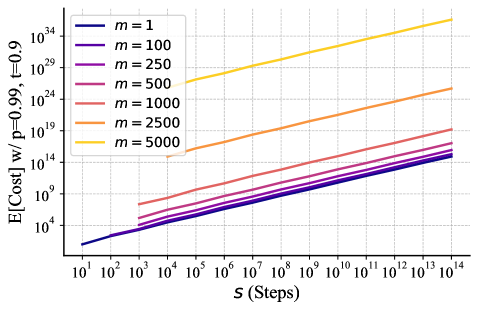
The MDAP framework not only achieves a breakthrough in reliability but also arrives at a subversive conclusion regarding cost-effectiveness. Through a rigorous cost analysis, the paper discovers that the more finely the task is decomposed (i.e., the smaller the number of steps m each sub-task contains), the lower the total cost required for the system to achieve the same level of reliability.
As shown in the chart below, as the number of steps m each agent is responsible for increases, the cost required to achieve the same reliability explodes exponentially. This means the "maximal decomposition" strategy of m=1 is not only the most effective but also the most economical.
The Impact of Decomposition on Cost
Source: arxiv.org/html/2511.09030v1
This finding was directly reflected in the model selection for the experiments. After evaluating various LLMs, the team found that the most expensive "frontier" models were not the best choice. After considering both single-step success rate and API call cost, a relatively small and inexpensive model, gpt-4.1-mini, emerged as the most cost-effective option.
This once again validates the core idea of the MDAP framework: the system's strength comes from its superior organization, not the supreme power of its individual components.
The Million-Step Challenge and Future Outlook
The power of the MAKER system was ultimately demonstrated by solving the 20-disk Tower of Hanoi problem. This puzzle requires (approximately 1,048,575) precise moves to complete. In the end, the system completed the entire task with zero errors—a flawless and impeccable performance.
In my view, the true value of this paper extends far beyond solving a classic intellectual game. It offers a completely new technological path for the field of AI, especially for Agentic AI, one that is fundamentally different from the mainstream "brute-force" approach.
- A New Paradigm for Reliability and Safety: Decomposing complex tasks into micro-steps that can be independently audited makes every action of the system highly controllable. This has immeasurable potential value in safety-critical domains such as financial trading, medical diagnostics, and autonomous driving. It reduces the risk of "runaway AI" at the architectural level.
- The Economic Viability of Accessible AI: By proving that ultra-reliable systems can be built using smaller, more economical models, it subverts the common perception that "AI equals burning money," opening up the imagination for the popularization and large-scale application of AI technology.
- A "Microservices Architecture" for AI: This idea aligns perfectly with the concept of "microservices" in modern software engineering. Just as microservices replaced enormous, cumbersome, and hard-to-maintain monolithic applications, a distributed collaborative system composed of "micro-agents" could well become the dominant paradigm for building the next generation of complex AI applications.
Of course, this framework has its limitations. Its biggest prerequisite is that the task itself must be clearly decomposable. For tasks that rely on global insight, creative association, or ambiguous definitions (such as writing a novel or formulating a company's ten-year strategy), how to perform effective decomposition remains an unresolved open question. Furthermore, enabling AI to automatically discover the optimal path for task decomposition will be key to whether this technology can move from the laboratory to the wider real world.
Nevertheless, this paper has successfully proven that a new methodology for building super-reliable AI systems is entirely feasible. It tells us that by "shattering intelligence into a million pieces" and reorganizing them with clever mechanisms, we may be able to realize the immense potential of artificial general intelligence faster, more safely, and more economically than by simply pursuing an "omnipotent god model." Excerpt: As AI models grow ever larger, is building a singular 'super-brain' the only path to solving ultra-complex problems? Or could the answer lie in shattering intelligence into a million tiny, perfectly coordinated pieces?


