
Beyond the Open-Source Narrative: Data Reveals AI's True Moats
As the narrative of open-source disruption dominates the AI conversation, does real-world data reveal a different story about who truly commands the high-value, professional-grade market?


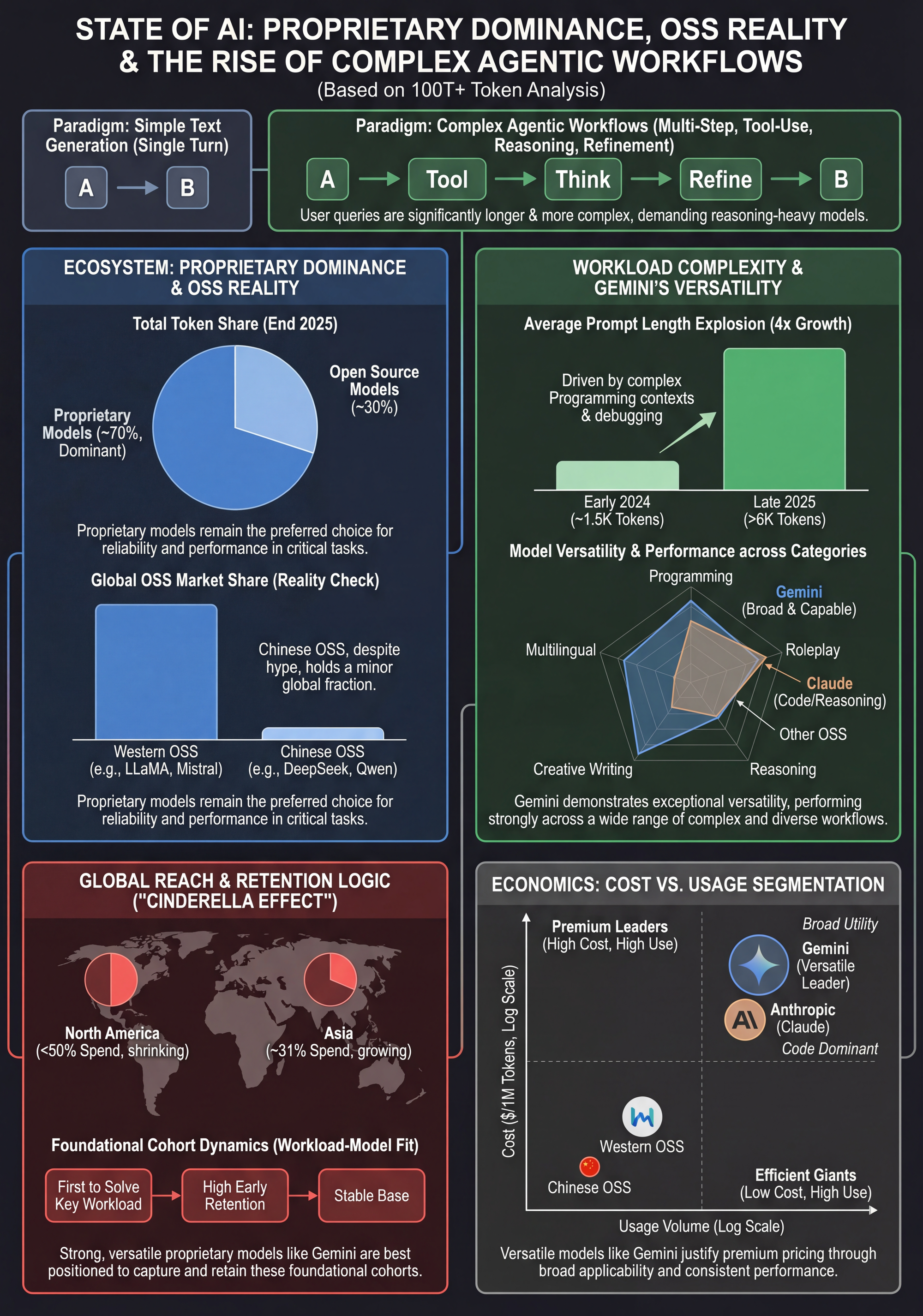
The Real State of AI: Unspoken Rules and the New Normal Revealed by Data
Amidst the constant clamor of the AI world, we are inundated daily with waves of new model releases, triumphant declarations from the open-source community, and endless speculation about the "next big disruptor." But what happens when the hype subsides? What does real user behavior look like? Based on an analysis of over 100 trillion tokens of real-world interactions, a report from OpenRouter acts as a prism, refracting the true dynamics of the AI arena that are often obscured by the glare of public opinion.
It tells us that this market is far more complex and rational than we might imagine. The main narrative isn't a simple showdown of "open-source versus closed-source," but rather a precise matching game of "workload-model fit."
The Enduring Giants and the Fleeting Challengers: Why Proprietary Models Remain the Cornerstone
Though the banner of open-source flies high, the data shows that proprietary (closed-source) models remain the most entrenched rulers of this domain.
While the total share of Open-Source Software (OSS) models has grown steadily over the past year, eventually stabilizing at around 30%—an impressive achievement in itself—it also means that the remaining 70% of token interactions in the market are still firmly in the hands of proprietary giants like OpenAI, Anthropic, and Google.
Total Token Share by Source Source: OpenRouter

This 70/30 split is no accident. The answer becomes clear when we examine the relationship between cost and usage. Proprietary models predominantly occupy the "high-cost, high-usage" quadrant of "Premium Leaders." This indicates that for scenarios requiring high reliability, top-tier performance, and the handling of complex professional tasks (such as high-stakes financial analysis or intricate code generation), users are willing to pay a premium for superior quality and stability.
Open-source models, on the other hand, shine in the "low-cost, high-usage" zone of "Efficient Giants," serving as the key drivers of mass-market volume.
Cost vs. Usage for Open-Source vs. Proprietary Models Source: OpenRouter
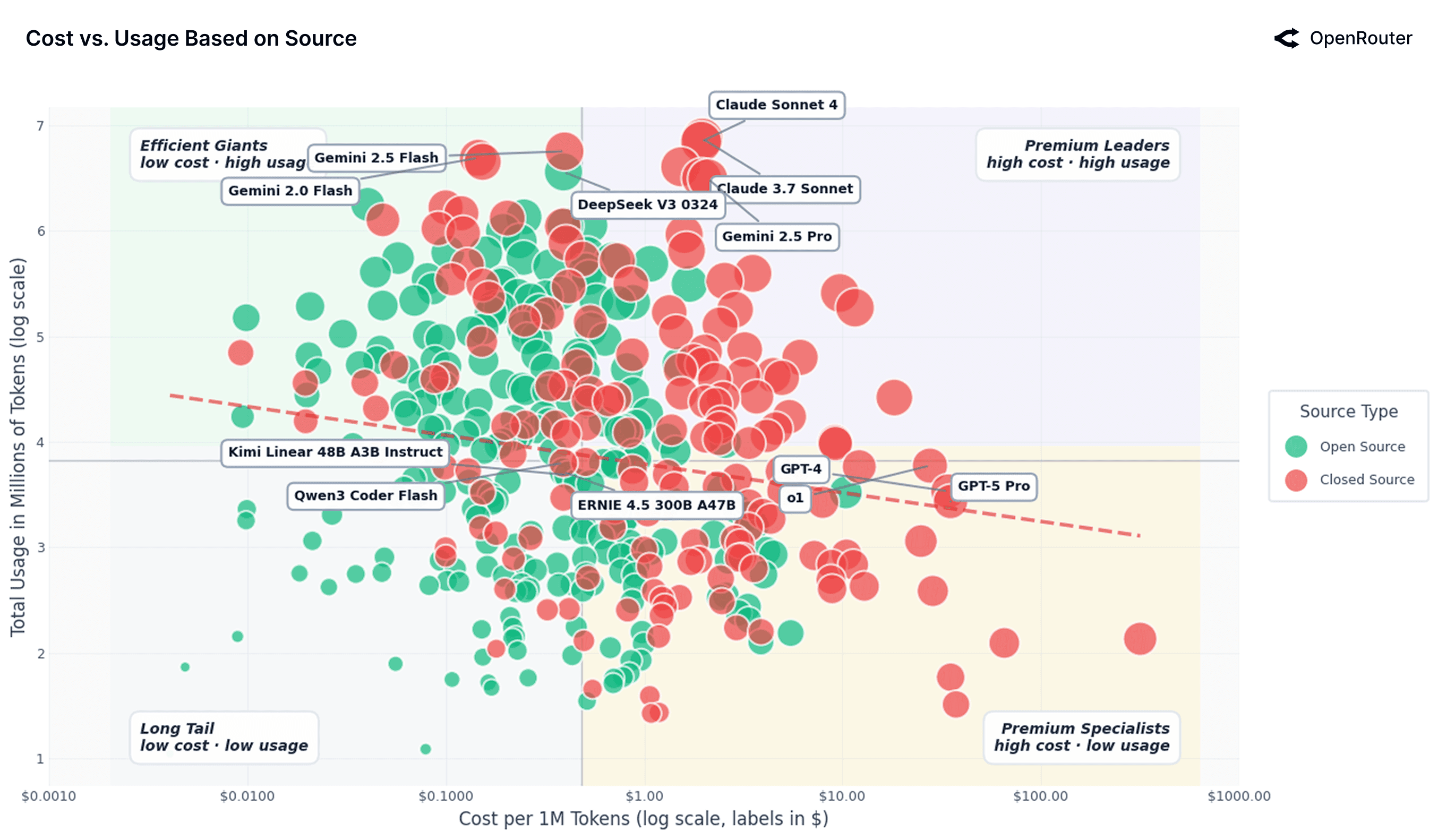
This is not a zero-sum game, but a market stratified by function. Proprietary models are the "heavy artillery" for professional productivity, while open-source models are the "light cavalry," offering high cost-effectiveness and accessibility. But without a doubt, in the most valuable core territories, the moat of proprietary models remains deep and wide.
A Song of Ice and Fire for Chinese Models: Beyond the Hype, What Are the Real Use Cases?
In recent years, open-source models from China, such as DeepSeek and Qwen, have risen meteorically. At the end of 2024, their share on OpenRouter was almost negligible. By mid-2025, their weekly share had at times captured nearly 30% of the total usage across all models, averaging a stable 13%—almost on par with the rest of the world's open-source models (RoW OSS).
However, volume and token count don't tell the whole story. A starkly different picture emerges when we delve into where these models are actually being used.
Data reveals that over half (about 52%) of all open-source model usage is dedicated to "Roleplay."
Open-Source Model Category Trends Source: OpenRouter
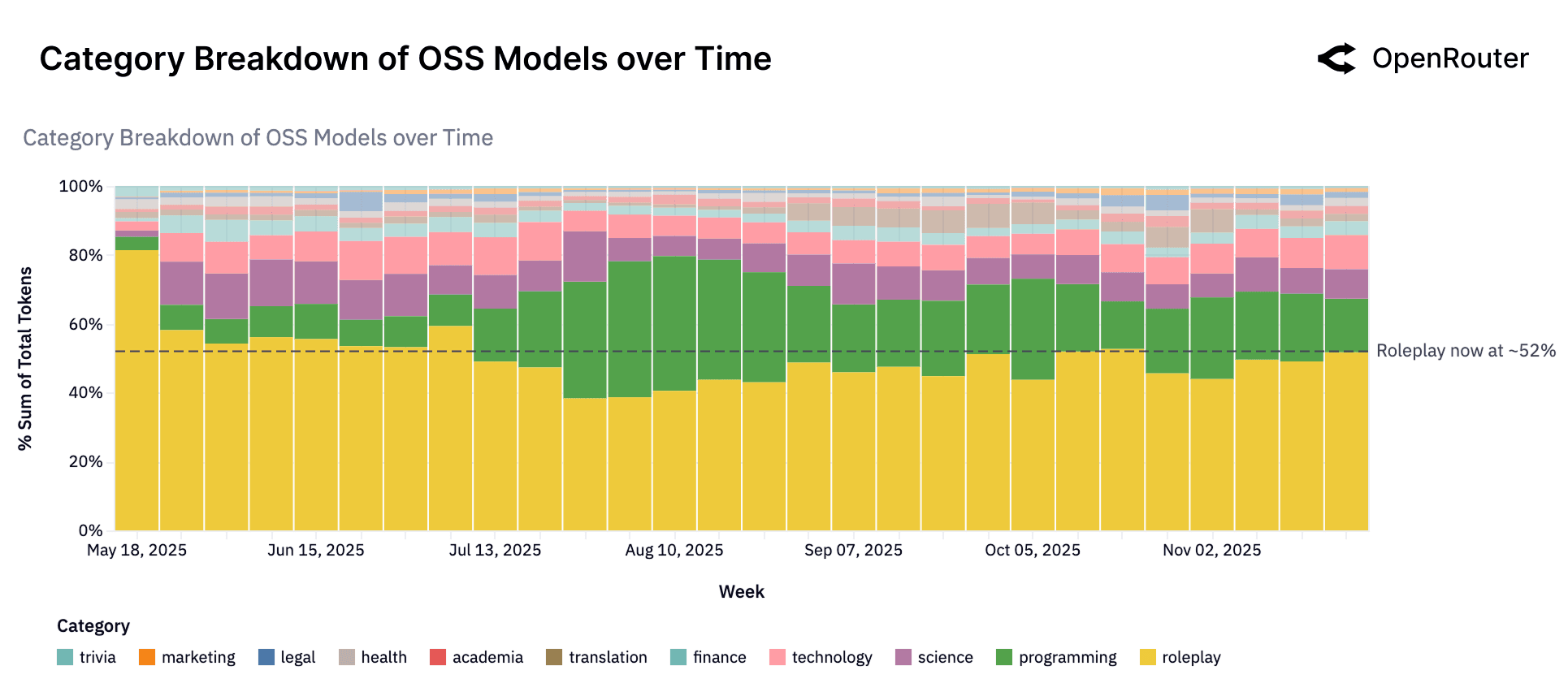
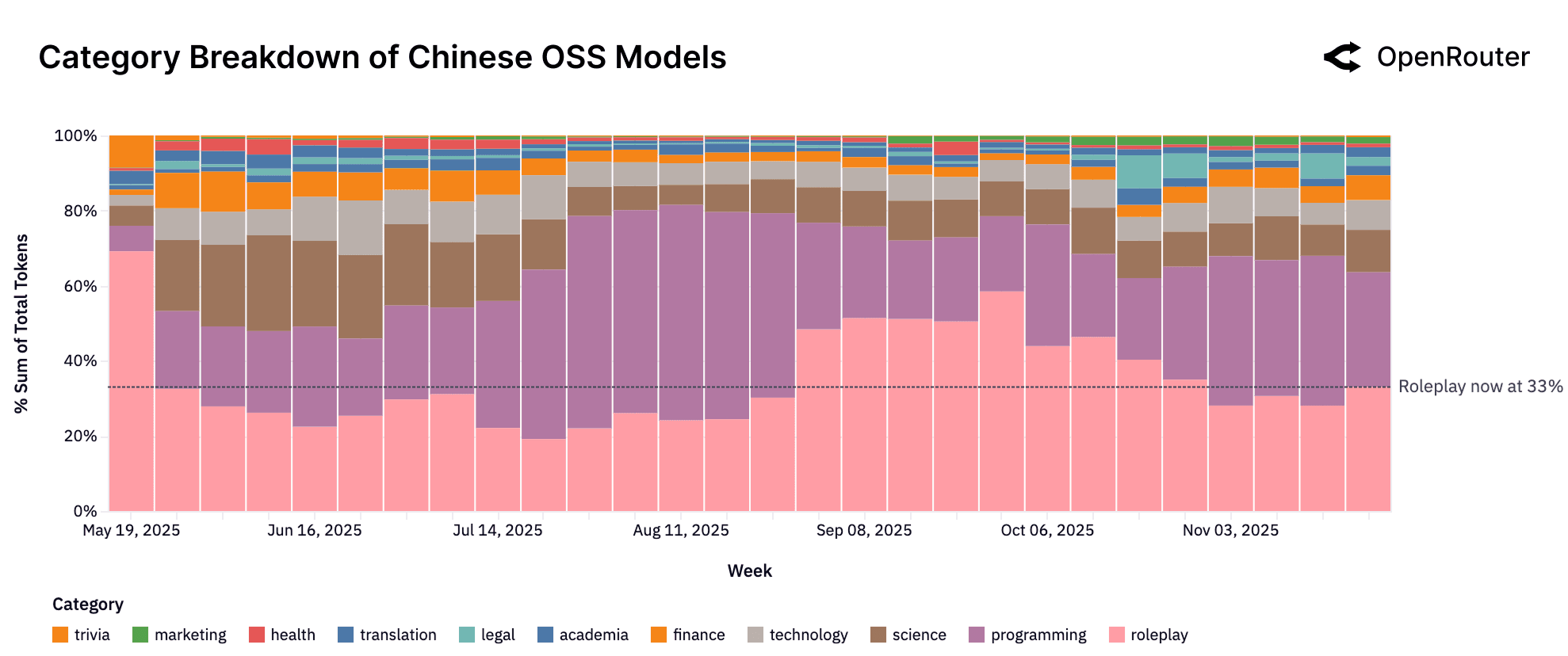
When we isolate Chinese open-source models, this trend, though moderated, persists, with "Roleplay" still being the largest single use case (around 33%). For DeepSeek, a former open-source leader, the vast majority of its tokens (over two-thirds) are used for role-playing, casual chat, and entertainment-driven interactions.
Chinese OSS Model Category Trends Source: OpenRouter
Top Tags for DeepSeek Source: OpenRouter

This isn't to say role-playing has no value—it represents a massive consumer entertainment market. But it does suggest that, contrary to what many might assume, the primary battlefield for Chinese open-source models at this stage is not a head-on confrontation with proprietary giants in high-value productivity domains like programming and technology. Instead, they have found their niche in a field more skewed towards consumer entertainment and less constrained by content moderation. This reality is perhaps less formidable than imagined, or more accurately, reflects a lopsided development.
No Longer Just a "Toy": The "Agentic" Evolution of User Workflows
One of the most profound shifts is occurring in how users interact with LLMs.
We are rapidly moving beyond simple, single-turn Q&A. In its place is a new paradigm of complex, multi-step "Agentic Inference" that requires models to perform logical reasoning and tool-calling. Users no longer treat LLMs as just knowledgeable chatbots, but as "agents" capable of executing complex tasks.
The most direct evidence of this trend is the dramatic climb in the share of tokens routed to "reasoning-optimized models," which surged in 2025 and now exceeds 50%.
Reasoning vs. Non-Reasoning Token Trends Source: OpenRouter

This has been accompanied by an explosive growth in prompt length. Since the beginning of 2024, the average prompt length has nearly quadrupled, from about 1,500 tokens to over 6,000. The primary driver behind this is "Programming"—requests involving code comprehension and debugging often exceed 20,000 input tokens.
Programming as the Main Driver of Prompt Token Growth Source: OpenRouter
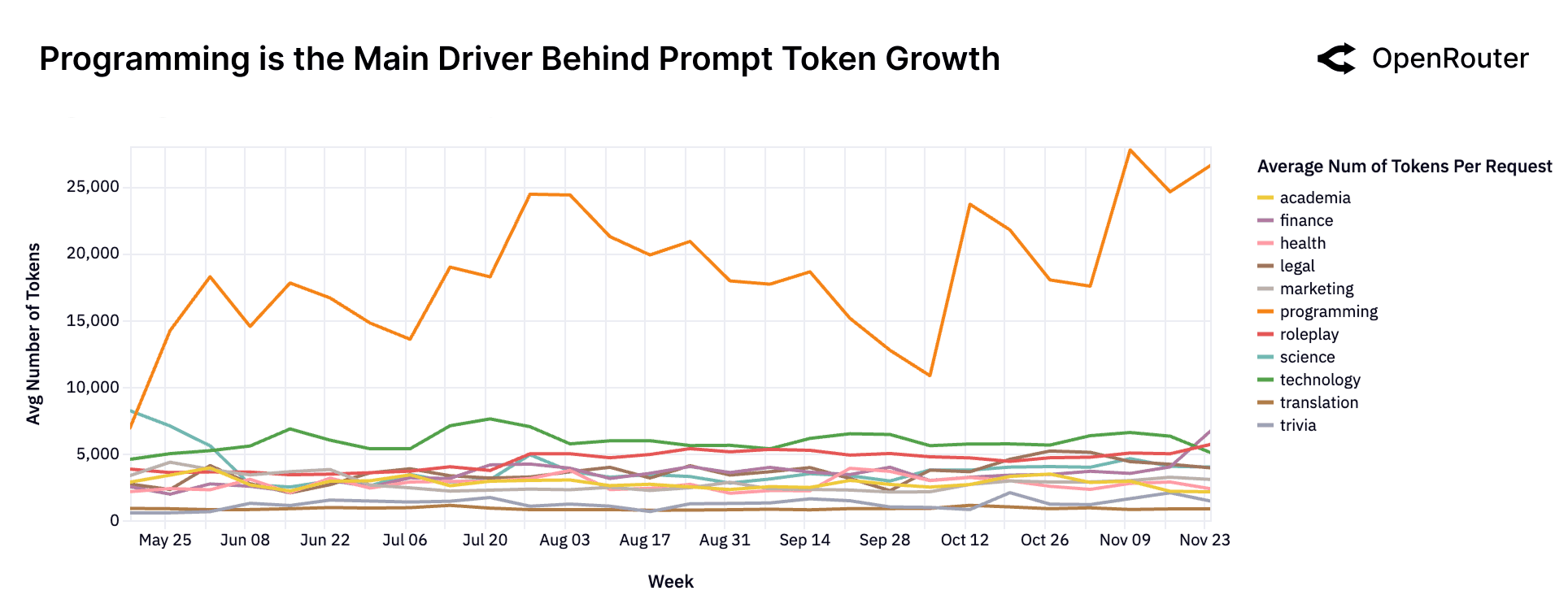
When we consolidate usage across all models, "Programming" has surpassed all other categories to become the largest and most consistently growing application, with its share soaring from about 11% at the start of 2025 to over 50% in recent weeks.
This sends a clear signal: the core value of LLMs is shifting from "generating text" to "solving problems," especially structured, logic-intensive technical problems.
Model "Personalities": The All-Rounder Google and the Specialist Anthropic
Different model providers also exhibit distinct "user profiles" or "personalities" in the real world.
- Anthropic's Claude series: With over 80% of its tokens used for programming and technical tasks and minimal use in role-playing, it is unequivocally a "programming specialist," the go-to tool for developers and technicians.
- OpenAI's GPT series: It is transitioning towards programming and technical tasks, which together account for over half of its total volume. The proportion of role-playing and casual chat from its earlier days has significantly declined. It is evolving from a "jack-of-all-trades" to something more specialized.
- xAI's Grok: For most of its existence, its usage has been overwhelmingly concentrated in programming, showcasing its strong appeal within the tech community.
Amidst these, Google's Gemini series stands out for its unique "all-rounder" quality.
Top Tags for Google Source: OpenRouter

Its use cases are exceptionally broad and balanced, spanning law, science, technology, programming, role-playing, and general knowledge queries. It isn't hyper-specialized in one domain like Claude but functions more like a versatile "Swiss Army knife," capable of handling a wide variety of tasks. This comprehensive capability makes it excel in scenarios requiring general information processing and cross-disciplinary knowledge integration, positioning it as a true universal information engine.
The Ultimate Moat: The "Cinderella's Glass Slipper" Effect
In such a fiercely competitive market, what constitutes a model's true moat? It's not a fleeting top spot on performance benchmarks, but user retention.
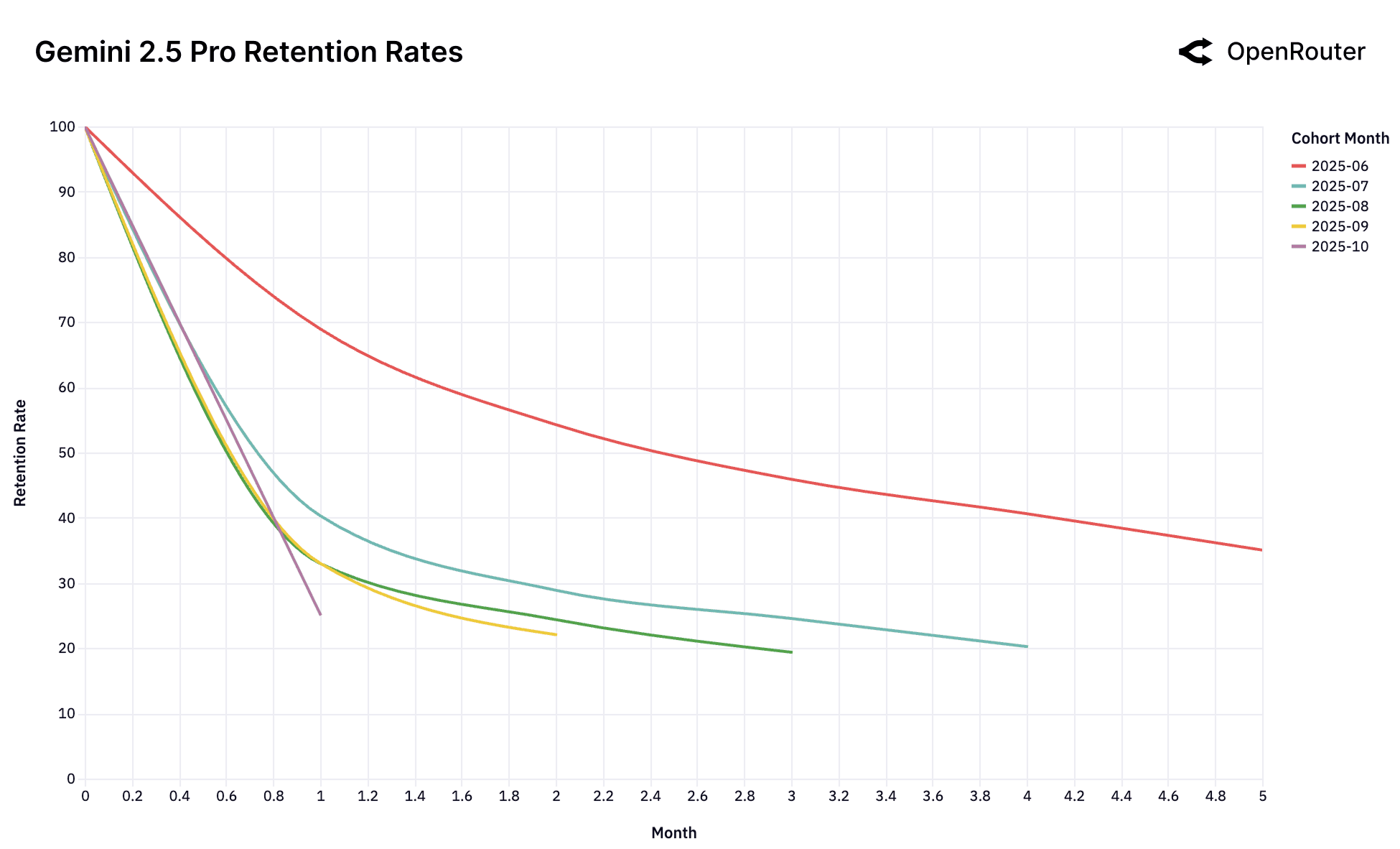
The report introduces a fascinating concept: the "Cinderella's Glass Slipper" effect. The core idea is that once a model perfectly fits a user's specific core workload (finding the user for whom the "glass slipper" fits), it creates powerful economic and cognitive inertia. Even if the overall churn rate is high initially, that small "foundational cohort" of users will exhibit astonishing loyalty.
The early user cohorts of Gemini 2.5 Pro and Claude 4 Sonnet are perfect examples. In their fifth month after launch, their core early user retention rates remained as high as 30-40%. They were the first to solve certain critical workloads, thereby locking in this high-value user base.
Retention for Gemini 2.5 Pro Source: OpenRouter
In contrast, models that failed to find their "glass slipper," like Llama 4 Maverick, saw all their user cohorts perform poorly and churn quickly.
This poses the ultimate question to all model developers: For whom is your model the "glass slipper"?
Conclusion
This report paints a much cooler, more realistic map of the AI application landscape than the mainstream narrative suggests. Here, proprietary models still command the value highlands with their absolute advantage in professional domains; Chinese open-source models are rising with astonishing speed in specific markets (especially entertainment) but have yet to mount a full-scale challenge to the core productivity landscape; users are becoming increasingly "professional," driving models toward more complex "agentic" tasks; and amidst the market noise, all-rounders like Gemini and specialists like Claude are building their true moats by finding their "foundational cohorts."
For investors and observers, perhaps it's time to shift our focus from mere performance benchmarks to the profound insights on market structure, user behavior, and long-term value that are being revealed by real usage data.


