
Beyond the Wall: How the Five 'Sins' of LLMs Herald the True Dawn of AGI
As AI models grow exponentially, are we hurtling towards superintelligence, or are we about to hit a wall defined by the fundamental laws of computation and information?


On the Fundamental Limits of LLMs at Scale
For the past few years, the narrative surrounding artificial intelligence has seemed remarkably straightforward: the bigger the model, the more capable it becomes. From GPT-3 to GPT-4, and with various companies now racing towards context windows of millions or even tens of millions of tokens, we seem to have convinced ourselves that the path to Artificial General Intelligence (AGI) is a smooth one, paved simply by scaling up models and feeding them more data. However, a paper from researchers at top institutions like Stanford University, Meta, and Google DeepMind has just injected a much-needed dose of sobriety into this frenzy.
Titled "On the Fundamental Limits of LLMs at Scale," the paper presents a paradigm-shifting argument: the growth of Large Language Models (LLMs) is not infinite. Instead, it is constrained by five "original sins," or fundamental limits, rooted in the very nature of computational theory, information theory, and statistical learning. These issues—hallucination, context compression, reasoning degradation, retrieval fragility, and multimodal misalignment—are not mere engineering hurdles but theoretical ceilings. Together, they form an almost insurmountable barrier for LLMs, signaling that the path of pure "scaling" may be nearing its end.
The Five Theoretical Ceilings of LLM Capabilities
The paper's authors construct a unified framework to systematically reveal the five interacting aspects that limit the reliability of LLMs. These five limitations cast an invisible net over the current development trajectory of all LLMs.
The five interacting aspects that limit the reliability of LLMs
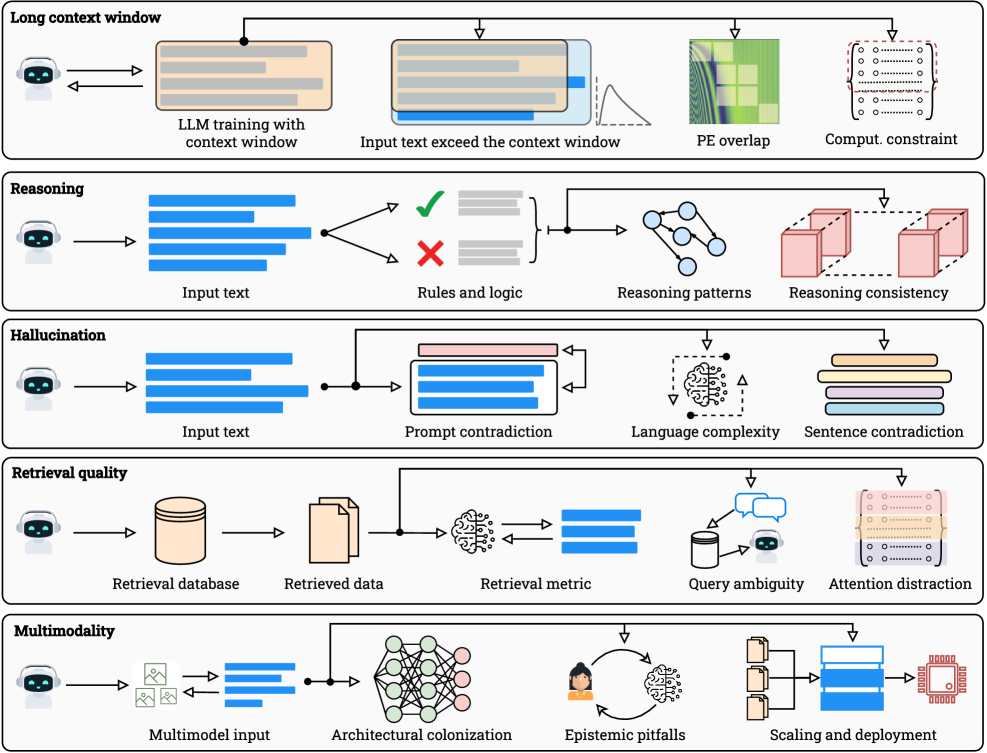
Next, we will dissect each of these five "sins" to explore their theoretical origins and real-world implications.
Limit 1: Hallucination – The Ineradicable "Creative" Lie
"Hallucination"—the phenomenon of a model generating fluent but false or factually contradictory content—is the most well-known flaw of LLMs. The paper argues that hallucination is not only common but also theoretically unavoidable.
The sources of hallucination are not singular but stem from three levels: theory, data, and evaluation mechanisms.
Taxonomy of sources of hallucination in LLMs
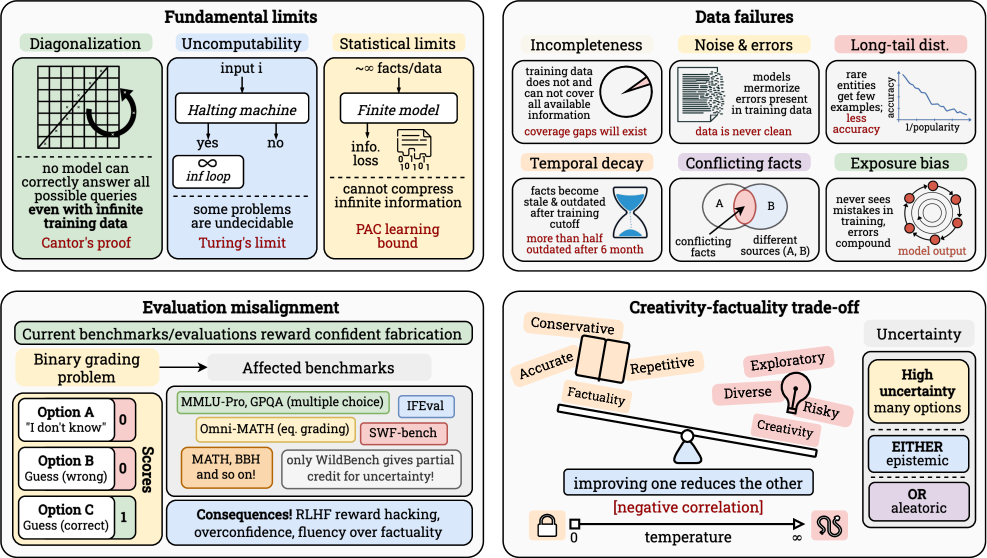
Theoretically, the existence of uncomputable problems like the Halting Problem guarantees that any finite model will fail on certain inputs. Meanwhile, the bottleneck described by Kolmogorov complexity in information theory means that when a model compresses vast amounts of information, it inevitably loses details, leading to distortion when confronted with rare or complex facts.
Data is a more direct cause of hallucination. The training corpus can never encompass all the world's knowledge, and this incompleteness leaves room for the model to make "plausible fabrications." Worse, web-scraped data is itself rife with noise and misinformation (studies estimate that common web crawls contain 2-3% factual errors), and models inevitably absorb these "toxins" during training.
Furthermore, a model's factual memory exhibits a severe "rich-get-richer" disparity.
Empirical evidence of data-induced hallucination (a): Drastic drop in accuracy for rare entities
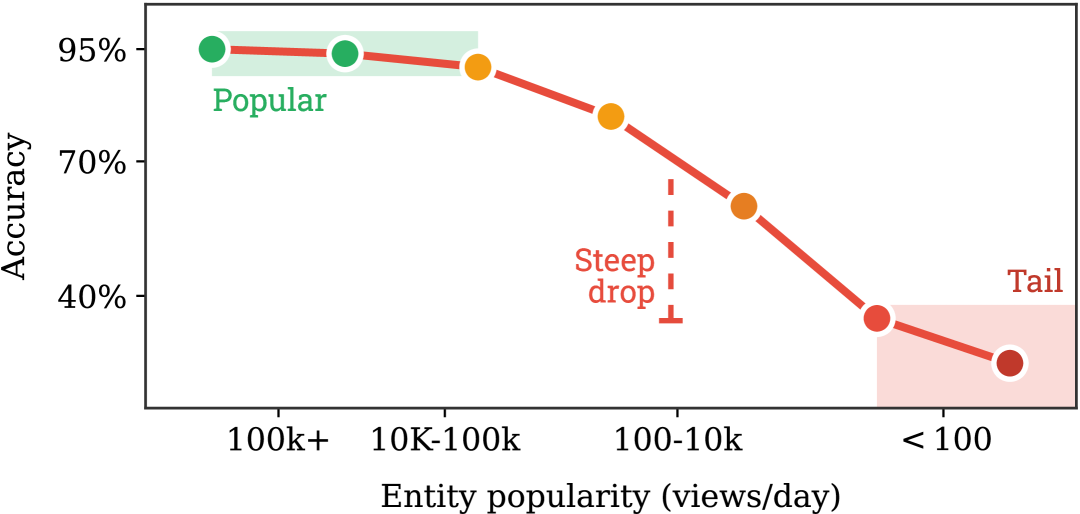
As shown in the figure above, for popular entities with over 100,000 daily views on Wikipedia, GPT-4's accuracy can exceed 90%. However, for "long-tail" entities with fewer than 100 daily views, the accuracy plummets to below 40%.
The passage of time is another fatal blow. Facts have a shelf life, especially in rapidly changing fields like news and technology.
Empirical evidence of data-induced hallucination (b): Information validity decays with training cutoff
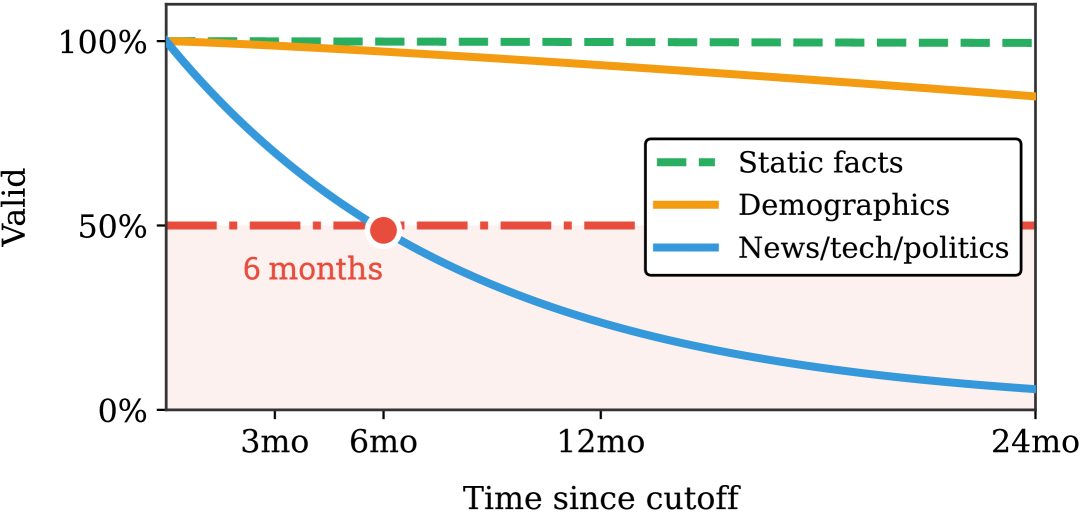
Research shows that over 50% of time-sensitive facts become outdated within 6 months of a model's training cutoff date. This means if you ask a model trained in 2023 about an event in 2024, it will likely give you a confident but incorrect answer based on old news.
Finally, the current evaluation systems even "encourage" hallucination. Binary scoring (right/wrong) incentivizes models to guess rather than admit "I don't know." Meanwhile, the reward mechanism of Reinforcement Learning from Human Feedback (RLHF) tends to favor answers that sound more confident and fluent, rather than those that are factually accurate, which undoubtedly exacerbates the model's tendency to spout nonsense with a straight face.
Limit 2: Context – The Seemingly Infinite, Yet Forgetful "Goldfish Memory"
From a few thousand tokens to Llama3.1's 128K token window, and on to million-token contexts, the "memory capacity" of LLMs appears to be expanding at a breakneck pace. However, the paper cuts to the chase: the nominal context length is far from the effective context length. When processing long texts, models tend to get "lost in the middle."
Three primary factors limiting effective long-context reasoning in Transformers
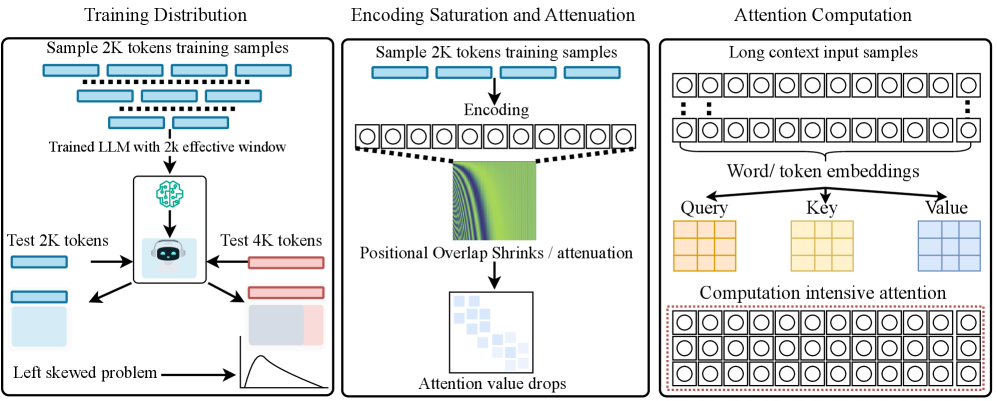
There are three main reasons for this:
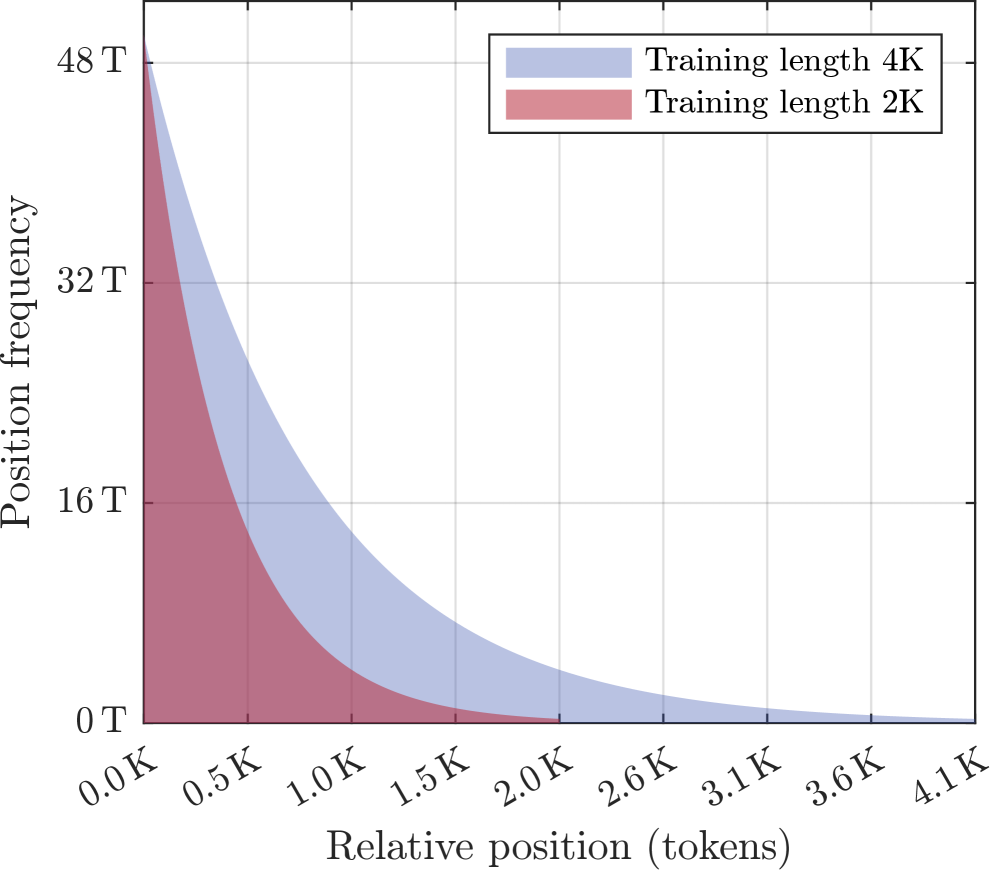
- Skewed Training Distribution: In pre-training data, short texts and the initial segments of long texts are far more common. This leads to severe under-training of "long-range dependencies" in the latter parts of the context. The model is like an athlete who has only practiced sprinting; when asked to run a marathon, it naturally falters in the second half.
Positional frequency distribution in training data
- Positional Encoding Saturation: Whether it's the early Sinusoidal Encodings or the now-mainstream Rotary Position Embedding (RoPE), all share a common problem: as the distance between tokens increases, their distinctiveness sharply declines. This makes it difficult for the model to discern the precise position of distant tokens, causing attention to naturally decay.
- Attention Computation Limits: The Self-Attention mechanism in Transformers faces an computational and memory bottleneck with long sequences. More importantly, when faced with thousands of tokens, the Softmax function disperses attention across a vast number of irrelevant tokens, creating a "Softmax crowding" effect that dilutes the truly critical information in a sea of noise.
Limit 3: Reasoning – A Poor Imitator, Not a Rigorous Logician
We expect LLMs to reason logically like humans, but their training objective—Next-Token Prediction—fundamentally predisposes them to pattern matching and memorization rather than reliable logical deduction. They pursue local linguistic coherence, not global logical consistency.
This is why LLMs are so fragile on tasks requiring precise intermediate steps, such as arithmetic, logic puzzles, and algorithmic execution. Even with techniques like Chain-of-Thought (CoT), models often know that something is the case without knowing why. Research has found that the intermediate steps in CoT have a negligible effect on the final answer's correctness, acting more like a "disposable mediator" fabricated to make the answer appear plausible.
Adaptability of LLM reasoning methods to mathematical frameworks

To overcome this "pseudo-reasoning," researchers have explored various strategies that attempt to combine the linguistic capabilities of LLMs with the rigor of external computation and verification.
Overview of reasoning strategies
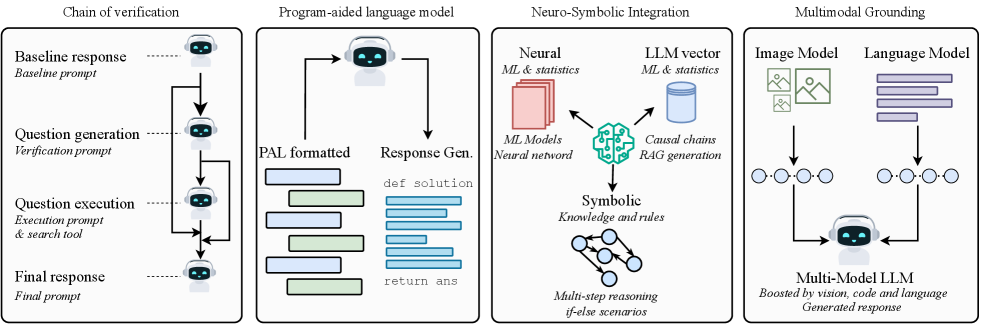
- Program-Aided Language Models (PAL): Have the LLM generate code (planning), which is then run by an external interpreter (execution), thus offloading the burden of symbolic operations to more reliable tools.
- Chain-of-Verification (CoVe): Uses a "generate-verify-refine" loop to subject the model's initial response to self-critique and iterative improvement.
- Neuro-symbolic Integration: Combines the neural network of an LLM with symbolic logic rules to enforce global consistency.
Limit 4: Retrieval – A Seemingly Powerful Ally, But a Fragile Crutch
Retrieval-Augmented Generation (RAG) has been hailed as the "silver bullet" for solving the knowledge limitations and hallucination problems of LLMs. The idea is simple: let the model first retrieve relevant information from an external knowledge base before answering. However, this seemingly perfect process is, in reality, fraught with peril.
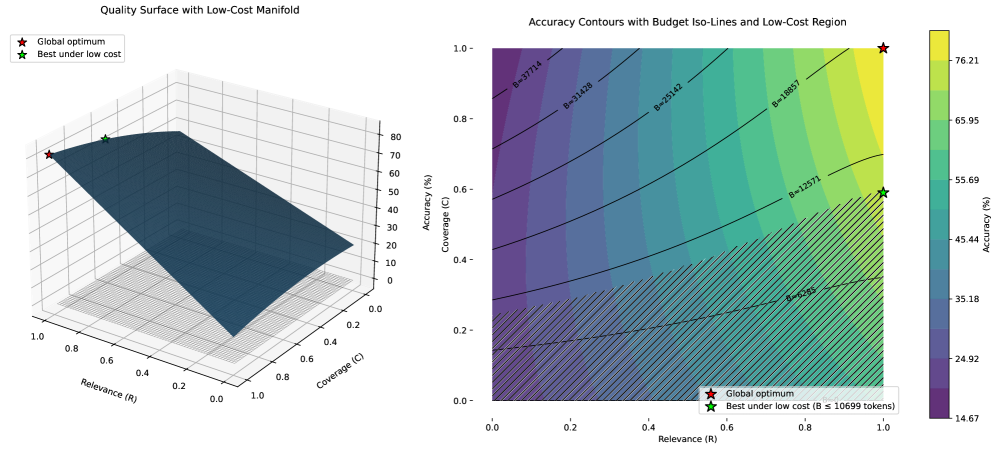
First is the Relevance–Coverage Dilemma. The limited context window forces RAG systems to trade off between "retrieving a few highly relevant snippets" (high precision) and "retrieving more supporting evidence" (high coverage). This trade-off is often a difficult one. As the figure below shows, optimal performance (red star) often requires extremely high retrieval quality, which is frequently unattainable in practice due to budget constraints (green star).
Performance landscape over the retrieval-coverage space
Second, LLMs do not simply accept retrieved information at face value. The famous "lost-in-the-middle" effect applies here as well, with the model paying more attention to information at the beginning and end of the context. More fatally, irrelevant or misleading information acts as a "distractor." Studies show that adding a single irrelevant paragraph to the context can cause the model's accuracy to drop by as much as 30%. When the model's own parametric knowledge conflicts with the retrieved external knowledge, its decision-making is unstable, and slight changes in the prompt can lead to completely different outcomes.
Limit 5: Multimodality – The Hegemony of Language and The Illusion of Grounding
Multimodal Large Models (MLLMs) were expected to "ground" language by incorporating other modalities like vision, allowing models to truly "see" the world and thereby overcome hallucination. But the reality is that MLLMs not only inherit all the flaws of language models but also introduce new problems.
The core issue is the "hegemony of text." Current MLLM architectures typically "translate" visual features into tokens that the language model can understand. This conversion is asymmetric and lossy; the rich semantics of visual information are largely destroyed when projected into the linguistic space. Research shows that the output tokens of VideoLLaMA-7B pay an astonishing 157 times more attention to text tokens than to visual tokens. The dominance of the language model stems from the sheer scale of its pre-training corpus, which far outweighs the visual-language alignment datasets, leading to an architectural "colonization."
Therefore, the supposed "perception" of MLLMs is more of a perceptual illusion. The model doesn't truly understand 3D space or physical causality; it merely learns the statistical co-occurrence between images of a "cat" and textual descriptions of a "sofa." It can understand "the cat is on the sofa" but struggles with novel yet logically possible combinations like "the sofa is on the cat."
Conclusion: Moving Beyond 'Brute Force,' Embracing Theory-Driven Innovation
In addition to the five intrinsic limits of the models themselves, the paper also sharply criticizes the severe problems within existing evaluation benchmarks: data contamination, judge bias, and a disregard for computational cost, which collectively create a false impression of continuous progress in model capabilities.
In summary, this paper systematically demonstrates that the "brute-force aesthetics" of simply scaling up is approaching its theoretical limits. The inevitability of hallucination, the decay of long context, the fragility of reasoning, the unreliability of retrieval, and the misalignment in multimodality are not simple engineering problems. They are fundamental challenges deeply embedded in the foundations of the current technological paradigm.
This does not spell the end of AI development. On the contrary, it heralds the dawn of a new era. Future breakthroughs will no longer depend solely on more FLOPs and larger datasets. Instead, they are more likely to emerge from fundamental architectural innovations (such as neuro-symbolic integration), more reliable reasoning and verification mechanisms, and a deeper understanding of computation, information, and learning theory. We are at a crossroads, moving on from the first phase of explosive, unchecked growth to a new chapter that demands more elegance, rigor, and theoretical depth.


