
Cadence Design 4Q25 Earnings Reivew: The Toll Booth of Chip Innovation
When every software company is scrambling to explain why AI won't eat their lunch, how did Cadence quietly deliver a quarter where AI actually made customers want to spend more?


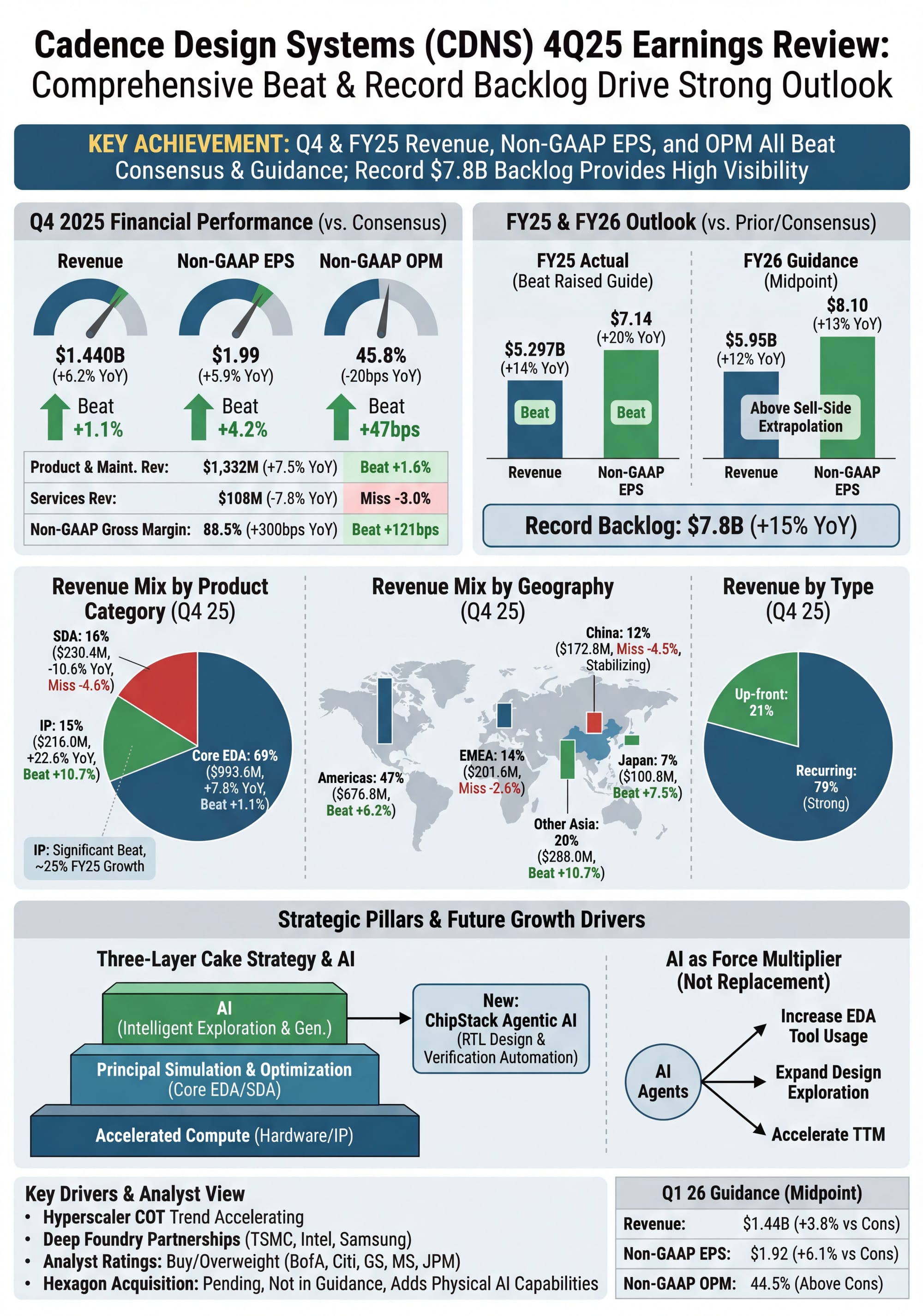
Cadence Design 4Q25 Earnings Review: The Three-Layer Cake
Every earnings season, the same question resurfaces in sell-side Q&A sessions: will AI make EDA tools obsolete? If customers can write RTL code directly with LLMs, won't Cadence's software be reduced to an expensive relic?
The 4Q25 data provides an unambiguous answer. But the logic behind that answer is far more interesting than a set of beat numbers.
The Quarter at a Glance: A Clean Sweep to Close the Year
The numbers first. Q4 revenue came in at $1.44B, up 6.2% year-over-year, beating consensus by 1.1% and the company's own guidance midpoint by 1.4%. Non-GAAP EPS hit $1.99, topping consensus by 4.2% and growing 5.9% from the prior year. Non-GAAP operating margin reached 45.8%, exceeding consensus by 47bps and the guidance midpoint by 80bps. Non-GAAP gross margin of 88.5% marked a five-quarter high, beating consensus by 120bps.
FY25 as a whole was equally clean: revenue of $5.297B (up 14.1% YoY), Non-GAAP EPS of $7.14 (up 19.6% YoY), Non-GAAP operating margin of 44.6% (expanding 210bps YoY) — all three core metrics surpassing full-year guidance that had already been raised during the year. The 3-year revenue CAGR stands at 14%, and the 3-year Non-GAAP EPS CAGR at 19%. Full-year free cash flow of $1.587B surged 41.9% year-over-year.
Cadence Design Annual Revenue and YoY Growth
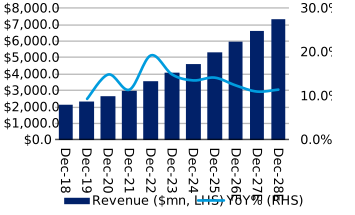
source: BofA
This is not a report card that scraped by. It is one delivered amid macro uncertainty and geopolitical headwinds, backed by high forward visibility. Backlog hit a record $7.8B, up roughly 15% year-over-year and approximately 11% sequentially from $7.0B last quarter. For a company deriving about 80% of revenue from recurring subscriptions, that figure is the foundation for future growth.
The CEO's "Three-Layer Cake": A Framework Worth Taking Seriously
More noteworthy than the numbers, however, is the platform strategy framework that CEO Anirudh Devgan articulated for the first time during the earnings call — what he calls the "three-layer cake."
The bottom layer is accelerated compute: GPU acceleration and hardware platforms. The middle layer is principal simulation and optimization — Cadence's traditional competitive core of physics-based and mathematically rigorous simulation and optimization engines. The top layer is AI, deployed to drive intelligent exploration and generation.
The deeper significance of this framework lies in how it directly addresses the market's most fundamental concern about EDA. When BofA's Vivek Arya asked point-blank during Q&A whether AI could let customers replace Cadence's existing products with internal tools, Devgan responded with a structural argument: EDA is engineering software that performs extraordinarily complex physics- and mathematics-based computations. Any AI tool — whether built by the company or used by customers — ultimately has to call Cadence's software to get the job done correctly. AI is not a substitute. It is an amplifier.
Citi offered a more systematic summary, identifying three moats that insulate the EDA industry against AI disruption: a technology moat (rigorous physics- and math-based optimization of billions of transistors, fundamentally different from general-purpose SaaS); a deep customer integration moat (Cadence holds weekly R&D alignment meetings with roughly 60-70 top strategic accounts, and the progression from 5nm to 3nm nodes pushes customers from standalone point tools toward vertically integrated flows); and a data moat (30+ years of proprietary design data spanning RTL through implementation flows — none of it publicly available, none of it accessible for third-party LLM training).
These three moats explain a counterintuitive phenomenon: the more AI-driven an agentic workflow becomes, the more frequently it calls the underlying Cadence tools. Devgan offered a vivid illustration — in a non-AI flow, a manual user might run 3 to 5 experiments in parallel to find the optimal PPA (Power, Performance, Area); in an agentic AI flow, the same design can spawn 10 or even 100 parallel experiments. More experiments mean more tool invocations.
The IP Breakout: The Quarter's Standout Story
Every quarter has one data point that demands attention. In 3Q25, it was the dramatic China revenue rebound from 9% to 18% and the near-48% operating margin. In 4Q25, the biggest surprise came from the Semiconductor IP business.
Q4 IP revenue share reached 15%, implying approximately $216M in revenue — beating consensus of $195M by a striking 10.7%. For the full year, IP grew nearly 25%, with a 3-year CAGR of 19%. The product portfolio spans critical die-to-die and memory interface IP including HBM, UCIe, PCIe, DDR, and SerDes.
When a KeyBanc analyst pressed on IP pipeline conversion timelines, Devgan's response carried quiet confidence: "You know us — one year does not make a trend. But after three years, I feel good about the IP business." The 2026 beginning backlog for IP is strong, and the company expects another robust year.
This breakout is no accident. It sits at the intersection of two structural forces: the rigid demand for standardized interface IP driven by chiplet architectures and advanced packaging, and Cadence's continued PPA improvement within the TSMC ecosystem. Citi noted that IP demand may already be outstripping Cadence's internal capacity. Even more notable: beyond the traditional TSMC partnership, Cadence is opening new IP revenue streams at other foundries — engineering fees from creating IP for Intel and Samsung represent incremental opportunities not yet reflected in the $7.8B backlog.
In our previous analysis of Cadence, we examined the technical architecture and competitive implications of the ChipStack AI Super Agent in detail. That article's central thesis — that Cadence's moat is migrating from individual tool competitiveness toward end-to-end workflow orchestration — finds another dimension of support in the 4Q25 IP data. As chip architectures shift from monolithic to chiplet, the demand for standardized, verified interface IP is itself a form of "orchestration tax."
Hyperscaler COT: A Structural Trend Accelerating
Another topic from the earnings call that warrants deeper attention is the acceleration of the hyperscaler COT (Customer-Owned Tooling) trend.
Needham analyst Charles Shi pointed out that the quarter's biggest industry highlight was a landmark hyperscaler customer adopting Cadence's complete digital full flow to tape out its first COT chip. Devgan offered an important industry-level observation in response: the commitment of major hyperscalers to designing their own chips is firmer today than it was a year or two ago — particularly in the past six months, where large hyperscalers have achieved demonstrable success with their in-house silicon.
"A year or two ago, people thought these companies wouldn't design their own chips. That doesn't mean merchant semi won't do well — merchant semi will do very well — but the large customers will design their own chips."
More intriguing still was his description of the evolutionary pathway: from ASIC to hybrid COT to full COT. The emerging form of hybrid COT involves multi-chiplet designs where customers develop some chiplets in-house, outsource others, and eventually bring everything internal. Each hyperscaler operates at least three major platforms. The proliferation of COT means more EDA consumption, more internal IP usage, and greater demand for hardware and system-level tools.
This is a self-reinforcing growth flywheel: the more hyperscalers design their own chips, the higher the design complexity, the deeper their dependence on EDA tools and IP, and the larger Cadence's wallet share per customer becomes. And this trend extends beyond cloud — automotive, robotics, and other verticals are following the same trajectory.
FY2026 Guidance: Between Caution and Ambition
FY2026 marks the first time Cadence has issued formal full-year guidance for the new fiscal year. The midpoint figures: revenue of $5.95B (up ~12% YoY), Non-GAAP EPS of $8.10 (up ~13% YoY), and Non-GAAP operating margin of 45.25% (up 65bps YoY). All figures exclude the impact of the pending Hexagon D&E business acquisition.
Q1 guidance also signaled a strong start: revenue midpoint of $1.44B (3.8% above consensus of $1.387B) and Non-GAAP EPS midpoint of $1.92 (6.1% above consensus of $1.81).
Cadence Design Quarterly Operating Income and Operating Margin
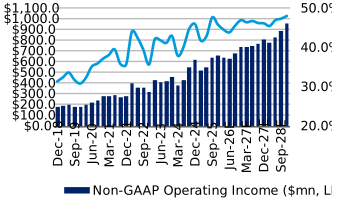
source: BofA
On FY26 operating margin, it is worth noting that the company charted a "middle path": the 45.25% midpoint is neither the aggressive expansion scenario GS had modeled at 47.2% (roughly 200bps above consensus), nor the M&A dilution scenario Citi had feared at 100bps below consensus. SBC as a percentage of revenue is expected to rise from 8.6% to approximately 9%, representing a primary driver of the GAAP-to-Non-GAAP differential.
There is a subtle upside signal here. CFO John Wall disclosed that FY25 delivered a 59% incremental margin, while FY26 guidance implies an incremental margin of roughly 51%. Morgan Stanley argues that if last year's guidance pattern repeats — FY25 was initially guided at 11.5% revenue growth and ultimately delivered 14%, with earnings coming in 6-7% above the initial forecast — the current FY26 guidance may prove similarly conservative. The CFO was candid about the annual de-risking embedded in initial guidance: hardware and China revenue typically offer only two quarters of pipeline visibility, so H2 assumptions are set conservatively.
Approximately 67% of FY26 revenue is already covered by beginning-of-year backlog. That is a remarkably high level of visibility.
Agentic AI Monetization: From Potential to Substance
On the commercialization pathway for AI products, the 4Q25 earnings call was more specific than any prior quarter.
ChipStack's positioning as an agentic AI Super Agent was explored at length in our earlier analysis. What the earnings call added was a broader picture of the agentic AI roadmap: at least four to five major agentic flows are under development — a front-end design agent (ChipStack), a back-end physical implementation agent (extending Cerebrus AI Studio), an analog design automation agent, and a packaging and system design agent. ChipStack is merely the tip of the iceberg.
Customer proof points also became more granular. Samsung used Cerebrus AI Studio to complete an SF2 design tape-out with a 4x productivity improvement. Altera reported 7-10x productivity gains. Back-end physical design achieved 7-12% PPA improvement — Devgan specifically noted that "migrating from one node to the next delivers roughly 10-20% improvement, so through AI optimization you can capture nearly half or even the equivalent of a full node migration."
On monetization, the CFO laid out a hybrid pricing strategy. Multi-year subscriptions remain the anchor for customer engagement; incremental usage will carry usage-based pricing through card models and token models; the services side will offer outcome-oriented packages priced around measurable improvement metrics such as cycle time and closure productivity. Agentic AI products will be priced as "virtual engineers/agents," representing an entirely new product category.
Devgan summarized it plainly: after two contract cycles of accumulation, monetization has moved from expectation to substance — now reflected in both results and record backlog.
Cadence Design TTM Free Cash Flow and FCF Margin
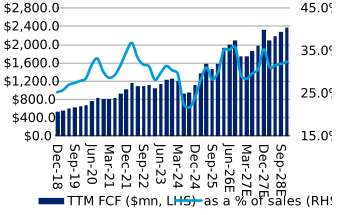
source: BofA
Regional and Product Mix: Signals Worth Tracking
China. Q4 contribution dropped to 12%, down from 18% in Q3. This largely follows the seasonal pattern — Q3's elevated share reflected catch-up effects, while Q4 reverted to a normalized level. Full-year FY25 China revenue grew 18% year-over-year. The CFO provided a clear forward framework: China represented 12% of revenue in FY24, 13% in FY25, and is expected at 12-13% in FY26, with better H1 visibility and conservative H2 assumptions. Devgan added that the China market stabilized in the second half of FY25, with all design activity trends mirroring the U.S. — active in AI chips, and even stronger in physical AI segments including automotive, autonomous driving, and EVs.
System Design & Analysis. Q4 share was 16%, with implied revenue of roughly $230M — missing consensus by 4.6%. This was the only product category that missed. The CFO explained that FY24 Q4 included a tough comp from a multi-year deal booked through the Beta CAE subsidiary, and that Beta CAE has deliberately shifted toward more annual subscription arrangements in FY25. BofA's structural analysis shows that 3D IC accounts for approximately half of SDA, with physical AI making up the other half — both directions are gaining share in their expanding TAMs. With the pending Hexagon D&E acquisition (annualized revenue of approximately $200M), SDA growth potential in FY26 remains attractive.
Hardware Verification. Another record quarter. Over 30 new customers were added, and 7 of the top 10 customers purchased both Palladium Z3 and Protium X3. The CEO expects FY26 hardware revenue to set yet another record, because "no complex AI chip or any other complex chip is designed without a hardware system." The Palladium Z3 system can handle designs of up to 1 trillion transistors and is built to serve customers for years.
Closing: Design Activity Is Accelerating
In the final stretch of the earnings call, Devgan shared a macro-level observation: the semiconductor industry may reach the $1 trillion mark in 2026 — roughly four years ahead of the industry's prior expectation of 2030. Citi independently confirmed this assessment.
If that projection holds, its implications extend well beyond Cadence. When the industry's overall design activity accelerates in tandem — propelled by AI infrastructure buildout and broad end-market demand — EDA's role as the "pick-and-shovel" provider for chip design only becomes more critical. For Cadence specifically, the 25 new digital full-flow logos added in 2025, expanded collaboration with TSMC on N2 and A16, entry into the Intel Foundry alliance, and broad commitments from Rapidus and Samsung Foundry all mean the company is embedding itself at an increasing number of design starting points.
The FY26 story still has chapters to be written. The timing of the Hexagon consolidation, the pace at which AI product orders convert to revenue, and the actual H2 performance of China and hardware all remain variables worth monitoring. But when a company trading at roughly 35x NTM P/E — below its 3-year median of 43x and near its 3-year low — carries a record $7.8B backlog, approximately 80% recurring revenue, and a 12-14% expected revenue CAGR, the pessimism embedded in the current market price warrants a second look.
Each layer of the cake is getting thicker.
Earnings Call Recap
Financial Statements Visualization
I will now share a more detailed analysis of this earnings result behind the paywall:


