
Can a GPU Really Be Profitable for Six Years?
Amidst the relentless pace of AI innovation, how can cloud providers justify a 6-year depreciation schedule for their GPU assets, and what hidden economic factors allow even 5-year-old hardware like the A100 to maintain a contribution margin as high as 70%?


The "Old Shovels" in the AI Compute Gold Rush: The True Lifespan and Economic Value of GPU Assets
In the current technology wave driven by artificial intelligence, GPUs have become the "picks and shovels" of the digital world. From large Hyperscalers to emerging Neoclouds, cloud service providers are investing billions of dollars on an unprecedented scale in a compute arms race. Yet, behind this frenetic capital expenditure, a critical economic question has surfaced, increasingly troubling investors: what is the true economic life of these expensive GPU assets?
When each new generation of chips promises an exponential leap in performance, it's natural to worry that the hardware purchased for a fortune today will rapidly depreciate into a pile of expensive "digital bricks" within a year or two. But is this really the case? Through a deep dive into operational economics, market dynamics, and the actual strategies of cloud vendors, we find that contrary to the prevailing anxiety over rapid depreciation, there is substantial evidence that a GPU can remain profitable for approximately six years. This is not just a theoretical number; it also aligns with the accounting and operational practices of industry leaders.
The Cornerstone of Profitability: Underestimated Cash Costs and High Contribution Margins
To understand why GPUs can have such a long life, we must first run the numbers. Many observers tend to link a GPU's value to its peak performance, assuming its worth will plummet with the launch of new products. However, this perspective overlooks a crucial factor: the cash operating cost of keeping a deployed GPU running is actually quite low.
According to analysis from Bernstein, these costs mainly include electricity, data center colocation, and maintenance fees. When we compare these costs to the market rental prices for GPUs, a clear picture emerges: revenue far exceeds operational expenditure.
GPU Hourly Economics
- The table assumes a utilization rate of 60% and an electricity cost of $0.10/KWh.
As the table clearly shows, even the Nvidia A100, which has been on the market for five years, still boasts a contribution margin as high as 70%. This means that after covering all direct operational costs, it continues to generate significant cash flow for cloud service providers. As long as the contribution profit is positive, it is a rational choice from a purely operational standpoint to keep the machine running. In contrast, only chips like the seven-year-old Volta architecture are beginning to approach the cash break-even point.
The "Non-Commoditized" Compute Market: Why Older GPUs Still Have a Place
However, a high contribution margin only tells half the story. A more profound question is: in a market of relentless performance improvement, why would anyone still be willing to pay for older, less powerful GPUs? The answer lies in the fact that Accelerated Compute is not a standardized commodity like memory or storage.
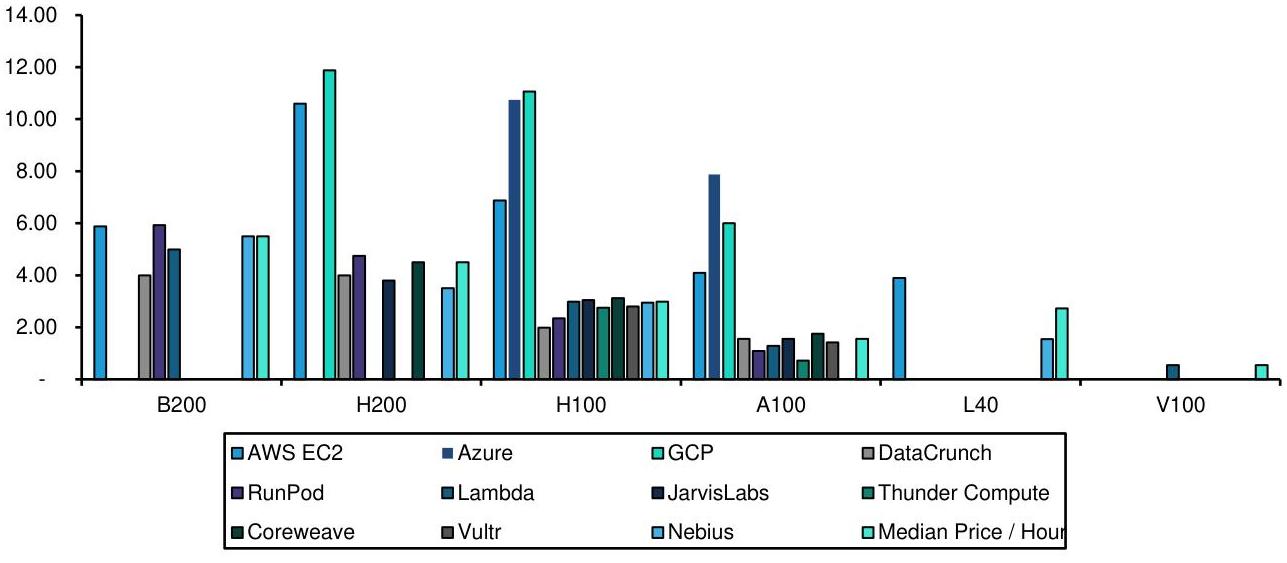
On-Demand GPU Pricing Varies by Provider, Complicating Analysis
(Source: Bernstein)
The chart above illustrates the wide variation in on-demand pricing for various GPUs across different cloud service providers, which itself proves the non-commoditized nature of the market. If compute were a pure commodity, prices would quickly converge to performance parity. But reality is different, primarily due to the existence of "Legacy Workloads."
Migrating an AI model or software already optimized for a specific GPU architecture (e.g., Nvidia A100) to a new generation (e.g., Nvidia H100 or B200) is not a simple "plug-and-play" operation. It often requires significant software engineering resources for re-testing, optimization, and even refactoring. For many workloads that are less critical or less sensitive to performance, continuing to run on older hardware, even at a slightly lower price-performance ratio, is far more cost-effective than undertaking a migration.
This creates a "captive" customer base for cloud service providers, allowing them to charge a premium for older hardware above what its performance parity would otherwise dictate.
GPU Rental Price-Performance
The table above clearly shows that newer GPUs (like H200 and B200) offer far superior floating-point operations per dollar compared to older models (like A100). Nevertheless, the market price for the A100 has not collapsed as a result.
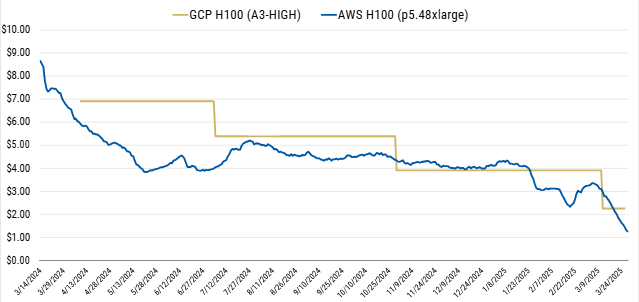
AI GPU H100 Rental Price Per GPU Per Hour
(Source: MS)
Observing the price trend chart for the H100, we can see that while the price has steadily decreased over time with increased supply, it has not experienced a precipitous drop. The decline is gradual, reflecting the market's process of finding distinct value propositions for both new and old hardware, rather than a simple "winner-take-all" dynamic.
From Theory to Practice: Cloud Giants' Accounting Principles and Contractual Strategies
Theoretical economic viability must ultimately be validated by the real-world behavior of market participants. When we examine the financial statements of Hyperscalers and the business contracts of Neoclouds, we find they are highly consistent with the "six-year lifespan" conclusion.
First, feedback from industry experts confirms the physical durability of GPUs. According to the experience of companies like Lambda, after an initial "burn-in" period of about six months, GPUs can typically operate stably for six to seven years, or even longer.
More compelling is the official depreciation policy of large cloud service providers.
Depreciation Period Disclosures for Relevant Categories by Hyperscalers
Source: Bernstein
As shown in the table, major players including Alphabet, Amazon, and Coreweave generally set the depreciation period for their servers and network equipment at five to six years. This indicates that the internal financial models of these companies, which are the largest investors in compute power, are based on the assumption that hardware like GPUs will continue to generate value over this period.
Furthermore, contract structures also play a role in locking in value and transferring risk. A Neocloud industry expert revealed that lease contracts for new GPUs typically have a minimum term of three years, while contracts with large buyers like Hyperscalers commonly extend to five years. These contracts are often guaranteed, meaning the customer commits to paying fees for the entire contract term. This effectively transfers the risk of future GPU value decline from the cloud provider (like Coreweave) to the end-user (like OpenAI).
The Endgame: The Real Bottleneck Is Not Chips, but Power and Space
Finally, zooming out from the chips themselves, the macroeconomic picture of AI infrastructure provides the ultimate support for the "long life" of GPUs. Currently, the biggest bottleneck limiting the expansion of AI compute is no longer the supply of GPU chips, but more fundamental elements: data center space, power supply, and networking equipment.
The available capacity in commercial data centers has fallen below 2%, and obtaining new power service agreements (ESAs) can take years. This means that even if a cloud provider has the latest GPUs, it may not have enough "powered shells" to house them. In this context, the value of older GPUs already deployed in existing data centers and operating stably is further solidified. Phasing them out would not only mean abandoning a cash-flow-positive asset but also giving up precious and non-renewable space and power allocation for new hardware.
Conclusion
Returning to the original question: can a GPU really be profitable for six years? The answer is a resounding yes. This is not based on blind optimism, but is rooted in solid economic logic and market realities:
- From an operational perspective, extremely low cash costs and high contribution margins make running older GPUs economically attractive.
- From a market demand perspective, the non-commoditized nature of accelerated computing, especially the existence of legacy workloads, creates sustained demand and a price premium for older hardware.
- From a business practice perspective, the five-to-six-year depreciation policies of cloud giants and multi-year guaranteed contracts all confirm their confidence in the long-term value of GPUs.
- From a macroeconomic perspective, structural bottlenecks in infrastructure such as power and data centers further extend the economic lifecycle of existing deployed assets.
Therefore, for investors, rather than excessively worrying about a "depreciation cliff" for GPU value, it would be more fruitful to focus on understanding this complex and unique market structure. It is this very structure that allows these digital-age "picks and shovels" to continuously extract value amidst rapid technological iteration, proving far more resilient than they appear on the surface.


