
Concentrated Growth - How the IT Sector Drove Nearly Half of U.S. TFP Growth from 1988-2023
If the IT sector makes up less than 10% of the U.S. economy, how has it been responsible for nearly half of its productivity growth over the past three decades?


Concentrated Growth: The Role of the IT Sector - Federal Reserve Bank of Chicago
The Secret Sauce of U.S. Economic Growth: How a Sector Making Up Just 8% Delivered Nearly Half the Gains
When we talk about economic growth, we often think of adding more labor or investing more capital. But the truly fascinating and crucial part of growth lies in the "secret sauce" that can't be easily quantified—what economists call Total Factor Productivity (TFP). It measures how efficiently we use our existing inputs (labor, capital) and is essentially a composite of technological progress, management innovation, and process optimization.
A recent research letter from the Federal Reserve Bank of Chicago delves into the sources of U.S. TFP growth since 1988 and arrives at a striking and profound conclusion: for the past four decades, the nation's productivity growth has been highly concentrated, its fate inextricably linked to one specific sector—Information Technology (IT).
Echoes of History: The Productivity Boom of the Dot-Com Era
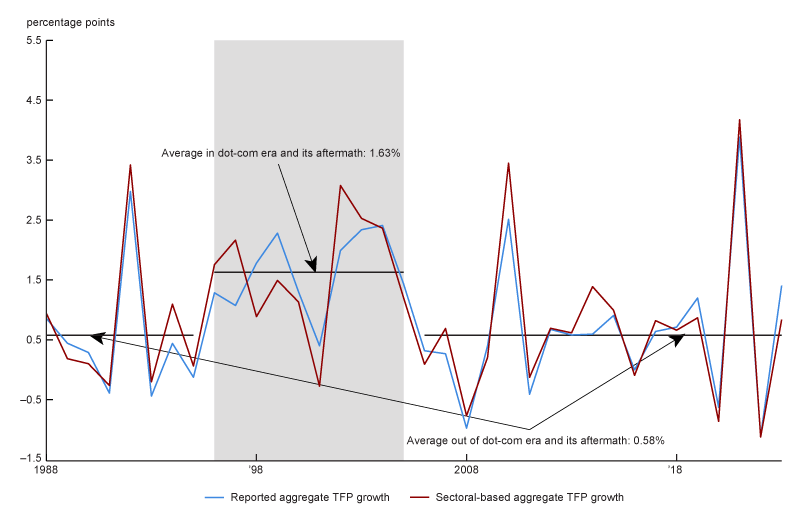
Looking back at the data from 1988 to 2023, the U.S. private business sector saw an average annual TFP growth rate of 0.87%. However, this stable average conceals dramatic volatility. During the dot-com era and its immediate aftermath (1995 to 2005), productivity growth was exceptionally strong, averaging 1.63% per year. In contrast, the average growth rate for the other years in the sample period was a modest 0.58%. This history clearly indicates that a powerful driving force once provided a massive boost to the efficiency of the entire economy during a specific period.
Annual Aggregate TFP Growth, 1988–2023 Source: Federal Reserve Bank of Chicago
The Engine Room of Growth: The IT Sector's Disproportionate Contribution
So, what was this driving force? By breaking down the economy by sector, the answer becomes strikingly clear. Between 1988 and 2023, the IT sector's own TFP grew at an astonishing average annual rate of 2.9%, nearly ten times the weighted average growth rate of all non-IT sectors combined (0.31%).
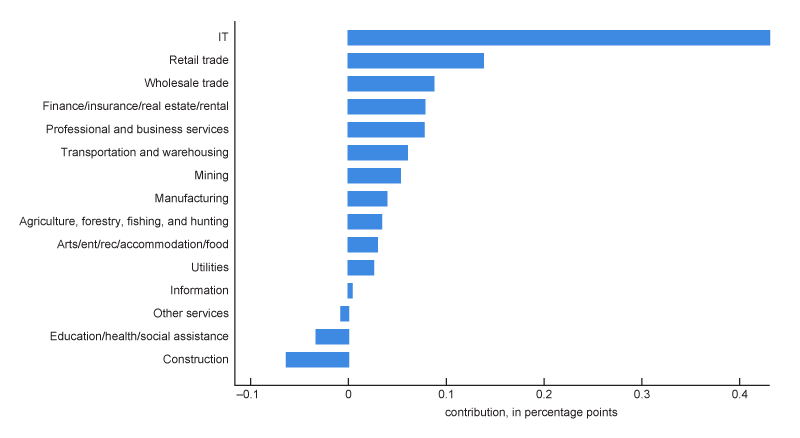
This vast difference in efficiency gains translated directly into a stark disparity in contributions to overall economic growth. Although the IT sector's share of value added in the private business sector averaged only about 8%, it contributed a staggering 45% of total TFP growth. In other words, a sector that is not particularly large in terms of economic size shouldered nearly half of the U.S. productivity gains. The remaining non-IT sectors, which account for 92% of the economy, contributed the other 55%.
The chart below vividly illustrates this concentration of contribution. The IT sector's contribution far outpaces that of much larger industries like retail, wholesale, and finance.
Average Annual Contribution to Aggregate TFP Growth by Sector, 1988–2023 Source: Federal Reserve Bank of Chicago
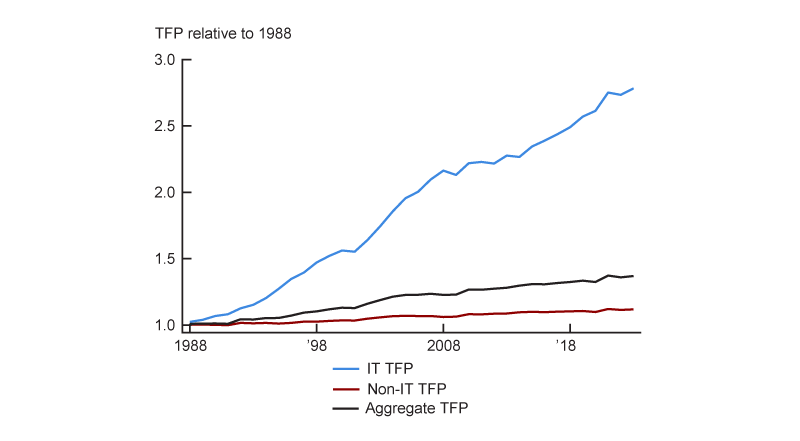
When we zoom out to the entire 36-year period, the gap becomes even more dramatic. From 1988 to 2023, the IT sector's own cumulative TFP grew by 178% (a factor of about 2.78), while the cumulative TFP of all non-IT sectors combined grew by only 12%. It was the IT sector's consistent outperformance that pulled the entire economy's productivity curve upward.
Cumulative TFP Growth in the IT and Non-IT Sectors, 1988–2023 Source: Federal Reserve Bank of Chicago
An Interesting Paradox: Why Hasn't Explosive Growth Led to a Larger Share?
This naturally raises a question: if the IT sector is so productive, with its real value added growing by over 2,300% between 1988 and 2023, why has its nominal share of the overall economy barely budged, inching up from just 7.6% to 8.8%?
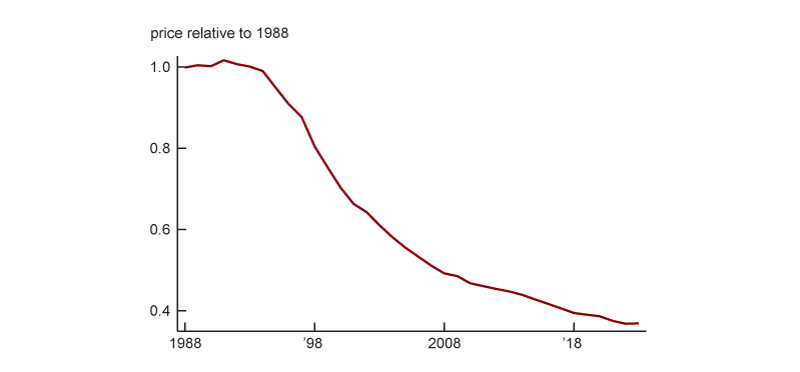
The answer lies in prices. This is a classic characteristic of the technology industry: rapid technological advancements lead to a sharp decline in costs and prices. Over the same period, the price per unit of the IT sector's products and services fell by nearly 70%. This massive price drop almost entirely offset the explosive growth in its real output, resulting in a remarkably stable share of the nominal economy. We've enjoyed technology that is ever more powerful and ever cheaper, and this is the other side of the IT sector's productivity miracle.
Growth in the Price of a Unit of Value Added in the IT Sector, 1988–2023 Source: Federal Reserve Bank of Chicago
Looking Ahead: A Story of Opportunity and Vulnerability
The Chicago Fed's research offers three key implications for understanding the past and looking to the future:
- The Key to the Past: To explain the story of U.S. economic growth over the past few decades, one must deeply understand the core factors that have driven the IT sector.
- The Engine of the Future: If historical trends continue, especially with the push from new technologies like Artificial Intelligence, the medium-term economic outlook for the U.S. will be critically dependent on the performance of the IT sector.
- The Fragility of Growth: When the sources of growth are so heavily concentrated in a single sector, the stability of the overall economy may be more fragile than in periods with broader-based growth. Any factor that causes innovation in the IT sector to stagnate or suffer a shock could have a profound impact on the pace of the entire economy.
Ultimately, all questions lead to a core uncertainty: will the IT sector's rapid TFP growth slow down due to diminishing marginal returns, or will it enter a new phase of acceleration fueled by the proliferation of Artificial Intelligence and other cutting-edge computing technologies? The answer to this question will largely shape the economic landscape for decades to come.


