
DeepSeek - Breaking the O(L^2) Bottleneck - How Sparse Attention Reshapes Long-Context Efficiency Without Sacrificing Capability
Can a Lightning Indexer break the O(L^2) curse of attention without sacrificing model capabilities?


 deepseek-ai
The Long-Context Curse and DeepSeek’s Response
How can large language models accelerate reasoning in long-context settings without losing capabilities? This has been one of the core bottlenecks in scaling. DeepSeek V3.2-Exp represents an experimental attempt to answer this. Built on the previous V3.1-Terminus, it introduces just one major innovation: DeepSeek Sparse Attention (DSA). The result—significant efficiency gains with essentially no loss in performance.
Technology Explained: Lightning Indexer and Sparse Selection
To understand DSA, recall that traditional attention computes interactions between every pair of tokens, with complexity . At a context length of 128K, this quickly becomes intractable.
DSA’s idea is straightforward: not all tokens matter equally. A lightweight Lightning Indexer first scores candidate tokens, and then only the top-k tokens are selected for full attention calculation. In other words: “filter first, then focus.”
Figure 1 below illustrates this design:
Figure 1 | Attention architecture of DeepSeek-V3.2-Exp
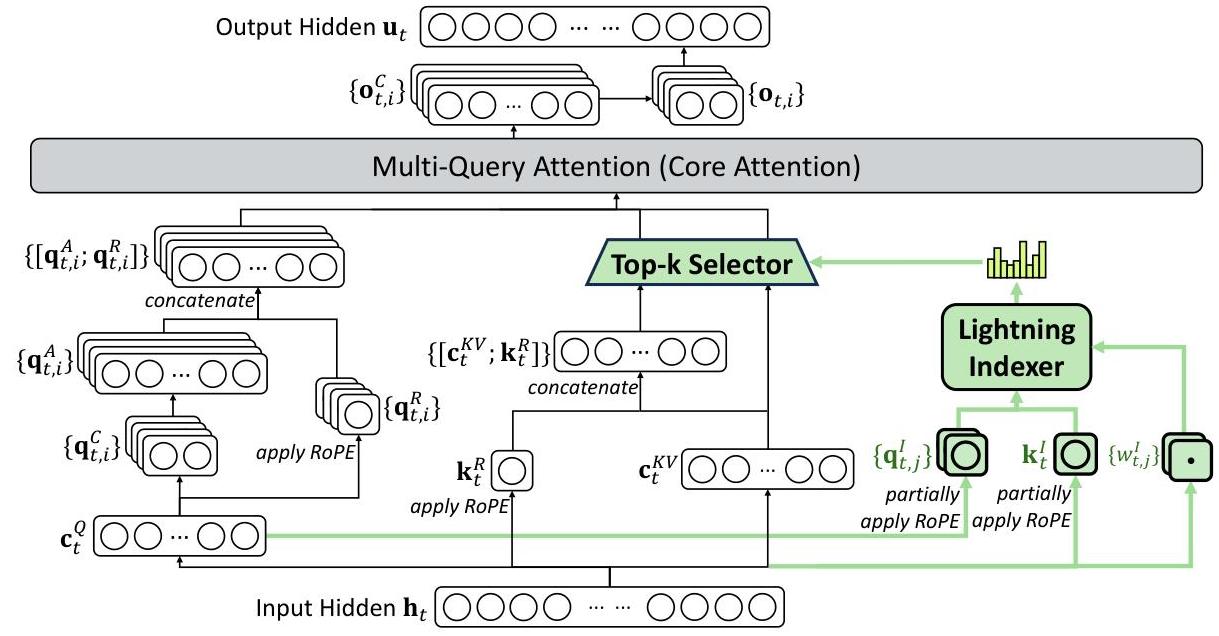
On the implementation side, DeepSeek embeds DSA into MLA’s MQA mode. Each key-value entry is shared across multiple queries, making computation far more efficient. This design ensures sparse attention is not just conceptually elegant, but also hardware friendly.
Training Pipeline: From Warm-up to Sparse
The training strategy is as deliberate as the architecture itself, structured into stages:
- Dense Warm-up: Initially, dense attention is kept. The main model is frozen, and only the Lightning Indexer is trained, learning to mimic full attention distributions. The warm-up lasts 1,000 steps, processing 2.1B tokens.
- Sparse Training: DSA is activated. Each query attends to only 2,048 tokens, while both the main model and the indexer are trained. This runs for 15,000 steps, covering a massive 943.7B tokens.
- Post-training: Specialist distillation is combined with Group Relative Policy Optimization (GRPO) reinforcement learning. Specialist sub-models in math, programming, and reasoning provide distilled knowledge. The unified RL stage then balances reasoning, alignment, and agentic tasks.
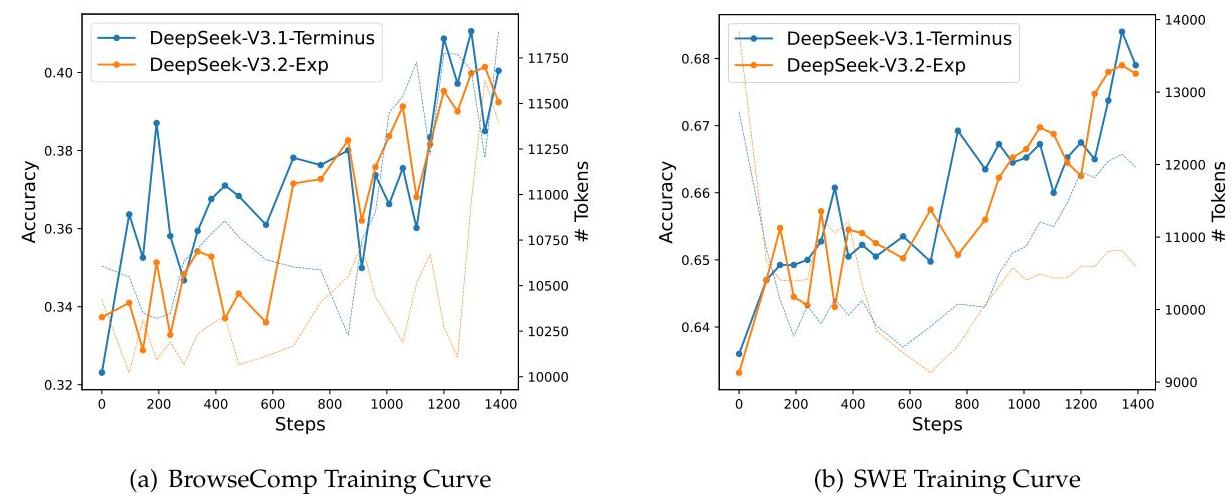
The training curves tell the story. Compared to V3.1-Terminus, V3.2-Exp tracks almost identically in performance gains across benchmarks, suggesting strong stability.
Figure 2 | RL training curve comparison
Evaluation: Near-Lossless Capability
Benchmark results indicate that V3.2-Exp maintains nearly identical performance to V3.1. For example, both score 85.0 on MMLU-Pro, while SimpleQA accuracy even edges higher (96.8 → 97.1).
Some reasoning-heavy tasks, such as GPQA and HLE, show slight drops. The reason? V3.2-Exp generates fewer reasoning tokens. Yet, when intermediate checkpoints with comparable token counts are used, the performance gap largely closes.
The key insight: DSA cuts computation dramatically without introducing structural degradation in capability.
Costs and Efficiency: The Ledger on H800 Clusters
Efficiency is the true headline.
DSA reduces attention complexity from to . In real-world deployments on H800 GPUs, the cost curves flatten dramatically.
Figure 3 | Inference costs on H800 clusters
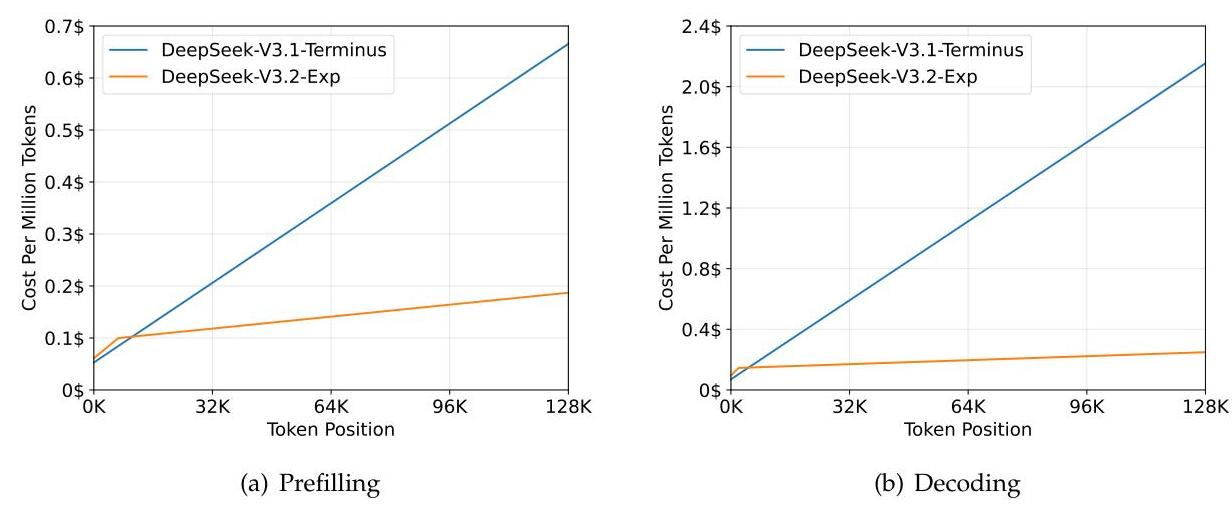
As token positions scale toward 128K, V3.1’s inference bill climbs steeply—approaching $2 per million tokens. By contrast, V3.2-Exp holds costs below $0.4. For any application dealing with long documents, this represents a meaningful economic breakthrough.
Risks and Outlook
Still, V3.2-Exp is not flawless. Three risks stand out:
- Whether the indexer can consistently achieve high recall in extreme cases.
- Robustness of long-chain reasoning outputs.
- Shifts in output length distribution that can affect certain benchmarks.
Further validation in large-scale, real-world agent workflows will be critical.
Conclusion: A Viable Cost-Reduction Path
From an investment perspective, V3.2-Exp is less about new “performance records” and more about validating a cost-reduction path. It shows that even with compute costs rising, architectural innovation can rewire the economics of inference. If this approach holds at scale, it will directly reshape the business models of AI applications.
Put simply: V3.2-Exp is not a “smarter” brain, but a more cost-effective one. And in the era of long-context reasoning, that may prove to be exactly what matters.


