
EA's $50 Billion Acquisition Rumor - Valuation, Growth Challenges, and Regulatory Risks
Amid a cooling gaming market, does the rumored 50 billion private equity bid for Electronic Arts represent a strategic bet on its resilient live-service model, or is it a premium exit for a company facing mounting IP licensing and "loot box" regulatory risks?


The Ambition of Capital and the Industry's Dilemma: A Deep Dive into Electronic Arts' Potential 50 Billion Acquisition
A massive rumor has recently sent shockwaves through the global gaming industry. Reports from several authoritative institutions indicate that video game giant Electronic Arts (EA) is in deep negotiations with an investor consortium, led by Silver Lake and the Saudi Arabia’s Public Investment Fund (PIF), regarding a potential private acquisition valued at up to $50 billion in Enterprise Value. Should this transaction materialize, its sheer scale is poised to surpass historical records, making it one of the largest Leveraged Buyouts (LBOs) in history.
This prospective mega-deal not only signifies the capital market’s strong endorsement of EA’s core asset value but also serves as a profound footnote on the structural challenges and consolidation trends facing the post-Covid-19 gaming sector. This compels us to ask: Against the backdrop of decelerating industry growth, does this 50 billion valuation represent a strategic bet by capital on EA's stable cash flow, or a premium exit for a mature company grappling with mounting licensing and regulatory risks?
The 'Disillusionment' of Industry Growth and EA's Value Anchor
The gaming industry experienced a sales frenzy during the pandemic, yet it has cooled off significantly over the past two years. Industry observers widely fear that, as player behavior shifts toward sustained engagement with established titles like Fortnite and Minecraft, the console market has transitioned from a "growth market" to a "mature market." Analysts project that the industry's growth rate in 2025 will be only about 4.6%, nearly flat with inflation, prompting many gaming executives to seek strategic alternatives.
It is precisely against this industry backdrop that EA's core value proposition stands out, primarily demonstrated by the successful pivot to its "live-service games" model.
- Pillar of Stable Cash Flow: Nearly 75% of EA’s 2025 fiscal year sales were derived from live-service revenue, rather than traditional new game purchases. This model, driven by continuously updated content in titles like the online shooter Apex Legends, provides the company with stable and predictable recurring revenue.
- The Moat of Sports IP: By leveraging its dominant position in sports gaming—including its FC soccer titles and Madden NFL football games—EA commands the world's most loyal player base and its most dependable revenue streams.
The Ambition of Capital: Sovereign Wealth Funds and the Return of the Modern LBO
The composition of the rumored buyer consortium for this potential privatization reveals a new trend in modern large-scale LBOs: the deep involvement of Sovereign Wealth Funds (SWFs) and massive institutional investors.
- PIF’s Strategic Positioning: The Saudi Arabia’s Public Investment Fund (PIF) not only holds approximately 10% of EA's shares but is also a significant investor in its competitor, Take-Two Interactive Software. Through the establishment of Savvy Games Group and large-scale global investments in sports and entertainment (such as LIV Golf), PIF has clearly articulated its strategic ambition to transform Saudi Arabia into a global video game destination.
- Private Equity’s Tech Focus: Silver Lake’s participation, as a private equity firm specializing in technology, signals an endorsement of EA’s underlying technology and business model.
- The Return of the Mega-LBO: In the post-Financial Crisis era, large-scale Leveraged Buyouts had largely faded from the scene. This transaction, alongside previous deals like Microsoft’s acquisition of Activision Blizzard and Take-Two Interactive Software’s purchase of Zynga, signals a renewed interest from capital in mature tech/entertainment assets with stable cash flows. Furthermore, the deal structure increasingly favors large investors like SWFs to diversify risk.
Stock Volatility and Valuation Scrutiny
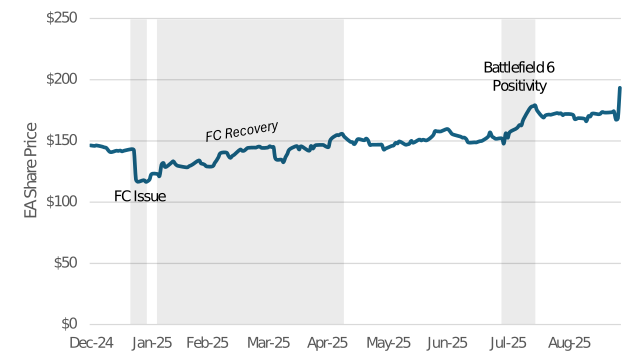
Despite the industry challenges, EA’s stock performance in 2025 has been driven by a dramatic sequence of events.
EA 2025 Stock Performance Drivers
Source: Morgan Stanley
As illustrated above, EA's stock suffered its largest decline in 17 years (16.7%) at the start of the year due to poor execution of its flagship FC soccer title. However, the share price subsequently recovered, fueled by problem resolution, accelerated financial performance, and positive feedback regarding the non-sports title Battlefield 6.
The rumored 50 billion Enterprise Value equates to a 17x multiple on Goldman Sachs' estimated 2027 fiscal year Adjusted EBITDA. Notably, this valuation multiple aligns with the 17x acquisition multiple Microsoft paid for Activision Blizzard based on its 2023 fiscal year estimate, demonstrating the market's recognition of EA as a core industry asset.
Nevertheless, investment banks maintain a cautious stance. Goldman Sachs upheld its "Neutral" rating on EA stock in its report, setting a 12-month price target of $170, without altering its valuation model based on the rumor. This target price is derived from a blended valuation methodology, where fundamental valuation accounts for an 85% weighting and M&A valuation for a 15% weighting.
The table below showcases Goldman Sachs' valuation framework, highlighting the trade-off between fundamental performance and M&A premium:
Source: Goldman Sachs
EA's Challenges: The Sword of Damocles in IP Licensing and Regulation
Although bolstered by robust live-service revenue, EA's future is not without peril, as its core business model faces two major structural risks:
1. Potential Loss and Rising Costs of Key IP Licensing
Many of EA's most crucial IPs, including sports titles like FC and Madden, and non-sports franchises such as Star Wars, operate under a licensing model. Renewals (typically every 5 to 10 years) pose risks of escalating costs, loss of exclusivity, or the complete forfeiture of the IP.
- The FIFA Lesson: EA terminated its FIFA licensing agreement in 2022, rebranding its flagship soccer series to FC. This demonstrates that even long-standing partnerships are not immune to disruption.
- The Madden Renewal: The market is keenly focused on the renewal of the Madden NFL licensing agreement, due in May 2026. While the partnership remains historically stable, the fact that the NFL entered into an agreement with Take-Two Interactive Software in 2020 (though currently restricted from developing a competing product to Madden) means any development could trigger market anxiety.
2. Regulatory Scrutiny of "Loot Box" Mechanics
The "Loot Box" mechanism is a core component of the profitability of EA's flagship titles, particularly FC and Madden. However, this mechanism has historically faced intense scrutiny from U.S. and foreign regulators, with some agencies suggesting it may violate gambling laws. As the regulatory environment tightens in international markets (which contribute 59% of EA's FY25 revenue), this presents ongoing uncertainty for EA's monetization model.
Furthermore, the non-sports pipeline, particularly the upcoming release of Battlefield 6 on October 10, 2025, is seen as a critical driver for EA’s stock to realize upside potential. Since the growth in sports game profitability is largely priced in by the market, the successful execution of non-sports titles is the core argument for demonstrating EA's future growth potential.
The Wave of Industry Consolidation and Future Catalysts
EA's potential privatization is undoubtedly the latest example in the massive wave of consolidation sweeping the gaming industry. This trend is jointly driven by industry maturation and capital's pursuit of stable assets.
The table below summarizes recent major video game M&A transactions, providing a historical benchmark for EA's valuation:
For EA, several key events over the next 12 months could act as stock price catalysts:
- Non-Sports Execution Proof: The launch of Battlefield 6 in October 2025.
- IP Licensing Stability: Progress on the Madden NFL licensing renewal in May 2026.
- Industry Dynamics Impact: The release of competitor Take-Two Interactive Software’s Grand Theft Auto VI in May 2026, which is expected to temporarily divert player engagement and consumer spending across the entire gaming sector.
- Sports Year Boost: The 2026 FIFA World Cup in June 2026 will significantly boost global interest in soccer, translating directly into sales for EA's FC titles.
Whether this privatization rumor ultimately materializes or collapses, it clearly signals the capital market's recognition of EA's core assets, alongside its caution regarding industry challenges. For investors, EA’s value lies in the stability provided by its live services and the moat of its sports IP; its risk, however, lies in its ability to continually demonstrate execution capability in its non-sports pipeline, navigating the narrow gap between regulation and licensing, to avoid becoming a stagnant "cash cow."


