
From Selling Engines to Building Cars: Decoding Nvidia's Structural Pains and Its Non-Zero-Sum Future
Is the recent spike in Nvidia's inventory a harbinger of demand collapse, or a misunderstood signal of a fundamental shift in how data centers are built? By dissecting the structural transition to rack-scale computing, we explore why the AI hardware war is far from a zero-sum game.


In financial markets, skepticism is nothing short of a survival mechanism. When a company’s market capitalization swells to trillions of dollars in a breathtakingly short window, examining its balance sheet with a magnifying glass isn't just reasonable—it is necessary.
Recently, the cacophony surrounding Nvidia has grown louder. From put options held by renowned investors like Michael Burry to conspiracy theories about "circular financing" circulating on social media, the market seems intent on finding the needle that pops the balloon. The core logic of these critiques sounds undeniably thrilling: Nvidia, the theory goes, invests in startups like CoreWeave, which then purchase Nvidia’s own GPUs, effectively "round-tripping" capital to inflate revenue. Meanwhile, a sharp rise in inventory levels is interpreted as the smoking gun of softening terminal demand.
However, if we are willing to cut through the emotional noise and dive into the micro-data of the supply chain, the pricing logic of the debt markets, and the architectural evolution of modern data centers, a vastly different picture emerges. This is not a "Ponzi" story about accounting fraud. It is a grand narrative about the computing industry’s painful but necessary metamorphosis—an evolution to "heavy industrialization".
1. The Debt Market’s Honest Vote: CoreWeave is Not a House of Cards
The central pillar of the "circular financing" argument rests on the assumption that the "Neo-Clouds" purchasing Nvidia GPUs lack genuine cash-generating ability and rely entirely on Nvidia’s equity injections to sustain their purchasing power. This view, while superficially logical, ignores the most honest corner of the capital markets: the Debt Market.
CoreWeave’s ability to secure billions in financing does not rely on checks written by Nvidia, but rather on the extremely high collateral value of the core assets it holds—the GPUs themselves—in the capital markets. This business resembles infrastructure leasing (akin to aircraft leasing) far more than it does a venture capital game. Look at CoreWeave’s capital structure: its funding sources primarily consist of term loans and asset-backed securities (ABS) provided by top-tier institutions like Blackstone and Magnetar. These veteran Wall Street players are willing to lend because the Unit Economics of compute leasing are crystal clear and highly attractive.
According to data from SemiAnalysis and others, even under conservative assumptions (e.g., a 6-year hardware depreciation schedule), the EBIT margin for deploying H100 clusters remains around 33.4%. Even more impressive is the project return: within a standard 5-year contract cycle, the Internal Rate of Return (IRR) for a GB200 cluster can reach as high as 20-30%.
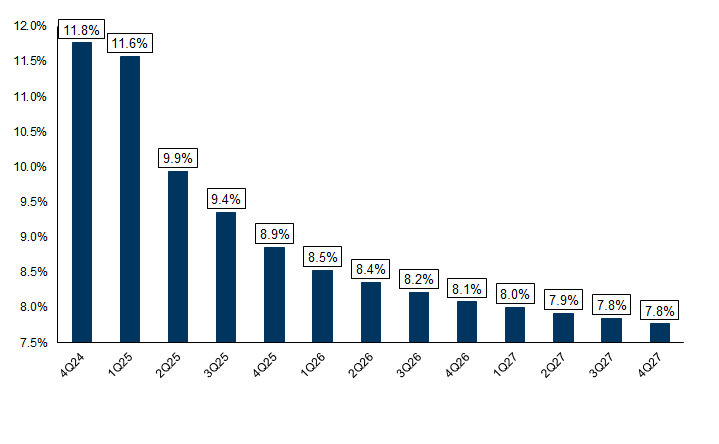
This high rate of return translates directly into a powerful "financial vote of confidence." As shown in the Goldman Sachs (GS) chart below, as scale expands and the business model is validated, the risk premium demanded by the capital markets for CoreWeave is significantly decreasing.
CoreWeave Expected Cost of Debt Trend (Falling from current 11.8% to 7.8% by 4Q27)
Source: GS
This touches the essence of the matter: if this were truly a Ponzi scheme, the yield curve on their debt should be steeply upward sloping, reflecting accumulating risk. The reality is the opposite—financing costs are projected to slide from the current 11.8% to 7.8% by the fourth quarter of 2027. Real cash flow generated by physical assets is the bedrock supporting this entire financing chain. In this logic, GPUs are no longer mere consumer electronics; they are productive assets, analogous to the turbines in a power plant.
2. The Inventory Puzzle: Structural Growing Pains of Selling "The Whole Car"
Another primary handle for short-sellers is inventory. The latest financial data shows Nvidia’s inventory value has climbed to nearly $19.78 billion, with Days of Inventory (DOI) rising from 105 days in the previous quarter to 118 days. In traditional semiconductor cycle theory, an inventory backlog is typically the harbinger of a demand collapse—chips aren't selling, so they gather dust in the warehouse.
But this time, we may be applying an outdated playbook to a new game. To understand the rise in inventory, we must recognize that Nvidia’s product form factor has undergone a qualitative leap: It is painfully but firmly transitioning from a company selling components (chips/boards) to a company selling complete data center systems (System Provider).
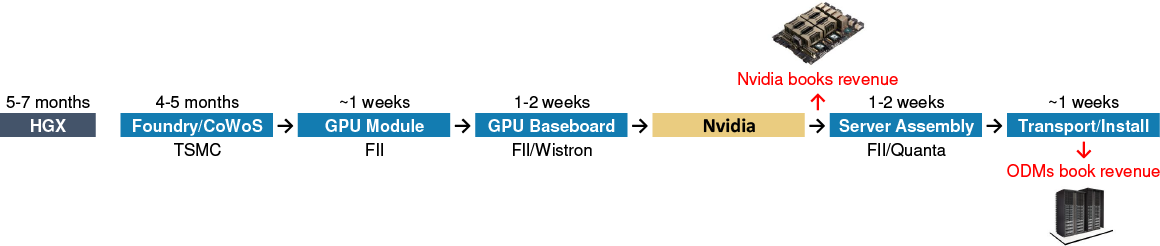
In the past, Nvidia primarily sold HGX or DGX boards. The supply chain for these was relatively simple: TSMC fabricated the chips, they were packaged, made into modules, and handed to integrators. The entire cycle took about 5-7 months. As an upstream provider, Nvidia’s product velocity was high, and revenue recognition occurred early.
Nvidia HGX AI Server Supply Chain Flow
Source: Bernstein
However, with the advent of rack-scale products like the GB200 NVL72, the rules have been rewritten. The NVL72 is not a simple electronic component; it is a "supercomputer unit" integrating 72 Blackwell GPUs, 36 Grace CPUs, two miles of copper cabling, complex liquid cooling systems, and high-speed switches.
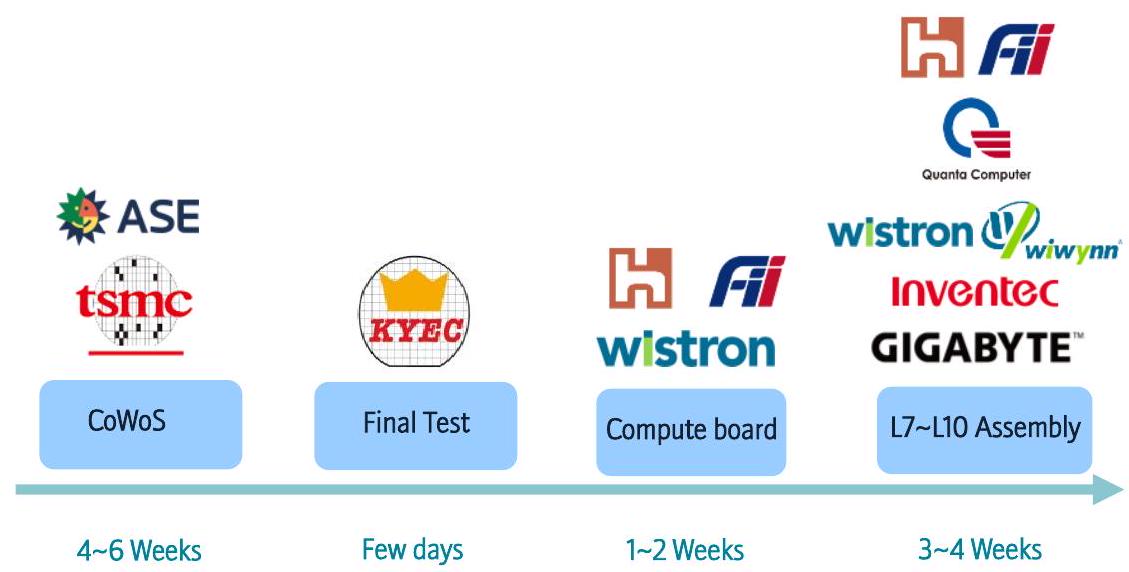
This implies an extreme elongation and complication of the supply chain. Nvidia now must wait not only for the chips to be produced but also for liquid cooling piping, racks, power modules, and other components to arrive. Only after completing complex system-level assembly and testing can they deliver to the customer and recognize revenue. It is as if Ferrari previously sold only engines, but now must sell the entire vehicle—naturally, more parts awaiting assembly will sit on the factory floor.
GB200 Server Production Timeline
Source: Bernstein
The truth behind the inventory increase lies in a "Speed Mismatch": the rate at which TSMC churns out chips is temporarily faster than the rate at which downstream ODMs can ramp up the assembly of these complex racks. A large volume of high-value GPU chips (Finished Goods) are forced to sit in warehouses as semi-finished goods, waiting to be mated with other components.
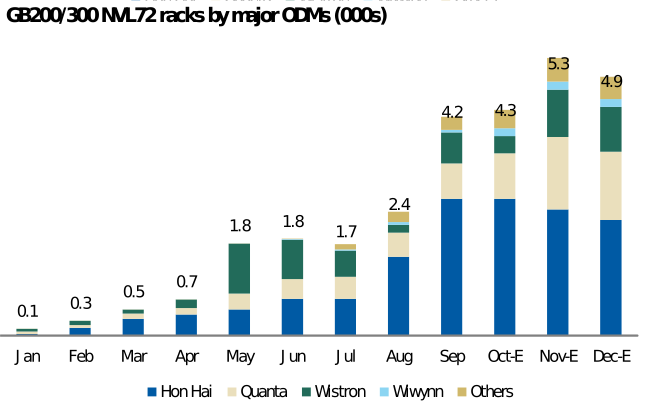
Bernstein’s data indicates that despite challenges, the output of GB200 racks is steadily ramping up. This isn't happening because no one wants them, but because the "chassis" isn't ready, so the "engines" must wait. Considering that the US "Big Four" cloud providers expect GB200 investments to account for 15% to 42% of their 2025 CapEx, demand is not softening—it is in a state of acute hunger. The rise in inventory is, in fact, a manifestation of Nvidia accumulating potential energy for the massive deliveries to come, rather than a signal of stagnation.
3. The Non-Zero-Sum Game: Why Google’s TPU Won't Kill Nvidia
Beyond financial skepticism, a more tangible shadow looms over Nvidia: competition from its largest customers, which has recently escalated significantly. Google is no longer content with using its proprietary TPUs in-house. It is now actively pitching them to external customers through a new "TPU@Premises" initiative, and is reportedly in talks with Meta for a multi-billion dollar deal to deploy TPUs in Meta's own data centers by 2027. Strikingly, this discussion includes using TPUs for training new AI models, a direct challenge to Nvidia's traditional stronghold.
This worry, however, ignores the macro volume of the AI hardware market. This is not a "kill or be killed" battle for a stagnant pool of assets; it is a fight for a slice of an incrementally exploding market. According to BofA forecasts, the Total Addressable Market (TAM) for AI data centers will rocket from approximately $242 billion in 2025 to over $1.2 trillion by 2030.
On a track expanding 5x, even if Nvidia’s market share regresses from its current monopolistic levels (>85%) to a rational dominance (around 75%), its absolute growth in revenue and profit will remain astronomical. Furthermore, the narrative isn't a simple 'Google vs. Nvidia' dichotomy. As Morgan Stanley analyst Joe Moore points out, Nvidia's business with Google is expected to be nearly $20 billion this year, still significantly larger than Google's own TPU business.
Industry GB200/300 NVL72 Equivalent Monthly Rack Output (2025)
Source: MS
The expansion of Google’s TPU is a more direct threat to others. This is a clear positive for Broadcom (as the ASIC partner for TPU) but constitutes an incremental blow to AMD. Once customers have a mature alternative like the TPU, their appetite for an "Nvidia backup plan" (i.e., the AMD MI series) diminishes significantly.
But for Nvidia, the moat is no longer just chip performance. Through the NVL72, Nvidia controls the Networking. In the training of trillion-parameter models, the performance of a single chip matters, but how thousands of chips collaborate efficiently as a "giant brain" matters more. In this regard, possessing the Cuda ecosystem and InfiniBand/NVLink technology, Nvidia still holds the pen that defines data center architecture. Google is attempting to counter this with software like its "TPU command center" and by promoting PyTorch compatibility to weaken the Cuda lock-in, but Nvidia's integrated system-level advantage remains formidable.
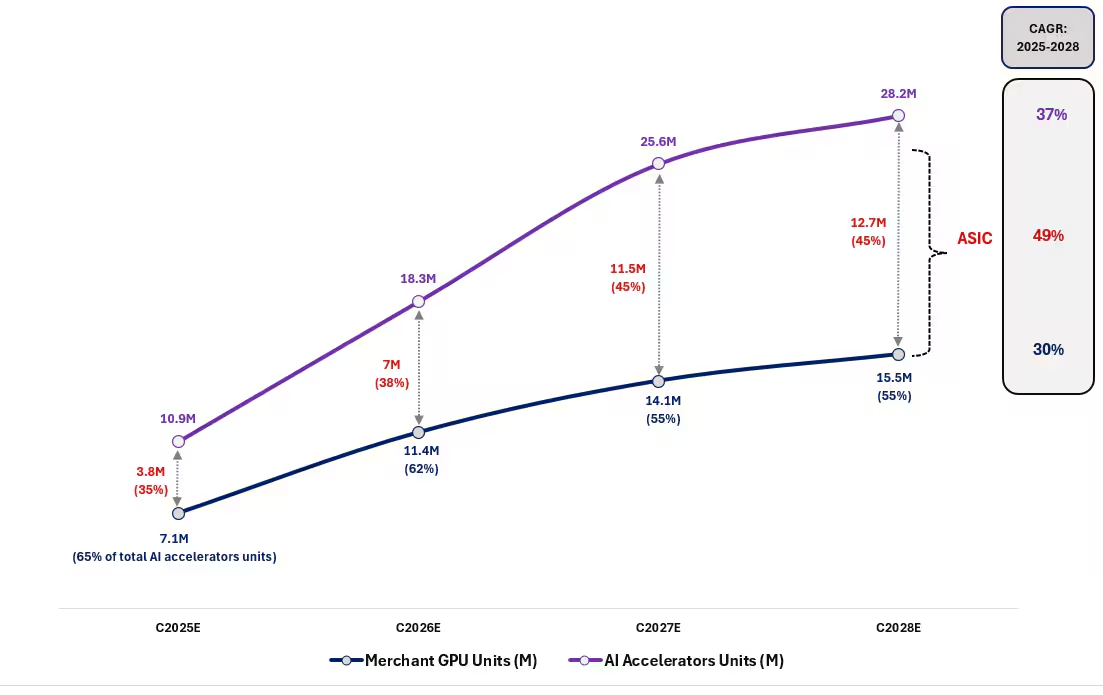
Merchant GPU vs. Custom Chip (ASIC) Future Market Share Trends
Source: Citi
As Citi’s forecast illustrates, although ASICs (purple line) are growing rapidly, Merchant GPUs (dark blue line) continue to occupy a position of absolute dominance. For the majority of enterprises that do not wish to be locked into a single cloud provider, Nvidia remains the "universal currency."
Conclusion: The Signal in the Noise
In the long history of tech investing, distinguishing between "cyclical fluctuations" and "structural shifts" is crucial—and incredibly difficult.
Current market anxieties regarding Nvidia are, to a large extent, an attempt to apply the experiences of old semiconductor cycles to the phenomena of a new AI industrial cycle. The so-called "circular financing" bubble looks pale against the backdrop of solid unit economics; the seemingly dangerous inventory spike is actually the necessary growing pain of the entire computing industry transitioning to a "rack-scale" delivery model.
When we talk about an AI bubble, it is worth looking at the market landscape projected to reach $1.2 trillion by 2030. In this massive non-zero-sum game, Nvidia may not take every chip off the table forever, but it remains the indispensable host of the feast. For the rational observer, the noise of today might just be the best moment to see the signal.
I will share a more detailed version of this post for all of my subscribers behind the paywall:


