
Generalist AI's GEN-0 Reveals a Blueprint for Scaling Embodied AI Through Model Size, Data, and Architecture
While AI has mastered language, the physical world has remained a stubborn challenge. What does it truly take to unlock predictable, exponential scaling for robotics, akin to the revolution we've witnessed with LLMs?


Generalist - Blog
The ‘GPT-3 Moment’ for Embodied AI: What Generalist AI’s GEN-0 Reveals
In the realm of artificial intelligence, we have grown accustomed to the exponential progress driven by Large Language Models (LLMs). Thanks to massive investments in data and compute, model performance has improved with a predictable consistency, a phenomenon known as "Scaling Laws." However, this elegant paradigm seemingly breaks down when we shift our gaze from the digital to the physical world. Robotics, the field of direct interaction with reality, has long been mired in complexity, data scarcity, and incremental progress. This is the essence of the famous Moravec's Paradox: perception and motor skills, which are effortless for humans, are extraordinarily complex for computers.
However, Generalist AI's recent announcement of its Embodied Foundation Model, GEN-0, appears to be challenging this status quo. The company claims to have discovered the critical "Scaling Laws" for robotics, hinting that embodied intelligence may be on the cusp of its own "GPT-3 moment." So, what does it truly take to achieve predictable scaling for intelligence in the physical world? The research behind GEN-0 reveals several key elements.
First: Crossing the "Intelligence Threshold" Where Model Size is Paramount
Generalist AI's research has uncovered that in robotics, not all models can learn effectively from vast amounts of data. Their experiments revealed a surprising "phase transition": smaller models (e.g., at the 1 billion parameter scale) quickly hit a bottleneck when fed with more pre-training data. They exhibit a phenomenon known as "ossification," where their ability to absorb new information stagnates.
Yet, a qualitative shift occurs when the model size increases to 7 billion parameters and beyond. These larger models can continuously learn and improve from massive volumes of physical interaction data, demonstrating powerful generalization capabilities and adapting to downstream tasks with minimal fine-tuning.
Figure 1: Model Size and the "Ossification" Phenomenon Source: Generalist AI
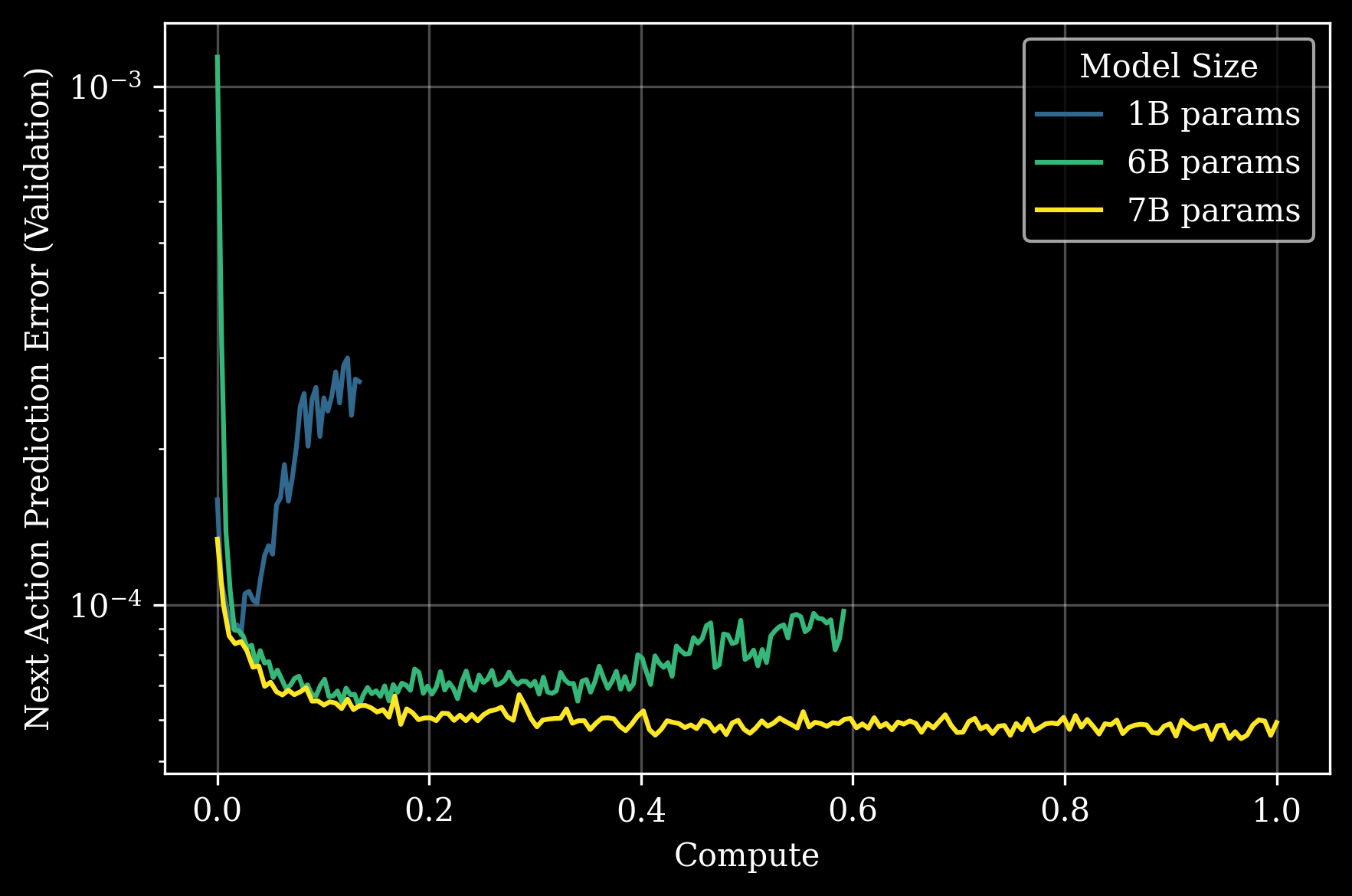
This chart clearly illustrates the performance divergence between models of different sizes. The 1B parameter model (blue) flatlines early in its training, while the 6B and 7B models show sustained improvement. This finding strongly suggests that model scale itself is a prerequisite for unlocking complex, general physical intelligence. The "common sense" of the physical world may demand a much higher computational complexity threshold than abstract reasoning, and we are only just beginning to explore what lies beyond it.
Second: Data is No Longer the Bottleneck, but the Fuel
For a long time, the biggest bottleneck in robotics has been the lack of high-quality, large-scale, and diverse real-world manipulation data. Generalist AI claims to have fundamentally solved this problem.
GEN-0 is pre-trained on an unprecedented dataset containing over 270,000 hours of real-world manipulation trajectories. This volume of data is reportedly orders of magnitude larger than any publicly available robotics dataset to date. More importantly, this dataset is accelerating, growing at a rate of over 10,000 new hours per week. The data is sourced from thousands of homes, warehouses, and workplaces worldwide, covering every manipulation task humans can conceive of, from peeling potatoes to threading bolts.
To handle such a massive data stream, Generalist AI built custom hardware, data loaders, and network infrastructure comparable to those used for training frontier video foundation models. This indicates that the second key element for achieving scaling laws in robotics is the establishment of a "data engine" capable of continuously producing high-quality, real-world data at a massive scale.
Third: A New Architecture—"Harmonic Reasoning"
With a sufficiently large model and vast amounts of data, you still need an "engine" capable of utilizing them efficiently. To this end, Generalist AI has introduced "Harmonic Reasoning," a novel training methodology and model architecture.
For a chatbot, it is feasible to "spend more time thinking" before responding. But for a robot acting in real-time, the laws of physics do not pause. The core idea behind Harmonic Reasoning is to enable the model to seamlessly "think" and "act" simultaneously. It creates a "harmonic" interplay between asynchronous streams of sensory input and action outputs, allowing the model to break free from the rigid "sense-think-act" loop that has traditionally constrained robot control.
This architecture allows GEN-0 to scale to very large model sizes without relying on System1-System2 architectures or inference-time guidance, enabling the natural emergence of human-like reflexes and physical common sense.
Conclusion: A Blueprint for General-Purpose Robots?
Generalist AI's GEN-0 is not just a new model; it's a systematic blueprint for how to achieve scalable physical intelligence. Its core lies in the combination of three elements:
- Sufficient Model Scale: Crossing the 7-billion-parameter "intelligence threshold" to avoid learning ossification.
- Massive Real-World Data: Building a vast and diverse dataset of physical interactions to serve as the fuel for learning.
- Efficient Training Architecture: Employing innovations like "Harmonic Reasoning" to allow the model to digest data and interact with the world in real-time.
The scaling laws demonstrated by GEN-0 offer the first glimpse of a future where robot performance can predictably improve with increased investment in data and compute.
Figure 2: The Power-Law Relationship Between Pretraining Data Scale and Downstream Task Performance Source: Generalist AI
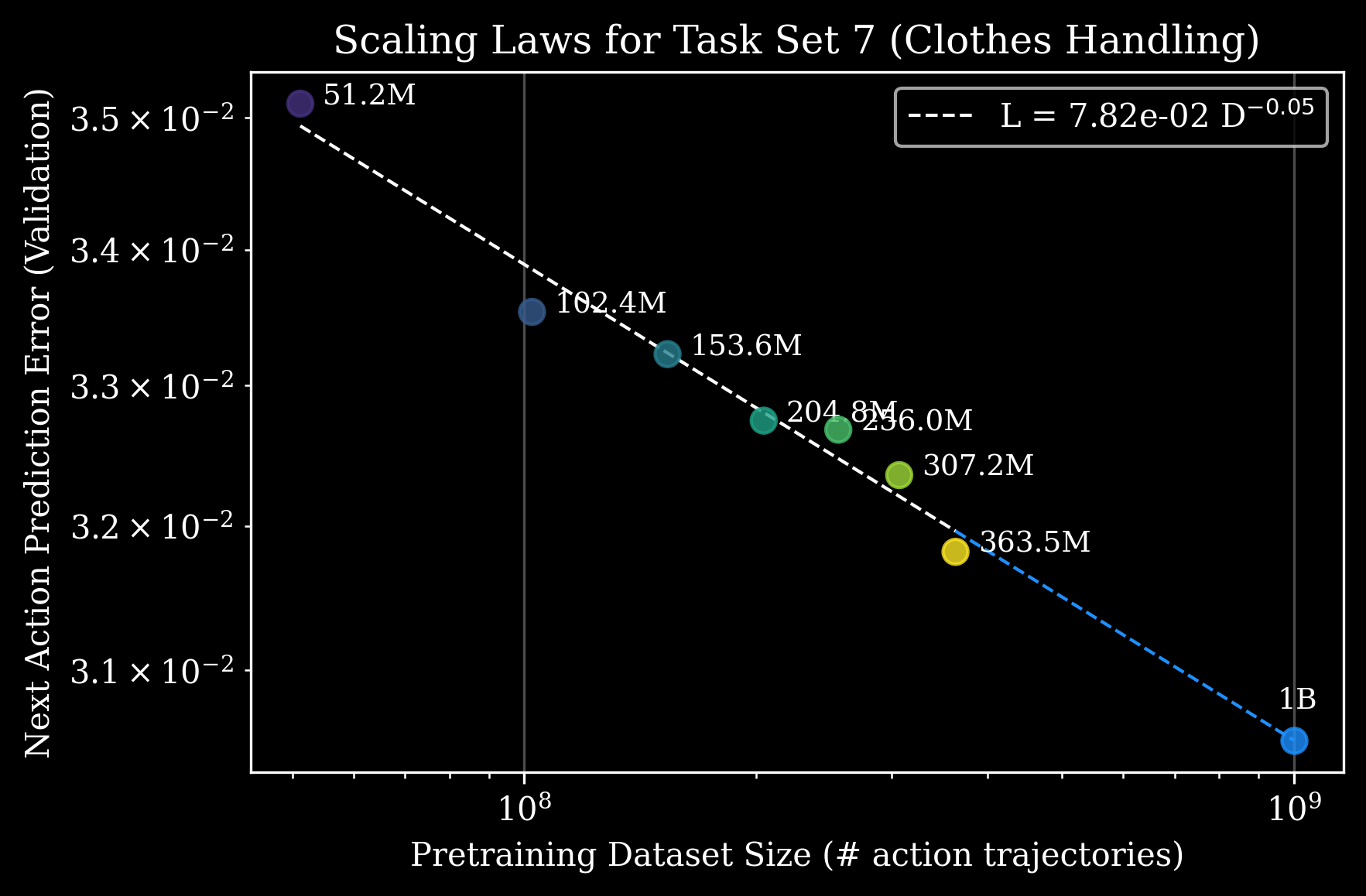
Of course, this remains the narrative of a single company for now, and its findings will require broader validation from the industry. But the evidence presented, particularly the "phase transition" related to model size and the power-law relationship between data scale and performance, is undoubtedly an exciting step forward for the field of embodied intelligence. It signals that we may be moving from an era of scattered techniques and manual engineering toward a new epoch of data-driven, scalable robotics. Is this the long-awaited "GPT-3 moment"? It may be too early to say for certain, but it is, without a doubt, the clearest roadmap we have seen to date.


