
Generative AI Functions as a Seniority-Biased Technological Change by Reducing Junior Hiring Rather Than Displacing Senior Staff
As Generative AI reshapes the workforce, is it eroding the very first rungs of the career ladder for new graduates, and what does the data truly reveal about who is most affected?


Source: 5425555.pdf
The Vanishing First Rung: How Generative AI is Reshaping the Career Ladder
Since tools like ChatGPT exploded into the public consciousness in early 2023, the conversation about AI's impact on the labor market has been relentless. Is AI a "career accelerator" or an "entry-level job killer"? For recent graduates, this uncertainty has created a palpable sense of anxiety.
This isn't just a feeling; the data suggests it's a reality. Since late 2022, the unemployment rate for recent U.S. college graduates (the red line below) has been on a worrying upward trend, even as the overall unemployment rate for all young workers (the blue line) has remained stable. Does this signal that Generative AI is disproportionately impacting a specific group?
Unemployment Rate: Recent College Graduates vs. All Young Workers Source: Generative AI as Seniority-Biased Technological Change - Evidence from U.S. R´esum´e and Job Posting Data by Seyed M. Hosseini & Guy Lichtinger
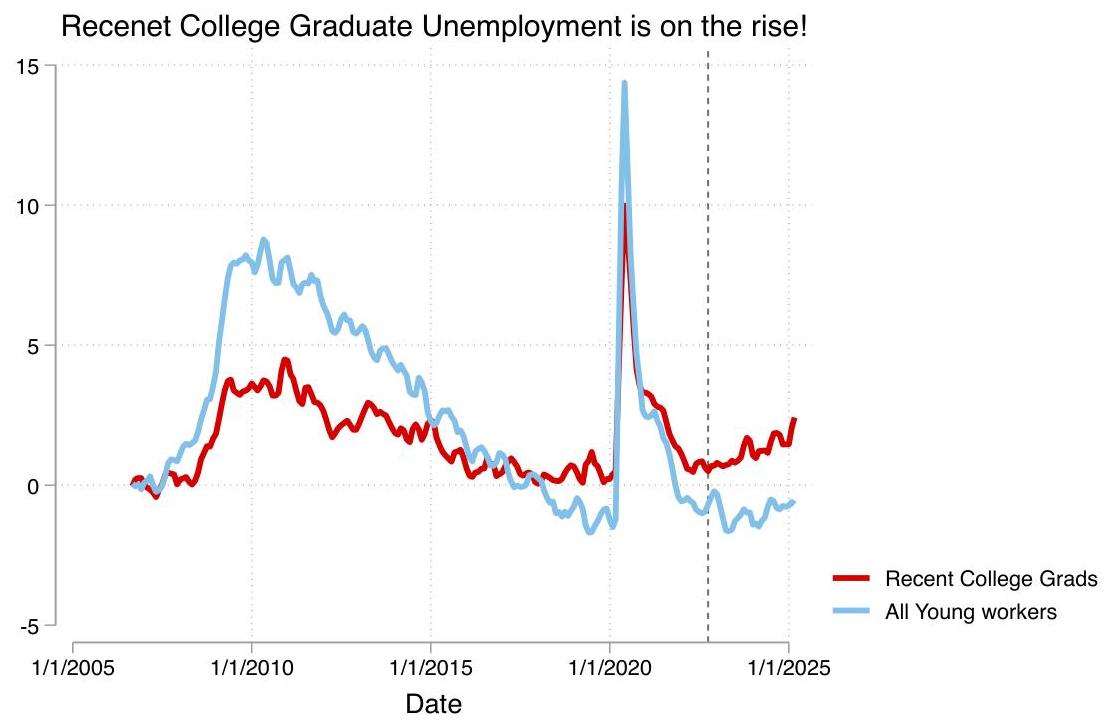
A new study by Seyed M. Hosseini and Guy Lichtinger, analyzing a massive dataset of résumés and job postings, uncovers the deep mechanics behind this trend. Their core conclusion: the rise of Generative AI constitutes a "Seniority-Biased Technological Change," with its primary impact concentrated on junior employees, not their experienced senior counterparts.
The AI Wave and the Job Market's "Great Divergence"
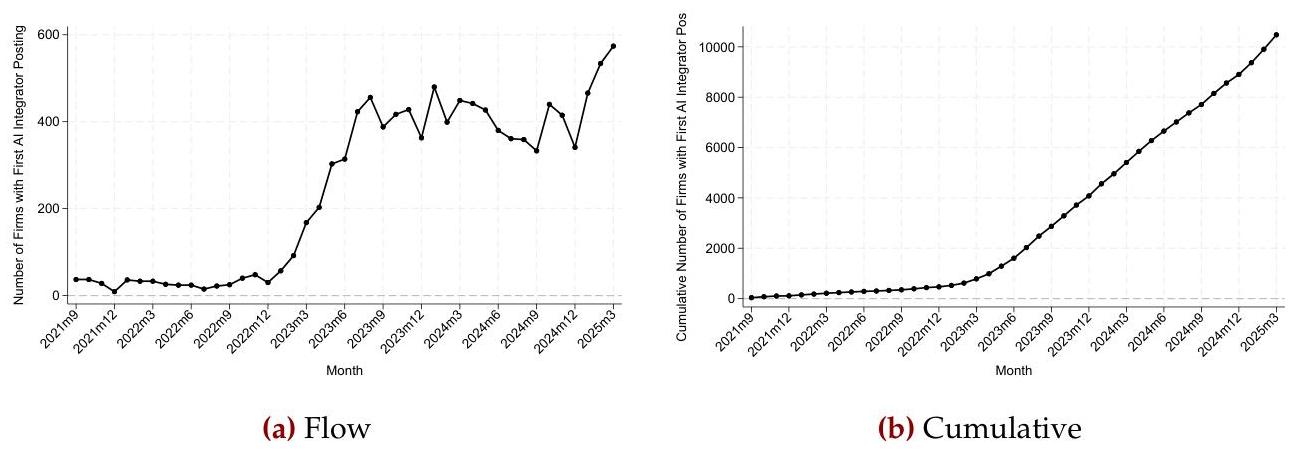
Before diving into the impact, let's look at how quickly companies have embraced AI. The researchers identified "AI adopters" as firms explicitly hiring for roles requiring Generative AI skills (like Copilot, Claude, or Prompt Engineering).
The data shows that before 2023, the number of new AI adopters was negligible. But starting in early 2023, the figure skyrocketed. By early 2025, over 10,000 firms had joined the wave.
Timeline of Firms First Posting for AI Integrator Roles Source: Hosseini & Lichtinger (2025)
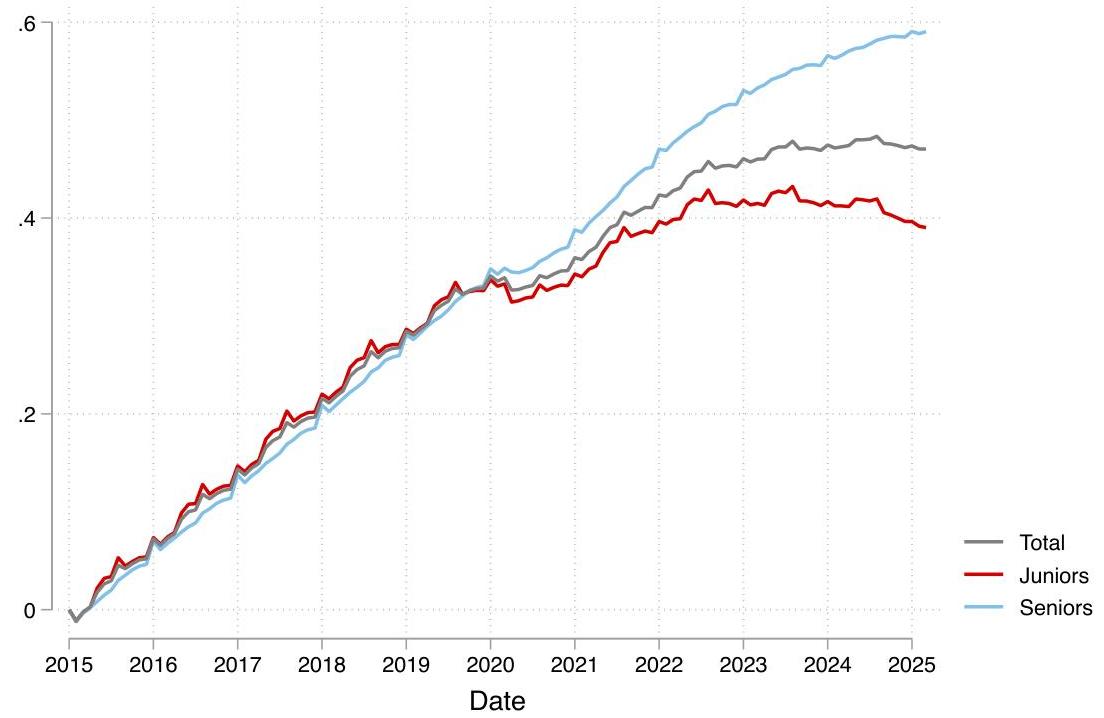
It was in the wake of this wave that the labor market began to split. Starting in mid-2022, senior-level employment continued its steady climb, while junior-level employment growth flattened and, after mid-2023, began to decline. The divergence of these two lines paints a stark picture of the different fates awaiting workers of different seniorities in the age of AI.
Employment Time Series: Junior vs. Senior Employees Source: Hosseini & Lichtinger (2025)
How is AI Reshaping Corporate Talent Strategy?
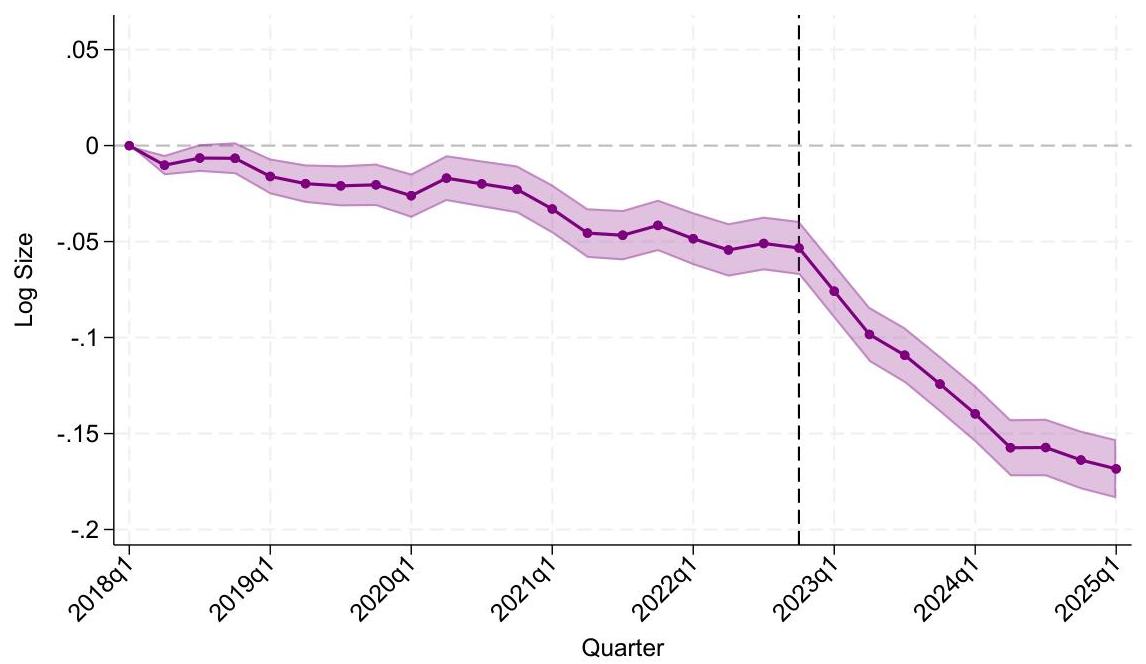
Using a rigorous "triple-difference" analysis, the study confirms a causal link: within firms that adopted AI, the employment of junior staff relative to senior staff saw a significant drop of 12%.
Triple-Difference Results: Impact of AI Adoption on Junior/Senior Ratio Source: Hosseini & Lichtinger (2025)
So, how did this happen? Did companies start laying off their junior employees? The answer is no. The study found that the reduction in junior headcount was driven by a more subtle shift:
- A Sharp Contraction in Hiring: AI-adopting firms didn't increase layoffs. Instead, they drastically cut back on hiring for entry-level positions. The data shows these firms reduced their junior hiring by an average of 22% compared to non-adopters. This aligns with market anecdotes, such as a marketing agency noting its clients had all but stopped hiring for entry-level roles because their work is now a "home run" for AI.
- An Increase in Internal Promotions: In a counter-intuitive twist, the study found that while the front door for new talent was narrowing, internal career paths were accelerating. AI-adopting firms actually increased the number of promotions for their existing junior staff into senior roles. This suggests that as AI automates routine entry-level tasks, experienced junior employees who can leverage AI become more valuable, earning faster promotions.
In short, AI hasn't triggered a mass layoff of junior workers. Instead, it's reshaping the workforce by strategically turning down the tap on new hires.
Who is Most Affected by This Transformation?
This AI-driven change is not affecting everyone and every industry equally.
The Industry Divide: Wholesale and Retail Hit Hardest
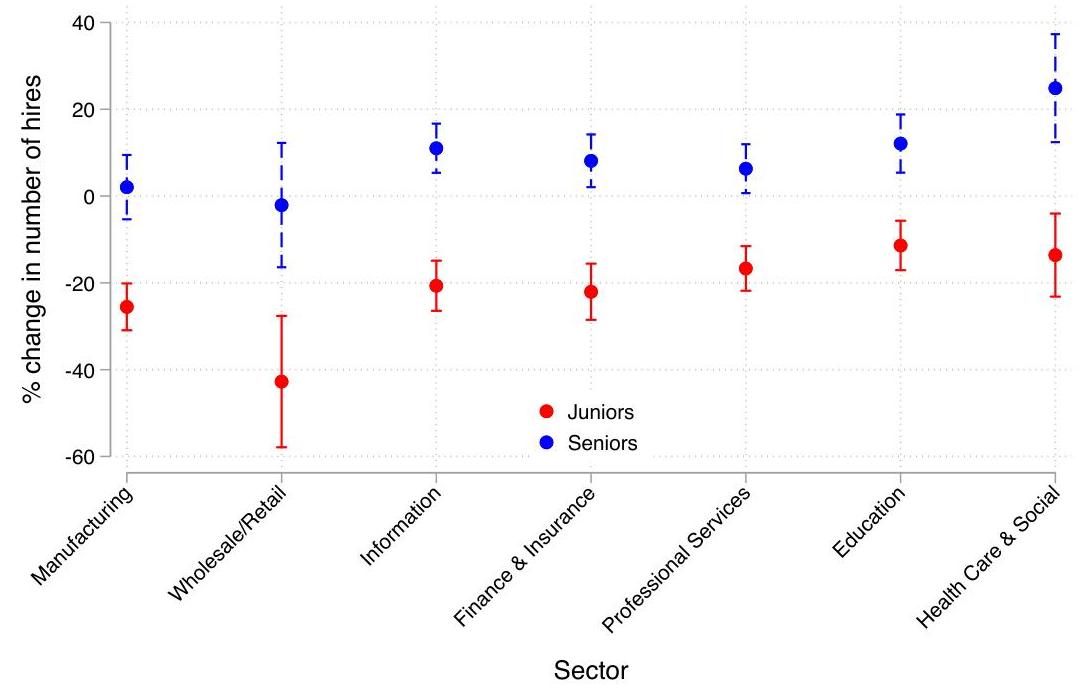
The study found that AI adopters across nearly all industries reduced their junior hiring. However, the impact was most severe in the Wholesale and Retail sector, where junior hiring plummeted by approximately 40%. This is likely because many entry-level jobs in this sector—customer communication, routine documentation, and marketing content—are highly susceptible to automation by current Generative AI tools. In contrast, senior hiring was not negatively affected in any industry.
Impact of Generative AI Adoption on Hiring, by Industry Source: Hosseini & Lichtinger (2025)
The Education Divide: The "Middling" Squeeze
Even more fascinating is the analysis based on human capital, proxied by the prestige of a graduate's university. The impact follows a distinct "U-shaped pattern."
Decline in Junior Employment, by University Tier Source: Hosseini & Lichtinger (2025)
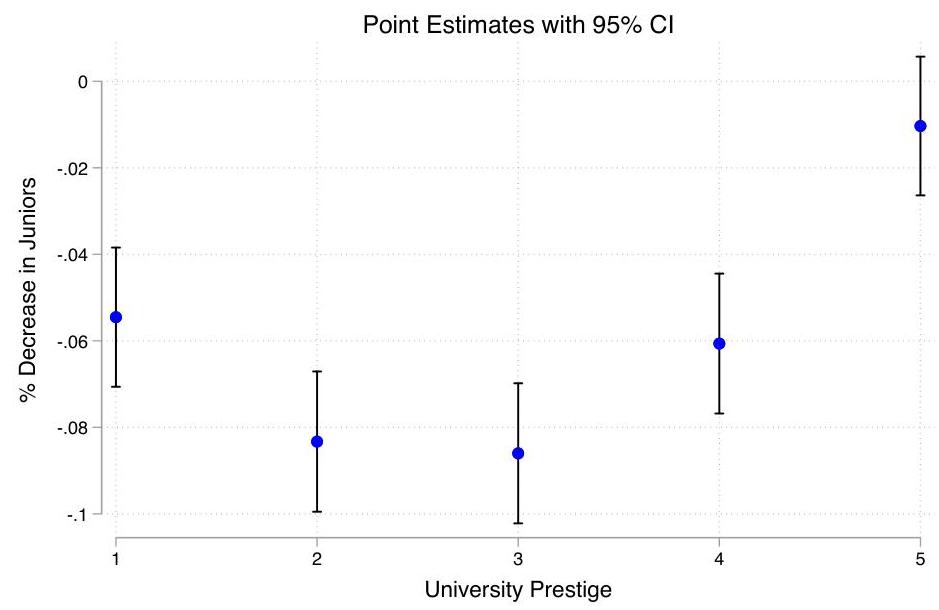
- The hardest-hit group is graduates from mid-tier universities (Tier 2 and Tier 3).
- Graduates from elite, top-tier universities (Tier 1, e.g., Ivy League) were less affected.
- Graduates from the least prestigious, lower-cost institutions (Tier 4 and Tier 5) were impacted the least.
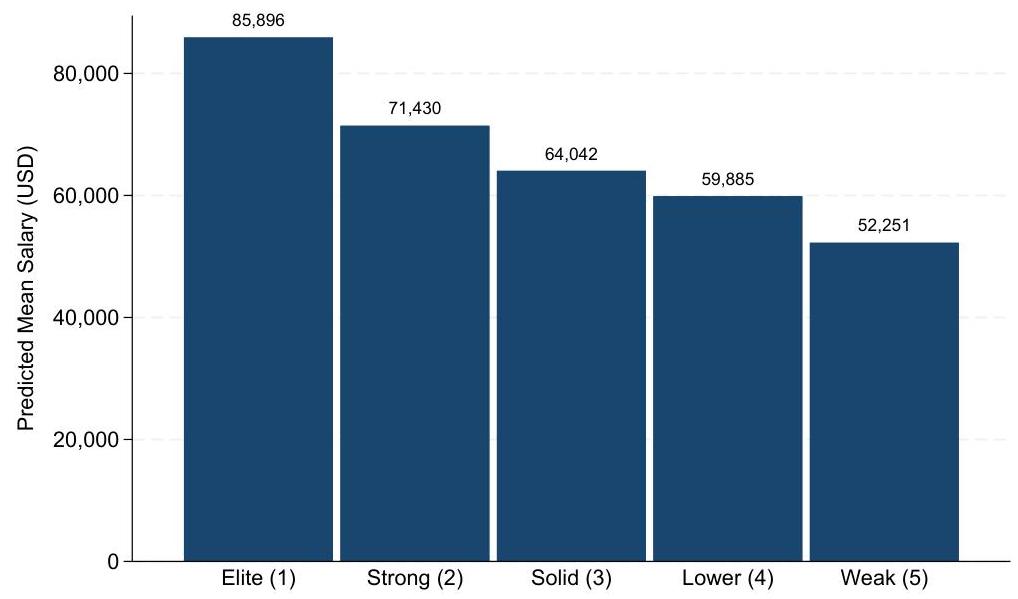
Why this pattern? Salary data offers a clue. Elite school graduates command the highest salaries, while those from the lowest-prestige schools earn the least.
Predicted Salaries for Junior Employees by University Tier (2022) Source: Hosseini & Lichtinger (2025)
The researchers theorize:
- Protection at the Top: The high productivity and quality of elite graduates make companies reluctant to cut hiring for them, even with AI.
- Protection at the Bottom: The low labor cost of graduates from less prestigious schools allows them to remain competitive against the cost of AI automation.
- The Squeeze in the Middle: It is the graduates in the middle—with neither a top-tier quality advantage nor a significant cost advantage—who are most vulnerable to being substituted by AI.
Conclusion: The Eroding Bottom Rung of the Career Ladder
This research paints a complex and profound picture. Generative AI is not, as many feared, leading to mass replacements of existing white-collar workers. Instead, it is reshaping the labor market in a more subtle but perhaps more consequential way: by eroding the very first rung of the traditional career ladder.
For companies, this means talent development models may need to shift away from mass hiring and filtering towards a greater reliance on experienced workers and accelerated internal mobility.
For young people about to enter the workforce, this presents a formidable challenge. Entry-level jobs are the critical starting point for gaining experience, achieving career mobility, and building lifetime earnings. If this starting point is narrowing, future upward mobility and income inequality could become even more pressing issues.
While this study represents an early look, and long-term market adjustments may alter these trends, the data sends a clear signal: the rules of the game are changing. How we adapt our education systems, skill sets, and career planning to a future deeply integrated with AI is the urgent question now facing us all.


