
Global DM 2026 W2 Recap
With U.S. manufacturing contracting and payrolls missing expectations by a wide margin, what underlying corporate resilience is convincing analysts to break a 5-year trend and raise earnings estimates, propelling the S&P 500 to fresh all-time highs?


Macro Overview
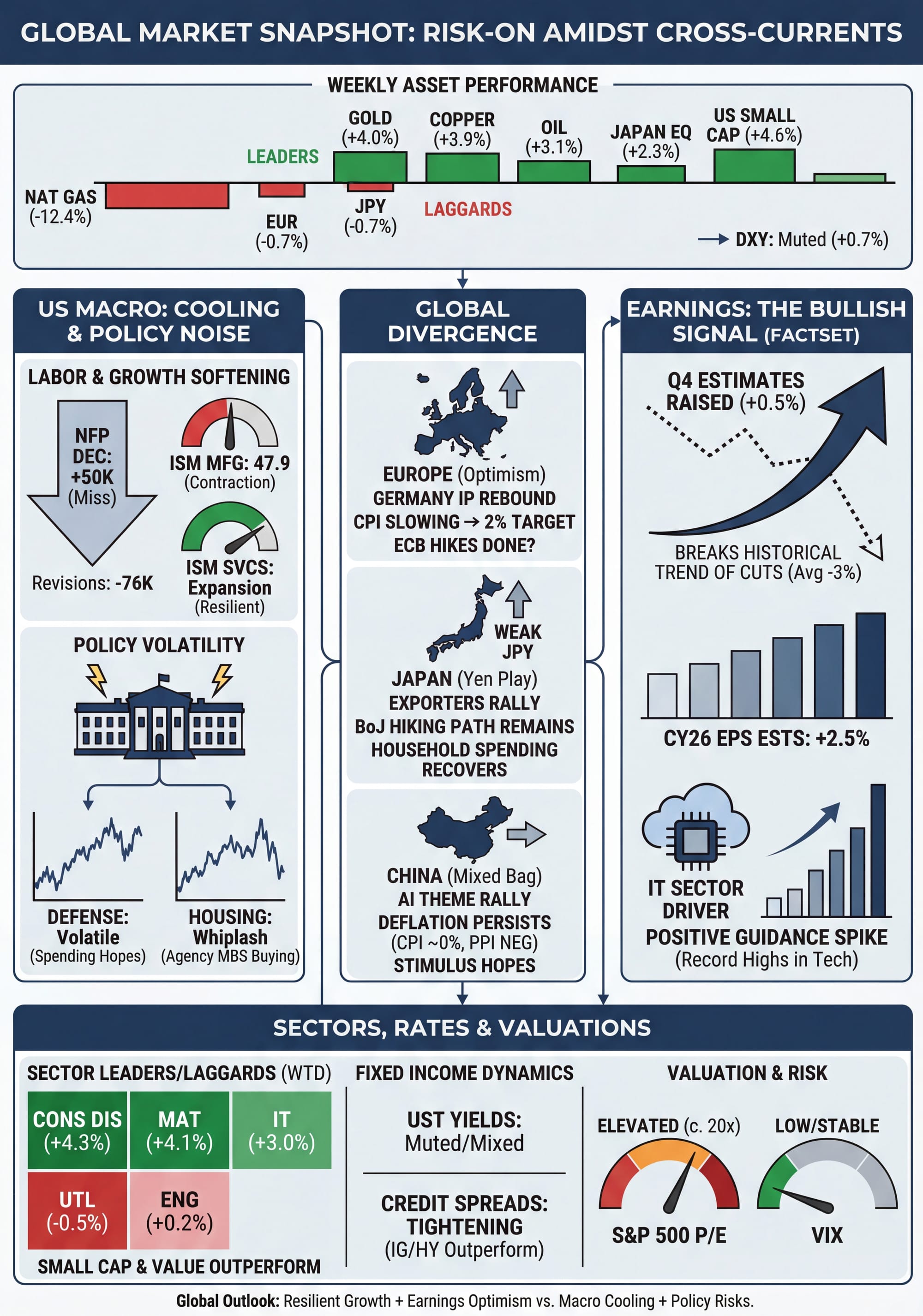
The first full trading week of 2026 saw global equities rally, pushing most major indexes to all-time highs despite mounting geopolitical tensions. Small-cap and value shares notably outperformed large-cap growth stocks, with the Russell 2000 Index leading gains. In the US, labor market data indicated weakness, with December job growth moderating and prior months revised lower, alongside declines in hires and job openings. Manufacturing activity contracted for the 10th consecutive month, while services remained resilient. The Eurozone showed signs of strengthening towards the end of 2025, driven by a German revival with better-than-expected industrial production and manufacturing orders, alongside accelerating retail sales. However, euro area headline inflation slowed to the ECB's 2.0% target, though sticky services inflation remained a concern. Japan's stock markets registered strong gains, buoyed by technology companies and yen weakness, while household spending bounced back significantly. China's markets advanced, fueled by AI trades, but persistent deflationary pressures continued to weigh on its economy, with full-year 2025 CPI at zero.
Policy Insights
President Donald Trump's flurry of policy announcements significantly influenced US markets, affecting aerospace and defense companies (through production acceleration demands and military spending increases) and homebuilders (via restrictions on institutional home purchases and directives for Fannie Mae/Freddie Mac to buy USD 200 billion in mortgage bonds to lower lending rates). In Europe, despite overall inflation reaching the European Central Bank's target, T. Rowe Price's chief European macro strategist Tomasz Wieladek indicated that persistent services inflation (at 3.4%) would likely prevent further ECB rate cuts. Japan's monetary policy is expected to see further interest rate hikes by the Bank of Japan in 2026, as Governor Kazuo Ueda confirmed the central bank's commitment to raising rates in line with economic and inflation improvements, despite investor concerns about massive government spending plans weighing on the yen. In China, persistent deflation and a prolonged housing downturn are expected to prompt the central bank to continue easing policy throughout 2026.


