Meta AI Introduces CWM, an Open-Weights Research LLM that Uses a World Model to Shift from Code Syntax to Semantics
How does teaching an AI to predict the consequences of code execution, rather than just its syntax, unlock a new level of problem-solving ability in software engineering?


CWM: An Open-Weights LLM for Research on Code Generation with World Models | Research - AI at Meta
Understanding Meta AI's CWM: A Leap from Code 'Syntax' to 'Semantics'
The Meta FAIR CodeGen Team recently released CWM (Code World Model), an open-source LLM with 3.2 billion parameters. This article focuses on explaining how CWM, by introducing the concept of a "world model," enables large language models to not only understand the "syntax" of code (its literal structure) but also delve into its "semantics" (the actual behavior and effects after execution). This leads to significant progress in tasks like code generation, reasoning, and planning.
This blog will guide you from high-level concepts to concrete implementations, and then to practical performance and limitations, helping you to understand CWM in a quick, neutral, and accessible yet in-depth manner.
1. Core Concept: From 'Syntax' to 'Semantics'—What is a Code World Model?
Traditional LLMs, when learning code, typically treat it as a special kind of text, learning its structure and patterns by predicting the next token. This is like learning a foreign language by first mastering vocabulary and grammatical rules. However, merely mastering syntax is not enough to truly "master" a language; what's more important is understanding the meaning and practical application behind it. For code, its "semantics"—what happens when it runs, how variables change, how the program interacts—is the essence of true understanding.
CWM's innovation lies in introducing the "world model" concept. You can think of a "world model" as analogous to our human understanding of how the world works, built through observation and experience. For instance, when we see a ball dropped from our hand, we "predict" it will fall to the ground, not fly into the sky—this is our "world model" of the physical world. CWM applies this concept to the realm of code, aiming to build a model that can simulate and predict the "world" of code execution.
To help CWM understand code semantics, the Meta team primarily used two types of large-scale "observation-action trajectory" data for training:
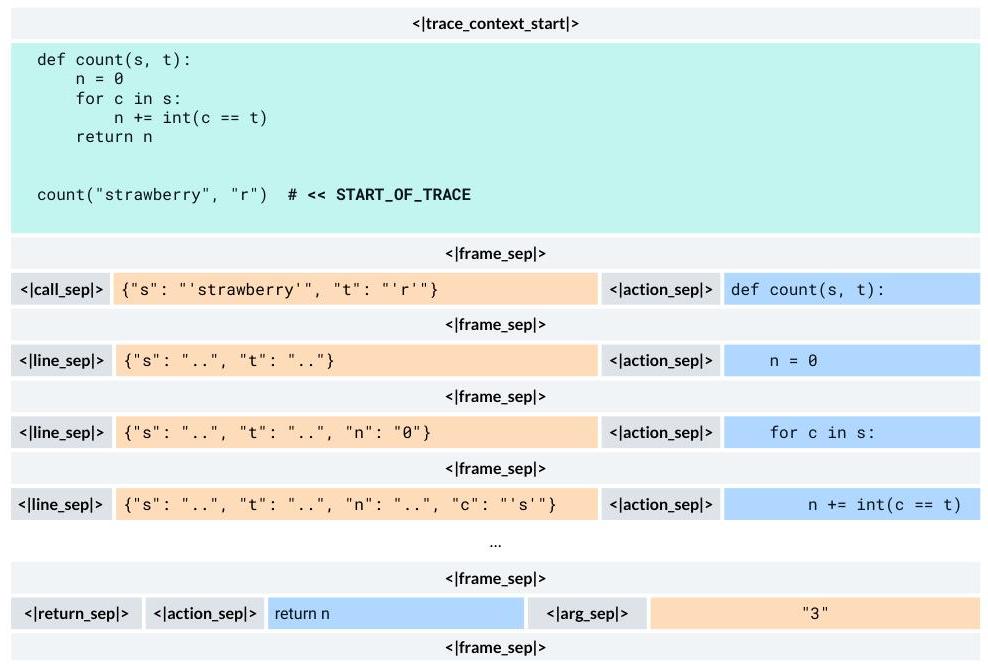
- Python execution traces: This is like showing the model how numerous Python programs run step-by-step, including how local variable values change at each step. This teaches the model that "if this code runs this way, then these variables will change that way." It allows the model to understand the dynamic behavior of code, not just its static text.
- The schematic for CWM's Python trace format clearly shows how variable states are captured during code execution:
- ForagerAgent: This is agent interaction data that simulates a software engineer solving real-world problems in a Docker environment. The agent attempts to perform tasks (like fixing bugs or implementing new features) by creating files, editing files, and running bash commands. By observing these "actions" and their resulting "environmental feedback," the model learns to perform multi-step software engineering operations like a real engineer. This enables the model to understand not only the code itself but also its application and interaction within a real development environment.
- ForagerAgent collects multi-step trajectories by prompting an LLM to solve software engineering tasks.
- Actions available to the agent include: creating files, editing files, running bash commands, and viewing or navigating files.
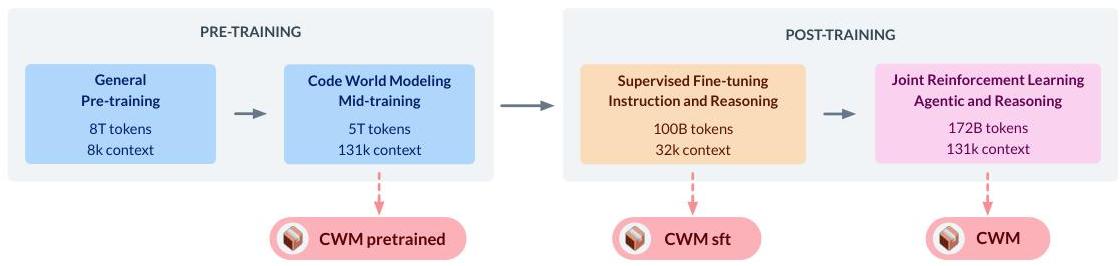
2. The Birth of CWM: A Three-Stage Training Journey
CWM's training process can be divided into three main stages, similar to our own learning process of "building a foundation, deep learning, and practical application":
- General Pre-training:
- This is the model's "foundational education" stage. CWM was trained on 8T tokens of diverse English text data, with 30% of it being code. This stage primarily allows the model to learn general language understanding and basic code syntax.
- The context length is 8,192 tokens, which can be thought of as the amount of information the model can "see" at one time.
- Code World Modeling Mid-training:
- This is CWM's "specialized courses" stage, building on the general pre-training with an additional 5T tokens. This phase introduces the aforementioned ForagerAgent data and Python execution traces, allowing the model to begin understanding the "semantics" and "behavior" of code.
- Additionally, data such as GitHub pull requests, compiler intermediate representations, Triton PyTorch kernels, and formal mathematics in Lean were included to further enrich the model's understanding of the code world.
- The context length was significantly increased to 131k tokens in this stage, meaning the model can handle much larger code files and more complex interaction histories.
- Post-training: Supervised Fine-Tuning (SFT) and Reinforcement Learning (RL):
- This is the model's "practical exercises and refinement" stage.
- Supervised Fine-Tuning (SFT): The model was trained on 100B tokens of high-quality labeled data to teach it how to better follow instructions and perform reasoning.
- Reinforcement Learning (RL): Using a variant of the Group Relative Policy Optimization (GRPO) algorithm, the model optimizes its performance on software engineering, programming, and math tasks through "trial and error." Like playing a game, the model learns to make better decisions based on "rewards" or "penalties" for its actions.
- This stage further enhances CWM's ability to solve complex programming-related problems, including tasks in Agentic SWE, Coding, Agentic coding, and Mathematics.
- This is the model's "practical exercises and refinement" stage.
The following diagram provides an overview of CWM's entire training journey, clearly illustrating the path from basic pre-training to world model mid-training, and finally to post-training fine-tuning and reinforcement learning:
A Brief on Model Architecture: CWM uses a 3.2 billion parameter dense decoder-only Transformer architecture. The Transformer is the foundation of modern LLMs; you can think of it as a "brain" that excels at processing sequential data, using an "attention mechanism" to determine which parts of the input sequence are most important. What's special about CWM is its combination of local and global attention blocks and its support for an ultra-long context of up to 131k tokens, which is crucial for handling complex codebases.
3. CWM's Capabilities in Action: Real-World Performance
After the training described above, CWM has achieved impressive results on multiple code generation, reasoning, and planning tasks.
- SWE-bench Verified Benchmark:
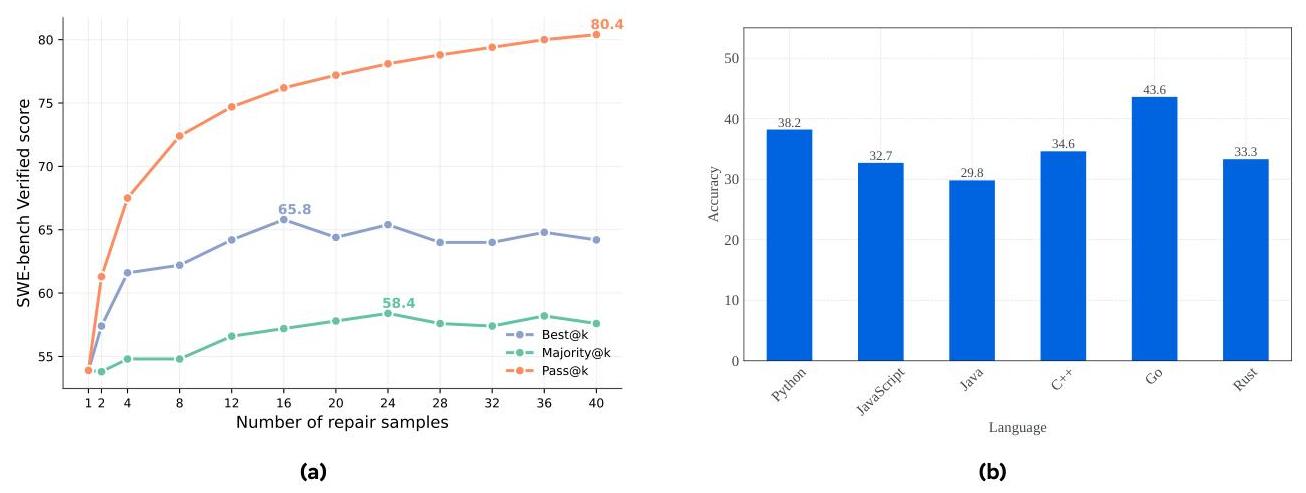
- This is a benchmark that evaluates a model's ability to resolve real-world software engineering bugs. CWM achieved a 65.8% pass@1 score with Test-Time Scaling (TTS), which involves generating multiple candidate solutions and verifying them with new tests.
- "pass@1" indicates the percentage of problems the model successfully solves on its first attempt. A score of 65.8% is very high, showing that CWM excels at solving practical software engineering problems, surpassing open-source models of similar size and even rivaling some larger or closed-source models.
- In the chart below, CWM's performance (blue bar) stands out among open-source models:
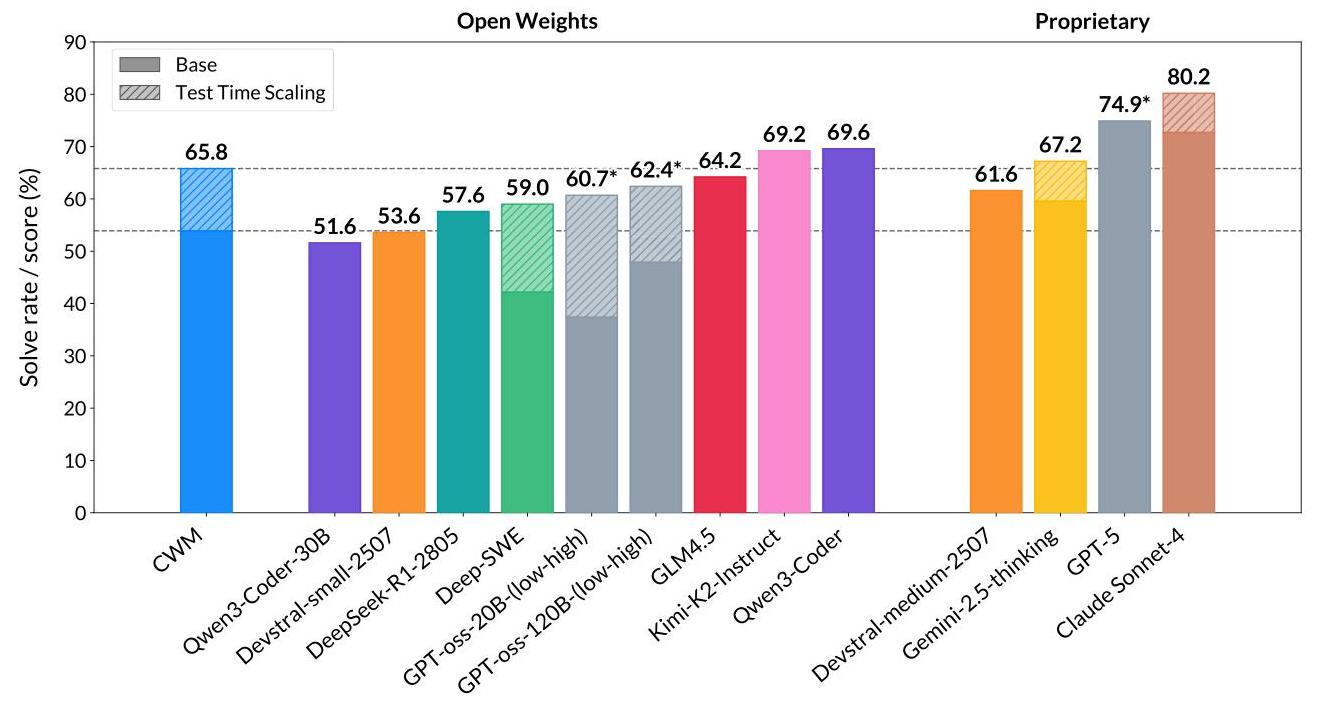
- With techniques like Test-Time Scaling (TTS) and Majority Voting, CWM's pass@1 rate can be significantly improved, as shown in the figure below:
- Competitive Programming Example:
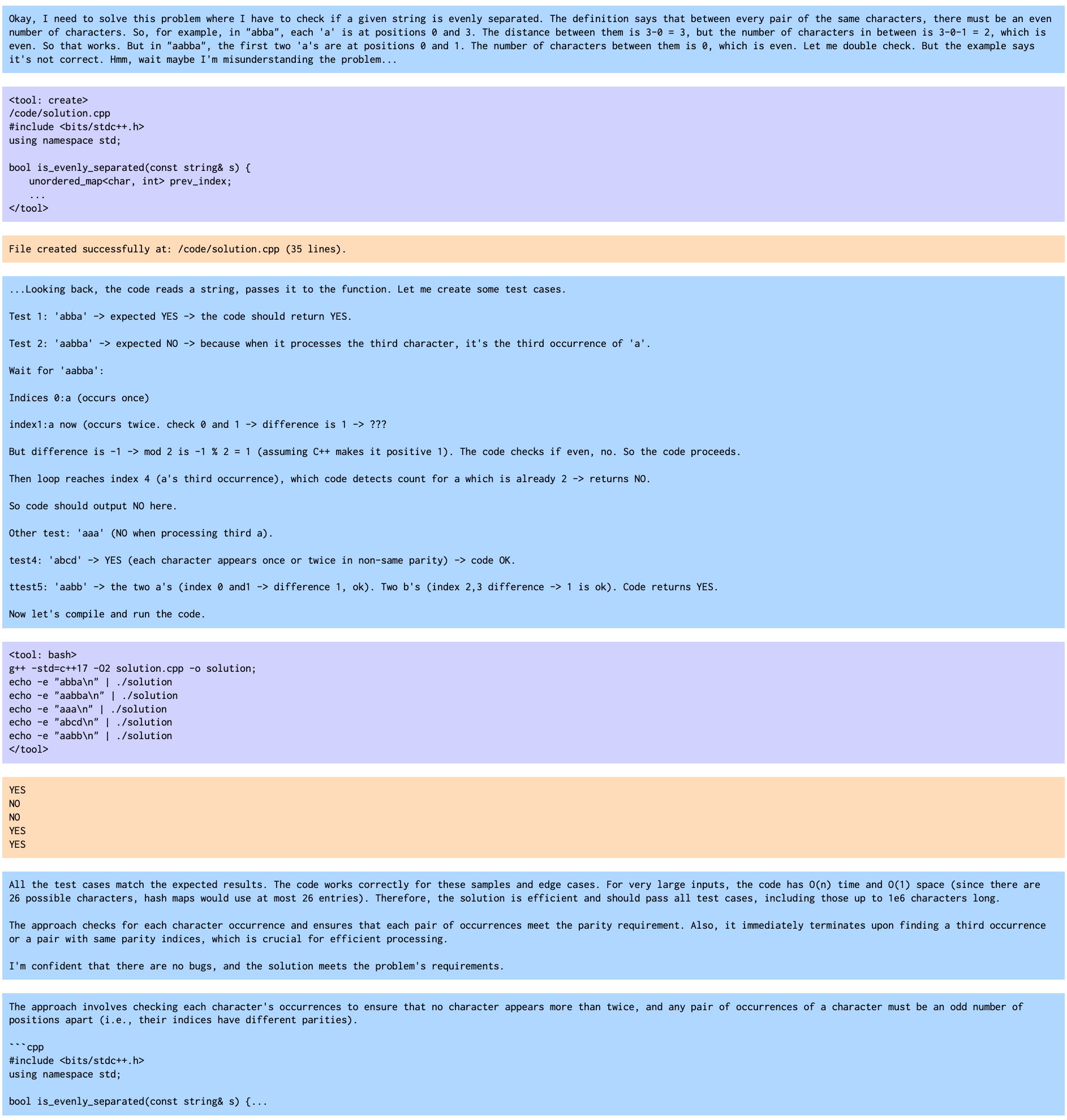
- CWM can act like a human competitor, first understanding a problem, then creating an initial solution, followed by constructing input-output pairs to evaluate the solution's correctness, and finally comparing its own predictions with the program's actual execution results. This demonstrates its powerful reasoning and planning abilities.
- The image below shows the complete process of CWM solving a competitive programming problem, including problem understanding, code generation, testing, and validation:
- Execution Trace Prediction and Reasoning:
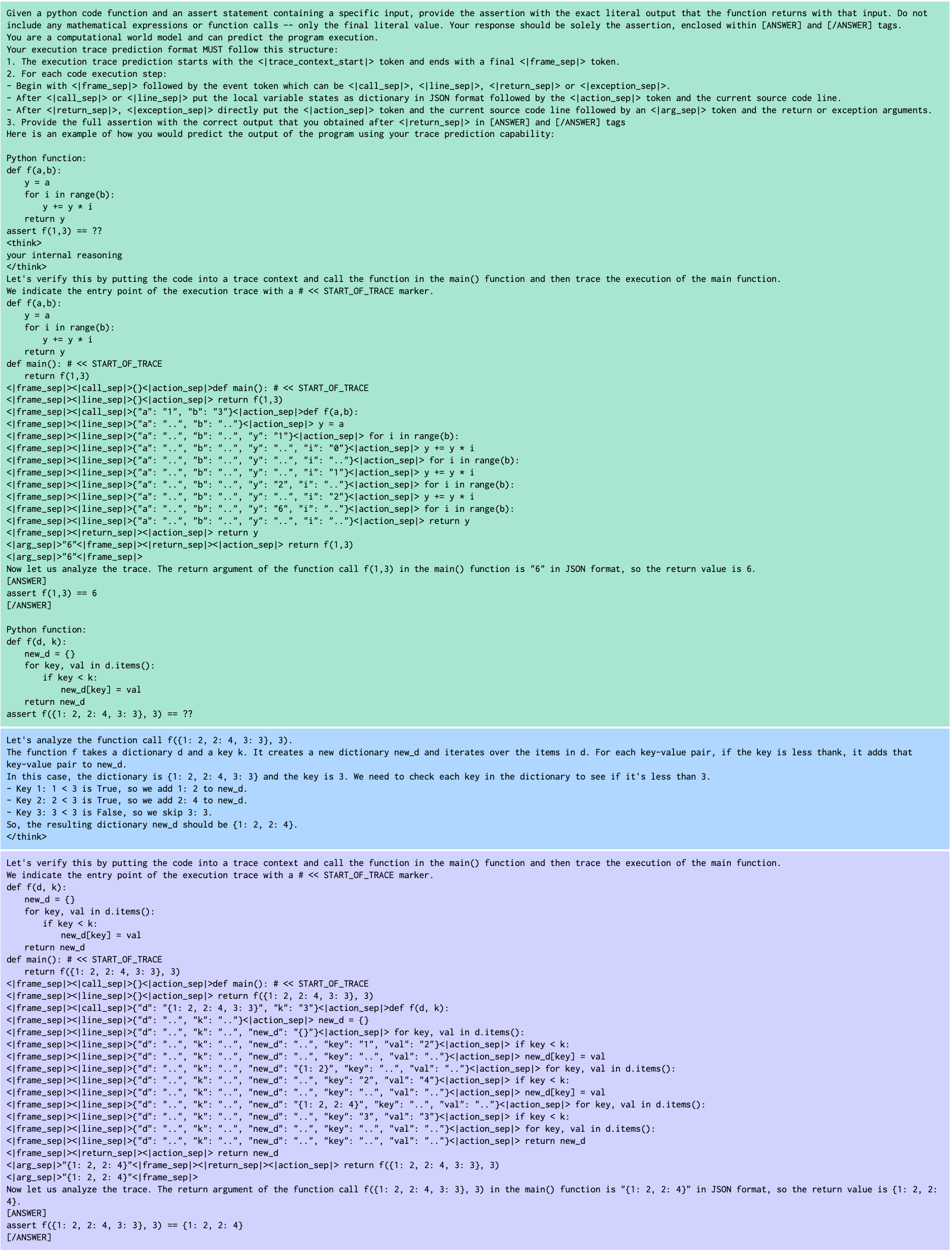
- CWM can predict each step of a Python code's execution, including changes in variable states, a capability referred to as a "neural debugger." This means the model can simulate the execution process without actually running the code, enabling "grounded reasoning."
- The following image illustrates how CWM predicts each step of code execution, including the state changes of local variables, which is crucial for understanding code behavior:
- Performance on Other Benchmarks:
- On LiveCodeBench (LCB), CWM also achieved excellent scores of 68.6% (LCBv5) and 63.5% (LCBv6), comparable to some top-tier models.
- On the math reasoning task Math-500, CWM reached a high score of 96.6%.
- On algorithmic complexity prediction (BigO(Bench)), CWM outperformed baseline models in both predicting and generating time complexity.
- Ablation studies (which observe the impact of removing certain training data) showed that GitHub PR trajectories, Python execution traces, and ForagerAgent data all had a positive impact on CWM's performance improvement.
4. The Heroes Behind the Scenes: Efficient Training and Infrastructure
To train such a complex model, Meta invested in advanced computational resources and technologies:
- Efficient Training Techniques: Training was conducted using H100 GPUs (high-performance graphics processing units, which can be thought of as the "brains" of a supercomputer), and parallel computing techniques like FSDP (Fully-Sharded Data Parallelism) and TP (Tensor Parallelism) were employed to significantly boost training efficiency.
- fp8 matrix multiplication: Using the float8 low-precision mode for calculations can double the computation speed and reduce memory consumption while maintaining accuracy.
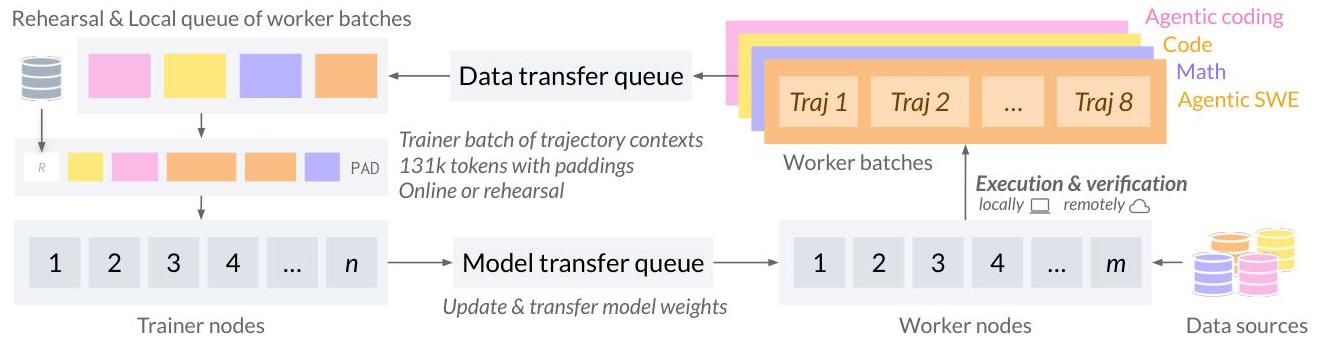
- Asynchronous RL System: For efficient reinforcement learning, Meta built an asynchronous distributed RL framework where worker nodes generate interaction trajectories between the model and the environment, while trainer nodes update the model's policy based on these trajectories. This functions like a large, distributed learning system, ensuring the model can learn continuously and efficiently.
- The overview of the asynchronous RL system shows how workers and trainers collaborate:
5. Limitations and Outlook
Although CWM demonstrates powerful capabilities, Meta has also been candid about its limitations:
- Positioned as a Research Model: CWM is a research-only model, primarily intended to advance academic research. It has not been fully evaluated or optimized for production environments and is not recommended for direct use in commercial products.
- Not a General-Purpose Chatbot: It is not a general-purpose chatbot. Its main strengths lie in code generation and reasoning, and it may not perform well on factual knowledge or classic natural language tasks.
- Domain and Language Limitations: The model was primarily trained and optimized for the code domain and the English language. Its performance on other programming languages or non-English tasks has not been verified.
- Future Directions: The research team plans to extend CWM to other programming languages or symbolic execution, leverage world model knowledge to improve performance on more tasks, and utilize the code world model for planning, such as developing a "neural debugger."
Conclusion
Meta AI's release of CWM represents a significant leap in the ability of LLMs to understand code. By introducing the "world model" concept and training on large-scale Python execution traces and ForagerAgent interaction data, CWM has elevated its understanding from the "syntactic" level of code to the "semantic" level of code execution. This has led to remarkable performance improvements in tasks like code generation, reasoning, and planning, showcasing particularly strong potential in resolving real-world software engineering bugs. As an open-source model, CWM is poised to provide a strong foundation and a new direction for future research and applications of AI in software engineering.


