
NVIDIA and Intel Announce Strategic Partnership with $5 Billion Investment for AI Infrastructure and PC Products
Is NVIDIA's $5 billion investment in Intel a lifeline for the struggling chip giant, or a strategic masterstroke by Jensen Huang to solidify his AI empire and navigate geopolitical headwinds?


Historic Partnership Announcement: NVIDIA and Intel Join Forces to Reshape AI and Computing Landscape
On September 18, 2025, global semiconductor giants NVIDIA and Intel jointly announced a historic and deep strategic partnership aimed at co-developing multi-generational AI infrastructure and personal computing products. This news has sent ripples across the technology sector, heralding a new chapter in the fields of AI and computing.
NVIDIA founder and CEO Jensen Huang characterized the collaboration as an acknowledgment that "computing has fundamentally changed," representing the convergence of two world-class platforms. He noted that AI is driving a new industrial revolution, reshaping the entire computing stack from chips to systems to software, and that the era of general-purpose computing has reached its limits, giving way to accelerated computing and AI.
Intel CEO Lip-Bu Tan similarly hailed the partnership as "a historic collaboration between two companies" and "a game-changing opportunity." He stated that the partnership builds upon the core strengths of both parties: NVIDIA as a leader in AI and accelerated computing, and Intel as a leader in data center and client PC CPUs.
As a core component of this partnership, NVIDIA agreed to invest $5 billion to purchase Intel's common stock at a price of $23.28 per share, acquiring approximately a 4%-5% stake. Media outlets such as Reuters and The Wall Street Journal highlighted that this investment follows the US Government's commitment of nearly $9 billion in August 2025, which secured about a 10% stake in Intel, providing yet another "lifeline" to the embattled chipmaker. Following the announcement, Intel's stock price surged over 20% on September 18, making NVIDIA's investment immediately profitable on paper.
Core Partnership Details: Dual Strategy for Data Center and PC Markets
The collaboration primarily focuses on product design, leveraging NVIDIA's NVLink technology to seamlessly connect both architectures, specifically targeting the data center and personal computing sectors.
Data Center Segment: Custom x86 CPUs for NVIDIA's AI Infrastructure Platform.
According to official statements, Intel will design and manufacture custom x86 CPUs for NVIDIA, which NVIDIA will integrate into its AI infrastructure platforms (such as rack-scale systems) and bring to market. Jensen Huang explained in the press conference that the existing x86 ecosystem was previously limited to connecting server CPUs via PCI Express, posing challenges for scaling large-scale AI systems like NVL72. Through this partnership, Intel's x86 CPUs will be directly integrated into the NVLink ecosystem, enabling the construction of rack-scale x86-based AI supercomputers. NVIDIA will, for the first time, become a major customer for Intel's server CPUs, purchasing these custom CPUs from Intel and reselling them integrated with its GPUs.
Personal Computing Segment: Developing x86 SoCs with Integrated NVIDIA RTX GPUs.
Intel will build and bring to market x86 System-on-Chips (SoCs that integrate NVIDIA RTX GPU chipsets. Jensen Huang noted that out of the 150 million laptops sold annually, there is a massive market for integrated graphics that NVIDIA has largely not addressed due to form factor, cost, or battery life considerations. By fusing Intel's CPUs and NVIDIA's RTX GPUs via NVLink, the two companies aim to create a "new category of integrated graphics laptops never before seen," addressing a vast, underserved market. NVIDIA will serve as the primary GPU chipset supplier for these SoCs, either directly or through Intel.
Jensen Huang particularly emphasized that Intel's Foveros multi-technology packaging capabilities are "very critical" to this collaboration, enabling the connection of NVIDIA's GPU chiplets with Intel's CPUs, representing an ingenious way to achieve such hybrid matching and rapid innovation.
Strategic Implications for NVIDIA: Fortifying Moat, Unlocking New Growth Avenues
Multiple analytical institutions contend that NVIDIA is the clear and greater beneficiary of this partnership.
- Tapping into New Revenue Streams and Significantly Expanding Total Addressable Market (TAM). According to analysis from JPMorgan Chase & Co., co-developing laptop SoCs provides NVIDIA with new revenue streams by entering the previously untouched mobile PC integrated GPU (iGPU) market. Jensen Huang estimated during the press conference that the data center CPU market is approximately $25 billion to $30 billion annually, and with 150 million laptops sold each year, this partnership will help both companies address a significant portion of these markets, estimating a total market opportunity of approximately $50 billion.
- Strengthening the Data Center Ecosystem and Reaching a Broader Customer Base. Both JPMorgan Chase & Co. and Morgan Stanley highlighted that for some customers explicitly requiring or preferring x86 computing, NVIDIA's previous ARM-based Grace CPU solutions (such as NVL72) had limitations. This collaboration enables NVIDIA to extend NVLink to x86 systems, offering customers more choices and thus broadening its potential customer base to include the vast majority of enterprise users still relying on x86. NVIDIA explicitly stated that this partnership has "no impact" on its ARM roadmap and that it will continue to fully advance ARM CPU development, indicating that the x86 solution is a complement, not a replacement, to its existing product lines.
- Astute Strategic Investment Yielding Multiple Benefits.
- Regulatory De-risking: Reuters, citing an eMarketer analyst, suggested that "spreading the wealth" to a key competitor helps NVIDIA alleviate antitrust regulatory pressure stemming from its market dominance.
- Alignment with Government Policy: Reports from Reuters and The Wall Street Journal both emphasized that this collaboration aligns strongly with the Trump administration's strategy to boost domestic chip manufacturing (Chips Act), helping NVIDIA gain favor with the US Government.
- Supply Chain Diversification and Future Option Assessment: This move grants NVIDIA direct access to and evaluation of Intel's foundry business and advanced packaging technologies, offering potential options for future GPU production supply chain diversification.
Implications for Intel: A "Lifeline" but Structural Issues Persist
While undoubtedly a significant boost for Intel, this partnership does not fundamentally resolve its long-standing structural challenges.
- Significant Short-Term Boost, Providing a Much-Needed "Lifeline." Both The New York Times and Reuters described this collaboration as a "lifeline" for the struggling Intel. The $5 billion capital injection from NVIDIA, coupled with previous investments from the US Government and SoftBank, further strengthens Intel's balance sheet. NVIDIA's technical endorsement and the partnership agreement provide Intel with clear direction and a defined role in the AI chip sector, boosting market confidence and causing its stock price to soar.
- Limited Incremental Business, Core Issues Unresolved. Morgan Stanley believes that server-side developments offer "not much new," and client-side impact is "not large," suggesting that market reaction may be excessive. JPMorgan Chase & Co., under "fairly loose assumptions," projects that the data center collaboration might only generate $100 million to $200 million in incremental annual revenue for Intel, a limited increase compared to its foundational business of approximately $16 billion.
- Failure to Secure Critical Intel Foundry Services Commitment. This is a critical limitation highlighted by all sources. Despite the partnership, NVIDIA has not committed to using Intel's wafer fabrication services in any meaningful way for its cutting-edge AI chip production. During the press conference, both Jensen Huang and Lip-Bu Tan lauded TSMC as a "world-class foundry" and expressed caution regarding Intel's own process technologies (such as 18A, 14A), stating that a decision would only be made after certification, to determine if it is the "right choice." A critical analysis from The Wall Street Journal even pointed out that this underscores Intel's structural problem of bundling chip design and manufacturing, suggesting that its only viable path forward is a complete split of the two.
Intel Foundry Revenue and Operating Profit Trend
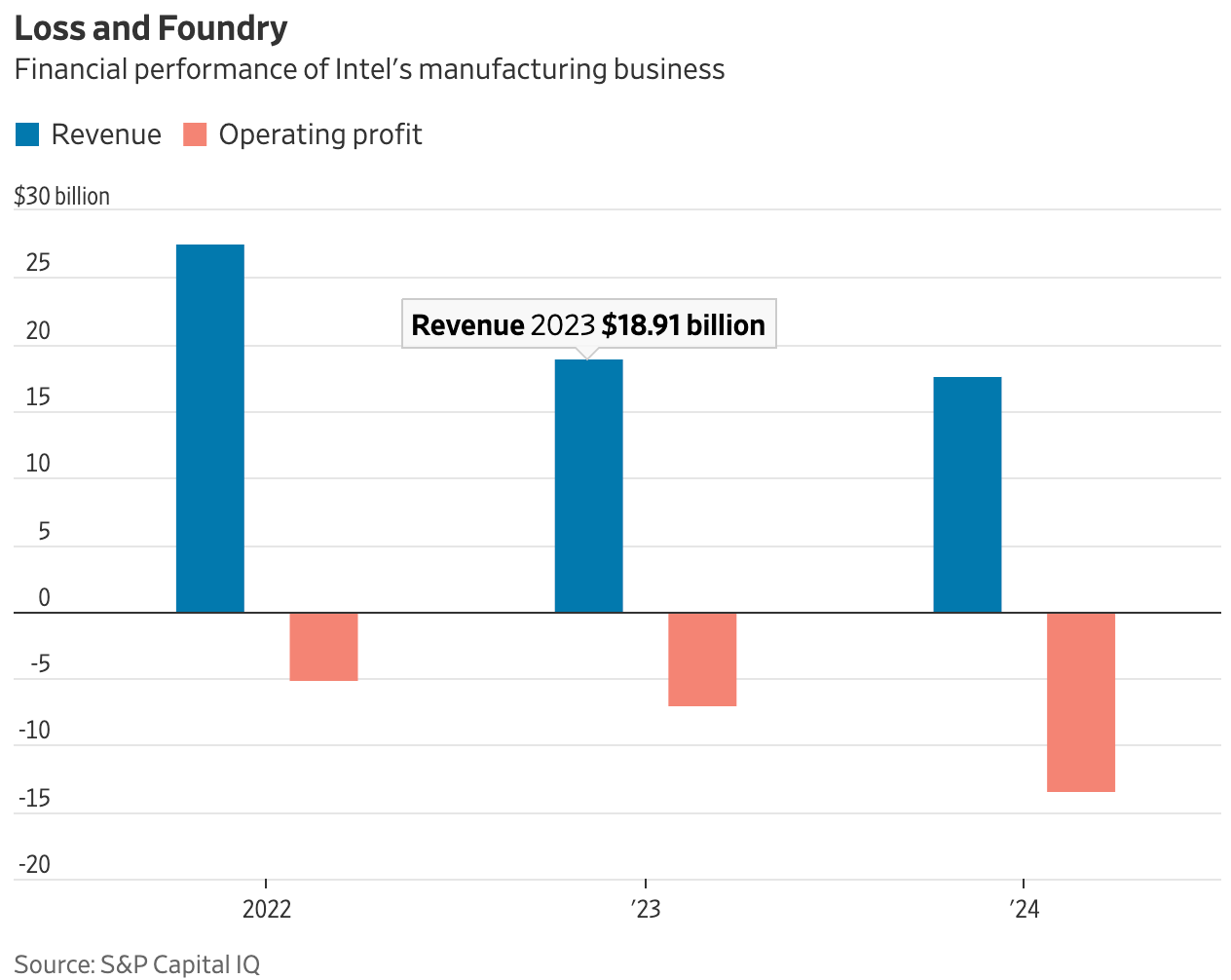
Source: S&P Capital IQ
Reshaping the Semiconductor Competitive Landscape
The alliance between NVIDIA and Intel is poised to have profound implications for the semiconductor industry's competitive landscape.
- Negative Impact on Advanced Micro Devices. Analysts from Goldman Sachs, Reuters, and Piper Sandler all believe that the combined strength of Intel and NVIDIA will make them a more formidable competitor, negatively impacting Advanced Micro Devices. The partnership could erode Advanced Micro Devices' market position in enterprise server CPUs and slow its market share gains in the desktop segment. Morgan Stanley, however, views the overall impact as neutral, as Advanced Micro Devices has "little to no content" in NVIDIA's systems anyway.
- Potential Negative Impact on ARM. Goldman Sachs suggests that this announcement might dampen investor confidence in the pace of ARM's data center market share growth.
- Impact on Other Supply Chain Companies. Goldman Sachs considers this news positive for Synopsys, as it helps restore market confidence in the health of its key customer, Intel. Morgan Stanley noted that the expansion of NVLink to x86 could potentially displace traditional PCIe connections, posing a challenge for ALAB, although ALAB is also a partner in NVLink Fusion, making the outlook unclear. Simultaneously, this partnership raises expectations for Intel's future capital expenditures, with KLA being identified as an "underappreciated beneficiary" in the WFE (Wafer Fab Equipment) sector.
Geopolitics and Government Role: The Heavy Hand of the Trump Administration
The strong geopolitical undertones and the discernible influence of the US Government behind this transaction cannot be overlooked.
- Strong Alignment with US National Strategy. The collaboration occurs against the backdrop of the US Government's aggressive push to support domestic semiconductor manufacturing and strengthen supply chain security through policies like the Chips Act. Commerce Secretary Howard Lutnick has repeatedly emphasized, "We must make these chips in America; we cannot lose to China." Analysts believe this move helps NVIDIA curry favor with the US Government, aligning "highly" with White House policy.
- Government Perceived as Playing a Significant Role in the Deal. A Bloomberg report indicated that President Trump had effectively become a "co-CEO" of Intel, exerting immense pressure on many companies and facilitating the US Government's equity investment in Intel. Analysts speculate that conversations between President Trump and Jensen Huang, as well as the government investment brokered by the White House weeks prior, could be related to this transaction, even sparking controversy over whether the government is "picking winners and losers."
Product Timeline and Future Outlook
According to information from JPMorgan Chase & Co., Morgan Stanley, and the press conference, Intel and NVIDIA's design teams have been collaborating on the new products for approximately 1 year, completing extensive architectural work. Although no specific launch dates were committed, analysts anticipate that initial versions of the server CPUs and laptop SoCs could be available sometime in 2027. Reuters reported that this partnership, by providing the necessary production volumes for Intel Foundry Services, could indirectly enhance the viability and competitiveness of Intel's 14A manufacturing process, planned for launch in 2027.


