
Nvidia's $5B Intel Bet Reveals ASML as a Potential Winner with Some Convexity
Is Nvidia's $5 billion bet on Intel a genuine vote of confidence in a resurgent rival, or merely a masterful political maneuver? And more importantly, who is the unexpected winner in this high-stakes semiconductor chess game?


Nvidia's $5 Billion Gamble: Intel's Salvation, or ASML's False Dawn?
Recently, the semiconductor industry witnessed an unexpected drama: industry giant Nvidia announced a $5 billion investment in its long-standing competitor Intel and deepened product cooperation. This news sent ripples through the calm waters of the market. Intel's stock price has soared by approximately 50% since early August, with the market seemingly celebrating the "alliance" between these former rivals.
However, as the market's initial frenzy subsides, a core question emerges: Is this massive investment truly a "lifeline" that can help Intel reclaim its manufacturing leadership, or merely a fleeting capital market euphoria? What does this signify for critical upstream equipment suppliers, especially lithography giant ASML? Is this deal more about emotional uplift, or does it translate into tangible orders?
The Facade of Cooperation and Market Euphoria
First, let's examine the details of this transaction. Nvidia and Intel have entered into a multi-year cooperation agreement, the core components of which include:
- Nvidia will invest \$5 billion in Intel at a price of \$23.28 per share.
- Intel will manufacture custom x86 data center CPUs for Nvidia's AI platform.
- The two companies will collaborate on developing PC processors integrating Nvidia RTX graphics technology, known as "x86 RTX SoCs," targeting the laptop market with annual sales of up to 150 million units.
From a product perspective, this collaboration undoubtedly represents a powerful alliance, aiming to challenge AMD's position in the PC market and expand Nvidia's influence in the data center CPU segment. The market has reacted positively, viewing this as a significant endorsement of Intel's technological prowess.
However, it's worth noting that the entire cooperation announcement did not explicitly mention that Nvidia would entrust any chips to Intel Foundry for manufacturing. This introduces a subtle concern beneath the market's optimistic sentiment.
Peeling Back the Layers: Can the Investment Save Intel?
Wall Street analysts are deeply divided on whether this investment can genuinely improve Intel's fundamentals.
On one hand, the deal brings concrete benefits. Analysts at Bank of America believe that in the context of persistent challenges to the x86 architecture from ARM, Nvidia's cooperation serves as an important validation of Intel's CPU technology. More directly, this investment significantly improves Intel's cash position. According to Citi's calculations, including Nvidia's \$5 billion, Intel is expected to receive approximately \$17.2 billion in cash by Q3 2025, which will boost its Book Value per Share from \$25.07 to \$28.98.
However, the opposing view is more cautious, even pessimistic. Citi analysts bluntly state that the market's reaction to the improvement in Intel's fundamentals is exaggerated. They estimate that the market opportunity for custom CPUs for Nvidia is limited, only about \$1 billion to \$2 billion annually, which is a mere "drop in the bucket" for Intel's massive scale.
Analysis from the renowned research firm Bernstein is even more incisive: Nvidia's investment fails to address the fundamental issues plaguing Intel Foundry's business – small scale, high costs, and poor execution. They argue that what truly helps Intel's foundry business is clients willing to commit real products for tape-out and production validation, not just a cash injection. In other words, money can provide a "lifeline" for Intel, but it cannot cure its "deep-seated issues" in the wafer foundry sector.
Nvidia's True Intentions
Given this, why would Nvidia lavish such a substantial investment on a competitor? Bernstein speculates that this is more akin to a shrewd strategic choice. Amid increasing global antitrust pressure, collaborating with a competitor can demonstrate an open and cooperative stance to regulators (especially the US government).
A subtle detail is that Nvidia preferred to invest directly in Intel rather than commit to using its foundry services. This indirectly confirms Nvidia's high trust and reliance on the current global foundry leader, TSMC. Even if Intel were to produce custom CPUs for Nvidia in the future, replacing the Grace CPU currently manufactured by TSMC, the impact on TSMC's revenue would likely be only 1-2%. This suggests that Nvidia's core strategy remains unchanged.
The Real Significance for ASML: Confidence Over Orders?
Circling back to the initial question: What does all this mean for ASML?
To answer this, one must first understand the market's prior core concerns. According to analysis by BNP Paribas Exane, the market has long worried about Intel's advanced process nodes (such as 18A and 14A) facing delays, leading to a contraction in its internal chip demand. If this were to happen, Intel's substantial backlog of EUV lithography machine orders with ASML might not materialize around 2027. This would undoubtedly pose a significant potential risk to ASML's future revenue growth.
From this perspective, while Nvidia's investment did not generate any new EUV equipment orders, its emotional uplift is crucially important. As an industry bellwether, Nvidia's "endorsement" strengthens market confidence that Intel will continue to invest in advanced process R&D. This confidence helps solidify the expectation of Intel's massive internal wafer demand (estimated at 90-120k wspm), thereby alleviating market concerns that ASML's future orders might be canceled.
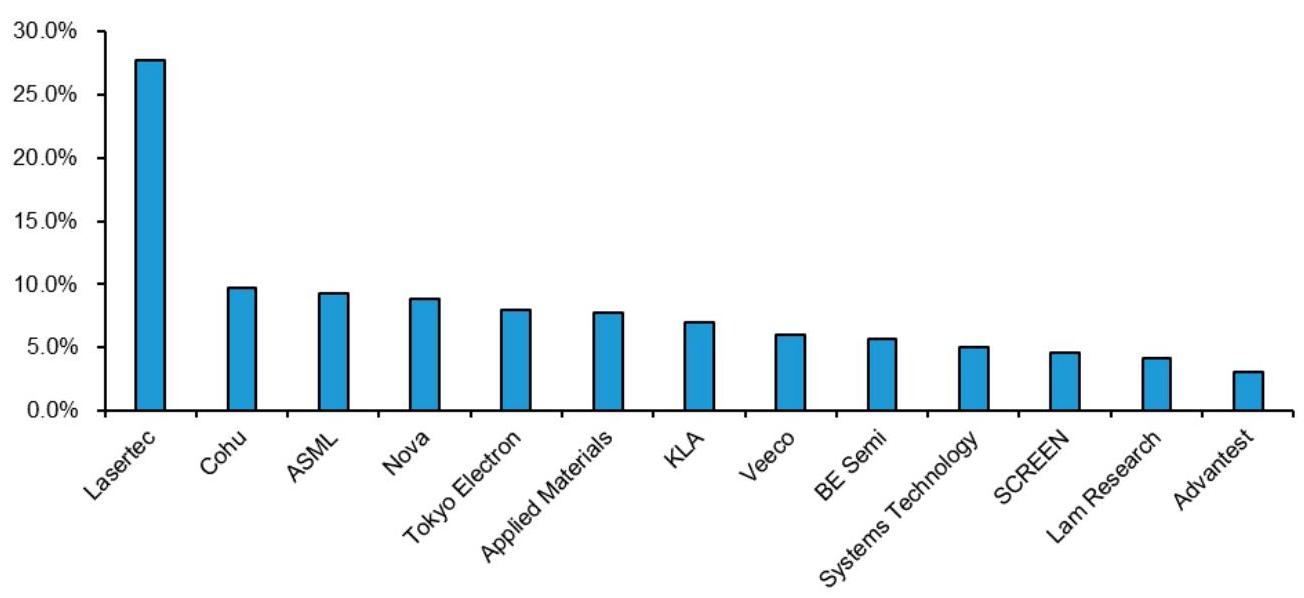
Intel, as a significant contributor to global semiconductor capital expenditure, sends ripples through equipment suppliers with any slight development.
Intel's Revenue Contribution to Key Equipment Suppliers Source: Bernstein
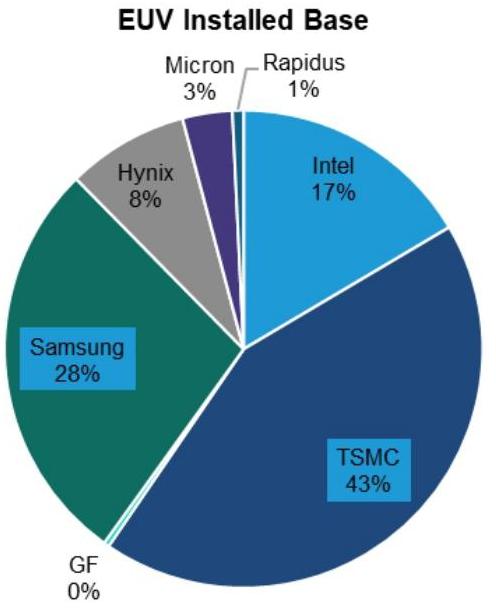
Among the global installed base of EUV lithography machines, Intel accounts for a high 17% share, second only to TSMC and Samsung, making it an indispensable core client for ASML.
Global EUV Lithography Machine Installed Base Share
Source: Bernstein
Therefore, for ASML, the short-term significance of this deal is more like a "reassurance," stabilizing market expectations for Intel's capital expenditure in the coming years and reducing the risk within its order portfolio. This might bolster investor confidence in ASML achieving double-digit sales growth in 2027.
Conclusion: A Victory at Distance
In summary, Nvidia's $5 billion investment in Intel is a complex multi-faceted game. It is not a "panacea" that can instantly turn the tide; Intel still faces severe challenges in the wafer foundry sector regarding technological catch-up, cost control, and execution.
For ASML, this transaction has not brought about a substantial performance inflection point, but rather a short-term risk mitigation and expectation stabilization. It has not created new demand, but it has safeguarded existing expectations. The market's euphoria may cool over time, but for alleviating a "lingering concern" for ASML investors, the symbolic significance of this $5 billion might be more important than its actual impact. Ultimately, ASML's future growth remains highly dependent on Intel's actual execution of advanced processes and its market competitiveness.


