
Nvidia's Multi-Trillion AI Capex Bull Case - Systemic TAM Revaluation Driven by Epoch.ai GATE Model and Full-Stack Moat
Is the market systematically underestimating Nvidia's TAM by pricing a technology cycle, not the AI Industrial Revolution?


The AI Capex and Nvidia Bull Case: A Multi-Trillion TAM Revaluation Systemically Underestimated?
Over the past two years, AI capital expenditure (Capex) has dominated the global technology investment narrative. However, a central paradox persists: Wall Street's long-term growth forecasts for infrastructure providers like Nvidia appear to be significantly "decoupled" from the exponential future envisioned by industry leaders such as Jensen Huang and Sam Altman.
To construct a compelling bull case, we must move beyond the current Cloud Service Provider procurement cycle and conduct a systematic analysis across three dimensions: the macro-level revaluation of Total Addressable Market, micro-level diversification, and the quantification of Nvidia's inherent competitive advantages.
I. The Exponential Macro-TAM Revaluation: AI Investment to Exceed 10% of Global GDP
The undervaluation of AI infrastructure investment potential stems from a conventional understanding of AI's role in the macro-economy. The Growth and AI Transition Endogenous (GATE) Model published by Epoch.ai offers a disruptive perspective, treating AI not merely as a technological upgrade but as an endogenous growth driver.
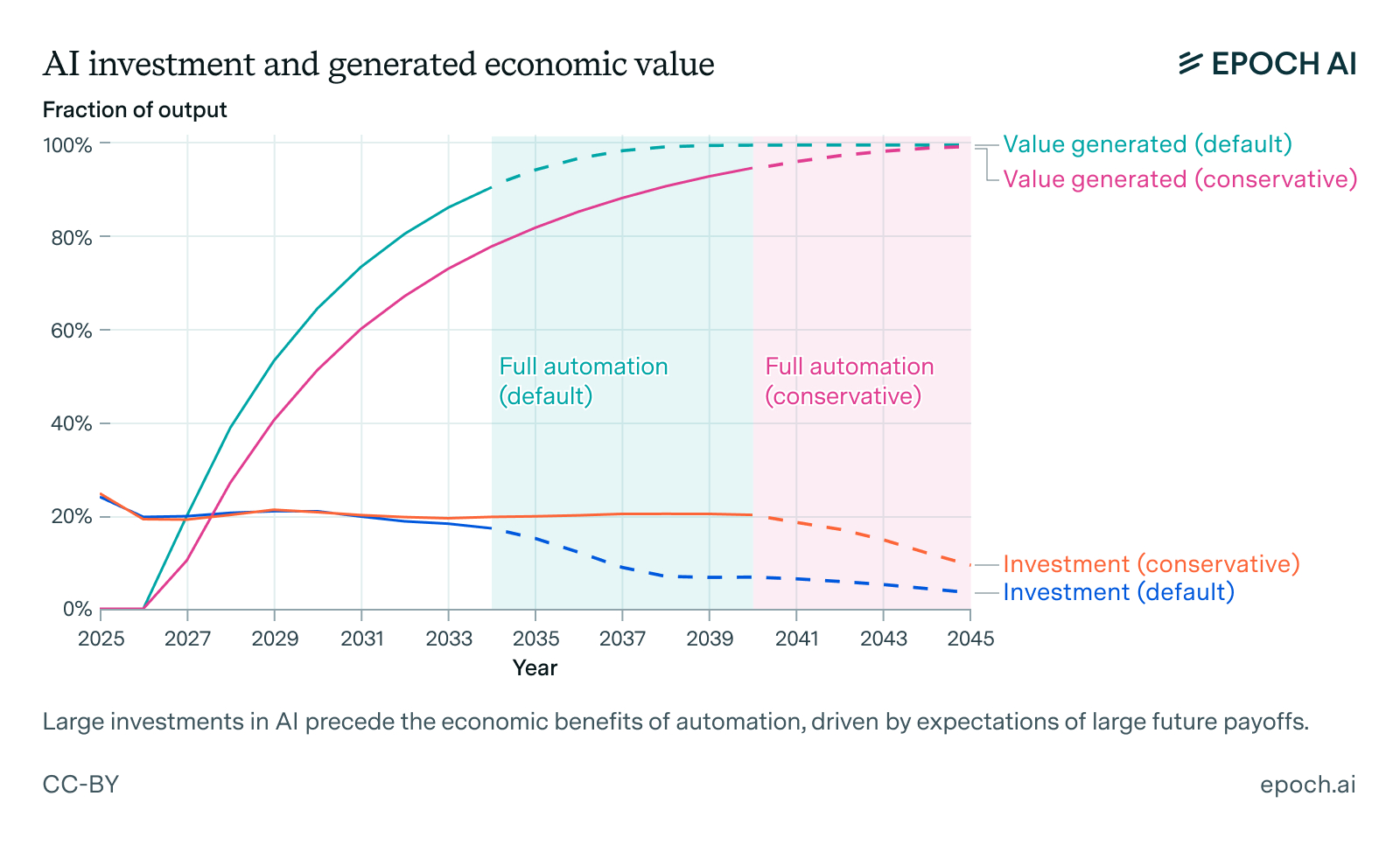
AI investment and generated economic value
Source: GATE: Modeling the Trajectory of AI and Automation | Epoch AI
1. The Macro-Level AI Investment Shockwave The GATE Model forecasts that AI will attract massive investment over the next 20 years, potentially exceeding 10% of global GDP, a scale approximately 50 times the current level. This investment precedes the full realization of AI's value, driven by economic agents' expectations of substantial future returns from task automation.
2. Accelerated Economic Growth and the Cost of the AI Factory The GATE Model further predicts that AI automation will significantly accelerate economic growth, with the growth rate potentially 2-20x higher than historical averages during the automation period. This exponential growth necessitates corresponding infrastructure.
Nvidia CEO Jensen Huang concretized this demand:
- Augmentation of Human Intelligence: Human intelligence accounts for roughly $50 trillion of global GDP. If AI can augment this, for example, by adding $10 trillion in GDP, and 50% of this incremental value (i.e., $5 trillion) is reinvested in AI infrastructure, an annual global capital expenditure reaching $5 trillion is justifiable.
- Trillion-Dollar Market: BofA Global Research projects that global spending on mission-critical data centers and AI infrastructure will reach $1 trillion by CY2030.
This macro-revaluation transforms AI Capex from cyclical spending into the infrastructure build-out for a New Industrial Revolution.
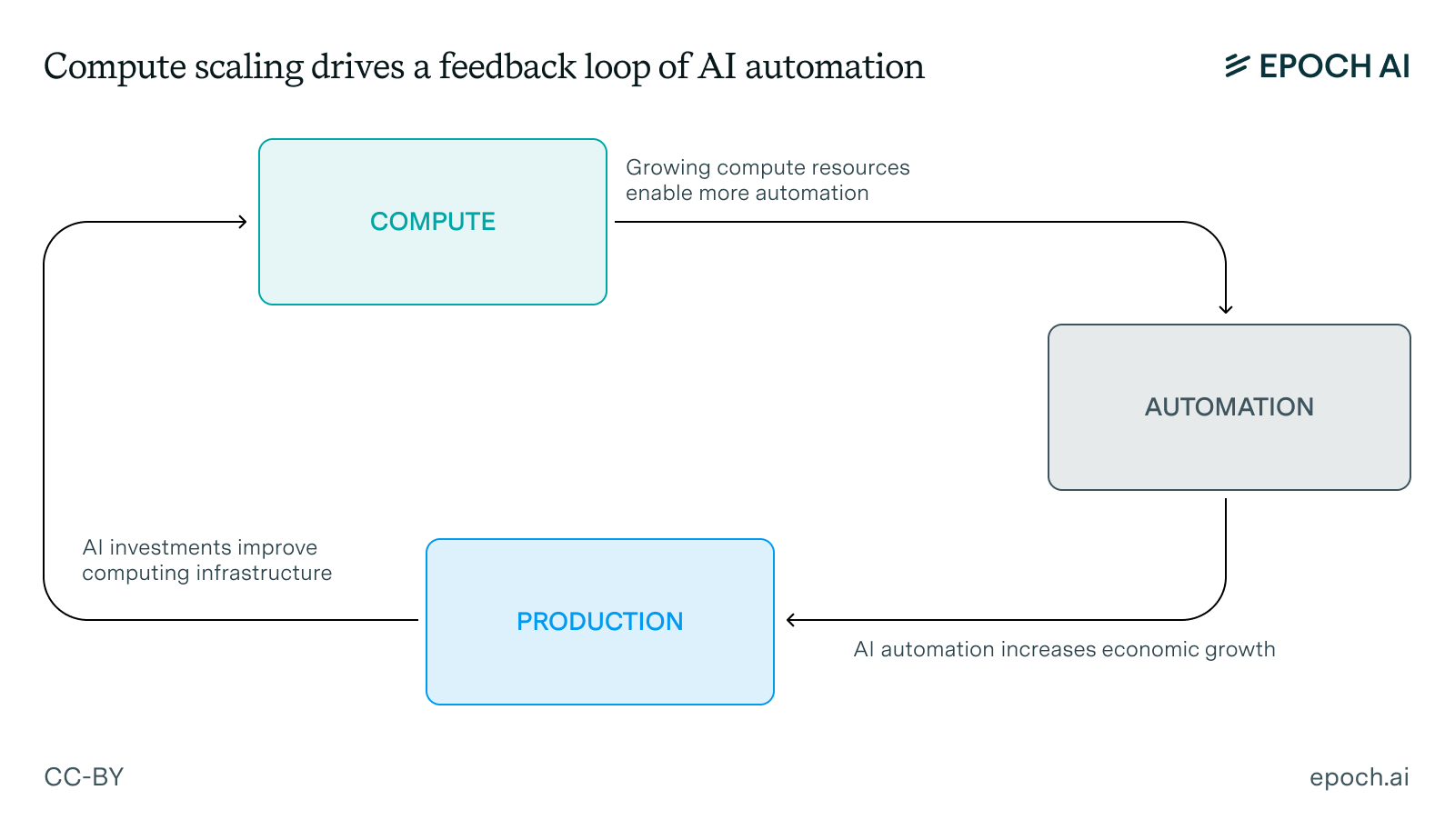
Compute scaling drives a feedback loop of AI automation
Source: Epoch.ai
II. Micro-level TAM Diversification: From Cloud LLMs to "Physical Intelligence" and "Sovereign AI"
The second pillar of the bull case is TAM diversification, where demand has expanded from the initial large-scale LLM training by Hyperscalers to new, long-term, and sustained vertical markets.
1. The Inference Explosion Driven by "Thinking AI" The center of gravity for AI workloads is shifting from training to inference. Jensen Huang notes that inference has evolved from "one-shot" Q&A to "Thinking AI" that requires complex reasoning, research, and tool use, representing a potential a billion-fold increase in compute demand. (see: https://www.youtube.com/watch?v=pE6sw_E9Gh0&t=4s)
- Inference Contribution: Inference has driven approximately 40% of Data Center revenue over the past four quarters.
- Enterprise-Grade Inference: Scalable inference use cases, such as GitHub Copilot and enterprise search, account for 5% of customers but drive 80% of the inference spending.
2. Physical AI and Robotics: A $300 Billion Long-Term Opportunity Experts widely agree that the future of AI lies in "Physical Intelligence".
- Market Size: Nvidia's head of robotics highlighted that Nvidia's long-term market opportunity in autonomous driving and robotics totals up to $300 billion.
- Application Deployment: This includes automotive manufacturers (e.g., Mercedes‑Benz, Volvo) planning to integrate real-time inference into their product systems, as well as defense sector applications in uncrewed naval vessels.
- Nvidia's Actual Revenue: Nvidia's Automotive revenue reached $570 million in Q4 FY25, representing a 103% year-over-year increase.
3. Sovereign AI: Tens of Billions in Incremental Market Sovereign AI has become one of the largest sources of incremental demand, driven by governments seeking to train models on local data to protect national security, culture, and language.
- Investment Scale: Nvidia stated that its Sovereign AI business exceeded $10 billion in FY24. Nvidia anticipates Sovereign AI revenue will reach tens of billions of dollars this year.
- Specific Case: For instance, Taiwan is building an AI factory equipped with 10,000 Blackwell GPUs, aiming to apply it across manufacturing, automotive, and urban domains.
III. Nvidia's Core Moat: Unrivaled TCO Advantage and Full-Stack Co-Design Beyond Moore's Law
Even with a massive TAM, investors must assess Nvidia's ability to sustain market share against challenges from competitors like ASICs and AMD. The Nvidia bull case ultimately rests on its unparalleled Total Cost of Ownership (TCO) advantage.
1. The Quantified TCO Advantage: $1 Investment, $5 Return In an era where power consumption is the greatest bottleneck for data centers, performance per watt is the ultimate deciding factor for customers.
- ROI Proof: For every $1 invested by Cloud Service Providers in Nvidia AI infrastructure, they earn $5 in immediate GPU hosting revenue over 4 years. This quantified 1:5 ROI is the fundamental reason customers continuously choose Nvidia.
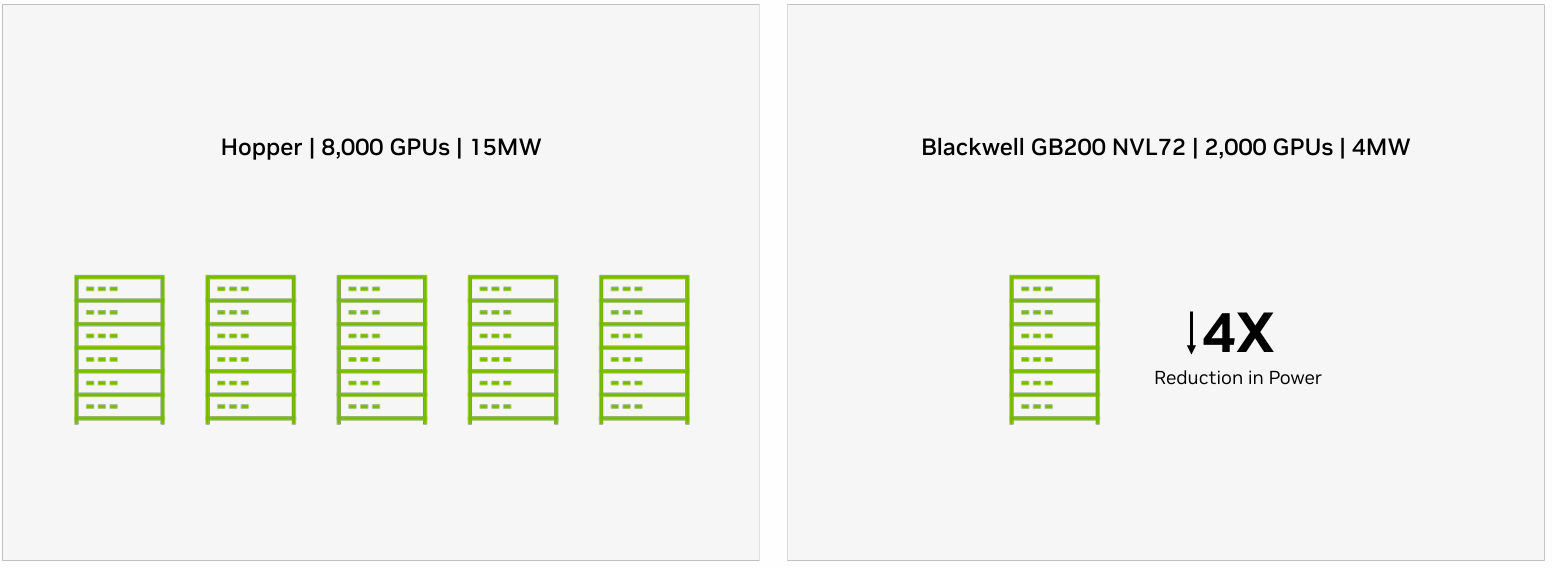
- Performance Leap: Nvidia achieves performance gains that surpass Moore's Law through an annual release cadence (Hopper, Blackwell, Rubin, Fineman). For example, the Blackwell architecture achieves a 30x increase in inference performance over the Hopper architecture.
- Lifecycle Advantage: Nvidia GPUs boast a 3-4 year longer lifecycle, further reducing TCO.
2. The Barrier of Extreme Co-Design (Full-Stack Co-Design) Nvidia's competitive advantage is no longer a single chip but a complex, system-level platform.
- Full-Stack Ecosystem: The platform encompasses the GPU, CPU (Grace), networking (NVLink, Spectrum-X), and software (CUDA, NIM, Omniverse).
- Networking as the Core: The strong growth in the Networking business (2Q26 revenue of $7.252 billion, a 46% QoQ increase) underscores the value of Nvidia's full-stack solution. CFO Colette Kress highlighted that the annualized revenue for Spectrum X enhanced Ethernet has exceeded $10 billion.
- Software Monetization: Software products such as Nvidia AI Enterprise and NIM are expected to approach an Annual Run Rate (ARR) of $2 billion, further strengthening the ecosystem's stickiness and Nvidia's pricing power.
Nvidia's Product Roadmap: Annual Iteration
Conclusion: Pricing a Non-Linear Transformation
The Nvidia bull case is built upon a multi-layered logical framework:
- Macro-Level: It is no longer a semiconductor company but the core infrastructure provider for a new industrial revolution, facing a multi-trillion-dollar economic transformation wave.
- Micro-Level: Through Extreme Co-Design, it offers unparalleled TCO and energy efficiency in a power-constrained era, building an insurmountable moat.
- Market: Its TAM is composed of replacement demand, incremental demand driven by high ROI, and multiple emerging trillion-dollar markets like Sovereign AI and Physical AI, ensuring strong growth visibility.
Naturally, risks persist: geopolitical tensions, supply chain volatility, and competitor catch-up. However, the core of this bull case lies in whether we believe the transformation brought by AI is linear and predictable, or exponential and disruptive.
If the answer is the latter, then measuring Nvidia using conventional valuation models is akin to measuring the value of the internal combustion engine by the standards of the horse carriage—a potential generational mistake. Ultimately, the question investors must answer is: Is the market ready to price an industrial revolution that has just begun?


