Redefining the Stack: NVIDIA's System-Level Answer to AI's Insatiable Demand
Why is a single breakthrough chip no longer the answer to AI's voracious computational needs, and how is NVIDIA's pivot to a full-stack, "extreme co-design" approach with Vera Rubin set to create a 10x leap in AI factory economics?


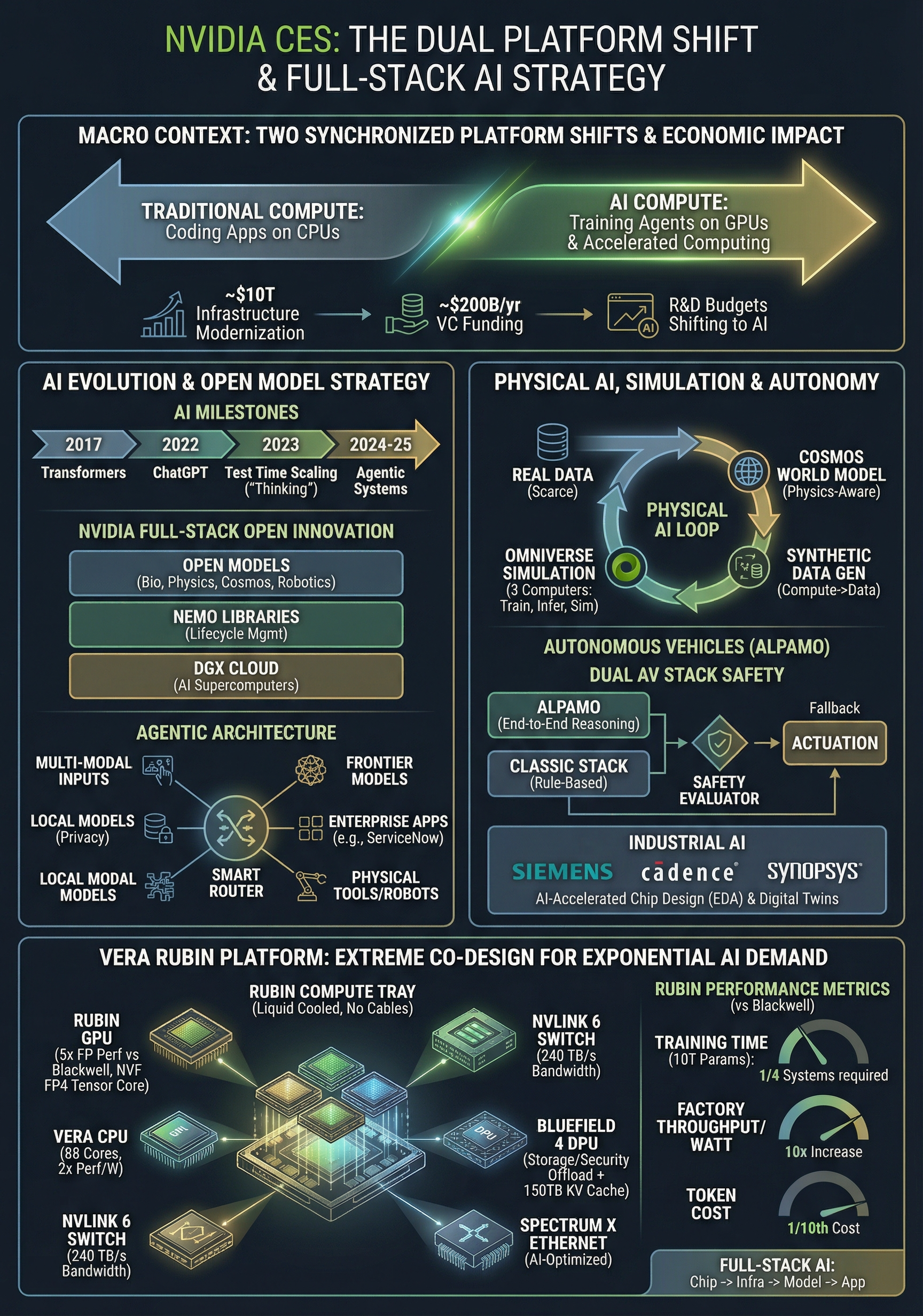
Under the spotlight of CES, NVIDIA CEO Jensen Huang, dressed in his trademark leather jacket, delivered a message that was anything but routine. He posited that we are currently undergoing an industry reset that occurs only once every 10 to 15 years, and this time, the computing sector is experiencing two concurrent platform transformations.
This might sound abstract, but the implications are profoundly concrete.
The first transformation involves a fundamental shift in the logic of application software development. We used to think of AI itself as the application, but now, "you will build applications on top of AI." The second transformation is even more foundational: the way software is developed and executed has been completely altered. We are no longer "programming" software; we are "training" it. Instead of primarily relying on CPU to run it, we are shifting towards GPU. Applications are no longer static, pre-compiled instructions; they are capable of understanding context and generating every pixel and every character from scratch in real-time.
Together, these two transitions are driving the modernization of a massive market. The approximately $10 trillion worth of computing infrastructure accumulated over the past decade, along with hundreds of billions of dollars in annual R&D budgets within a $100 trillion industry, are all migrating to this new computational paradigm.
Where will the funding come from? Huang’s answer was straightforward: "From the shift between classical R&D methodologies and AI-driven approaches."
AI's "Thinking" Moment and the Gravity of an Open Ecosystem
To understand why NVIDIA is pushing this hardware revolution with such aggression, we must first grasp the astonishing pace of AI's own development.
From the Transformers model in 2017 to the global inflection point of the ChatGPT moment in 2022, and then to the introduction of "Test Time Scaling" inference models in 2023—which Huang popularly summarized as "thinking." AI is no longer just providing one-off answers; it is beginning to perform real-time, continuous reasoning and iteration.
This "thinking" capability, coupled with the rise of Agentic Systems, allows AI to possess human-like abilities in reasoning, research, tool usage, and planning. This has spurred countless innovations, from Cursor, which changes the way we code, to Perplexity, which coordinates multiple models to complete complex search tasks.
Behind all this innovation is the rapid proliferation of Open Models. Although current open models lag behind the cutting-edge closed-source models by about 6 months, their iteration speed and explosive download volumes are attracting startups, large enterprises, and researchers globally to participate in this AI revolution.
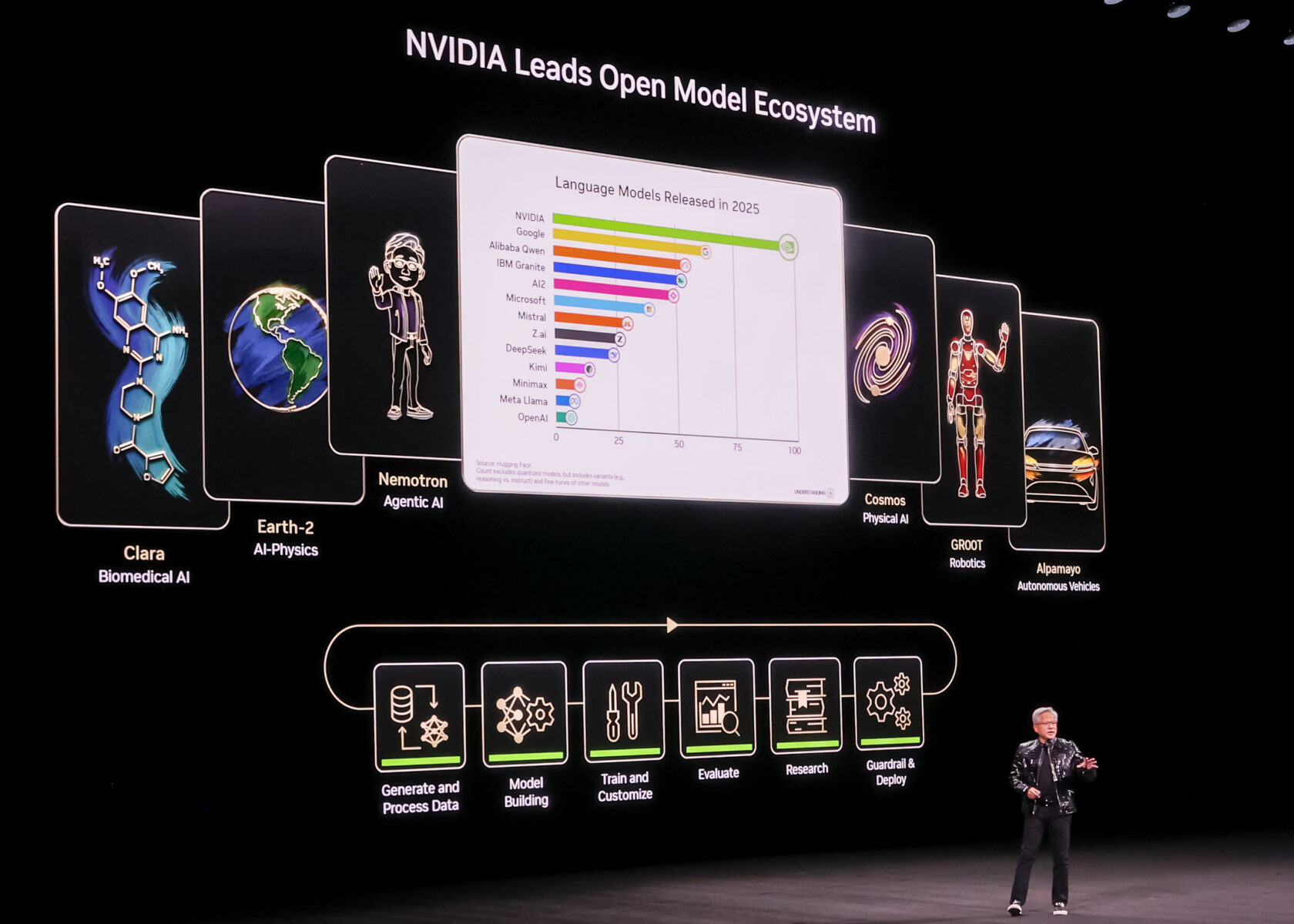
NVIDIA is not just a facilitator of this revolution; it is a core participant. They operate multi-billion dollar AI supercomputers, not only developing their own frontier AI models but also choosing to open them—along with the training data—to the world.
From La Protina and Open Fold 3 for biopharma, to Earth 2 for weather forecasting, and the robotics system Groot, NVIDIA is building a full-stack, open AI ecosystem.
NVIDIA’s Open Model Ecosystem
From Screen to Reality: Physical AI and World Models
However, NVIDIA's ambitions extend far beyond the digital realm. Huang dedicated significant time to articulating a grander vision: Physical AI—getting AI out of the screen and enabling it to enter and understand the physical world we inhabit.
This faces a fundamental challenge: How can AI acquire the "common sense" of the physical world? This includes concepts like object permanence (the object remains there when you turn your head), causality (the water spills when you knock over the cup), and fundamental physical laws such as gravity and friction.
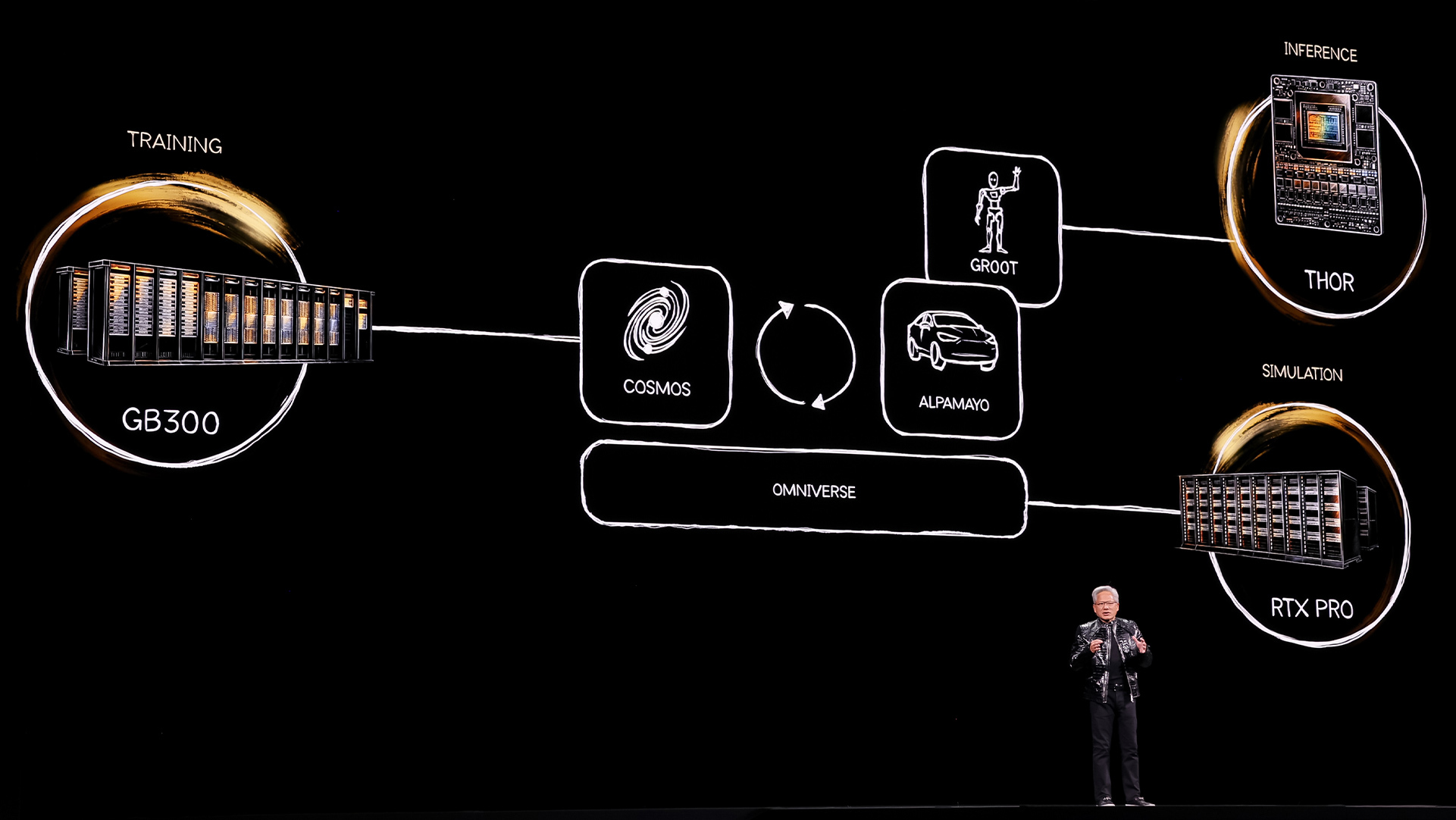
NVIDIA's answer is a tripartite system:
- Training Computers: Used to train AI models.
- Inference Computers: Running on edge devices like cars and robots.
- Simulation Computers: Perhaps the most critical component. By performing large-scale, physically accurate simulations within the digital twin world of Omniverse, they generate the data necessary for AI training—data that is difficult to acquire at scale in the real world.
The core of this strategy is Cosmos, a "World Foundation Model." Unlike LLM, it doesn't learn language; it learns how the world operates and aligns physical behavior with language. It can generate realistic video from a static image or dynamic interactions consistent with physical laws based on a simple scene description.
Cosmos transforms computation into data, providing the crucial nourishment for autonomous vehicles and robots to handle long-tail problems.
NVIDIA’s Physical AI Closed-Loop System
Based on this, NVIDIA introduced Alpamo, the world's first "thinking and reasoning" autonomous driving AI. It not only controls the vehicle but can also articulate in real-time why it is making a certain decision. By breaking down extremely complex, long-tail scenarios into a series of relatively normal sub-problems and reasoning through them, Alpamo aims to solve the thorniest challenges in the autonomous driving sector.
Vera Rubin: Extreme Co-Design for Exponential Growth
After laying the groundwork with the exponential growth demands of AI, Huang finally unveiled the answer: the brand-new computing platform, Vera Rubin.
It is named after the astronomer Vera Rubin, who discovered evidence of dark matter, signifying its purpose: solving computationally intensive challenges that are known to exist but are immensely difficult. The challenge? AI model scale and token generation are growing by a factor of 10 per year, a pace Moore's Law simply cannot match.
NVIDIA’s countermeasure is "Extreme Co-Design." Instead of the usual approach of upgrading just one or two chips, they have completely redesigned every core chip that constitutes the Vera Rubin platform.
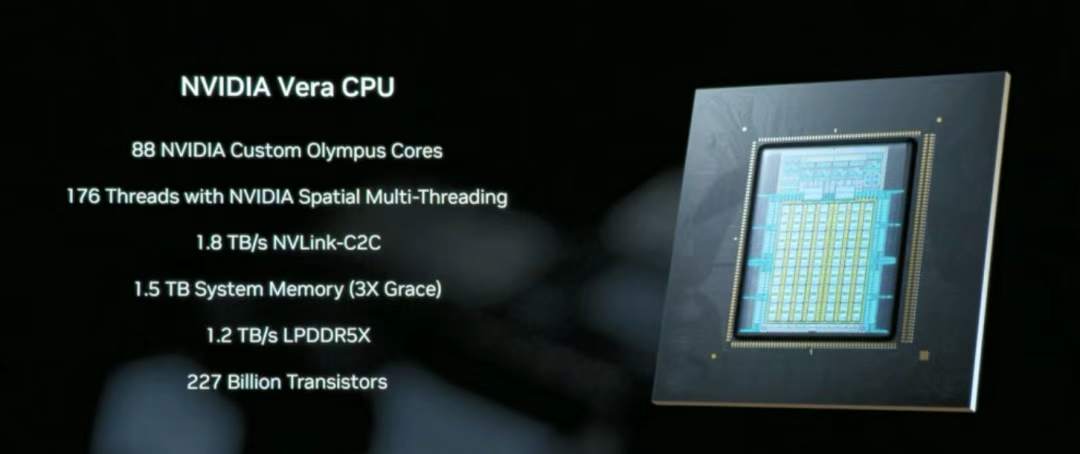
- Vera CPU: Designed specifically for power-constrained environments, featuring 88 physical cores supporting 176 threads via Spatial Multi-Threading technology, delivering 2X the performance per watt of the previous generation.
NVIDIA Vera CPU
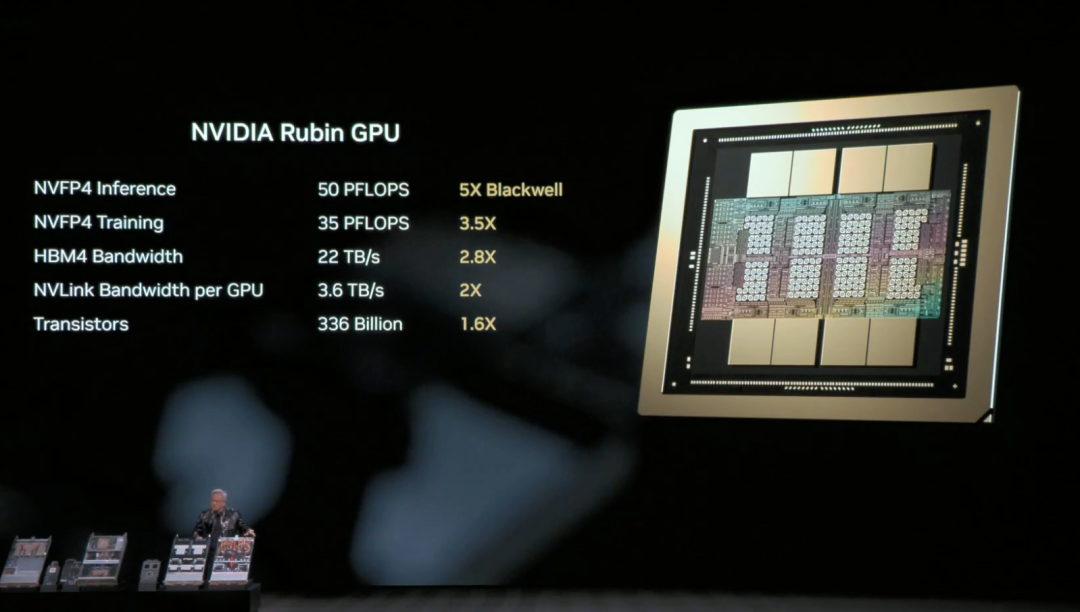
- Rubin GPU: Its floating-point performance is 5X that of Blackwell, while the transistor count has only increased by 1.6X. This is underpinned by major architectural innovations such as the NVF FP4 Tensor Core, which dynamically adjusts precision based on computational needs, enabling adaptive optimization at the hardware level.
NVIDIA Rubin GPU
However, the true revolution lies at the system level. The Vera Rubin Compute Tray is an engineering marvel. It completely eliminates internal cables, hoses, and fans, integrating 17,000 components, including 8 Connect X9 NICs, 2 Vera CPUs, and 4 Rubin GPUs, into a highly compact unit.
Vera Rubin Compute Tray (Left) vs. Previous Generation (Right)
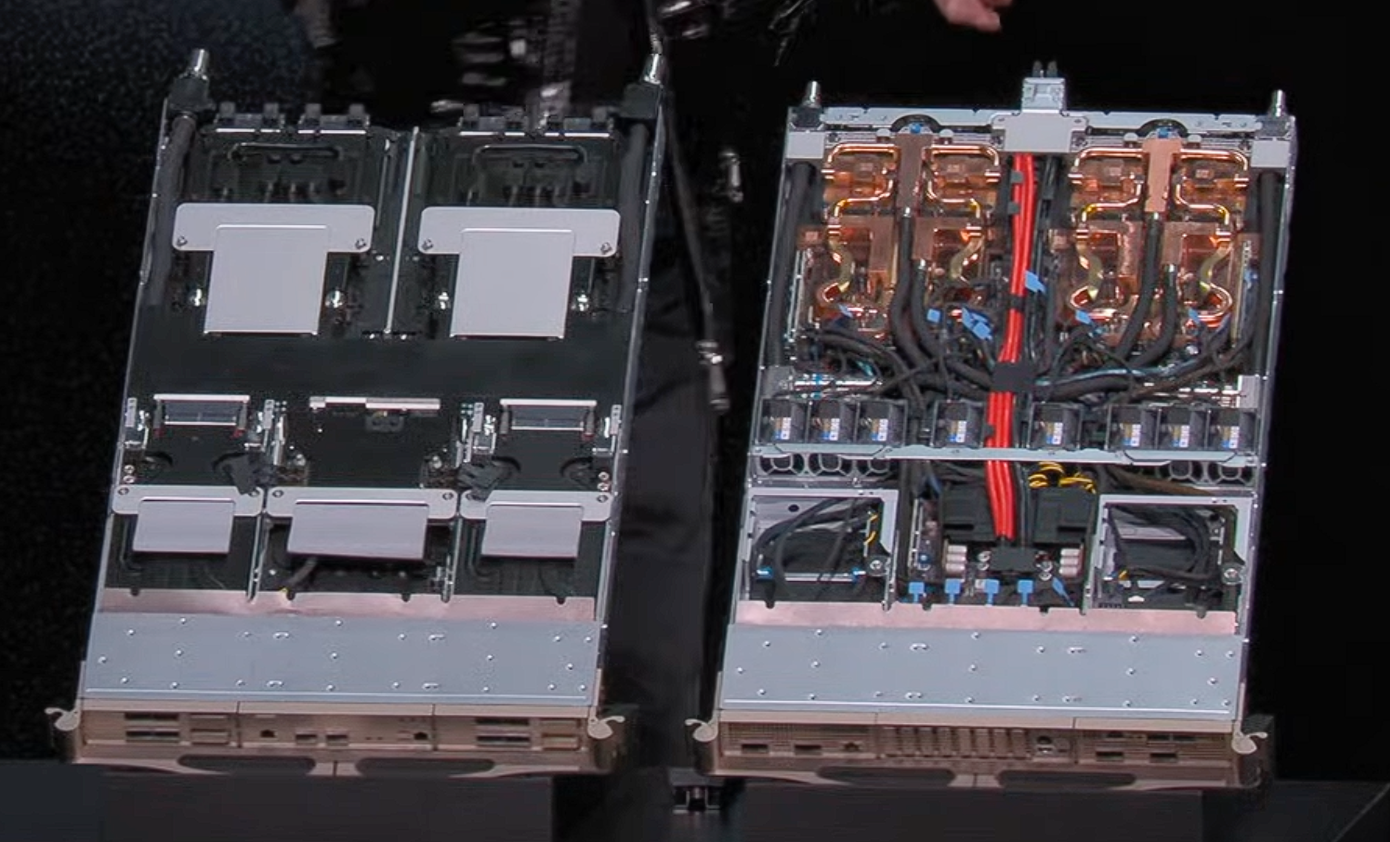
This design not only slashes assembly time from 2 hours to 5 minutes but also delivers astonishing energy efficiency improvements. The entire system is 100% liquid-cooled, utilizing 45°C hot water for cooling, eliminating the need for traditional data center chillers.
Furthermore, the new generation Bluefield 4 DPU and Spectrum X network switches provide unprecedented bandwidth and network throughput while addressing two major bottlenecks in AI computation: offloading storage and security functions to allow the GPU to focus purely on computation; and resolving the AI model's "working memory" deficit by providing massive in-rack context memory (KV Cache).
The Ultimate Business Value
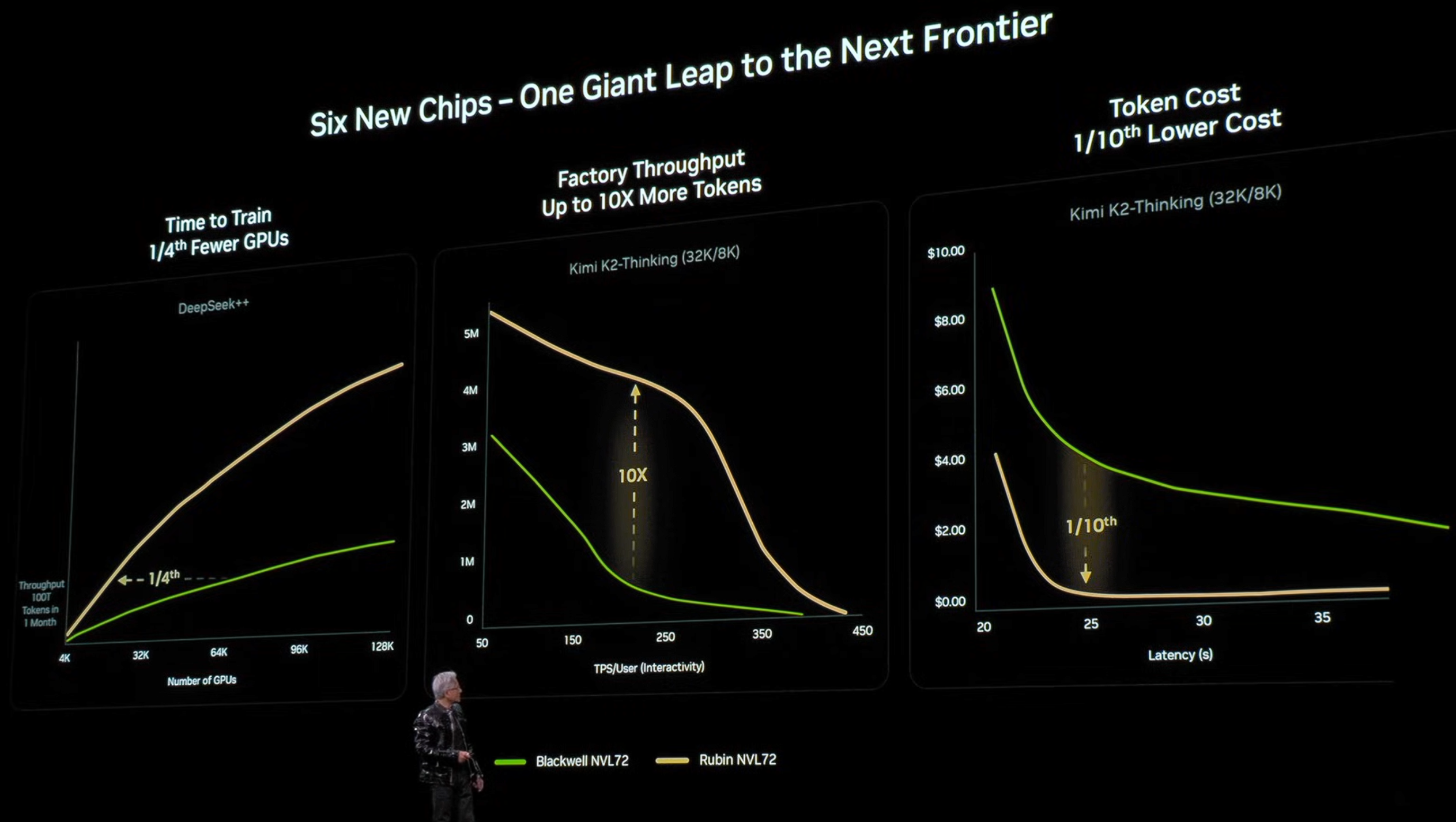
All these dazzling technological breakthroughs ultimately converge on three clear commercial values: Faster Time-to-Market, Higher Factory Throughput, and Lower Token Cost.
- Time-to-Market: Using the Rubin platform, only 1/4 of the system quantity is required to complete the training of a 10 trillion parameter, 100 trillion token model within the same timeframe (1 month).
- Factory Throughput: For a 1 Gigawatt AI factory, Rubin’s throughput per watt (which directly impacts revenue) is projected to be 10X higher than Blackwell.
- Token Cost: The cost-efficiency of token generation on Rubin is estimated to be only about 1/10 that of Blackwell.
Commercial Value Leap Driven by the Vera Rubin Platform
From chip to system, from infrastructure to models and applications, NVIDIA is no longer merely a semiconductor company. It is constructing a complete, full-stack AI computing platform. Through deep collaboration with industrial giants like Siemens, Cadence, and Synopsis, this transformation, driven by Physical AI and Agentic AI, is permeating every corner of industrial design, starting from the data center. A new industrial revolution, powered by extreme co-design, may have just begun.


