
Sam Altman, Jakub, and Wojciech - OpenAI's $1.4 Trillion Infrastructure Bet on Personal AGI, Platform Shift, and the 2028 Automated Researcher Goal
$1.4 Trillion for $30 Billion Revenue? Unpacking OpenAI's audacious gamble on a "personal AGI" and the five safety layers designed to contain the coming Superintelligence.


Sam, Jakub, and Wojciech on the future of OpenAI with audience Q&A
From "Oracle in the Sky" to "Trillion-Dollar Infrastructure": Unpacking OpenAI's AGI Accelerator, Three Strategic Pillars, and the Hard Cost of Superintelligence
In a public discussion held in late October 2025, OpenAI CEO Sam Altman, Chief Scientist Yakob, and other senior leaders unveiled an ambitious, capital-intensive roadmap for AGI. This conversation was not merely a declaration of technological vision; it served as a profound commitment to shaping the global tech landscape for years to come.
OpenAI's core conviction is that Deep Learning systems could potentially reach Superintelligence levels in less than 10 years. However, achieving this goal and ensuring its benefits are broadly distributed to humanity requires more than just algorithmic breakthroughs. It necessitates a Tripartite Strategic Pillars approach—comprising research, product, and infrastructure—backed by an unprecedented financial commitment.
1. Vision Evolution: From "Oracle" to "Empowering Tool"
Sam Altman began by outlining the evolution of OpenAI's mission. While the company remains committed to ensuring that Artificial General Intelligence (AGI) benefits all of humanity, the understanding of AGI itself has become more pragmatic and focused: it is shifting from an "Oracle in the sky" to a tool that empowers people.
The new vision centers on building a Personal AGI—an Ambient Always-Present Companion—that is ubiquitous, capable of accessing and coordinating various tools, services, and systems to assist with both professional work and personal life.
Altman stressed that while the economic impact of AI is immense, its long-term value lies in its potential to autonomously discover new science or help humans accelerate scientific discovery. If a 200-year process of scientific advancement could be compressed into 20 years or even 2 years, that would be the most crucial factor driving improvements in quality of life and societal transformation.
2. Research Acceleration and the "Automated Researcher" Timeline
OpenAI's core competency remains its research laboratory. Chief Scientist Yakob noted that by scaling up the training of Deep Learning systems, OpenAI is accelerating its trajectory toward Superintelligence. The current generation of models possesses capabilities roughly equivalent to a “5-hour” task completion window, as evidenced by their performance matching top human competitors in events like the International Olympiad in Informatics.
To further accelerate this progress, OpenAI is setting internal targets focused on Automated Research:
- Near-Term Goal (September 2026): To achieve an AI research intern system capable of meaningfully accelerating human researchers.
- Ultimate Goal (March 2028): To realize a fully Automated AI Researcher system capable of autonomously delivering large-scale research projects.
This timeline underscores OpenAI's sense of urgency and highlights that both algorithmic innovation and further Deep Learning scaling are the main drivers extending capability. Of particular note is Test Time Compute (Contextual Computation)—the amount of time the model spends "thinking"—which is considered a new dimension with orders of magnitude of remaining improvement potential.
3. Platform Transition: Building the AI Cloud Ecosystem
If research is the engine, the product strategy defines the track. Sam Altman explicitly stated that the product is evolving from an AI super-assistant within ChatGPT into a Platform for others to build upon.
OpenAI is charting a course to build an AI Cloud, aiming to open its technology to as many people as possible, allowing them to build services and applications on top of it. Altman referenced Bill Gates’ view that a true platform is only built when “the value created by people building on top of the platform is greater than the value created by the platform builder.” This is OpenAI's strategic focus for the coming year.
This platform evolution is grounded in two fundamental principles:
- User Freedom: Recognizing the diverse needs and desires of people globally, OpenAI aims to grant users significant control and customization over how they use AI, albeit within broad boundaries. The company plans to introduce an Adult Mode in December, allowing adult users greater flexibility in areas like creative writing, following age verification and better detection of true mental health crises.
- Privacy: AI privacy is paramount, as people interact with it differently than previous technologies (e.g., like speaking to a doctor or spouse). Beyond robust technical safeguards, OpenAI is discussing the concept of AI Privilege to provide strong policy protection.
In showcasing GPT-5 usage scenarios, one user noted that the model could save weeks of work on tasks involving “101 part numbers,” highlighting its potential for efficiency gains in specialized tasks.
4. The Trillion-Dollar Infrastructure: Hard CapEx of the AGI Race
The most striking element of this grand narrative is OpenAI's staggering commitment to infrastructure development.
OpenAI's current committed infrastructure build-out totals slightly over 30GW, representing a total financial obligation of approximately $1.4 trillion, spanning multiple years.
This figure, determined by current revenue growth and financing capabilities, demonstrates OpenAI's resolve to push the AGI race into a realm of hard Capital Expenditure (CapEx) competition. Achieving this scale requires massive collaboration across the supply chain: chips, data centers, energy, land, and chip fabrication facilities.
Altman also presented a more ambitious future vision (not a commitment): establishing an infrastructure factory targeting the creation of 1GW of compute capacity weekly, with an expectation to reduce the cost per GW to $20 billion over a 5-year lifecycle.
To support this goal, OpenAI has initiated the Stargate data center project, with the first site already under construction in Abilene, Texas.
Image: The construction site of the OpenAI Stargate data center project.
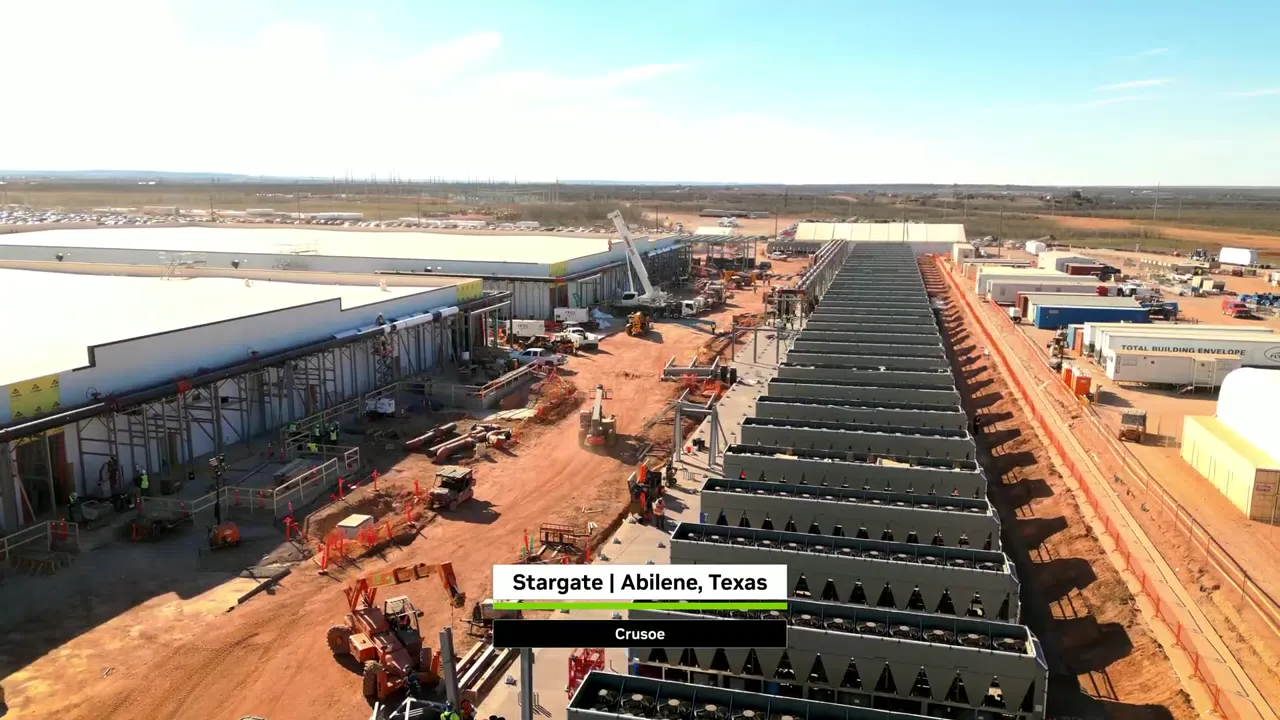
Source: Nvidia
5. Balancing Mission and Capital: Restructuring and the Safety Framework
To balance its "benefit humanity" mission with immense capital requirements, OpenAI has simplified its organizational structure: the OpenAI Foundation, a non-profit organization, controls a Public Benefit Corporation (PBC), the OpenAI Group. The Foundation initially holds approximately 26% of the PBC's equity and governs it.
The Foundation is set to become one of the largest non-profits ever and has announced two initial focus areas:
- Cure Disease: A commitment of $25 billion to utilize AI in curing diseases.
- AI Resilience: A new and broader domain than traditional AI Safety, aimed at building an ecosystem to cope with the risks and disruptions posed by advanced AI.
Voyche explained that Resilience goes beyond merely instructing models to restrict queries related to virology; more critically, it involves establishing Rapid Response capabilities when issues occur, addressing risks like Manmade Pandemics that AI might enable. This is analogous to the establishment of Cybersecurity infrastructure during the early days of the internet.
The Five-Layer Safety and Alignment Framework
To ensure safety, OpenAI has structured its thinking into 5 layers, with Value Alignment considered the most crucial and long-term safety problem for Superintelligence, focusing on the AI’s fundamental goals and high-level principles.
The company is heavily investing in Chain of Thought Faithfulness, a research direction that attempts to keep certain parts of the model's internal reasoning unsupervised. The goal is to better represent the model's internal processes, providing a scalable tool to address the non-scalable problem of Value Alignment.
6. Conclusion and Investment Outlook
OpenAI's latest briefing paints a picture of an accelerating and capital-intensive AGI future.
- Superintelligence Acceleration: The Automated Researcher goal of March 2028 signifies that OpenAI is shifting the AGI discussion from "if" to "when."
- Infrastructure Moat: The $1.4 trillion commitment will have structural consequences for the global compute, energy, and chip supply chains, establishing an extremely high CapEx moat for OpenAI. This scale of investment indicates that future AGI competition is not just a battle of algorithms but a hard fight over capital and infrastructure.
- Business Model Shift: The transition from a single product to the AI Cloud platform means that OpenAI's revenue drivers will shift from consumer subscriptions toward Enterprise services, which are necessary to support annual revenue targets in the tens of billions of dollars.
Regarding an IPO, Sam Altman believes it is the most likely path, given the company's capital needs and scale, though it is not the immediate priority. As Superintelligence gradually evolves, OpenAI is cementing its position as a platform builder and AGI pioneer through trillion-dollar infrastructure. Investors must closely monitor the spillover effects of this massive CapEx on the entire technology ecosystem, particularly in chips and energy.


