
Synopsys FY2025 Annual Report Visualization
With the massive Ansys acquisition, Synopsys is betting its future on becoming an all-encompassing engineering powerhouse. But as debt balloons to over $13 billion, profits fall, and a core division falters, is this a case of strategic brilliance or a deal too far?


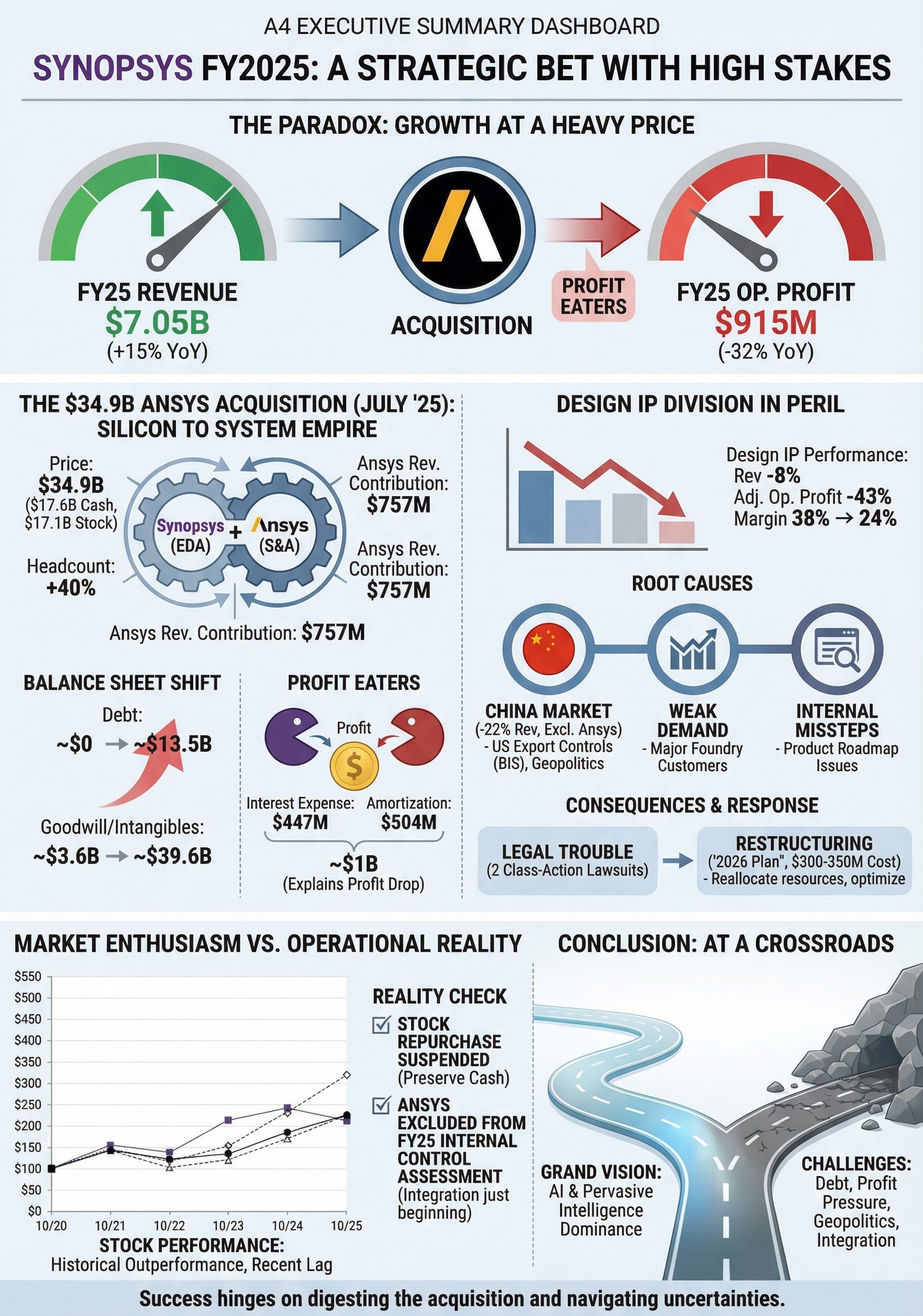
In its just-concluded fiscal year 2025, semiconductor design software giant Synopsys delivered what appeared to be a stellar performance on the surface: revenue grew by 15% year-over-year, reaching $7.05 billion. However, peeling back the layers of revenue growth reveals a more complex and challenging picture: the company's operating profit plummeted 32% to $915 million, down from $1.36 billion in the prior fiscal year.
Revenue is up. Profit is down.
Behind this conflicting set of figures lies the opening gambit of a high-stakes bet by Synopsys, with the very future shape of the company at the center of the table.
A $34.9 Billion Acquisition
At the heart of this gamble is the acquisition of engineering simulation and analysis (S&A) software leader ANSYS, Inc., which the company officially completed in July 2025. This monumental deal, valued at $34.9 billion (approximately $17.6 billion in cash and $17.1 billion in stock), not only increased Synopsys's headcount by about 40% but also marked a decisive step in its transformation from a leading "chip design" company to an engineering solutions empire spanning the entire "Silicon to System" workflow.
The integration of Ansys contributed $757 million in revenue, accounting for almost the entirety of Synopsys's full-year revenue growth. By combining its traditional strength in Electronic Design Automation (EDA) with Ansys's formidable capabilities in physical world simulation, Synopsys aims to create an unparalleled platform to help customers accelerate innovation in cutting-edge fields like AI, automotive, and aerospace.
However, ambition comes at a heavy price.
To finance this mega-acquisition, Synopsys's balance sheet underwent a dramatic transformation. The company's Goodwill soared from $3.4 billion to nearly $26.9 billion, and its net intangible assets surged from less than $200 million to $12.7 billion. More critically, its long-term debt exploded from a negligible level to approximately $13.5 billion. The cash flow statement more directly reveals this massive capital shift: the company raised $14.3 billion through financing activities such as issuing senior notes and term loans, while cash used for acquisitions in investing activities amounted to a staggering $16.5 billion.
The interest expenses from this enormous debt, coupled with the massive amortization of intangible assets from the Ansys acquisition, became the twin beasts devouring profits. The financial report shows that in fiscal 2025 alone, interest expense reached $447 million, while amortization of acquisition-related intangible assets was an even larger $504 million. These two items, totaling nearly $1 billion, almost entirely account for the stunning decline in operating profit.
Diverging Fates: The Plight of the Design IP Division
While the Design Automation division surged ahead with the Ansys integration, another core business of Synopsys—the Design IP (Intellectual Property) division—was weathering a harsh winter.
In fiscal 2025, the Design IP division's revenue declined by 8% year-over-year, and its adjusted operating profit plunged by 43%, with profit margins slashed from 38% to 24%.
The root of the problem points largely to the Chinese market. Impacted by U.S. export control policies and geopolitical factors, Synopsys's revenue in China (excluding Ansys) fell by 22% year-over-year. As a case in point, in the third quarter of 2025, the company received an "is-informed" letter from the U.S. Department of Commerce's Bureau of Industry and Security (BIS), imposing a license requirement on its export of ECAD software to China. Although this restriction was later rescinded, the uncertainty it created had already taken a toll on the business. Furthermore, weak demand from major foundry customers and the company's own missteps in certain product roadmaps jointly contributed to the division's decline.
Adding to its woes, the struggles of the Design IP division have not only dragged down overall financial performance but also attracted legal trouble. The company is currently facing two class-action lawsuits from shareholders, alleging material misstatements or omissions regarding the Design IP division's performance and information related to the Ansys acquisition.
- Kim v. Synopsys, Inc.: Alleges that the company violated the Securities Exchange Act of 1934 by making material misstatements about the performance of its Design IP division.
- New England Teamsters Pension Fund v. Synopsys, Inc.: Makes similar allegations and involves shareholders who acquired company stock as a result of the Ansys acquisition.
In response to these challenges, Synopsys has already taken action. The company announced a new restructuring plan (the "2026 Plan") with a total cost between $300 million and $350 million, aimed at reallocating resources from the Design IP division to higher-growth opportunities and optimizing overall operational efficiency following the Ansys merger. This is undoubtedly a direct response from management to the current headwinds.
Market Enthusiasm vs. Corporate Pains
Perhaps the most interesting part of the story is this: on one side, the company faces numerous operational challenges and financial pains; on the other, the capital market shows extreme enthusiasm.
5-Year Cumulative Total Return Comparison
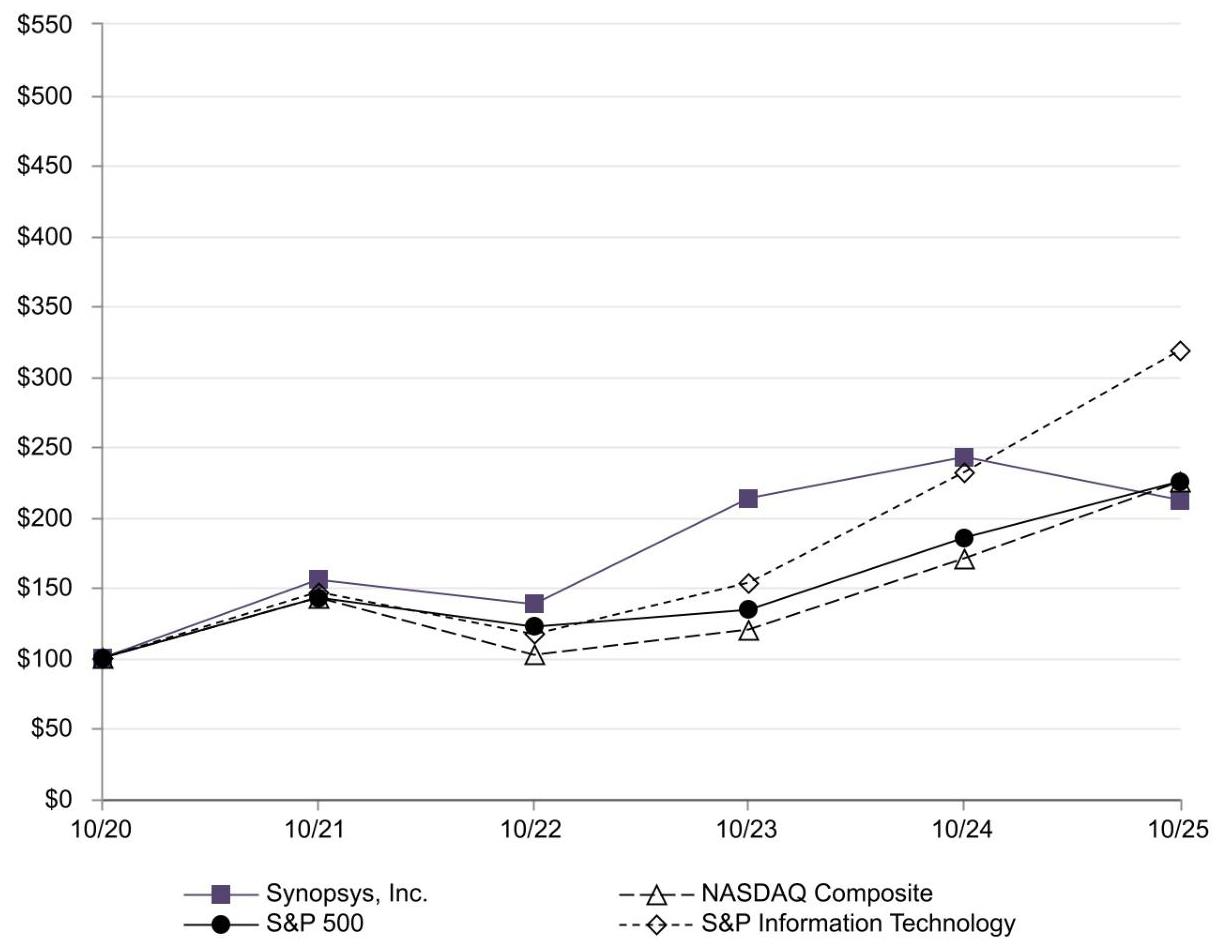
source: Synopsys FY 2025 Annual 10K Report
As the chart above shows, for most of the past five years, Synopsys's stock performance has far outpaced the S&P 500 and the Nasdaq Composite, even surpassing the S&P Information Technology index. However, in the recent six-month pullback, it has begun to lag behind these three benchmarks.
But the details on the ground serve as a reminder to remain level-headed. To preserve cash for its massive debt obligations, the company has suspended its stock repurchase program. Meanwhile, a footnote in the financial report concerning internal controls is noteworthy: when assessing the effectiveness of internal controls for fiscal 2025, management explicitly excluded the newly acquired Ansys—a business that contributed approximately 21% of the company's total assets and 11% of its total revenue. This indicates that the integration and digestion of Ansys have only just begun.
Conclusion
Synopsys stands at a critical crossroads. With the acquisition of Ansys, it has painted an immensely ambitious vision for its future—that of a tech empire capable of dominating both the chip and system design realms. In the era of AI and "Pervasive Intelligence," this vision is undeniably exciting.
However, the path to this empire is fraught with challenges: enormous debt, profit pains, a struggling core business, intense geopolitical maneuvering, and a daunting integration task.
In the coming years, whether Synopsys can successfully digest this expensive "feast" and convert resources and synergies into tangible profit growth will be the key to determining the success or failure of this high-stakes gamble. For investors, what they see now may be a thrilling story, but the next chapter is filled with uncertainty.


