
The Critic Who Learned to Paint: Tuna and the Dawn of a Truly Unified AI
How can we finally end the long-standing schism between AI's 'analytic left brain' and 'creative right brain,' creating a unified model that no longer forces us to choose between the precision of a critic and the imagination of an artist?


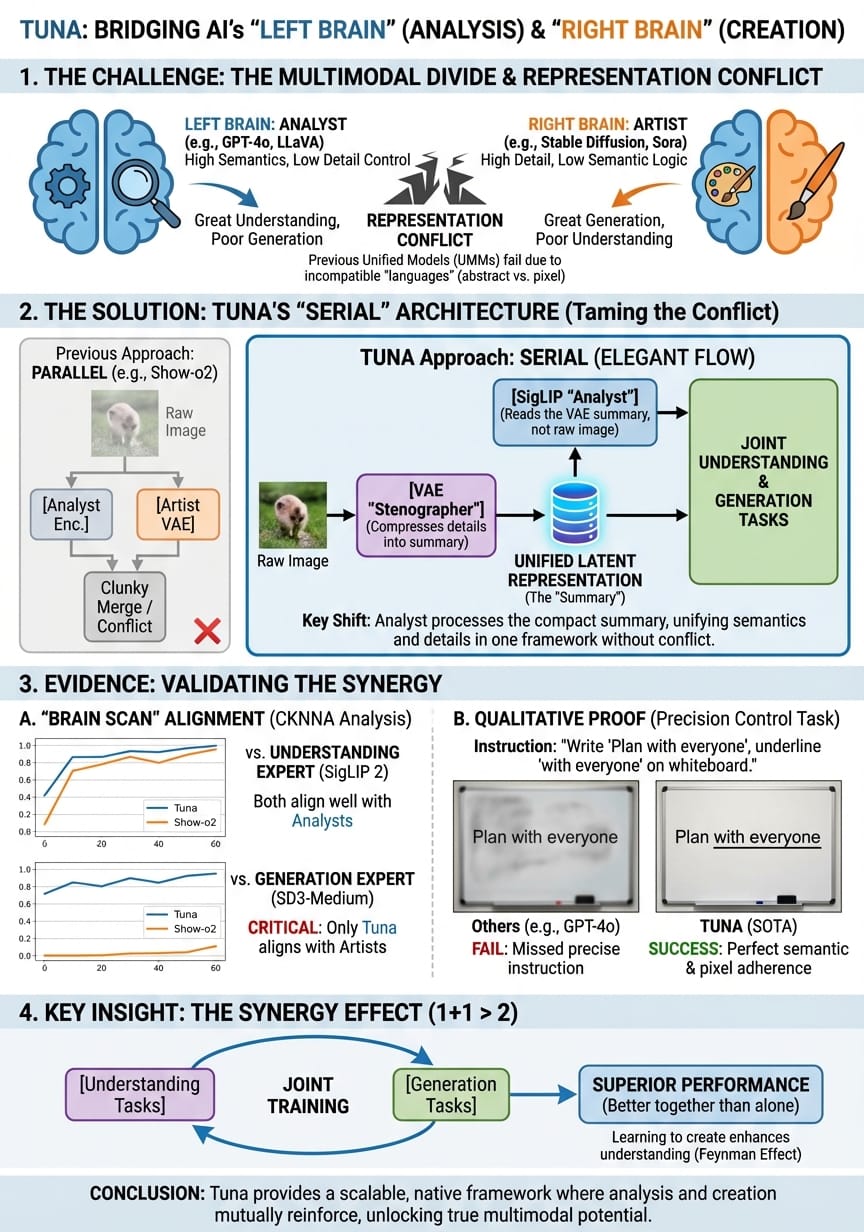
AI's Left and Right Brain: How the Tuna Model Unites Seeing and Creating
In the world of artificial intelligence, a long-standing, seemingly irreconcilable conflict has persisted—a division between the "left brain" and the "right brain."
Some AI models are premier "analysts." They possess an extraordinary ability to understand, capable of accurately interpreting complex scenes in an image, recognizing text, and even grasping humor and memes. GPT-4o and LLaVA are prime examples of this category. They are like seasoned art critics who can eloquently discuss a painting's composition, emotion, and meaning. But if you were to ask this critic to pick up a brush and create something from scratch, they would likely be at a loss.
Other AI models are brilliant "artists." Stable Diffusion and Sora are standouts among them. They can transform simple text descriptions into breathtaking images and videos, turning imagination into pixels. But these artists often possess more sensibility than reason; when tasked with complex instructions that demand rigorous logic and precise understanding, they frequently stumble.
This schism between the "critic" and the "artist" is one of the most central challenges in the field of multimodal AI today. The industry has been trying to merge the two into what are called Unified Multimodal Models (UMMs), but the results have often been disappointing. The outcome is either a mediocre "jack-of-all-trades, master of none" or a clunky assembly where two "experts" work in the same office but speak different languages, leading to inefficiency and high costs.
Until recently. A paper from institutions including Meta BizAI and HKU has shown us a new possibility. Their proposed model, Tuna, appears to have found a more elegant path, one that truly gets the AI "analyst" and "artist" to work in concert.
The Elegance of a Series Connection: Tuna's Different Path
In the past, the failure of unified models stemmed from "representation conflict." Simply put, the language used by the "analyst" is highly abstract and semantic, while the language of the "artist" is one of fine-grained pixels and latent space. The logic and granularity of these two languages are completely different, so forcing them together naturally creates conflict.
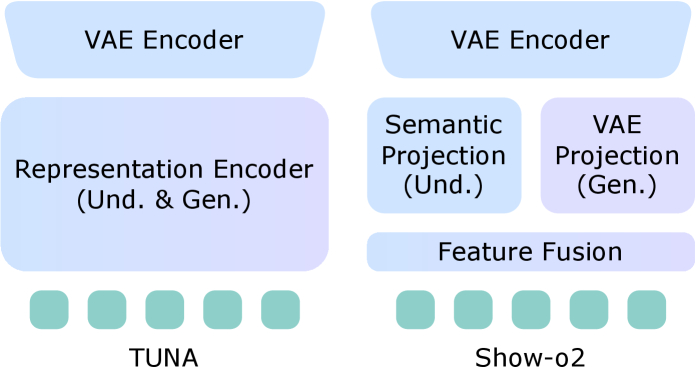
Previous models, like Show-o2, attempted a "parallel then fuse" approach. It let the "analyst" and the "artist" work separately before stapling their reports together at the end. This is like a project where two teams use incompatible databases and then try to merge their data—the inevitable result is information loss and chaos.
Tuna's concept, however, is as simple as it is profound. It doesn't use a parallel structure; it uses a series connection.
A comparison of Tuna's architecture with Show-o2's
Source: ArXiv: 2512.02014
We can understand this with an analogy:
- The Variational Autoencoder (VAE) is like a "stenographer." It can flawlessly compress all the details of a high-resolution image (the original ledger) into a compact "summary" (the latent representation). This summary is the foundation for generating images, ensuring the "artist" has enough detail to work with.
- The Representation Encoder (SigLIP) is like a "senior analyst." He excels at extracting high-level, macroscopic insights and semantics from information.
Tuna's approach is to stop the "analyst" from looking at the original image and instead have him read the summary written by the "stenographer."
This seemingly simple change brings about a qualitative transformation. The "unified visual representation" that flows within the model now both retains the rich detail needed for generation tasks (from the stenographer) and is imbued with the high-level semantics required for understanding tasks (from the analyst's distillation). The two "languages" no longer clash; they are seamlessly integrated within a single, unified framework.
The Evidence: A Scan Inside the Model's "Brain"
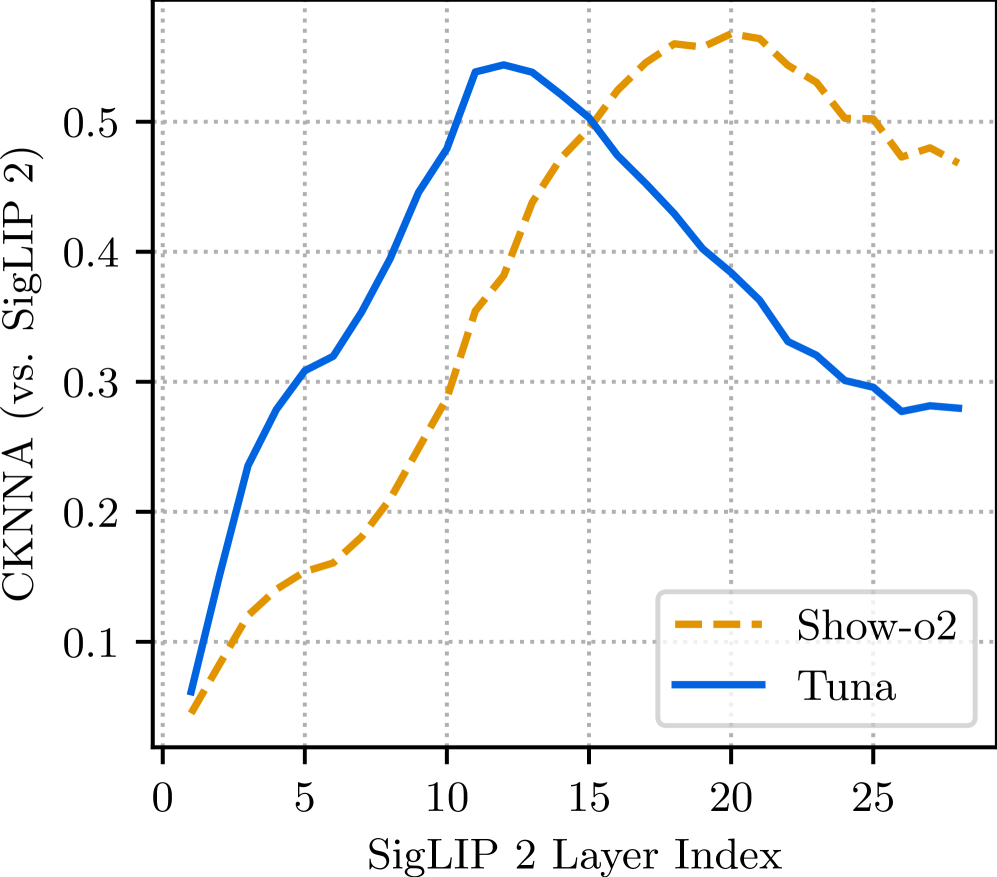
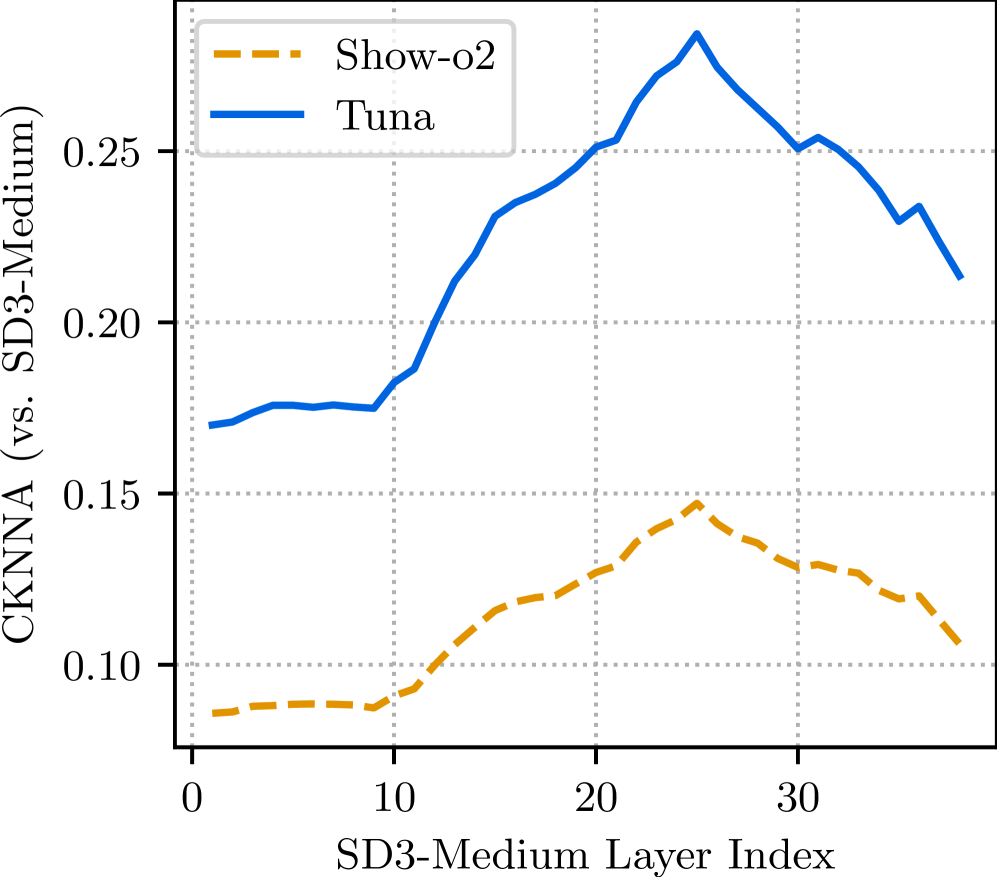
That's a beautiful idea in theory, but does it actually work? The researchers conducted a brilliant experiment using a technique called CKNNA to measure whose "thinking patterns" Tuna's most closely resembled. Think of it as a "brain scan" for an AI.
They compared Tuna's representations for their alignment with both a top-tier "understanding expert," SigLIP 2, and a top-tier "generation expert," SD3-Medium.
Analysis of Tuna's and Show-o2's representation alignment
Source: ArXiv: 2512.02014
The results are crystal clear.
- The left chart shows that in terms of alignment with the "understanding expert," both Tuna (blue line) and Show-o2 (orange line) perform well, indicating that both possess strong comprehension abilities.
- But the right chart reveals a world of difference. Tuna's alignment with the "generation expert" is far higher than Show-o2's at every layer of the model.
This result proves it plainly: Show-o2's unification was more of a compromise. It was, in essence, an analyst with a specialty, who had merely dabbled in painting. Tuna, on the other hand, has become a true dual-threat, its internal representations mastering both the depth of understanding and the precision of generation.
It Starts with Handwriting on a Whiteboard
Theoretical elegance is only truly persuasive when it translates into real-world performance. Tuna has achieved state-of-the-art (SOTA) or highly competitive results across multiple benchmarks, including image understanding, generation, editing, and video tasks.
But sometimes, a single image is more telling than a mountain of data.
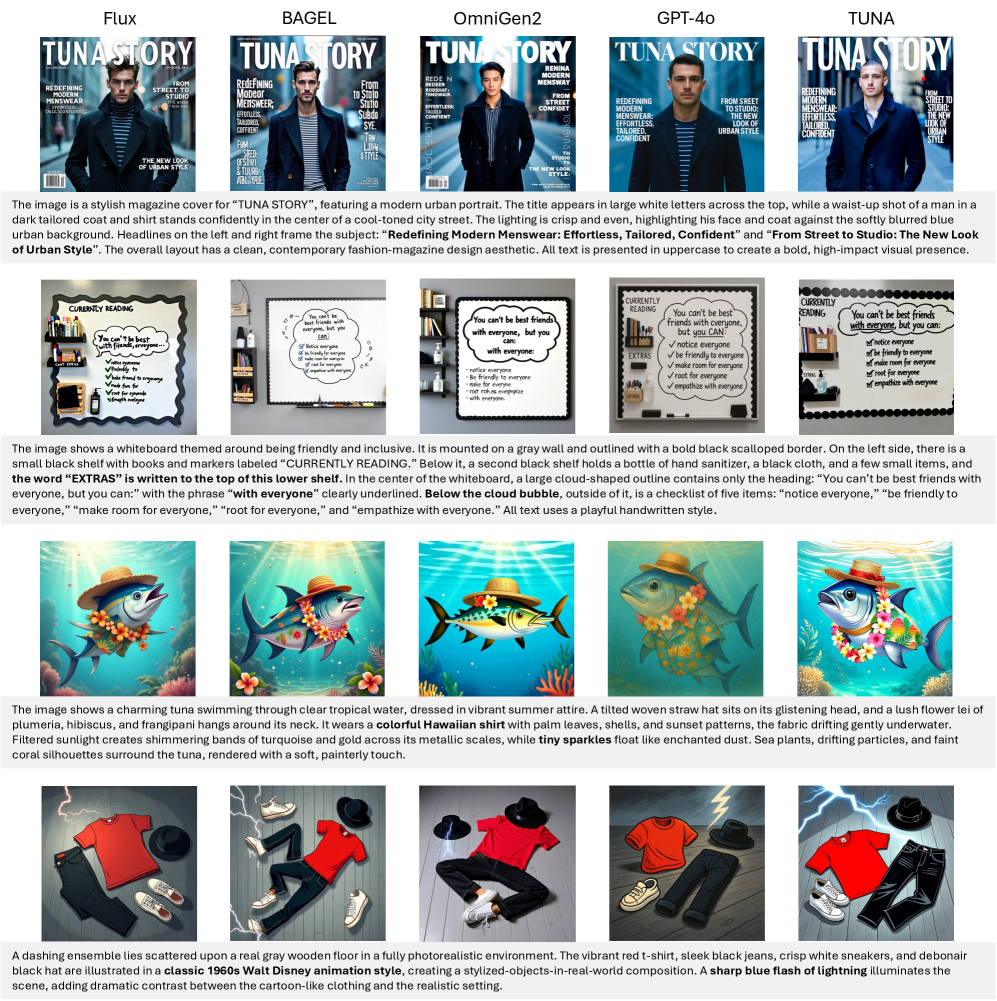
Qualitative comparison of Tuna with baseline models on image generation
Source: ArXiv: 2512.02014
Look at the "Whiteboard" example in the second row of the image above. The prompt asks the model to write text on a whiteboard, including the phrase "Plan with everyone," and specifically requests an underline beneath "with everyone."
- Other models, including GPT-4o, either misspelled the words or failed to comprehend the "underline" instruction.
- Only Tuna (far right) executed every part of the request perfectly. It not only rendered all the handwritten text correctly but also precisely added the underline to the specified phrase.
This small detail is a testament to the power of Tuna's architecture. It demonstrates that the model not only "understood" every nuance of the instruction (the analyst's ability) but also possessed the "control" to "draw" that understanding with precision (the artist's ability).
An Unexpected Discovery: The 1+1>2 Synergy
One of the most exciting findings from the research was a counter-intuitive "synergy."
Conventional wisdom suggests that making a model learn multiple tasks at once might cause interference. But Tuna's ablation studies showed that jointly training on both understanding and generation tasks produced better results than training on either task alone.
In other words, learning "how to paint" (generation) actually enhanced the model's ability to "see the world" (understanding). This is just like how humans learn; we use "output" (teaching others, writing, building projects) to drive our "input" (reading, studying), thereby achieving a deeper level of mastery. It is the very essence of the Feynman Technique.
Conclusion: A More Unified Future
The emergence of Tuna may mark a turning point in the development of multimodal AI. It has "tamed" the visual representation conflict that has long plagued researchers.
What it presents is not just a model that leads on various benchmarks, but a blueprint for an architecture that is concise, efficient, and scalable. This means that future AI may no longer have to make a painful trade-off between "understanding" and "generation." We can look forward to a more native AI where the left and right brains work in concert—an AI that can perceive the world with the acuity of the sharpest analyst and also create within it with the talent of the most gifted artist.
This will not only give rise to more powerful AI assistants but also open up new frontiers of imagination for automated content creation, human-computer interaction, and beyond. The battle between AI's left and right brain may finally be heading toward unification.


