
The Great Unbundling: Deconstructing Jobs, Reconstructing Careers
Will AI trigger a "job apocalypse"—or will history repeat itself through creative destruction, and who bears the cost during the transition?


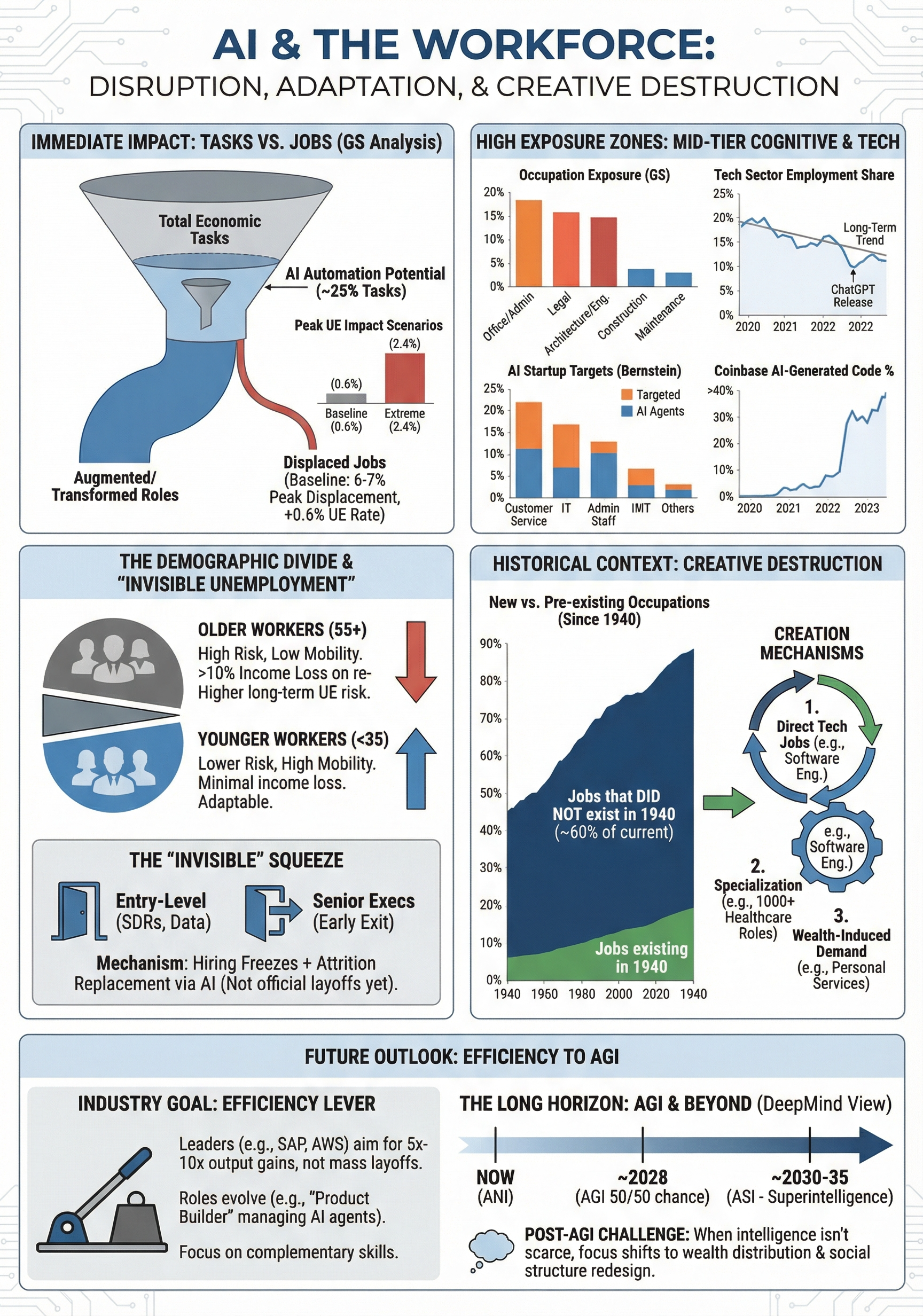
Will AI Take Your Job? AI's Impact on the Labor Market
Every few years, the anxiety over "machines replacing humans" makes a comeback. This time, the leap in generative AI's capabilities has made the question feel uncomfortably real. ChatGPT can write code, Claude can analyze financial reports, and Midjourney can create illustrations—jobs once thought to require "human intelligence" seem to be steadily eroded.
But if we zoom out, the answer is likely more complex than it appears.
25% of Tasks Can Be Automated, But That Doesn't Mean 25% of People Will Be Unemployed
An analysis by Goldman Sachs, based on the U.S. Department of Labor's O*NET database, shows that generative AI could potentially automate 25% of work tasks in the U.S. economy. That number sounds alarming, but tasks and jobs are two different things.
Occupational Distribution of AI-Automatable Tasks
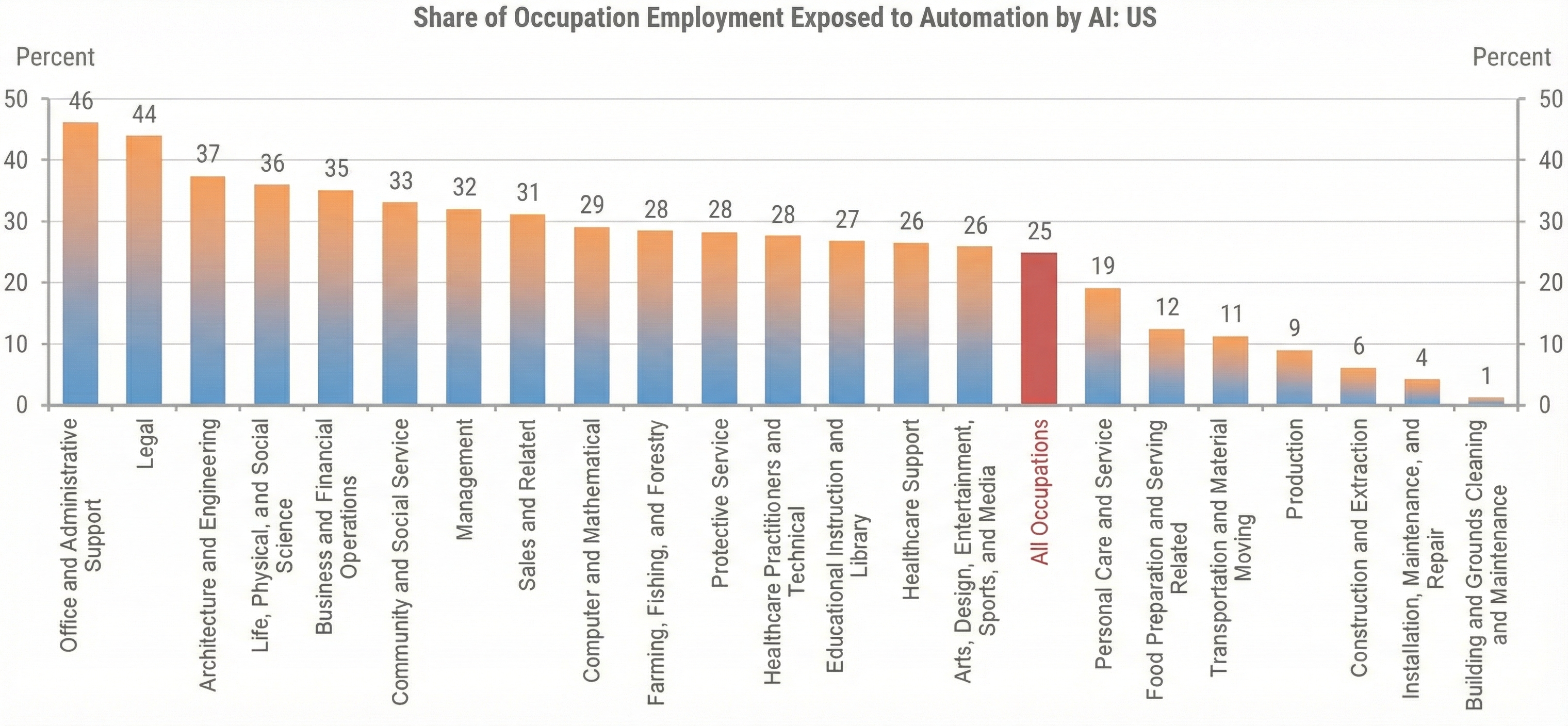
Source: Goldman Sachs, Jarvis
Administrative support, legal, and computer & mathematical occupations have the highest exposure. Construction workers and maintenance staff, however, are almost unaffected. This is intuitive: AI excels at processing text, code, and data, but it can't yet climb a roof to fix tiles.
The proportion of jobs that will be completely replaced is much smaller. Goldman Sachs's baseline forecast is that 6-7% of jobs will be displaced during the AI adoption period, corresponding to a peak unemployment rate increase of about 0.6 percentage points. Even in the most extreme scenario—compressing the AI adoption cycle to 5 years and doubling the replacement rate to 12-14%—the peak increase in unemployment is around 2.4 percentage points, affecting approximately 4.1 million people.
Scenario Analysis of AI's Impact on Unemployment
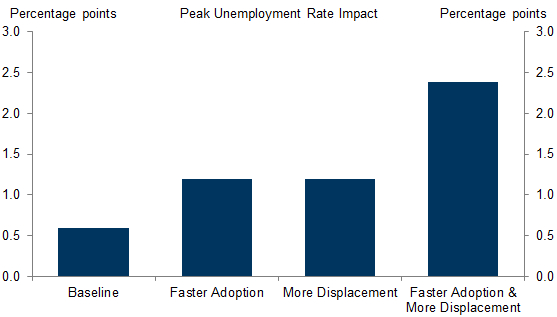
Source: Goldman Sachs
This is certainly not a small number. But it's far from a "job apocalypse."
Who Is Most at Risk? Mid-Level Cognitive Roles Bear the Brunt
A Bernstein analysis of over 100 AI startups reveals a clear picture: Agentic AI is primarily targeting roles that require cognitive ability but not deep domain expertise.
Customer support is first in the line of fire, with 25% of AI Agents designed to replace these positions. Data entry clerks, HR/IT support, administrative staff, and junior sales representatives follow closely behind. Research from the ILO confirms this: Clerical Support faces the highest risk, while agricultural workers, craftspeople, and machine operators are almost unaffected.
Distribution of Job Roles Targeted for Replacement by AI Agents Across Industries
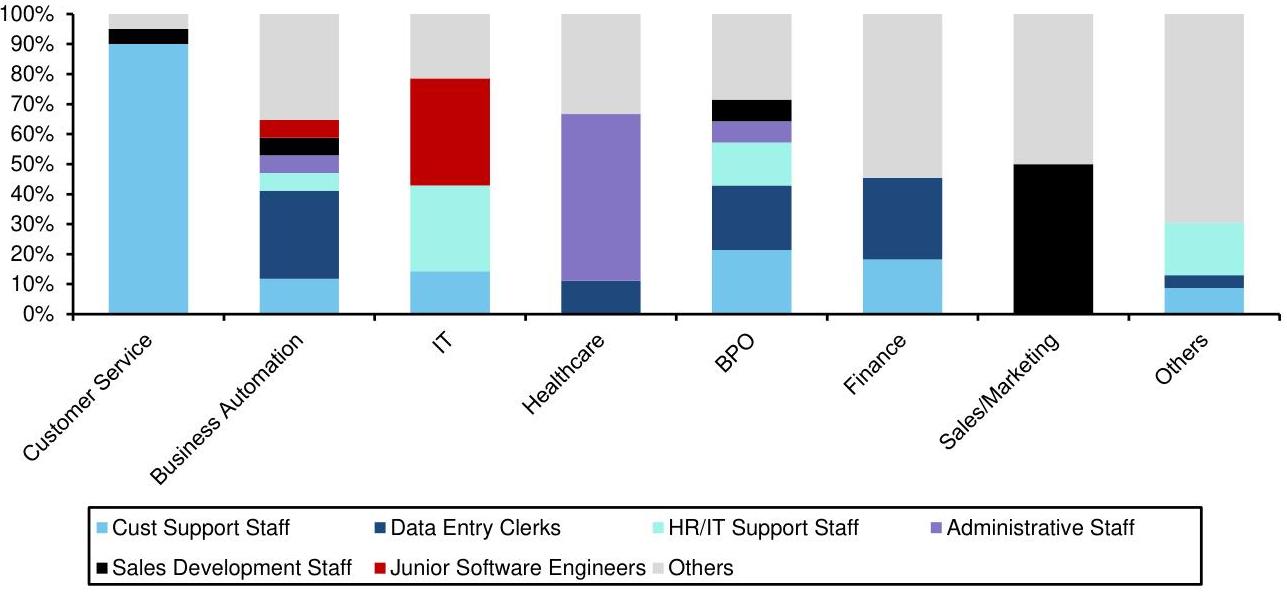
Source: Bernstein
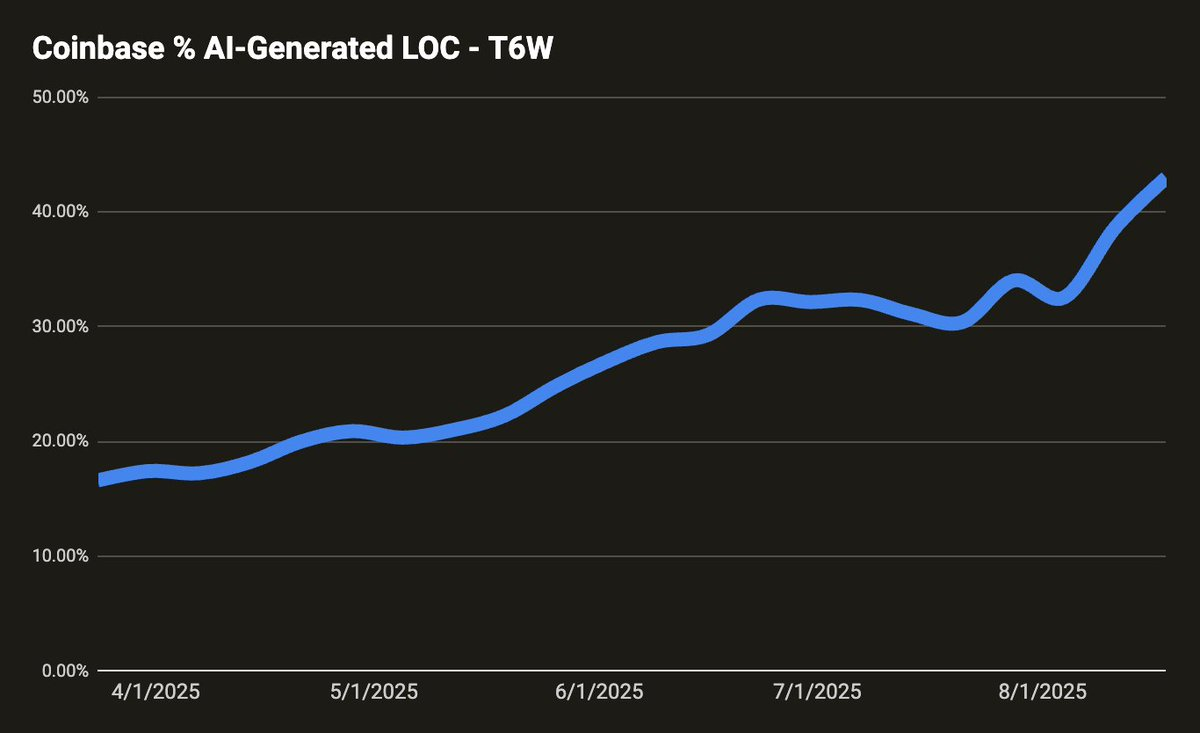
Software development is one of the areas where AI has penetrated most deeply. Anthropic reports that 44% of its API usage is related to coding; Anysphere's Cursor achieved $1 billion in ARR in less than 3 years; and JP Morgan predicts the AI coding market could reach $120 billion by 2030. Data disclosed by Coinbase shows that the percentage of AI-generated code is climbing rapidly.
Coinbase's Percentage of AI-Generated Code
Source: Coinbase
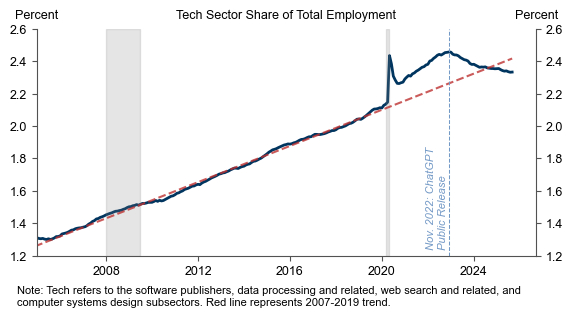
The tech industry's share of total employment has already fallen below its long-term trend line. In sectors with high AI adoption rates, there is a slight positive correlation with unemployment among young workers aged 20-30. These are the early signals.
Tech's Share of Total Employment Declines Relative to Long-Term Trend
Source: Goldman Sachs
Age is the Cruelest Dividing Line
If the job displacement caused by AI is a storm, then people of different ages are carrying vastly different umbrellas.
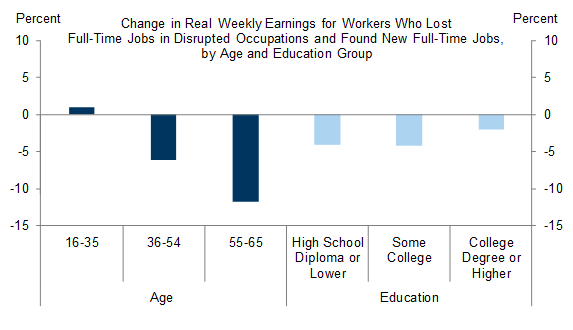
Goldman Sachs's historical analysis of job displacement over the past three decades shows that older workers over 55 face real income losses of more than 10%, while younger workers under 35 experience almost no loss. The key mechanism allowing young people to adapt is occupational mobility—they are more likely and more willing to switch to entirely different job categories.
Real Income Loss of Displaced Workers by Age
Source: Goldman Sachs
Workers from declining occupations take an average of 4 weeks longer to find a new job and suffer a real income loss of over 4%—double the loss of other displaced workers. More worryingly, they are 5-10 percentage points more likely to become long-term unemployed or exit the labor force entirely.
This is not a uniformly distributed shock. It is more like a sharp wedge driven into specific demographic groups.
History Says: 60% of Today's Jobs Didn't Exist in 1940
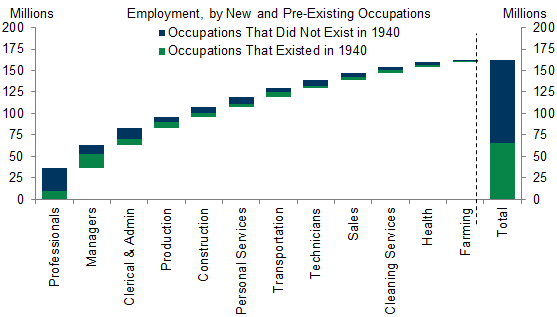
Before discussing how many jobs AI will "eliminate," there's a number worth remembering: 60% of today's workers are in occupations that did not exist in 1940.
Over the past 85 years, more than 85% of employment growth has come from the creation of new occupations. Technology is the core driver behind all of this.
Technology-Driven Creation of New Occupations is the Main Driver of Long-Term Employment Growth
Source: Goldman Sachs
This creation happens through three mechanisms.
First, technology directly gives rise to new occupations. In the last 30-40 years, over 6 million workers have entered computer-related fields—software engineers, IT system managers, tech support specialists—jobs that simply did not exist before the computer age. The gig economy, e-commerce, content creation, and video games have absorbed another 8-9 million people.
Second, technology drives occupational specialization. In healthcare, for example, the number of distinct medical professions grew from 100-200 in the 1920s to over 1,000 by 2020. As the division of labor becomes increasingly fine-grained, new roles emerge.
Third, the income growth brought by technology indirectly stimulates new demand. The rise of service-sector jobs like pet care, nail technicians, personal trainers, and tutors is a direct result of people becoming wealthier and willing to pay for more services.
History doesn't guarantee the future. But it provides a powerful anchor: technological revolutions are never just about destruction; they are also about creation.
"Invisible Unemployment": A Threat That Won't Show Up in Official Data
Venture capitalist Jason Calacanis introduced a concept worth watching on the 20VC podcast: "Invisible Unemployment."
"It's everywhere, and it's going to grow this year, but it's not in the government data yet."
The mechanism is simple: companies don't actively lay people off, but they use AI to fill vacancies from attrition and stop hiring new people. IBM's attrition rate was less than 2% last year, partly because employees knew they had "no other job to go to."
This hits two groups the hardest.
Entry-level positions are shrinking. AI can replace junior sales reps (SDRs), handle basic data organization, and manage customer support. Unless they are top-tier talent, recent graduates are finding that the door is narrowing.
At the other end are senior executives. Many executives aged 55-65 have "quietly exited the labor market." They are difficult to retrain and struggle to find new positions willing to take them.
"The high-end and the entry-level and senior management are going to be under immense pressure in 2026."
This impact won't immediately be reflected in unemployment statistics. But it is changing the underlying structure of the labor market.
What Do Tech Leaders Think? Efficiency Gains, Not Mass Layoffs
A representative view comes from Muhammad Alam, Head of Product and Engineering at SAP. His goal is not just an incremental improvement but a 5x to 10x leap in efficiency—enabling 40,000 employees to generate the output of 200,000. He emphasizes, however, that this has not led to layoffs because "the backlog of work is enormous." SAP might even moderately increase its headcount in 2026.
Roles will change. Product managers will evolve from "product managers" to "product builders." The role of an individual engineer may cease to exist—everyone will have to become an "engineering manager," overseeing a large number of AI agents.
AWS CEO Matt Garman's statement is equally optimistic:
"I'm a very big believer that there will be absolutely more jobs created by AI in the medium to long run than are eliminated."
But he doesn't shy away from reality: "Your job will change. What made you successful in the past won't be what makes you successful in the future."
Garman calls the idea of "replacing junior employees with AI" one of the "stupidest ideas." The reason is pragmatic: young employees are the most experienced with AI tools and the least expensive. Without a talent pipeline, a company cannot remain healthy long-term.
AGI: A More Distant Horizon, A More Fundamental Question
Google DeepMind co-founder Shane Legg predicts a 50/50 chance of achieving minimal AGI by 2028, with full AGI arriving between 2030 and 2035.
He believes ASI (Artificial Superintelligence) is almost inevitable. The argument is based on a simple physical comparison: the human brain operates at 20 watts while a data center uses 200 megawatts, a difference of 10^7 times; neural signals fire at 100-200 hertz while chips operate at 1 billion hertz, another 10^7-fold difference.
"Is human intelligence the top of the possible? I think absolutely not."
Legg's thoughts on a post-AGI society are profound:
"The current system where people get resources by selling their mental or physical labor might no longer work. The 'pie' should become much, much bigger. The question is how to distribute the wealth of society and how to structure the 'post-AGI' economy and social fabric."
Interestingly, he believes the most vulnerable in the short term are precisely the "elite cognitive jobs"—senior M&A lawyers, machine learning engineers—work that can be done entirely remotely over the internet. Plumbers, in contrast, are relatively safe because robotics remains too expensive to compete with human labor on price.
Our Situation and the Path Forward
Synthesizing all this information, a complex picture emerges:
What AI brings is not a job apocalypse, but a profound wave of creative destruction. It will cause real, painful structural adjustments, especially for older workers who lack the ability to reskill and those in specific "mid-level" cognitive roles.
At the same time, it holds immense creative potential. As SAP's Muhammad Alam described, the goal is not to cut staff but to use AI to achieve a 5x to 10x leap in efficiency, enabling existing teams to accomplish several times their previous workload and thus accelerate innovation.
What does this mean for us as individuals?
- Embrace, Don't Resist: Continuously learn and view AI as a lever to enhance personal capabilities, not as a competitor.
- Cultivate Complementary Skills: Focus on abilities that AI struggles to replace, such as defining complex problems, cross-disciplinary communication, creative thinking, and empathy.
- Maintain Mobility: Especially for the young, be willing to experiment and switch paths, exploring more possibilities early in your career.
As for the more distant era of AGI (Artificial General Intelligence), that will represent an economic paradigm shift on another level. As Google DeepMind's Shane Legg contemplates, when intelligence itself is no longer scarce, we may need to redesign our entire system of wealth distribution.
This is a grand and distant proposition. But the road to the future is always paved by the steps we choose to take today.
This AI-driven transformation has only just begun.
Staying vigilant, continuously learning, and actively adapting is perhaps the most resilient mindset we can adopt.
I will share a more detailed version of this post with more charts behind the paywall:


