
The New Matthew Effect - Why "Deep Fusion" Creates Non-Linear Gaps in the AI Era
Why do 19% of enterprise users still treat powerful models as mere toys, while 'Frontier firms' integrate custom GPTs at 7x the rate of the median, proving that the true driver of ROI is no longer model performance, but the organizational leap from casual adoption to 'Deep Fusion'?


The state of enterprise AI | OpenAI
The "New Matthew Effect" in the AI Era: When Productivity Gaps Are No Longer Linear
Artificial intelligence is permeating the very fabric of enterprise operations at an unprecedented velocity. According to the "State of Enterprise AI" report released by OpenAI in late 2025, the number of enterprise ChatGPT seats has surged nearly 9-fold over the past year, with total weekly message volume growing by an astounding 8-fold. This undoubtedly signals the definitive arrival of a new era.
However, beneath this booming landscape, a question demanding deeper reflection emerges: Is the productivity dividend brought by AI being distributed equally among every employee, or are we witnessing the invisible exacerbation of a new form of inequality? The report’s data reveals a sobering yet intuitive trend—a significant "AI Divide" is forming, not just between companies, but more profoundly between employees within them.
Comprehensive Penetration: AI as Core Infrastructure
Before dissecting the disparities, we must first understand the depth and breadth of AI's integration into the enterprise. It has long ceased to be a "toy" for a few tech enthusiasts; it is becoming the core infrastructure for many organizations.
- Deep Integration into Workflows: Customized GPTs and Projects are becoming the tools of choice for solidifying corporate knowledge and automating processes. Their weekly user base has grown by a staggering 19-fold year-over-year, and recently, approximately 20% of enterprise messages are processed through these bespoke tools. Banco Bilbao Vizcaya Argentaria (BBVA) regularly utilizes over 4,000 internal GPTs, marking AI-driven workflows as a persistent instrument in their daily operations.
- Scaling via APIs and Developer Workflows: Enterprises are deeply integrating AI models into their own products and systems via APIs. Over the past 12 months, the average reasoning token consumption per organization has increased by 320-fold, indicating that smarter models are being systematically applied to increasingly complex tasks.
This deep integration delivers ubiquitous, measurable value. The report shows that 75% of surveyed employees believe AI has improved the speed or quality of their work. On average, ChatGPT Enterprise users save 40–60 minutes per active day, a figure that climbs to 60–80 minutes in fields such as data science and engineering.
The Race Across Industries and Geographies: Uneven Acceleration
The proliferation of AI is far from monolithic; different industries and regions are displaying vastly different rhythms and priorities.
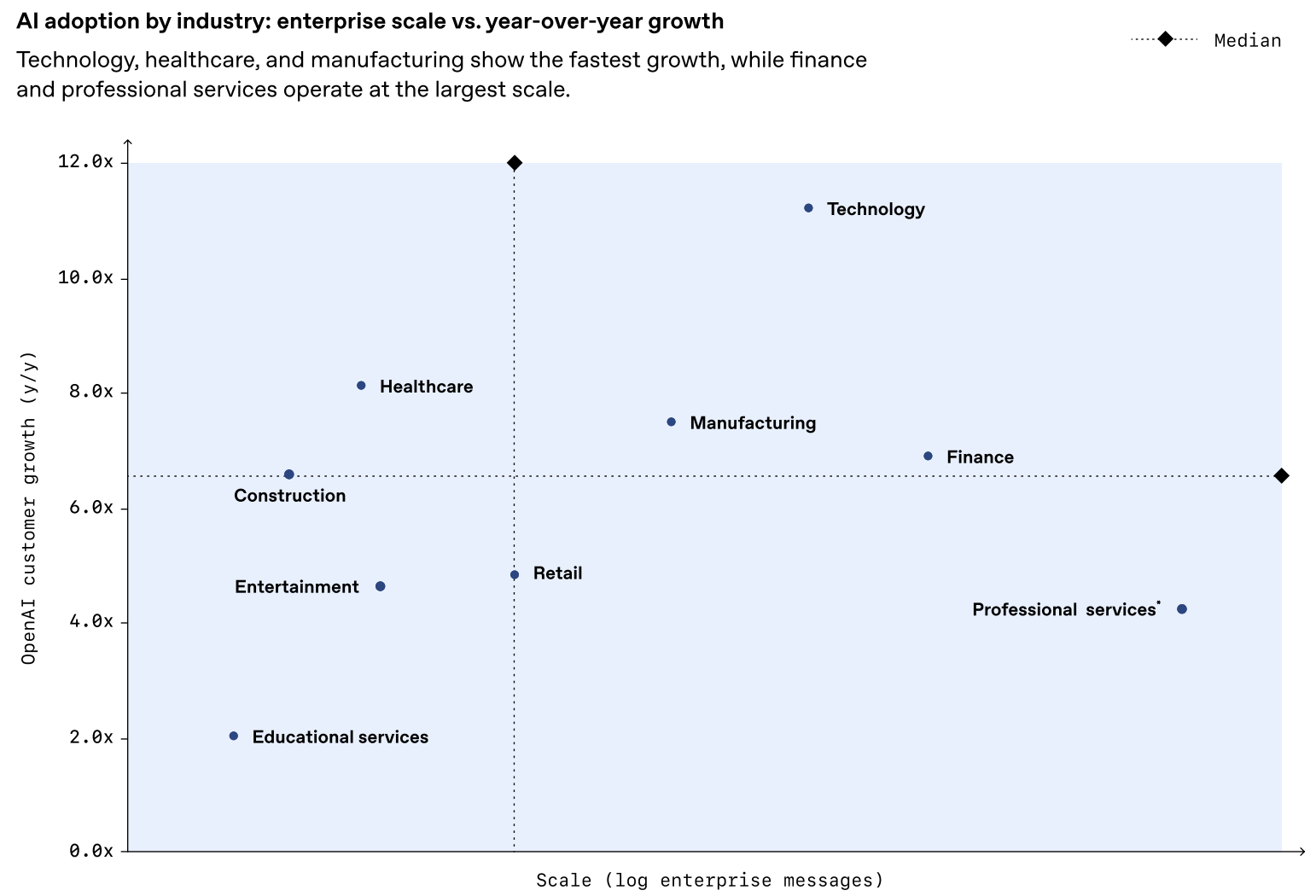
- Industry Divergence: In terms of scale, professional services, finance, and technology were early adopters and remain the most concentrated sectors for ChatGPT enterprise clients. However, in terms of growth velocity, technology (11x), healthcare (8x), and manufacturing (7x) are catching up at a much faster pace.
AI adoption by industry: enterprise scale vs. year-over-year growth
Source: OpenAI - The state of enterprise AI 2025 report
- Geographic Expansion: While the United States remains the core market for AI adoption, international growth is accelerating rapidly. Over the past year, the growth rate of paid commercial customers in markets like Australia (187%), Brazil (161%), and the Netherlands (153%) has exceeded the global average (143%). Japan has emerged as the country with the most enterprise API clients outside the US.
The Individual Chasm: From 6x to 17x
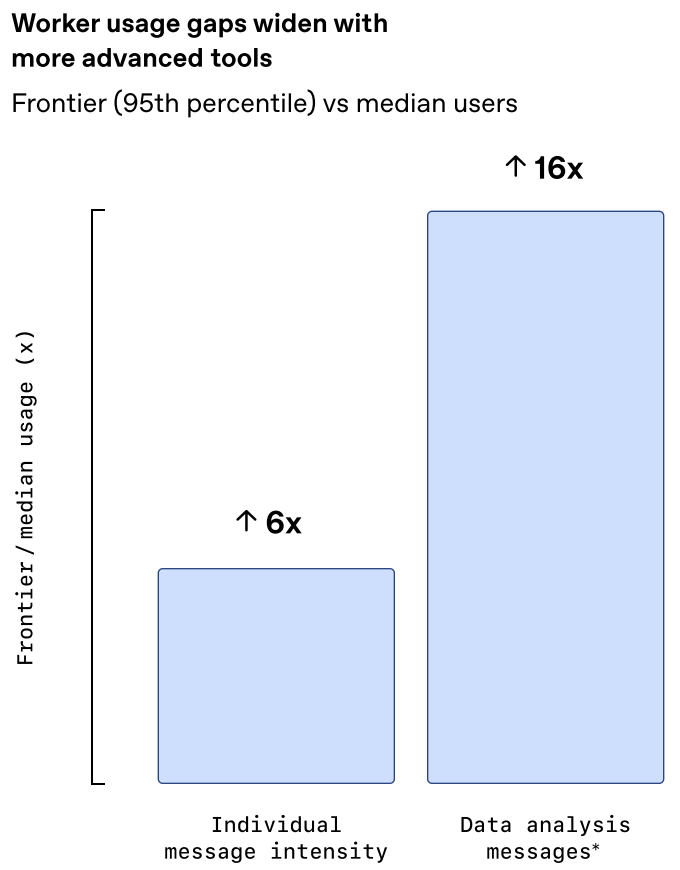
Against a backdrop of general benefit, the productivity gap between individuals is widening at an alarming rate. The report introduces the concept of "Frontier workers" (the top 5% of users by intensity) versus "Median workers," revealing massive disparities in usage behavior.
Overall, Frontier workers send 6 times the volume of ChatGPT messages compared to the median user. However, when we drill down into more technical tasks, this gap widens dramatically.
- For data analysis tasks, the usage intensity of Frontier workers is 16 times that of the median.
- For coding tasks, this gap reaches an astounding 17 times.
Worker usage gaps widen with more advanced tools
Source: OpenAI - The state of enterprise AI 2025 report
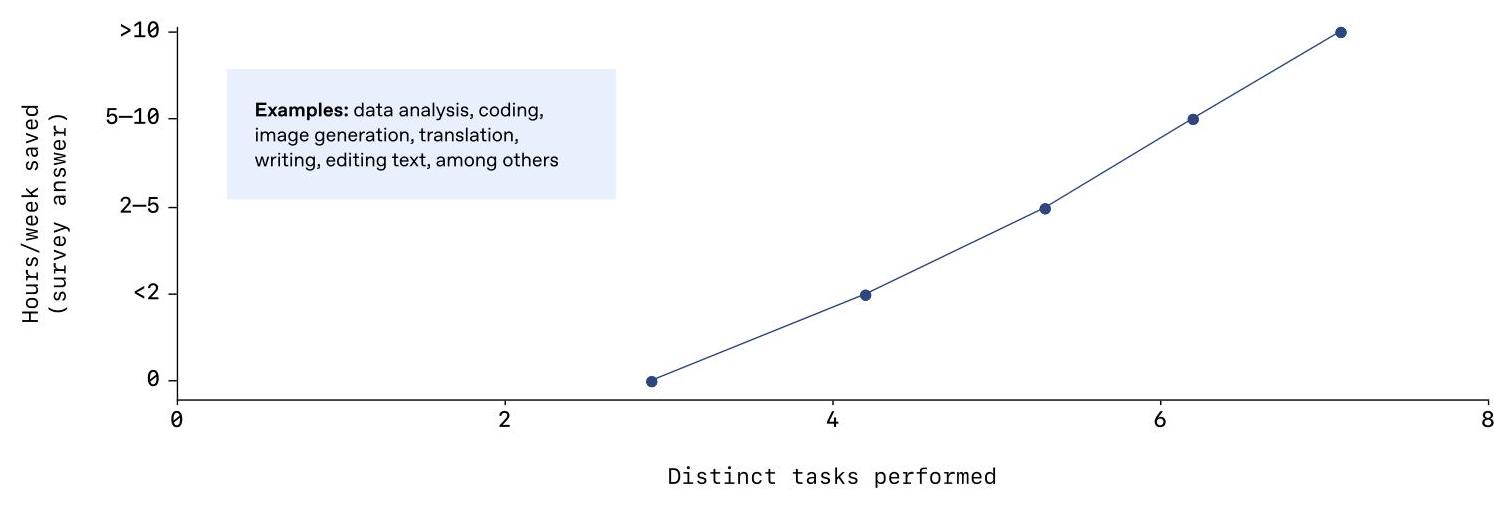
This immense difference in usage translates directly into quantifiable productivity returns. The report indicates that the time employees save is directly correlated with the number of distinct task types they perform using AI. Those who limit AI to merely one or two tasks are seeing productivity gains that are magnitudes lower than those who fully embrace AI across seven or eight domains, such as research, analysis, coding, and writing.
Hours saved per week vs. distinct tasks performed
Source: OpenAI - The state of enterprise AI 2025 report
Employees who save more than 10 hours per week consume 8 times the amount of "intelligence" (measured by model credits) compared to those who save almost no time. They are not just using AI more frequently; more importantly, they are using more diverse and deeper tools, seamlessly weaving AI into every link of their workflow.
The Root of the Divide: Dabbling vs. Deep Fusion
Why has such a massive chasm emerged? The answer lies not in the technology itself, but in the behavioral patterns of the users.
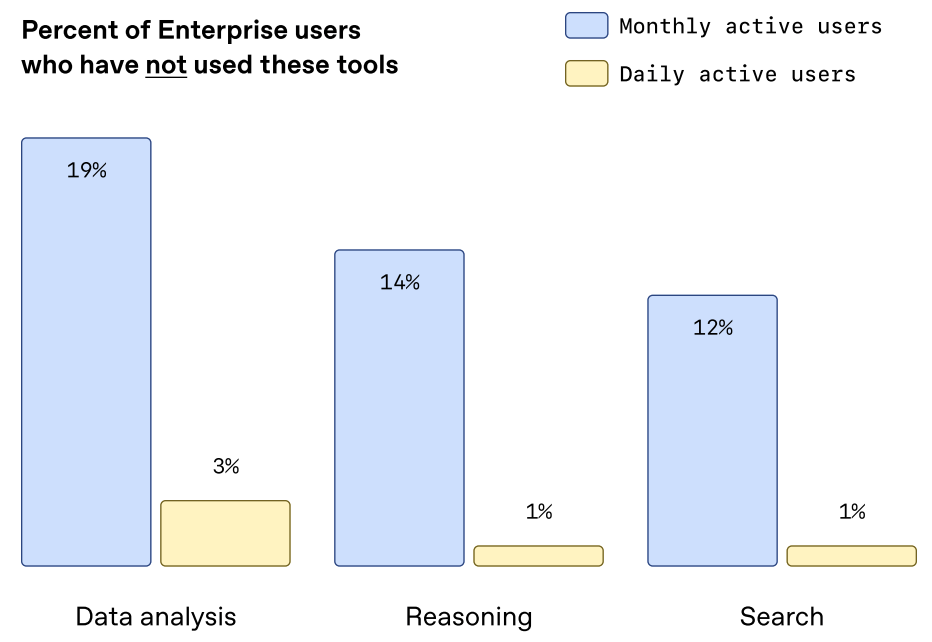
A surprising statistic reveals that even among active enterprise users of ChatGPT, a significant portion has never attempted to use its most powerful features. Among monthly active users, 19% have never used data analysis, 14% have never used reasoning capabilities, and 12% have never used search.
Percent of Enterprise users who have not used these tools
Source: OpenAI - The state of enterprise AI 2025 report
This implies that for many employees, AI usage remains in the "toy" phase—occasionally writing an email or polishing a paragraph—without ever regarding it as a powerful engine capable of reshaping core workflows. They scratch the surface, missing the true transformation AI can offer.
Frontier workers are entirely different. They have moved beyond basic Q&A to leveraging AI for complex tasks they previously could not complete independently, such as code review, spreadsheet automation, or even designing and building custom GPTs to solve specific problems. The report notes that 75% of surveyed employees state that AI allows them to complete new tasks they were previously unqualified for.
This expansion of capability is blurring the traditional boundaries of job roles. Employees with non-technical backgrounds are venturing into coding and data analysis—a shift that was unimaginable in the past.
The Organizational Mirror: From Individual Differences to Corporate Gaps
The chasm between individuals inevitably projects onto the enterprise level, creating massive disparities between firms.
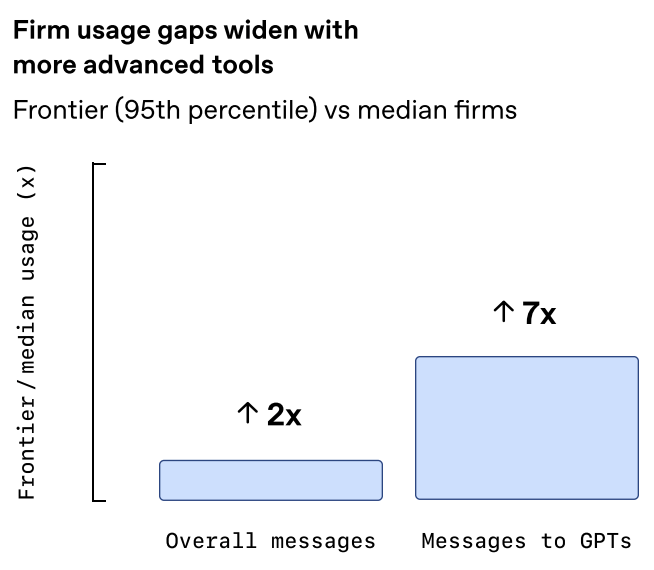
The report contrasts "Frontier firms" with "Median firms." Frontier firms not only generate twice the message volume per capita but also show a 7-fold difference in the use of custom GPTs, which represents a deeper integration into workflows.
Firm usage gaps widen with more advanced tools
Source: OpenAI - The state of enterprise AI 2025 report
This clearly demonstrates that leading companies are no longer satisfied with treating AI as a peripheral productivity gadget. Through systemic investment, executive sponsorship, and active change management, they are forging AI into a core organizational capability. They are connecting internal data interfaces, encouraging employees to create and share reusable AI workflows, and establishing evaluation systems to track AI performance against real business outcomes.
As a 2025 study by Boston Consulting Group found, AI leaders have realized 1.7 times the revenue growth and 3.6 times the Total Shareholder Return (TSR) over the past three years. From Moderna compressing weeks of drug discovery analysis into hours, to Lowe's AI shopping assistant doubling online conversion rates, to Indeed improving the probability of job seekers being hired by 38% through AI matching—these cases confirm that deep AI adoption is tightly coupled with tangible financial performance and organizational advantage.
Conclusion: The Real Challenge is "Organizational Readiness"
OpenAI's report paints a realistic picture of the AI era: it is not a feast where everyone advances in lockstep, but a race where huge gaps are opening up.
For individuals, merely "knowing how to use" AI is far from sufficient; the key lies in whether one can "deeply fuse" it into every aspect of work, expanding the boundaries of one's own capabilities.
For organizations, the challenge is even more severe. The report’s conclusion hits the nail on the head: The primary constraint facing enterprises is no longer model performance or the tools themselves, but "organizational readiness."
How to guide employees across the chasm from dabbling to deep fusion, how to build an AI culture that encourages innovation and sharing, and how to systematically embed AI capabilities into core business processes—these are the strategic differentiators that will determine which companies thrive in the AI era.
The ubiquity of AI is merely the first half of the game. The divergence in productivity driven by the depth of adoption is the truly profound and far-reaching second half. The gap has appeared, and it is widening.


