
The Pragmatist’s Concession: Why AWS Rented NVIDIA’s Superhighway to Buy Certainty
Is AWS’s decision to integrate rival Nvidia’s proprietary NVLink a sign of capitulation, or a masterclass in pragmatism that trades low-level autonomy for the one asset money usually can't buy—time?


A Pragmatic Pivot: Why AWS Is Plugging Into NVIDIA’s Network
In the grand narrative of the tech industry, "vertical integration" is often hailed as the ultimate holy grail. For a giant like Amazon Web Services (AWS), this has been a guiding principle. From its Nitro controllers to Graviton CPUs and the home-grown Trainium AI chips, AWS has spent nearly two decades trying to prove one thing: absolute control over every component a bit flows through is the only path to ultimate efficiency and profit.
However, at the recent re:Invent conference, an intriguing fissure appeared in this long-held philosophy.
AWS and NVIDIA announced a deepened partnership, the core of which is AWS's plan to integrate NVIDIA's NVLink Fusion technology into its next-generation AI chip, Trainium4. This means that in the future, Amazon's own chips running in AWS data centers will no longer rely on Amazon's proprietary interconnect protocol. Instead, they will communicate through NVIDIA's pathways, NVIDIA's switch trays, and NVIDIA's defined rack architecture (MGX).
At first glance, this seems like another sweeping victory for NVIDIA; not only are they selling expensive GPUs, but now even their competitors' chips must pay them a "toll." But if we cut through the fog of market sentiment and examine this from an infrastructure engineering perspective, we see it’s not a simple zero-sum game. It is, in fact, an exceptionally shrewd and pragmatic strategic compromise by AWS in the face of physical limits—trading a degree of low-level autonomy for the most precious asset in the AI arms race: time.
Building the Car is Easy, Paving the Road is Hard
To understand why AWS made this choice, we must first grasp the real pain points of today's AI infrastructure.
In the past, deploying servers was a relatively linear process: buy the machines, plug in the network cables, and power them on. But in the era of trillion-parameter large models, the importance of the computing unit itself (whether GPU or ASIC) is being diluted by the interconnect. When you need tens of thousands of chips to work in concert as if they were a single, monolithic processor, the bottleneck is often not how fast the chips can compute, but how fast data can move between them.
This is the so-called "scale-up" challenge. To solve it, hyperscalers must not only design chips but also reinvent the entire physical form of the data center: from liquid-cooled racks capable of handling kilowatt-level power consumption to optical-electrical interconnect networks that can manage terabit-scale throughput. As we've seen in our latest industry research, developing such a complete rack-level architecture—including trays, cooling, power delivery, and an incredibly complex switch fabric—can cost billions of dollars and take several years of engineering. Any delay in one part, such as connector yields or signal degradation in cables, can postpone the launch of an entire cluster.
For AWS, while iterating on the Trainium chip design is crucial, the opportunity cost of delaying its deployment to wait for a proprietary interconnect network (like their own NeuronLink) to mature would be immeasurable.
A Generational Leap in Architecture: From Neighborhood Relay to Direct Superhighway
This collaboration marks a qualitative upgrade in Trainium's interconnect topology.
The current Trainium2 relies primarily on AWS's proprietary NeuronLink, which constructs a point-to-point Torus network. Think of it like an office: to pass a file to a colleague in the far corner, you have to pass it to your neighbor, who passes it to their neighbor, and so on. This architecture is relatively low-cost, but in large-scale clusters, the increasing number of "hops" leads to significant latency. Moreover, if one person "takes a day off" (a node fails), the path requires complex rerouting.
By integrating NVLink Fusion, however, Trainium4 will connect directly into a switch-based architecture built by NVIDIA.
NVIDIA's MGX-based system tray, which will serve as the physical backbone for AWS's Trainium4 clusters.
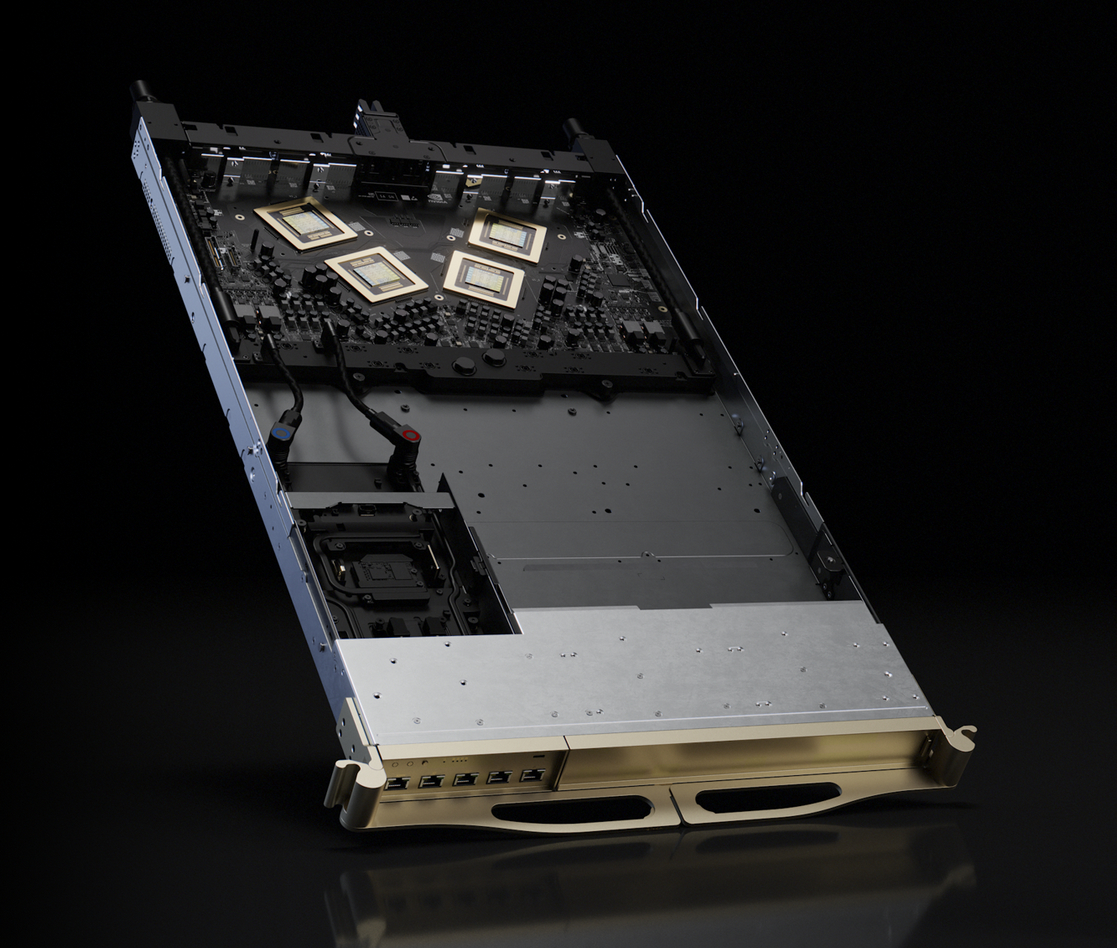
Under this new architecture, the 72 Trainium4 chips within a rack will achieve all-to-all connectivity via an NVLink Switch Tray. This means every pair of chips has a direct, high-speed highway between them, with no intermediate nodes. According to the disclosed data, this architecture allows each ASIC to have up to 3.6 TB/s of interconnect bandwidth, with the total rack bandwidth reaching a staggering 260 TB/s.
More importantly, AWS isn't just buying an interface standard; they are effectively adopting NVIDIA's entire MGX rack architecture. This is equivalent to directly reusing a physical design that NVIDIA has already validated in mass production—from the power delivery capacity of the power backplane to the blind-mate design of the liquid cooling pipes.
The NVLink Fusion architecture, enabling an all-to-all connection between 72 ASICs via NVLink 6 Switches.
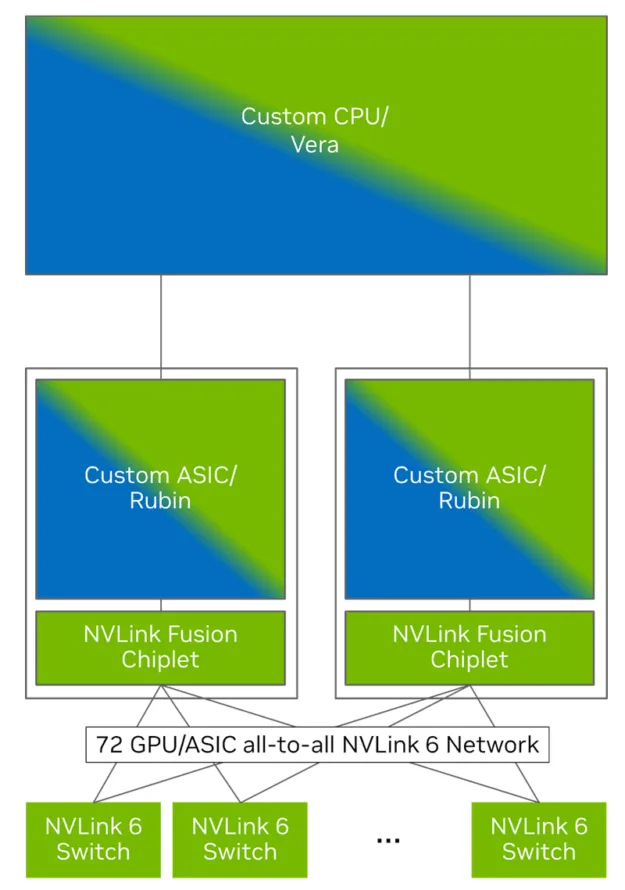
This is the epitome of AWS's pragmatism: rather than spending two years verifying whether its own rack can handle a 100 kW power density, it's simply using the road NVIDIA has already paved. By integrating the NVLink Fusion Chiplet, Trainium4 becomes physically "plug-and-play."
Division of Labor: Not a Full Surrender
So, does this mean AWS has completely adopted NVIDIA's technology stack at the network level? The answer is more complex than it appears. Based on the joint statements from NVIDIA and AWS, the division of labor is clear, and it highlights the shrewdness in AWS's 'concession':
- Intra-Rack (Scale-up): This domain truly belongs to NVIDIA. Trainium4 clusters will use NVLink 6 and NVLink Switch trays for all-to-all interconnectivity. This is essentially a done deal.
- Inter-Rack (Scale-out): This remains firmly in AWS's control. Communication between clusters will continue to be managed through AWS's own Elastic Fabric Adapter (EFA) and the Nitro System for cloud-side abstraction and control.
In its promotional materials, NVIDIA uses phrases like "can harness" or "can combine," which suggests it's offering AWS more of an optional menu. Whether AWS will deploy NVIDIA's Spectrum-X Ethernet or Quantum-X800 InfiniBand networks at scale is still an unknown. We'll have to wait for the products to be deployed to see the outcome.
Therefore, AWS's core strategy can be summarized as:
- Inside the rack: Leverage NVIDIA's mature NVLink solution to solve the most difficult physical interconnect challenges of scaling up.
- Outside the rack: Retain the freedom and control to build large-scale clusters using its own EFA, Nitro, and Ethernet technologies—the very foundation of its competitive advantage as a cloud provider.
Not Just an NVIDIA Win, but the Crystallization of a Standard
The market might easily interpret this as AWS conceding to NVIDIA's dominant position. And admittedly, it does solidify NVIDIA's role as the gatekeeper of AI infrastructure. By opening up NVLink to a competitor, NVIDIA is turning its proprietary interconnect protocol into the "TCP/IP" of the AI era—no matter what car you drive (chip), if you want on the superhighway (high-performance cluster), you have to pay the toll (for switches and cabling).
But this doesn't mean AWS has lost. In the cloud services arena, certainty is often more valuable than autonomy.
The power of Google's TPU, for instance, is largely due to its expensive but highly efficient Optical Circuit Switching (OCS) architecture, which gave Google a massive early advantage. AWS's move to adopt NVLink Fusion is, in essence, a strategic play to close this infrastructural generation gap.
By ceding some control at the lowest level, AWS has eliminated the single biggest uncertainty in deploying Trainium4. This allows them to assure customers that Trainium4 is not only cheaper but also that its underlying cluster network boasts the same level of communication efficiency and stability as the NVIDIA H100/Blackwell clusters they are already familiar with. This dramatically lowers the psychological barrier for customers to migrate from NVIDIA GPUs to AWS's in-house silicon.
Furthermore, this move frees up AWS's engineering resources. They no longer need to grind away at the most fundamental scale-up physical interconnect problems. Instead, they can focus their energy where they excel: broader Ethernet scale-out networks, upper-layer software stack optimization (the Neuron SDK), virtualization and scheduling (the Nitro System), and deep integration with services like SageMaker.
Conclusion: The New Normal of Coopetition
We are witnessing the AI chip industry enter a new stage of maturity. The wild, early days—where every company had to build everything from sand up to the last screw on the rack—are coming to an end.
This move by AWS and NVIDIA signals a rebalancing of industry roles. NVIDIA is evolving from a mere chip supplier into the de facto standard-setter for the data center's physical layer. Meanwhile, AWS is leveraging this emerging standard to accelerate the commercialization of its custom silicon.
For investors, this is no longer a simple story of "who will replace whom." The data center of the future may present a fascinating hybrid: the racks and networks might have NVIDIA's DNA, but the brains doing the thinking could come from Amazon, Google, or Meta. In this complex dance of coopetition, companies that can flexibly leverage their rivals' strengths to shore up their own weaknesses will often go further than those who stubbornly insist on a purely "full-stack proprietary" approach.
AWS has chosen to go further, even if it means paying its rival for an expensive ticket to the show.


