
The Price of Progress: AGI's Path to Prosperity or a Catastrophic Wage Collapse?
As artificial intelligence automates its way towards AGI, are we on a path to unprecedented prosperity, or is the price of progress a catastrophic collapse in human wages?


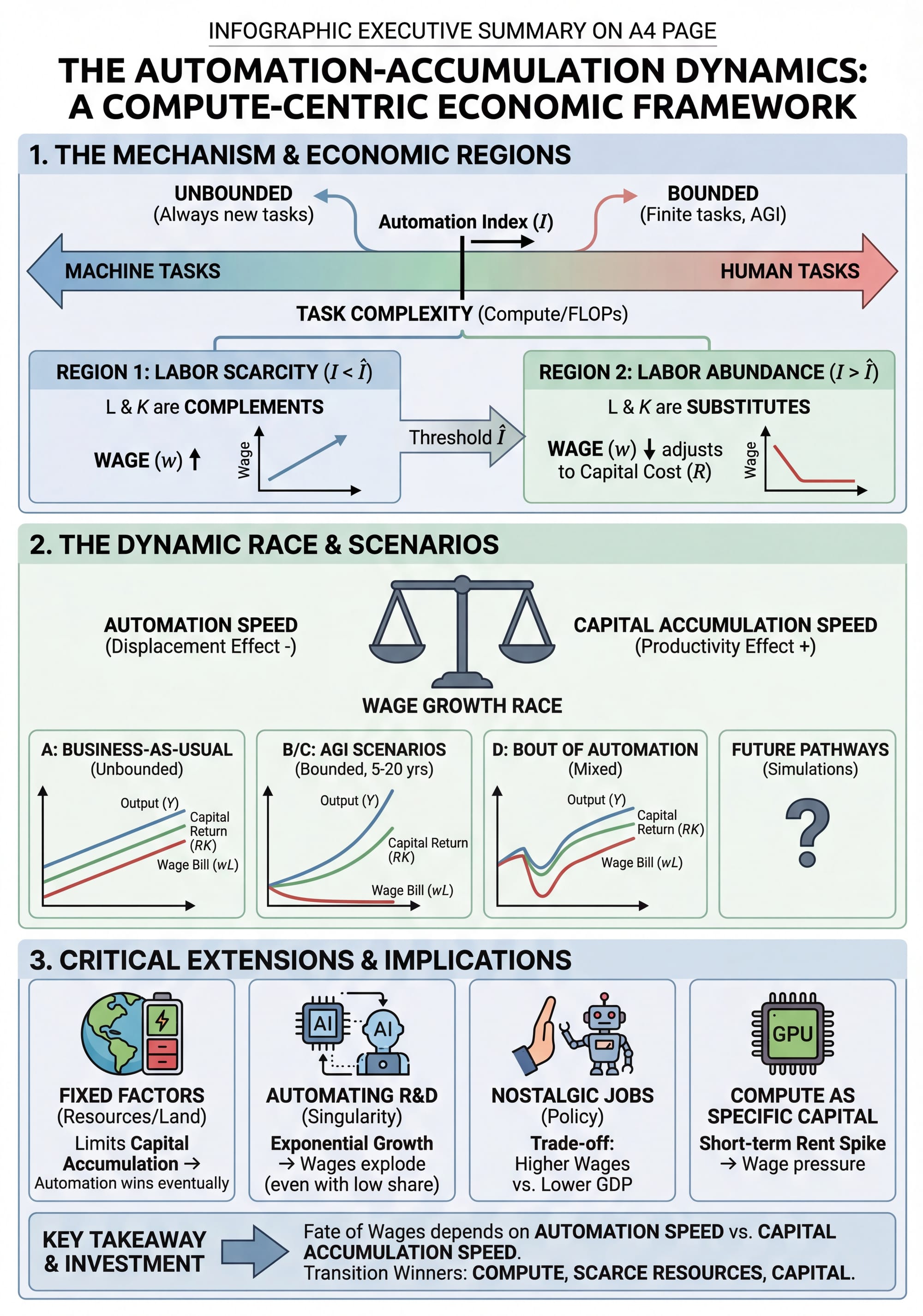
Scenarios for the Transition to AGIWe would like to thank Ajay Agrawal, Tamay Besiroglu, Erik Brynjolfsson, Tom Davidson, Joe Stiglitz and seminar participants at Anthropic, Google, GovAI, and OpenAI for helpful conversations and comments.
The conversation around artificial general intelligence (AGI) often swings between two extremes: a technological utopia of explosive productivity and material abundance on one side, and a cyberpunk dystopia of mass unemployment and social upheaval on the other. While these grand narratives are captivating, they often lack a grounded framework for analysis. The real questions we need to answer are: on the path from today to a future where AGI is possible, how will the economy evolve? And what kind of turbulence and restructuring will our wages and wealth endure?
Recently, economists Anton Korinek and Donghyun Suh, in their Arxiv paper "Scenarios for the Transition to AGI," offer a remarkably insightful analytical tool. It's less an academic exercise and more a strategic wargame for the future of wealth distribution, sketching out several potential scripts that could play out in the coming decades for all of us living through this transition.
The Core Mechanism: When Work Becomes a Computational Problem
The core insight of the paper is its deconstruction of all human work into a composition of "atomic tasks," each with a different level of "computational complexity."
Imagine all the jobs humans can do—from the simplest arithmetic to drafting complex legal documents, to inventing new scientific theories—arranged along an axis of ever-increasing complexity from left to right. Technological progress, especially the growth in computing power represented by Moore's Law, acts like an "automation frontier" constantly advancing to the right. Tasks to the left of this line can be performed by machines; tasks to the right remain the exclusive domain of humans.
Here, the authors introduce a critical perspective: what determines if a task can be automated is not how difficult it feels to a human, but the amount of computation required for a machine to execute it. This explains the famous "Moravec's Paradox"—why tasks that are trivial for a human toddler, like visual recognition and walking, have been some of the most formidable challenges for AI for decades, while complex calculations that strain the human mind are completed by computers in an instant.
This seemingly simple setup leads to a pivotal question that determines our fate: is this axis of task complexity infinite, or is there an upper limit that we cannot surpass?
Two distributions of task complexity
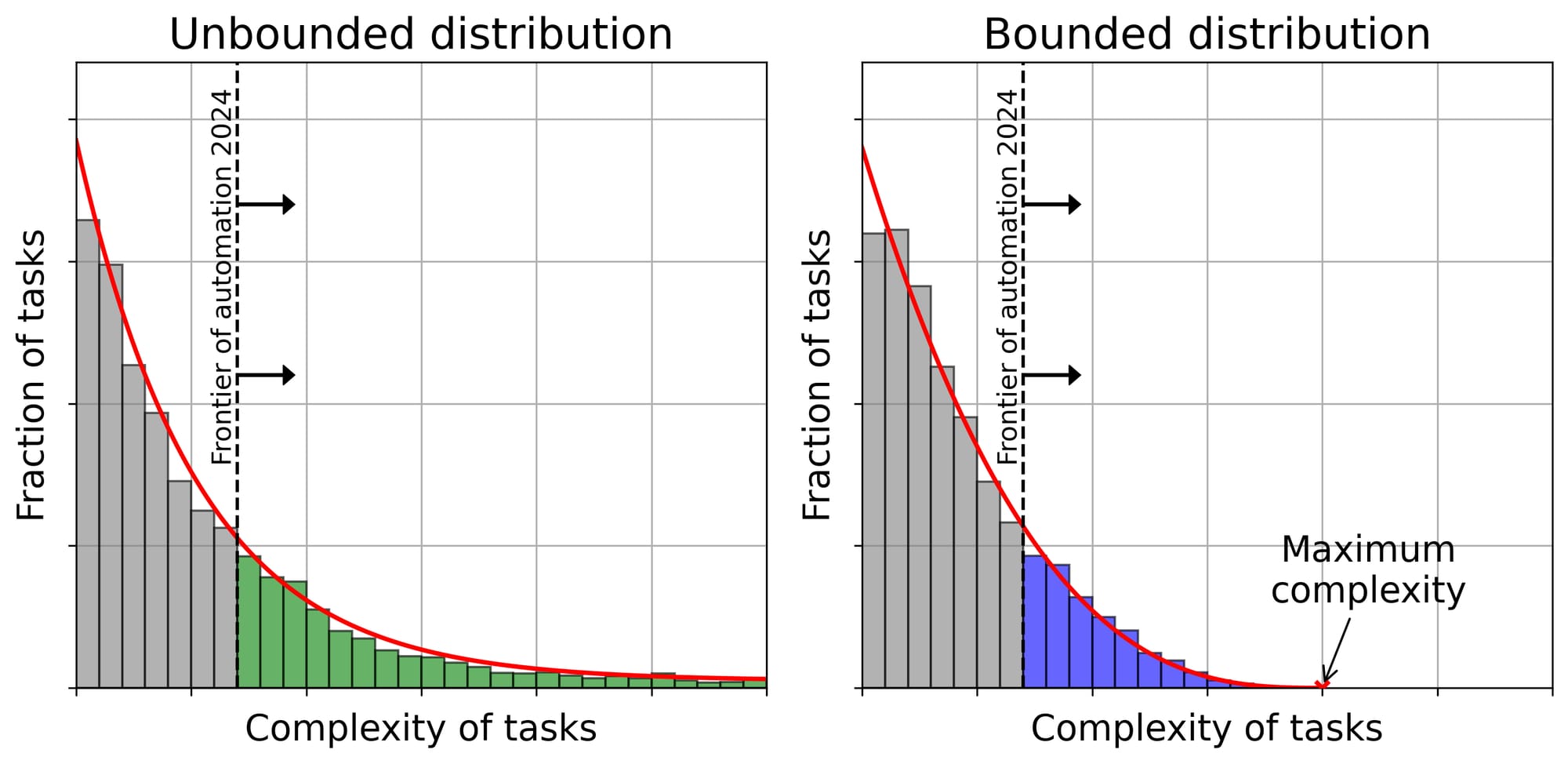
source: Arxiv -《Scenarios for the Transition to AGI》, Korinek & Suh, 2024
The paper proposes two fundamental shapes for this distribution. The first is an Unbounded Distribution (left side of the figure), which posits an infinitely long axis, always leaving more complex, machine-proof tasks for humans to conquer. This model closely mirrors the historical experience of the last two centuries, where technology has consistently acted as a catalyst for creating new forms of work. The second, a Bounded Distribution (right side), suggests a "ceiling" to the complexity of all tasks humans can perform. Under this model, once technology surpasses this final frontier, complete automation becomes not a question of if, but when.
This single divergence directly steers the economy toward two fundamentally different states.
In Region One (the labor-scarce zone), automation's reach is limited, leaving a vast landscape of complex tasks for human hands and minds. Here, capital (machines) and labor (humans) are valuable complements. The more low-complexity tasks machines handle, the more they amplify the value of their human counterparts. In this virtuous stage, productivity rises, and wages follow suit.
But as the automation frontier relentlessly pushes rightward, the economy crosses an invisible tipping point into Region Two (the labor-surplus zone). At this point, the territory of human-exclusive tasks has shrunk dramatically. The scarcity of labor is stripped away, and its economic value begins a steady march toward the operational cost of machines. Capital and labor, once allies, become fierce competitors.
The Dynamic Game: A Race Between Automation and Capital Accumulation
On a dynamic timeline, the ultimate fate of our wages depends on a breathtaking race: the contest between the "replacement effect" and the "productivity effect" of automation, coupled with the speed of capital accumulation.
- Automation itself is a double-edged sword: it suppresses wages by substituting for human labor (the replacement effect), yet it also pushes wages up by increasing the overall productivity of the economy (the productivity effect).
- Capital accumulation plays a critical balancing role. If a society can accumulate capital (by investing in more machines, computing power, energy, and infrastructure) fast enough, capital becomes relatively abundant and "cheaper." This, in turn, boosts the demand for its complement—labor—thereby propping up wage levels.
The core insight here is chillingly clear: if automation advances too quickly, before society has had time to accumulate enough matching capital, labor can instantly shift from scarce to abundant, triggering a sharp fall in wages.
Four Future Scenarios
Based on their model, the authors simulate four possible scenarios for the next two to three decades by setting a series of standard economic parameters like discount rates and risk aversion coefficients, ensuring the rigor of their simulation.
Scenario A: Business-as-Usual
- Assumption: Task complexity is unbounded, and the tail is "thick" enough that there are always new, more complex tasks awaiting humans.
- Result: Output and wages grow in tandem at a stable rate. This is essentially the pattern of the industrial era we are familiar with, where the shares of capital returns and the total wage bill remain relatively stable.
Scenarios B & C: The Advent of AGI (Baseline & Aggressive)
- Assumption: Task complexity is bounded. The computational power of the human brain has its limits, and AI will eventually be able to complete all human tasks within a specific timeframe (the baseline scenario assumes 20 years, while the aggressive scenario assumes 5 years, the latter referencing pessimistic forecasts from figures like AI godfather Geoffrey Hinton).
- Result: Initially, the productivity effect dominates, and wages see a brief uptick. However, as automation crosses the critical threshold and the economy enters "Region Two," wages will experience a precipitous collapse. In the long run, total output (GDP) will grow explosively, but nearly all the gains will accrue to the owners of capital.
Output and Wages in the Baseline AGI Scenario
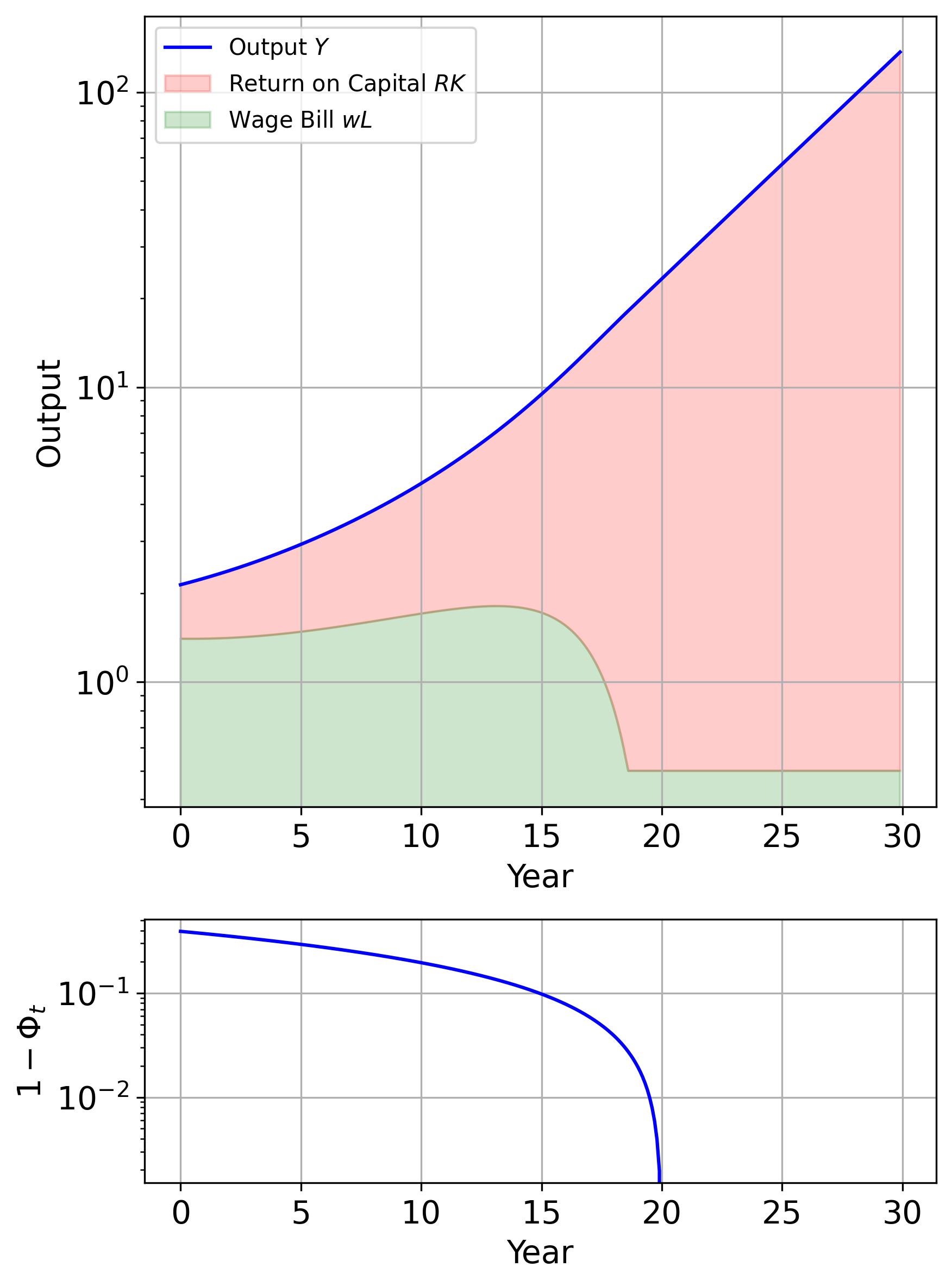
source: Arxiv -《Scenarios for the Transition to AGI》, Korinek & Suh, 2024
Note the dramatic collapse of the green line (total wage bill) around year 18, even as total output (the blue line) continues to accelerate.
Scenario D: The Automation Wave
- Assumption: This is a hybrid scenario. In the near term, a technological breakthrough (like LLMs) rapidly automates a large swath of cognitive tasks, but a "long tail" of very difficult tasks still remains.
- Result:
- Short-term Shock: The pace of automation far outstrips the pace of capital accumulation, causing an initial, sharp decline in wages.
- Long-term Recovery: Over time, the economy accumulates enough capital. Labor, now scarce relative to the abundant capital, becomes valuable again, and the economy returns to "Region One." Wages begin to recover and enter an upward trajectory once more.
Output and Wages in the Hybrid Scenario
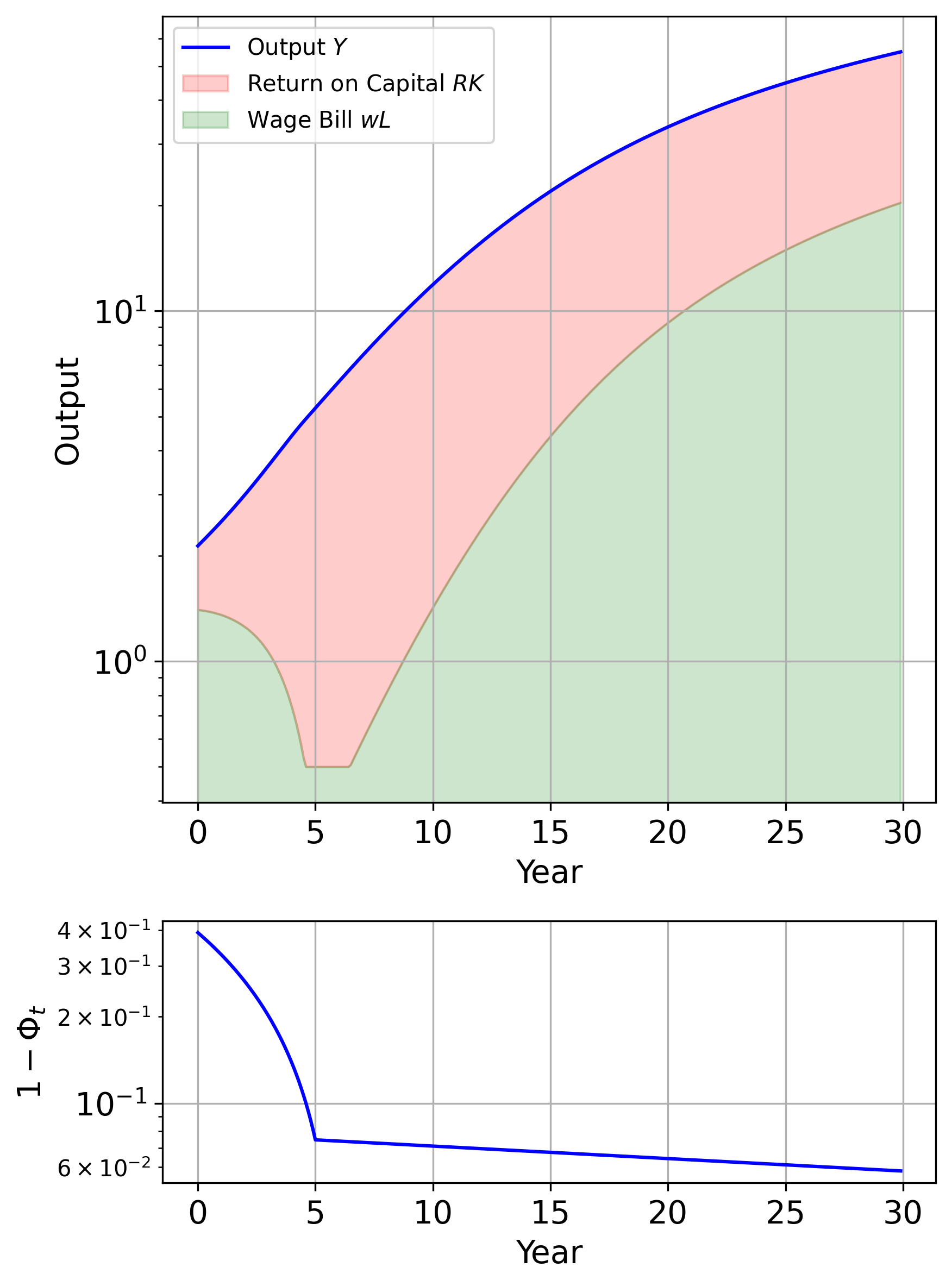
source: Arxiv -《Scenarios for the Transition to AGI》, Korinek & Suh, 2024
This "V-shaped" reversal in the wage curve (the green line) is particularly noteworthy, as it signals the potential for intense growing pains during the transition, followed by long-term opportunities.
Key Variables and Real-World Considerations
Of course, a model is a simplification of reality. The authors also explore several key variables that could alter the outcome.
- Bottlenecks from Fixed Factors: If economic growth is ultimately constrained by non-renewable "fixed factors" like land, rare minerals, or energy, then even if tasks are unbounded, capital accumulation will hit a ceiling. In this case, automation would eventually outpace capital accumulation, leading to stagnant or falling wages. In the long run, owning "atoms" (physical resources) might prove more valuable than owning "bits" (intelligence).
- The 'Automation' of Automation: If AI can not only produce goods but also be used to accelerate technological R&D itself (i.e., "automating innovation"), the economy could enter a state of super-exponential growth, or a "singularity." In this scenario, although labor's share of total income might decline, the absolute value of wages could still increase explosively because the economic pie is growing infinitely larger.
- 'Nostalgic Jobs' and Policy Intervention: Society might, for ethical or cultural reasons, choose to prohibit machines from performing certain jobs (such as judges, clergy, or legislators). Such policy interventions could effectively maintain the scarcity of labor, ensuring continued wage growth, but at the cost of sacrificing potential GDP growth. This reveals a profound policy trade-off: we must choose between distributive fairness and economic growth.
- Compute as 'Specific Capital': This perspective is highly relevant to today's market. In the early stages of AI development, computing power (like Nvidia's GPUs) is an extremely scarce "specific capital." Its owners can capture super-normal returns, while the returns to labor and traditional capital may be suppressed. In the long term, however, as compute itself becomes something that can be mass-produced and accumulated, it will eventually revert to being ordinary capital, and its excess returns will be diluted. This perfectly explains the current AI gold rush and also foreshadows its future evolution.
A Wealth Roadmap for the Future
Returning to our initial question: will AGI bring prosperity or collapse? The paper by Korinek and Suh tells us the answer isn't black and white. Instead, it depends on the outcome of the race between the "speed of automation" and the "speed of capital accumulation." The final outcome of this race will reshape the wealth distribution of our entire society.
This paper brings into sharp focus that during the AGI transition, value will undergo a massive shift away from pure Labor and toward three other factors: specific capital that can capture short-term excess profits (like today's computing power), fixed factors that provide long-term scarcity (like land, energy, and minerals), and general capital that can universally share in the dividends of growth. This isn't just a matter of asset allocation; it points to a profound question about the very nature of value in the future.
If we are currently in the early stages of an "automation wave," the labor market will inevitably experience a severe shock before the broader societal infrastructure can fully catch up. The long-term endgame, however, will depend on our collective choices regarding technology, resources, and policy. This paper offers no easy answers, but it provides an indispensable, sober, and rigorous compass for navigating these monumental questions.


