
Visa 1Q26 Earnings Review: The Quiet Metamorphosis of a Payment Network
When half of the revenue growth comes from services that didn't exist a decade ago, is Visa still just a "payment network"—or something else entirely?


Visa 1Q26 Earnings Review: The Quiet Metamorphosis of a Payment Network
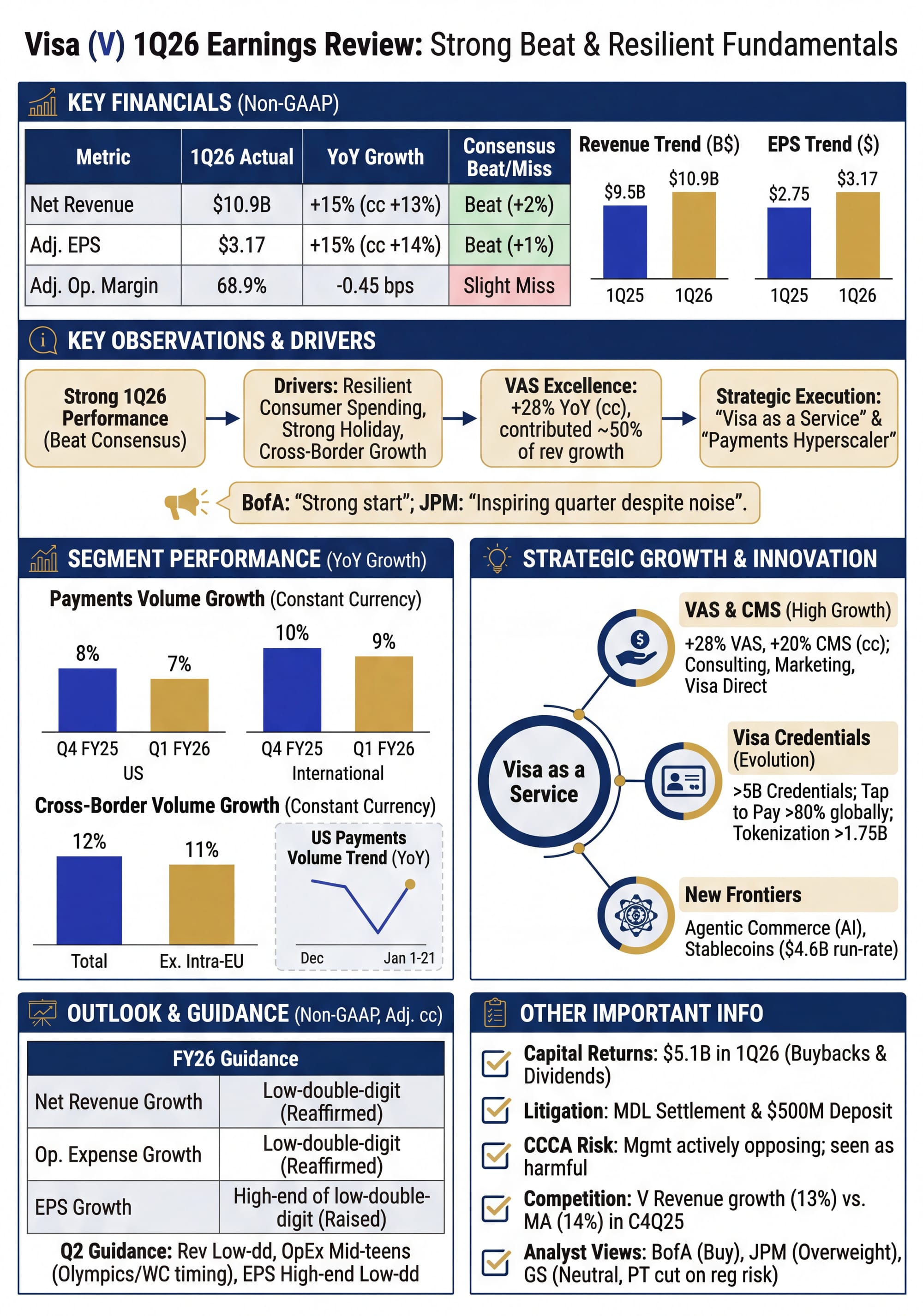
On the surface, Visa’s fiscal first-quarter 2026 results were a textbook "beat and raise"—both revenue and EPS comfortably cleared Wall Street consensus. But if you stop at the headline numbers, you risk missing the narrative that actually matters.
During the earnings call, CEO Ryan McInerney used a rather ambitious term to define Visa’s trajectory: "A payments hyperscaler."
This wasn't just rhetorical flourish. This quarter, Value-Added Services (VAS) grew 28% on a constant currency basis, contributing roughly half of the total revenue growth. In other words, the engine driving the world's largest payment network is being quietly swapped out—shifting from a model driven purely by transaction volume to a platform model centered on services and technology.
That is the story worth dismantling in this report.
Behind the Numbers: A Solid Opening
Non-GAAP Net Revenue rose 15% year-over-year to $10.9 billion, beating market consensus by approximately $200 million. Non-GAAP EPS came in at $3.17, up 15%, also ahead of expectations. On a constant currency basis, revenue growth stood at 13%, accelerating 2 percentage points from the previous quarter and landing firmly within the company’s "high end of low double-digits" guidance.
Bank of America described the quarter as a "solid start," attributing the performance to resilient consumer spending, a robust holiday season, and sustained growth in cross-border volumes.
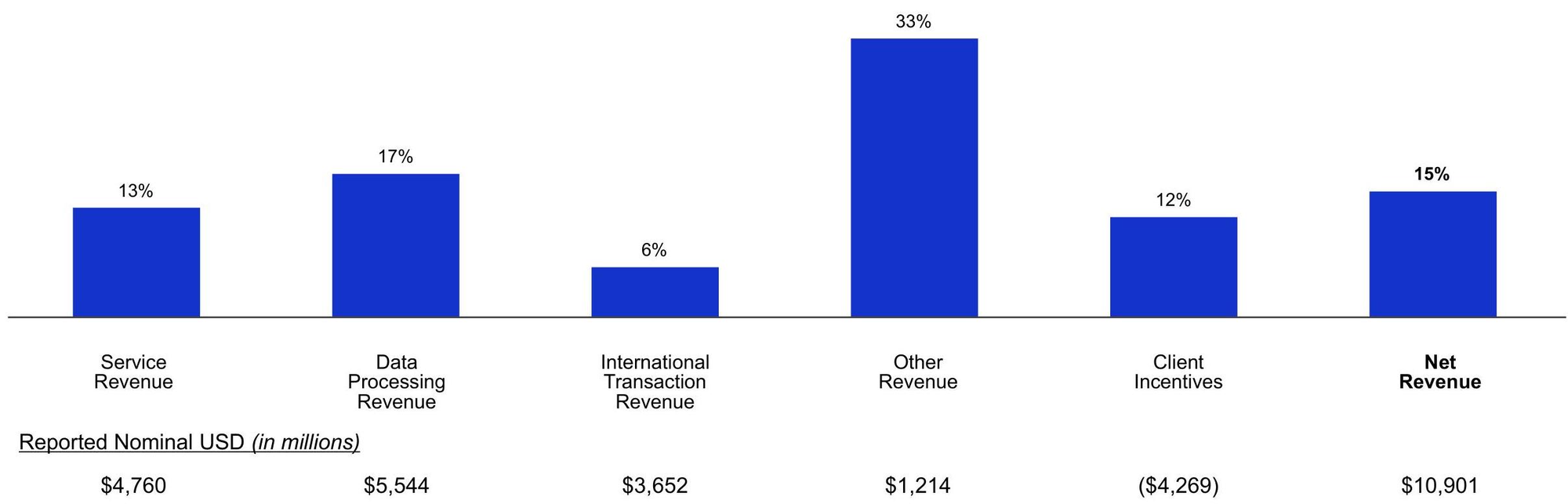
Visa 1Q26 Revenue Mix and YoY Growth
source: Visa Earnings Supplement
A look at the revenue composition reveals some telling details. Data Processing Revenue grew 17% to $5.54 billion, making it the fastest-growing core business line. Other Revenue (primarily capturing VAS like consulting and marketing) surged 33% to $1.21 billion. Together, these two segments essentially underpinned the entire revenue beat.
On the flip side, International Transaction Revenue grew only 6% to $3.65 billion, noticeably lagging expectations. CFO Chris Suh’s explanation on the call was straightforward: lower-than-expected currency volatility, combined with mix pressure from the rising share of lower-yielding businesses like Visa Direct. Investors should take note—the growth rate of cross-border revenue is being diluted by structural changes in the business mix. This is not a short-term phenomenon.
Client Incentives increased by 12%, a pace slower than gross revenue growth, aided by some one-time reversals related to client performance. This provided an additional tailwind to Net Revenue.
Consumer Spending: Resilience Amidst Deceleration
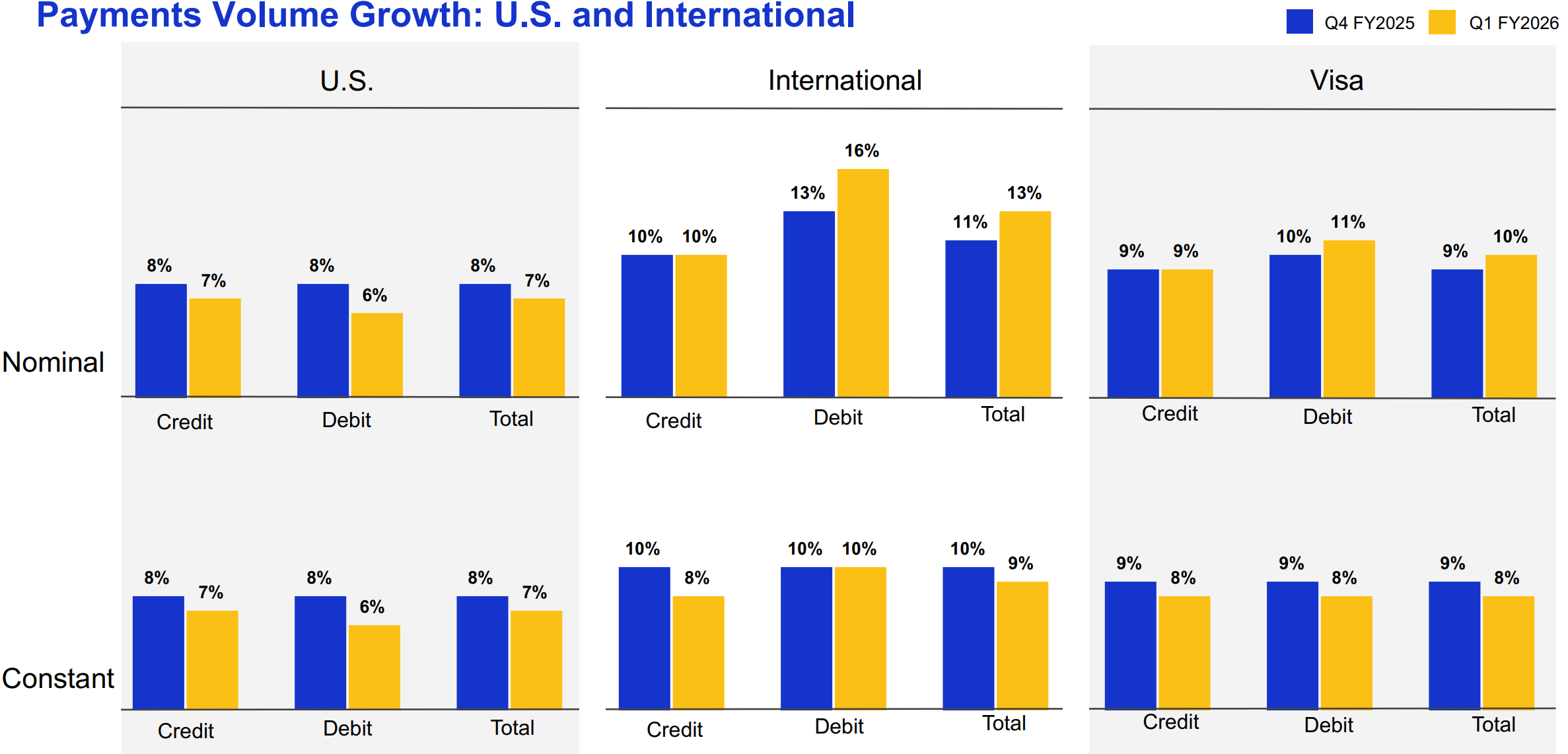
The performance of payment volumes presented a divergence: "Nominally bullish, flat on a constant currency basis." Global payment volume grew 10% in nominal terms, beating consensus. However, on a constant currency basis, growth was 8%, slightly missing the 8.74% consensus and decelerating 80 basis points from the previous quarter.
Payments Volume Growth: U.S. and International
source: Visa Earnings Supplement, Jarvis
U.S. payment volume (constant currency) grew 7%, slowing from 8% in 4Q25. There were specific drivers here: a Visa Direct client shifting residual volume to a proprietary solution, the migration of Capital One debit cards causing a loss in Interlink volume, and severe weather impacting consumption. However, J.P. Morgan noted that these one-off factors are expected to ease gradually.
The international market painted a different picture. International payment volume (constant currency) grew 9%, significantly outperforming the U.S., with standout performances in Asia Pacific/CEMEA (+17%), Latin America (+20%), and Canada (+12%).
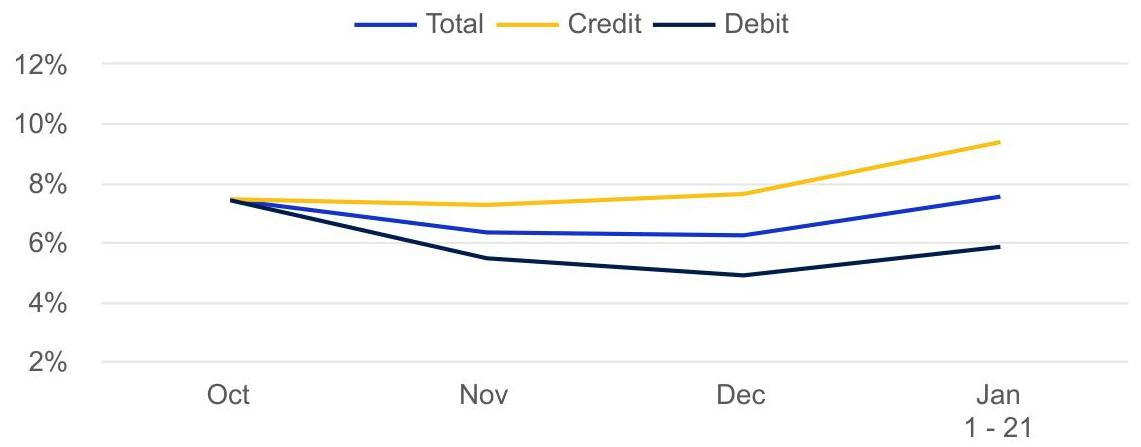
But the most reassuring signal for the market came at the very end of the quarter.
U.S. Payments Volume Intra-Quarter Trend (2025Q4 to Jan 21, 2026)
source: Visa Earnings Supplement
Data through January 21 shows U.S. total payment volume growth rebounding to approximately 7.6%, with credit card growth staging a distinct V-shaped recovery. Goldman Sachs data reinforces this trend—month-to-date U.S. credit card volume growth reached 10% as of January 26, far exceeding the 7% consensus. This serves as a powerful rebuttal to early-year fears regarding a consumer slowdown.
Management also offered a valuable micro-perspective on the call: U.S. consumer spending across income cohorts remained consistent with the prior quarter. High-income groups are growing faster than low-income groups, while discretionary and non-discretionary spending are performing in lockstep, showing no signs of deterioration.
Cross-Border: Robustness Masked by FX
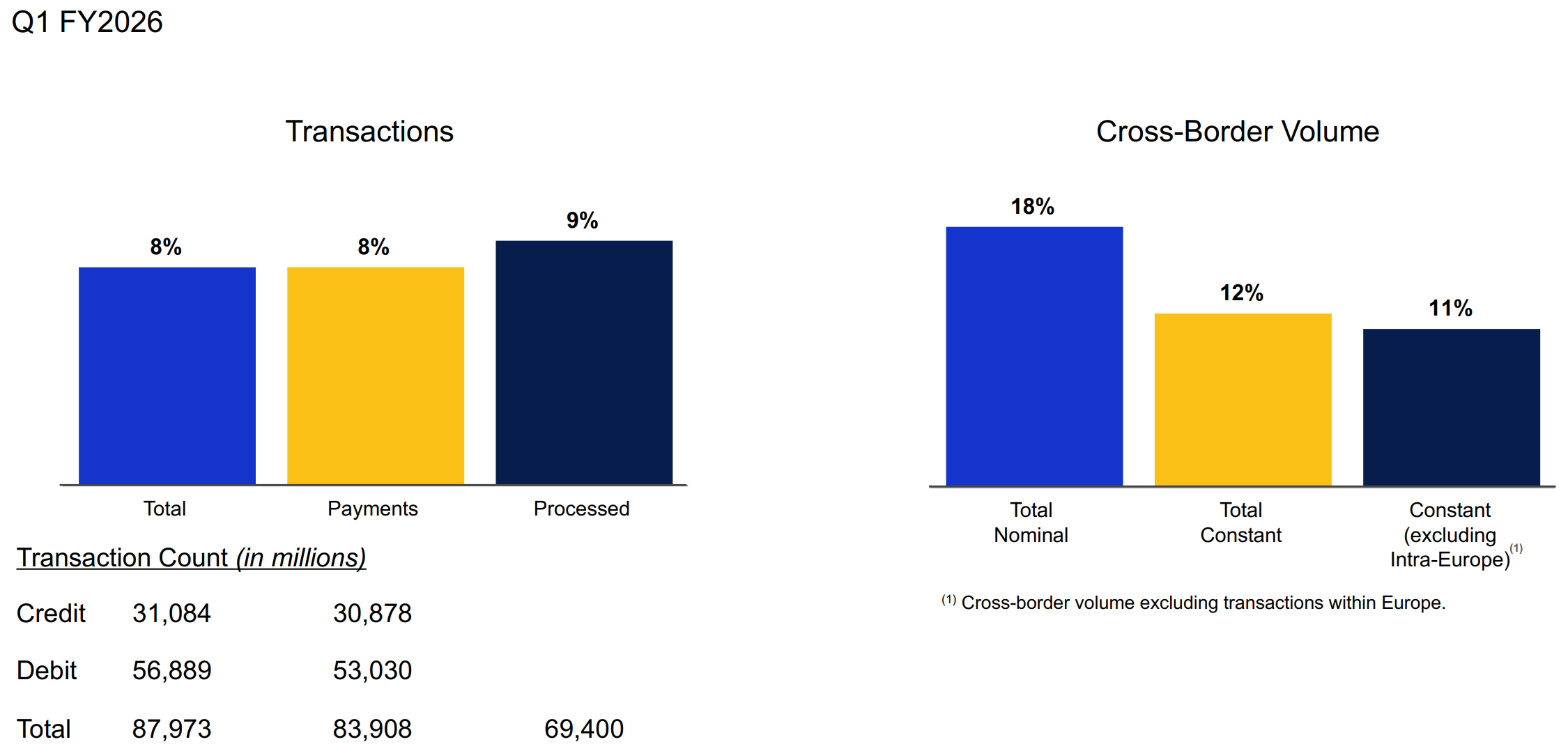
Cross-border transactions remain one of Visa’s most profitable business lines. This quarter, total cross-border volume grew 18% nominally and 12% in constant currency, both beating consensus.
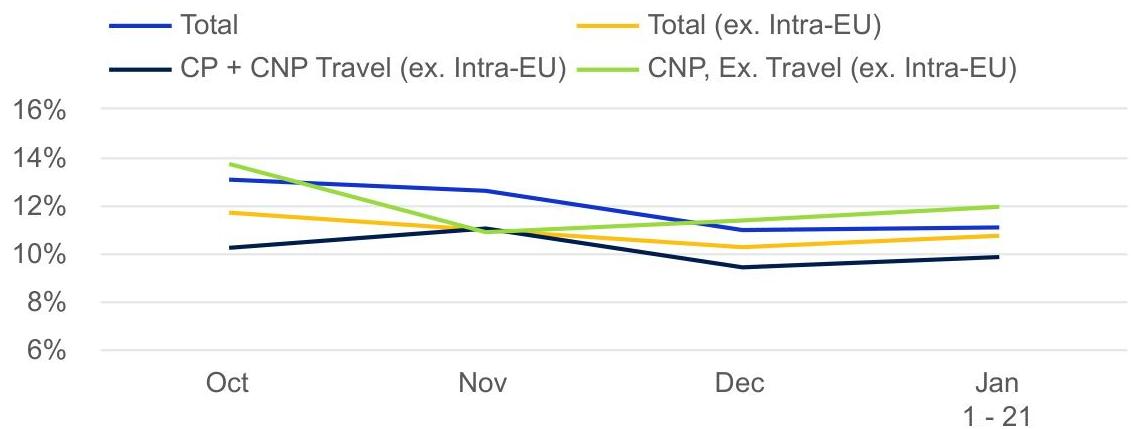
Cross-Border Volume Intra-Quarter Trend (2025Q4 to Jan 21, 2026)
source: Visa Earnings Supplement
Excluding intra-Europe transactions, cross-border volume (constant currency) grew 11%, slightly below the consensus of 11.81%. Breaking this down: cross-border e-commerce grew 12%, travel-related cross-border grew 10%, and commercial transactions remained strong. Notably, inbound volume to the U.S. from Canada has started to improve.
As of January 21, ex-Europe cross-border growth stabilized around 11%. Bank of America believes this data indicates that cross-border trends remain robust, suggesting no need for excessive concern in the near term.
1Q26 Transactions and Cross-Border Overview
source: Visa Earnings Supplement
Processed transactions grew 9% to 69.4 billion, narrowly missing consensus. However, the intra-quarter trend mirrored volume data—recovering from a low of 8% in December to nearly 9%, indicating a resurgence in transaction activity.
VAS: More Than Just "Added Value"
If this earnings report has a protagonist, it is Value-Added Services.
VAS revenue grew 28% on a constant currency basis, far outpacing Mastercard’s 19% over the same period. J.P. Morgan described it as an "inspiring quarter looking past FX volatility and OpEx noise." The growth was driven by strong demand for consulting and marketing services, and the strength was broad-based—this isn't a story of one or two large clients moving the needle.
Commercial and Money Movement Solutions (CMS) also shone, growing 20% in constant currency, accelerating from 14% the previous quarter. CEO McInerney attributed this to the successful execution of their "three-legged" strategy: converting more SME spend, expanding use cases like virtual payments, and helping partners reach under-penetrated spend.
Visa Direct transactions grew 23% to 370 million, as the company continued to deepen relationships with partners like Nuvei (expanding to 30+ countries) and PayPal's Xoom (expanding to 60+ markets).
Management also highlighted that 2026 is a "unique year"—with both the FIFA World Cup and the Olympics occurring. These global events not only generate incremental VAS revenue but, more importantly, deepen client partnerships. This partially explains why the OpEx guidance for Q2 and Q3 leans high—marketing spend will be concentrated in these quarters.
Credential Evolution and Emerging Tracks
Visa’s total global credentials have now surpassed 5 billion. A few key metrics outline the depth of digital penetration: Tap to Pay penetration in global face-to-face transactions has breached 80% (nearing 70% in the U.S.); Tap to Phone has expanded global acceptance points to over 1.75 million; and total Visa tokens have exceeded 1.75 billion—more than three times the number of physical cards.
In e-commerce, the share of guest checkout has dropped from 44% in FY2019 to roughly 16% in FY2025, and is less than 4% among the top 25 merchants. J.P. Morgan expects Visa to implement tokenization-related pricing adjustments in the second half of FY26, which could drive an annualized revenue lift of about 1 percentage point.
Looking at the frontier, Visa is positioning itself in two directions. First, Agentic Commerce—through its Visa Intelligent Commerce solutions, the company is working with over 100 partners globally, already live in the U.S. and CEMEA regions. Second, Stablecoins—this quarter saw stablecoin card issuance launch in 9 new countries, bringing the global total to over 50 countries, with total stablecoin settlement hitting a global run rate of $460 million annually.
The revenue contribution from these two tracks is currently negligible. But their strategic significance lies in the positioning: if Visa is truly to become a "payments hyperscaler," it needs to secure its place in every node of the next-generation payment infrastructure.
Guidance: Cautious Optimism
Despite the significant beat in Q1, Visa merely reiterated its full-year FY26 guidance of "low double-digit" revenue growth. The only shift was an upward revision of the full-year EPS guidance from "low double-digits" to the "high end of low double-digits," largely due to a lower tax rate.
CFO Chris Suh’s explanation was candid: the upside from Q1 and higher utilization of products and services is essentially offsetting the headwinds from expected continued weakness in currency volatility. This "beat but don't raise" approach is perfectly in character with Visa’s historical conservatism.
For Q2, guidance points to "low double-digit" net revenue growth, "mid-teens" OpEx growth (driven by Olympics and FIFA marketing), and EPS growth at the "high end of low double-digits." J.P. Morgan noted that Visa’s Q2 revenue guidance is slightly above Mastercard’s (low double-digits vs. low end of low double-digits), potentially marking the first time in four years that Visa’s organic revenue growth outpaces its rival.
Risks and Valuation
Operational Expenditure (OpEx) was one of the few blemishes this quarter. Non-GAAP OpEx rose 16% year-over-year to $3.39 billion, significantly higher than the sell-side expectation of 12%. On a GAAP basis, a $707 million provision for the MDL litigation pushed total OpEx growth to 27%.
On the regulatory front, the Credit Card Competition Act (CCCA) remains a looming shadow. When asked directly by Goldman Sachs analyst Will Nance during the Q&A, CEO McInerney stated the company remains highly engaged on Capitol Hill, characterizing the bill as "very harmful and simply unnecessary." Citing regulatory pressure, Goldman Sachs lowered its 12-month price target from $417 to $408, compressing the valuation multiple from 29x to 28x.
Bank of America and J.P. Morgan sit on the other side of the table. BofA reiterated its Buy rating, viewing recent share weakness as a product of excessive worry; J.P. Morgan maintained an Overweight rating, seeing any dip as a buying opportunity.
Conclusion
The most critical signal in this earnings report isn't by how much revenue or EPS beat expectations—those numbers, in themselves, aren't surprising. What truly demands attention is the structural shift: VAS contributing to 50% of total revenue growth.
This signifies that Visa is gradually transforming from a conduit-style business dependent on global consumption growth into a platform enterprise capable of driving organic growth through pricing, services, and technological innovation.
This transition won't happen overnight. Declining FX volatility, uncertainty around the CCCA, and Mastercard’s lead in EPS growth (25% vs. 15%) are variables investors must continue to track. But if the momentum in VAS can be sustained, the valuation narrative for Visa may need to be rewritten—no longer just a "beta on global consumption," but an "alpha on payment infrastructure."
Earnings Call Recap
Financial Statement Visualization
I will now share a more detailed reviewe of this earnings result behind the paywall:


