
Visa and Mastercard's Revised Antitrust Settlement Shifts Interchange Cost Burden to Issuers and Consumers, Leaving the Duopoly Intact
Visa and Mastercard's landmark settlement promises merchants lower fees and more choice after a twenty-year battle. But in this intricate dance of payments, who truly benefits, and who will ultimately pay the price?


A Two-Decade War Concludes, Yet the Power Dynamics of the Payment World Remain Unchanged
After a grueling twenty-year legal tug-of-war with U.S. merchants, payment giants Visa and Mastercard are finally closing in on a landmark antitrust settlement. This saga, which began in 2005, struck at the heart of the burdensome costs imposed by Interchange Fees and the "Honor All Cards" rule. Now, a new settlement appears to offer a glimmer of victory for merchants: fees are slightly reduced, and choice is seemingly increased. However, in the intricate web connecting networks, banks, merchants, and consumers, a subtle transfer of costs and a redistribution of benefits are quietly setting the stage for a new game. Is this settlement a win-win endgame, or just the beginning of a zero-sum contest?
The Core of the Settlement: A Finely-Tuned Rate and a 'Choice' in Name Only?
This revised settlement agreement was proposed after a previous version was rejected by the court in June 2024. The old proposal was deemed "insignificant" for its meager rate cuts of only 4-7 basis points, with the court stating it failed to effectively promote market competition. In contrast, the new agreement makes more substantial concessions on key terms:
- Reduction and Capping of Interchange Fees: The agreement promises that, upon taking effect, Visa and Mastercard will lower their combined system-wide weighted average effective interchange fee rate by at least 10 basis points and maintain this for five years. Concurrently, the published rates for standard consumer credit cards will be capped at no more than 125 basis points above their current levels for a period of eight years. This 10-basis-point reduction, while better than the market's worst-case fears of 15-30 bps, still falls short of the regulatory ceilings in markets like the European Union (capped at 30 bps) or Australia (capped at 50 bps).
- Loosening the "Honor All Cards" Rule: This is perhaps the most anticipated change for merchants. In the past, merchants were required to accept all cards under the same network, including high-fee premium rewards cards. The new rule allows merchants to selectively decline certain credit cards by category, such as refusing all Premium Consumer Credit Cards or Commercial Credit Cards. To facilitate this, new visual identifiers will be added to cards, and Point-of-Sale (POS) systems will provide technical support.
Additionally, the agreement relaxes rules on Surcharging, permitting merchants to apply a surcharge of up to 3% at the brand or product level, and allows them to form "Merchant Buying Groups" to enhance their negotiating power.
Ripples in the Payment Ecosystem: Who Wins, Who Loses?
While the terms of the settlement seem favorable to merchants, a deeper analysis of the players across the payment ecosystem reveals a far more complex reality.
The Networks (Visa & Mastercard): A Welcome Relief
For Visa and Mastercard, this settlement is more of a relief than a real blow. Analysts widely agree that the 10-basis-point cut in interchange fees will have a negligible direct impact on the two network giants' revenue (projected at less than 0.01% of FY26 revenue). This is because interchange fees are primarily earned by issuing banks, and the pressure from the cost reduction will largely fall on them.
Looking back at the 2011 Durbin Amendment, which drastically cut debit card interchange fees, Visa and Mastercard leveraged the scale and complexity of their operations to adjust pricing strategies. Their total net revenue take rates actually increased by about 5% between 2010 and 2013. History shows they have sufficient leverage to protect their profitability. Therefore, this settlement serves more to eliminate a long-standing legal uncertainty than to inflict a substantive financial hit.
The Issuers: An Unavoidable Pain
Issuing banks are the parties most directly hurt by this settlement. Interchange fees are a crucial source of revenue for their credit card business, and a 10-basis-point reduction will directly drag down their top and bottom lines. J.P. Morgan estimates that, without any mitigating actions, this could create a negative impact of up to 5% or even 10% on the EBITDA of some institutions.
It's foreseeable that issuers will not stand idly by. The most likely response will be to adjust their credit card products, specifically by reducing the value of the rewards and points that consumers have grown accustomed to. The pressure of these costs will ultimately be passed on.
The Acquirers: The Quiet Beneficiaries
In contrast to issuers, acquirers—especially companies like Toast and Lightspeed that serve small and medium-sized businesses (SMBs) with a fixed-rate pricing model—are poised to be clear winners. The fees they charge merchants are bundled, so when the underlying interchange cost decreases, they are not obligated to pass on 100% of the savings. This allows them to capture a portion of the difference as profit, providing a significant boost to their profitability.
The Merchants: A Pyrrhic Victory?
Merchants have gained theoretical autonomy to reject high-cost rewards cards. But is this a viable option? In the U.S. market, where a culture of credit card rewards is deeply entrenched, premium cards are often held by high-spending customers. Refusing these customers to save a fraction on interchange fees could mean losing much larger sales. The consensus among analysts is that the vast majority of merchants will not dare to take this risk. Consequently, this newfound "freedom" may prove difficult to exercise in practice, making it more of a Pyrrhic victory.
The Consumers: The Ultimate Payers
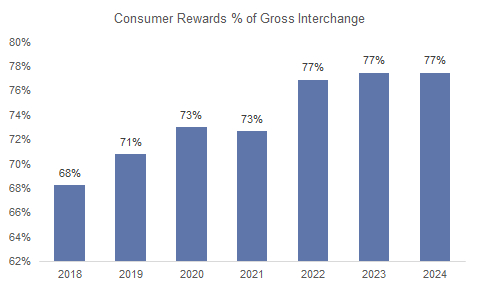
In this game, consumers may seem like bystanders, but they are likely to be the ones who ultimately foot the bill. Over the past few years, intense competition for customers has led issuers to continuously enhance rewards, with a large portion of interchange fees being returned to consumers in the form of points and cashback.
Consumer rewards have accounted for a rising share of total interchange fees over the past six years
Source: Goldman Sachs
As the chart shows, the share of consumer rewards in total interchange fees has steadily increased, rising from 68% in 2018 to 77% after 2022. As interchange revenue declines, the most direct reaction from issuers will be to compress this expense. This means the points on consumers' credit cards may be devalued, and the perks of premium cards could be diminished. The generous, rewards-driven credit card ecosystem we know is facing unprecedented pressure.
Market Landscape and Future Outlook
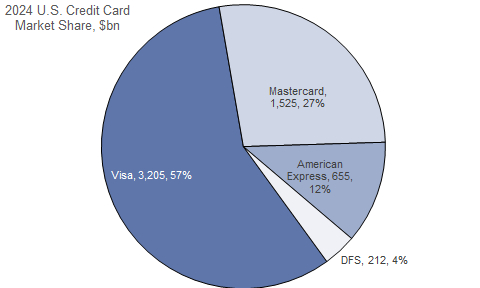
Currently, the U.S. credit card market remains dominated by the duopoly of Visa and Mastercard, which together command over 80% of the market share. Any structural change in this massive market, with over $5.5 trillion in annual consumer credit volume, will have far-reaching consequences.
US Credit Card Market Share in 2024
Source: Goldman Sachs
In conclusion, this settlement, which seemingly ends an old era of disputes, actually ushers in a new phase of the game. It does not fundamentally challenge the duopoly of Visa and Mastercard. Instead, it deftly shifts the cost pressure from the networks to the issuers, with the burden likely to be passed on to consumers in the end. Merchants have gained a choice in name only, one that practical business considerations will prevent them from using.
For the world of payments, this is not a revolution but a subtle recalibration of interests. The smoke from the legal battles may be clearing, but the commercial game revolving around fees, choice, and consumer value is just beginning. The next question will be: when rewards are no longer as enticing, will consumer payment habits change? That is the real key to shaping the future of the payment landscape.


