
Visa FY2025 Annual Report Visualization
Beyond traditional card payments, can Visa's pivot to a 'network of networks'—leveraging GenAI, Stablecoins, and $10.9B in Value-Added Services—successfully capture the massive $200 trillion commercial money movement opportunity?


Part I
Part II
Part III
Visa FY2025: Growth, Innovation, and the $40 Billion Shadow of Litigation
Digital payments behemoth Visa delivered a remarkable performance in fiscal year 2025, reporting $40.0 billion in net revenue, an 11% increase year-over-year. Yet, beneath the veneer of this stellar earnings report, a silent battle for future dominance is underway. Facing escalating scrutiny from global regulators and record-high legal risks, can Visa maintain its long-held hegemony in the digital payments landscape?
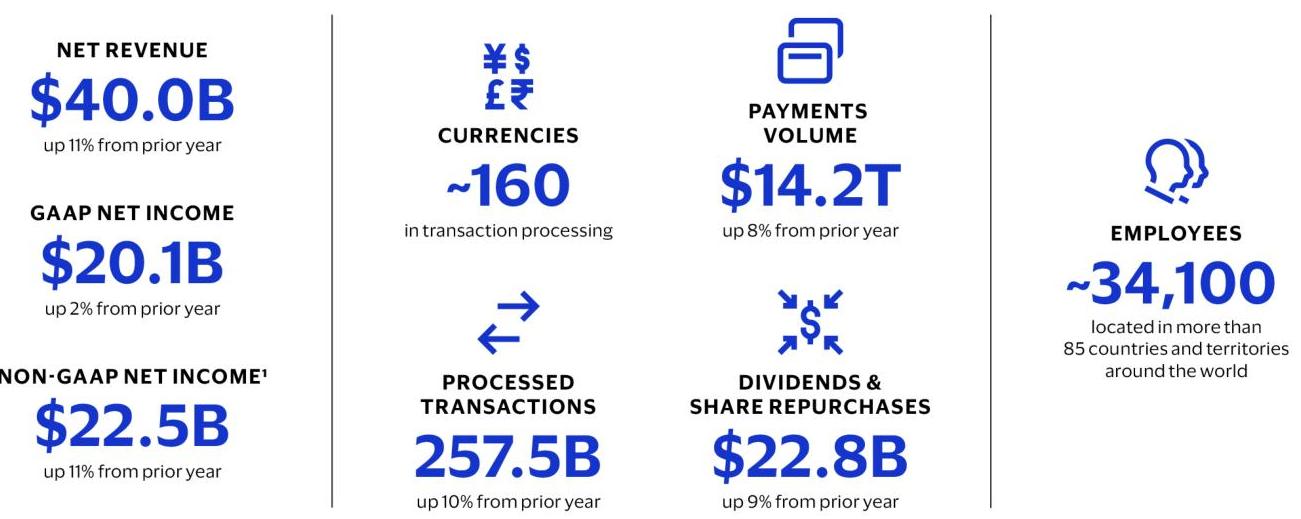
Visa FY2025 Key Financial Highlights
Financial Performance: Strong Growth, Underlying Concerns
Visa achieved robust growth across multiple dimensions in FY2025. Processed transactions reached 257.5 billion, climbing 10% year-over-year, while payments volume surged to $14.2 trillion, an 8% increase. Notably, Non-GAAP net income grew 11% to $22.5 billion, and diluted earnings per share (EPS) rose 14% to $11.47, underscoring the resilience of its core business.
However, a closer look at the financial statements reveals several warning signs. GAAP operating expenses soared by a significant 30% to $16.0 billion, primarily driven by a sharp escalation in litigation provisions. This figure ballooned from $462 million in FY2024 to $2.56 billion in FY2025, reflecting a rapidly deteriorating legal environment for the company.
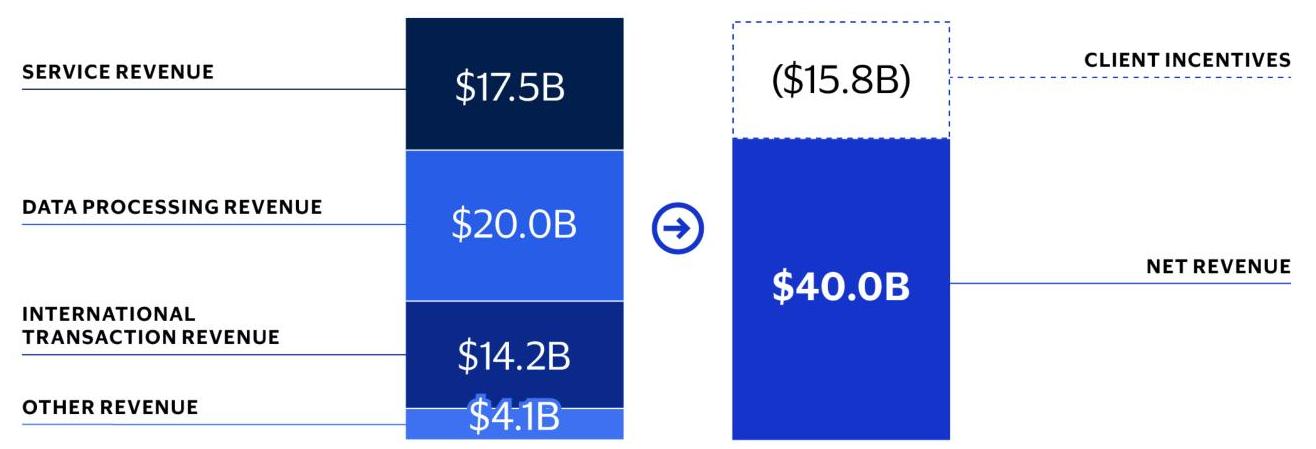
Visa FY2025 Revenue Structure Analysis
The Three Pillars Strategy: Ambition Beyond Traditional Payments
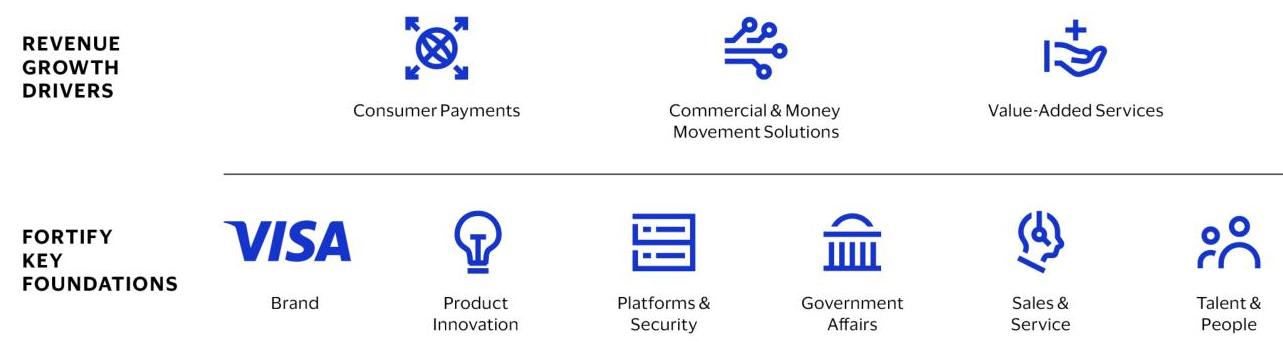
Visa's growth engine is built upon three meticulously designed strategic pillars: Consumer Payments, Commercial and Money Movement Solutions, and Value-Added Services. This strategy signals the company's ambition to transition from a traditional payment network to a comprehensive fintech platform.
In the Consumer Payments arena, Visa is redefining the checkout experience through its "Tap to Everything" strategy. By the end of FY2025, Tap to Pay accounted for 79% of global face-to-face transactions, including 66% in the U.S. market. Tokenization technology deployment reached a significant milestone, with over 16.0 billion tokens configured, substantially enhancing the security of digital payments.
Commercial and Money Movement Solutions represent Visa's largest growth opportunity. Through the Visa Direct platform, the company is targeting a Total Addressable Market (TAM) estimated at roughly $200 trillion annually. In FY2025, Visa Direct processed over 12.5 billion transactions and served more than 650 partners, demonstrating the immense potential of this business segment.
Visa Three Pillars Growth Strategy
Value-Added Services: From Network to Technology Platform
The Value-Added Services (VAS) segment achieved rapid growth of 24% in FY2025, reaching $10.9 billion in revenue. This segment is subdivided into four key portfolios: Issuer Solutions, Acquirer Solutions, Risk and Security Solutions, and Consulting and Other Services, with a combined annual revenue opportunity estimated at $520 billion.
Particularly noteworthy is Visa's commitment to Artificial Intelligence (AI). The acquisition of Featurespace has strengthened Visa’s real-time behavioral analysis and AI-driven payment protection capabilities. Furthermore, the company launched the "Visa Intelligent Commerce" platform, designed to support autonomous AI agents initiating and executing transactions on behalf of users. This move potentially heralds the dawn of the Agent Commerce era in the payments industry.
Legal Risks: The Sword of Damocles
However, the most formidable challenge facing Visa lies in the legal realm. As of September 30, 2025, the company's total litigation provision reached $3.03 billion, a substantial increase from $1.73 billion in 2024. Of this amount, the reserve balance for the Multidistrict Interchange Fee Litigation (MDL) alone stood at $2.69 billion, a heavy burden hanging over the company.
This legal marathon, which originated in 2005, concerns the interchange fee policies of Visa and Mastercard and remains unresolved. In FY2025, Visa allocated an additional $2.21 billion in reserves for this litigation and deposited $875 million into a U.S. litigation escrow account.
Beyond historical liabilities, Visa is confronting new legal battles. In September 2024, the U.S. Department of Justice (DOJ) filed an antitrust lawsuit, accusing Visa of monopolizing debit network services. Concurrently, several derivative lawsuits and securities class actions are progressing, all of which could significantly impact the company's financial performance and reputation.
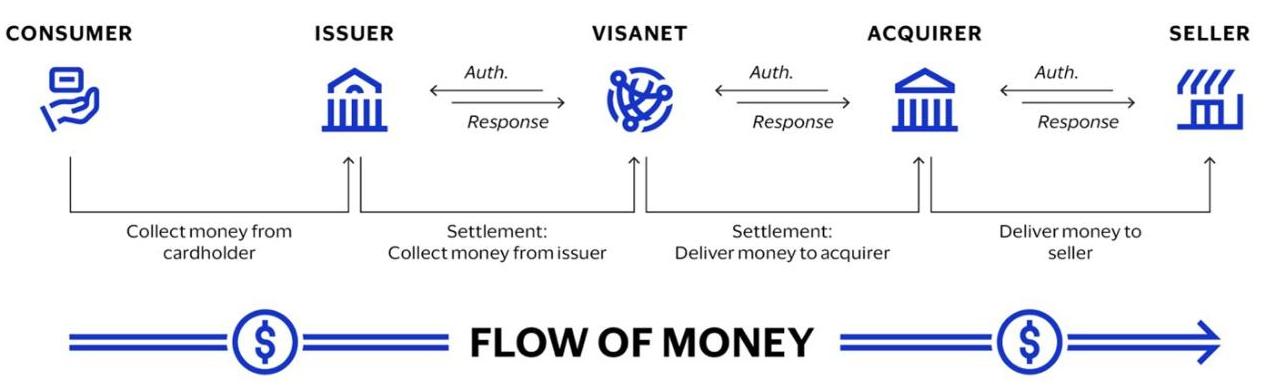
Visa Four-Party Model Business Architecture
Regulatory Pressure: Navigating Global Scrutiny
Regulatory oversight of the payments industry is intensifying globally, particularly concerning interchange rates and data localization. In the United States, the Federal Reserve Board proposed further reducing debit interchange fee rates. In Europe, the Interchange Fee Regulation (IFR) limits interchange fees for consumer credit and debit cards to 30 and 20 basis points, respectively.
More critically, several nations are actively promoting domestic payment systems. Countries like China, India, and Indonesia are implementing data localization requirements or domestic processing mandates, creating competitive advantages for local payment providers. While Visa submitted its application for a bank card clearing institution license in China in May 2020, the timing and outcome remain uncertain.
Technological Innovation: Betting on the Future
In response to these challenges, Visa is aggressively positioning itself for the next generation of payment technology. In the stablecoin sector, Visa sees massive potential for cross-border money movement and in emerging markets. Since 2020, Visa has facilitated over $100 billion in crypto and stablecoin asset purchases and more than $35 billion in consumer spending.
In the realm of AI, Visa is integrating AI models and applications through its internal GenAI hub. Since its launch in March 2025, nearly 26,000 employees have utilized the platform, engaging in over 261,000 AI-driven chats. This initiative not only enhances operational efficiency but also lays the foundation for future AI-powered payment products.
Capital Management: Shareholder Returns vs. Strategic Investment
In terms of capital allocation, Visa demonstrated a strong commitment to shareholder returns. In FY2025, the company returned $22.8 billion to shareholders through dividends and stock repurchases, a 9% increase year-over-year. In April 2025, the Board of Directors authorized a $30.0 billion stock repurchase program, signaling management's confidence in the company’s long-term prospects.
Simultaneously, Visa is actively pursuing strategic acquisitions. The acquisition of Featurespace for $946 million in December 2024, and Pismo for $929 million in January 2024, strengthens the company’s capabilities in AI-driven payment protection and issuing processing.
Future Outlook: At a Critical Juncture
Standing at the vantage point of 2025, Visa finds itself at a critical crossroads. On one hand, its Three Pillars strategy is being successfully executed, and its financial performance is sound. On the other hand, regulatory and litigation risks pose a material threat to its fundamental business model and profitability.
Visa's future trajectory will hinge on its ability to effectively navigate the increasingly complex legal and regulatory landscape while sustaining innovation and growth. Whether the company's "network of networks" strategy and technological investments can continue to create value amidst tightening regulatory constraints remains the primary focus for investors.
Visa’s FY2025 earnings report is more than just a financial statement; it is a microcosm of a technology giant seeking balance and breakthrough in an era of profound transformation. The answer to whether Visa will continue to lead the payments industry or be constrained by emerging technologies and regulatory pressure is slowly unfolding.
Source: Visa FY2025 10-K Report


