
Mastercard 4Q25 Earnings Review: A Government Grant, A Renewal, and a Question About Earnings Quality
When Mastercard's EPS crushed consensus by over 12%, how much of this blowout quarter was powered by durable growth engines—and how much rested on a one-time government grant that flatters the bottom line?


Mastercard 4Q25 Earnings Review: A Government Grant, A Renewal, and a Question About Earnings Quality
On the surface, Mastercard's fourth quarter of fiscal 2025 was nearly flawless.
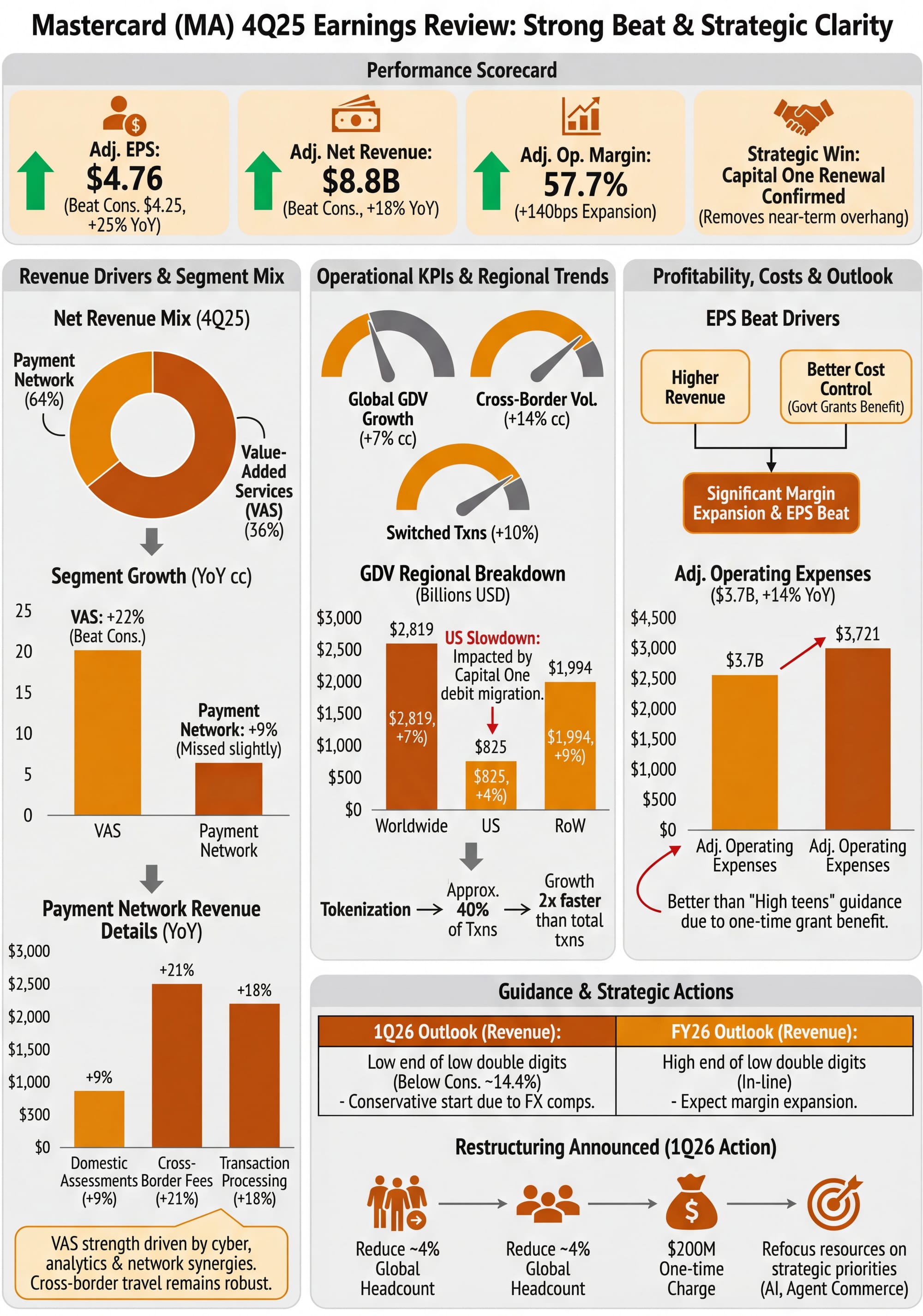
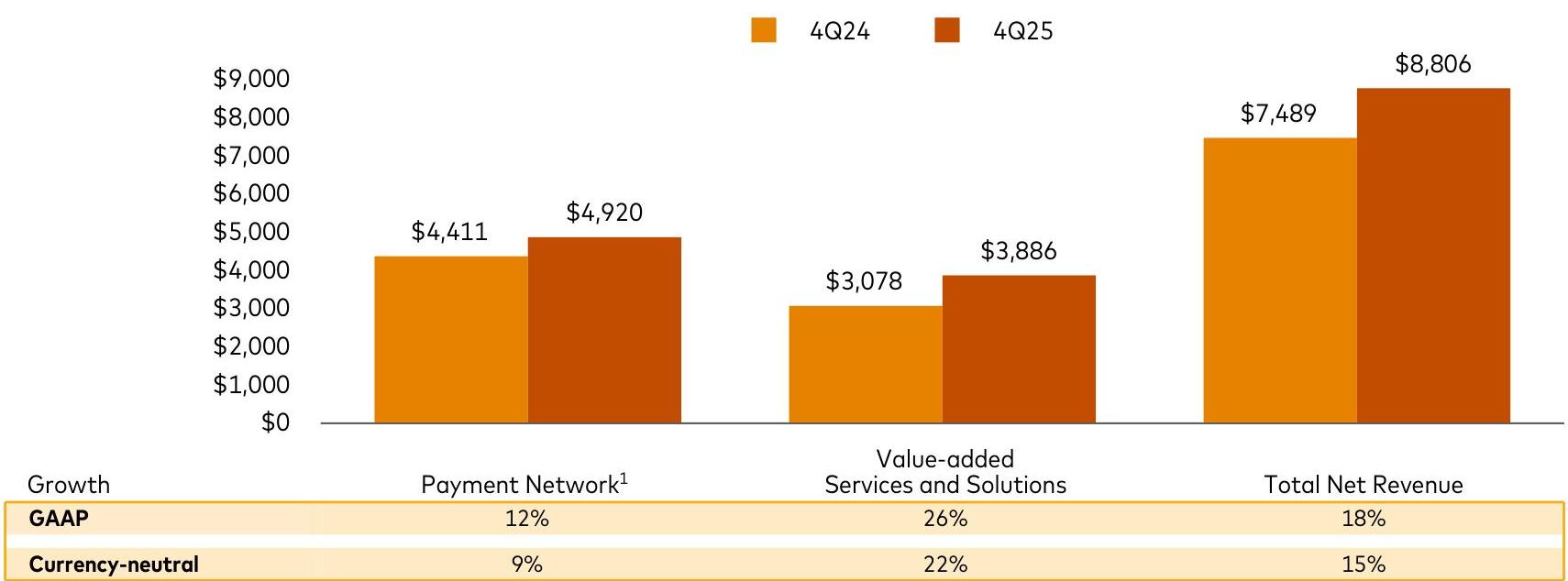
Adjusted EPS came in at $4.76, up 25% year-over-year, comfortably blowing past the consensus estimate of $4.25. Adjusted Net Revenue reached $8,806 million, growing 18% (or +15% on a currency-neutral basis), edging out the Street's expectation of $8,780.6 million and tracking in line with management's prior "high teens" guidance. Adjusted Operating Margin expanded to 57.7%, a 140-basis-point improvement year-over-year.
It's the kind of report card that lets the bulls sleep well. But if you're inclined—as I am—to ask "why" behind the numbers, the story gets more nuanced.
Q4 2025 Key Business Drivers (YoY Growth)

source: Mastercard
A Grant That Reshaped the Profit Picture
The quarter's most noteworthy "surprise" didn't come from operational outperformance. It came from a multi-year government grant finalized at the tail end of December.
CFO Sachin Mehra disclosed on the earnings call that the grant was tied to investment commitments in a specific region. Its immediate impact was substantial: Citi's analysis shows it improved operating expense growth by roughly 5.5 percentage points, while contributing approximately $135 million in benefits to other income and expense items. J.P. Morgan added that the economic value of this grant was recognized as a one-time event in 4Q25 but will continue to flow through 2026.
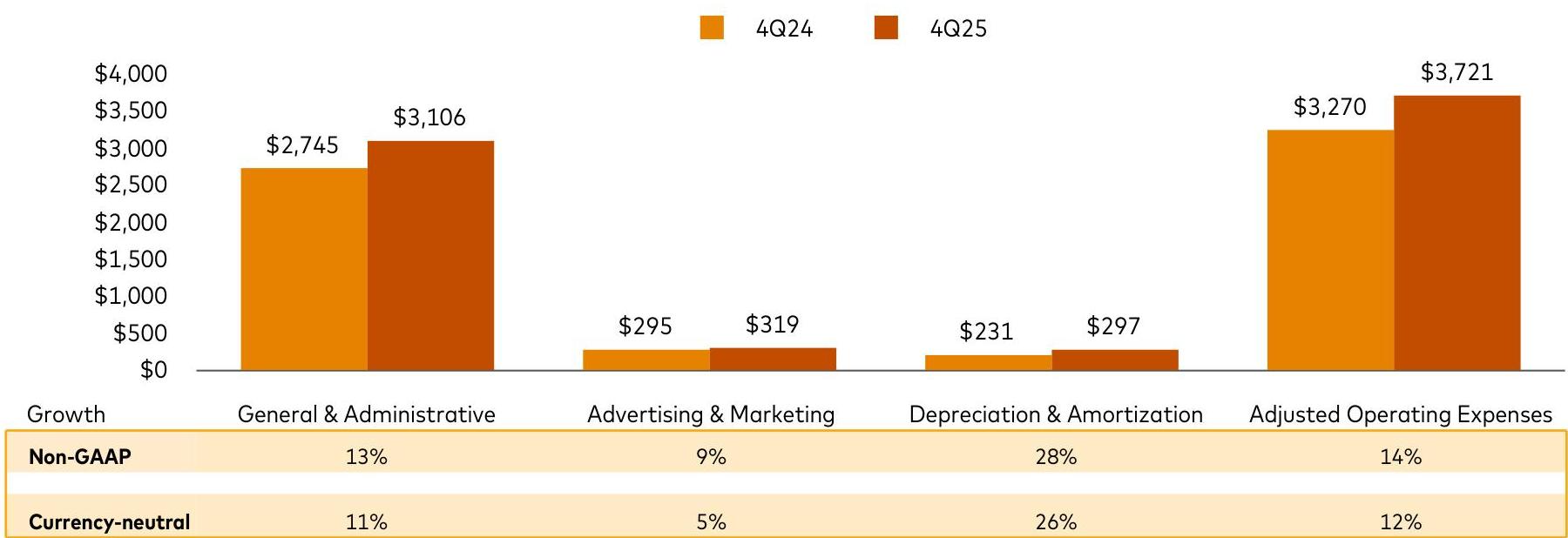
This explains why Adjusted Operating Expenses grew just 14% year-over-year (or +12% currency-neutral)—well below both management's "high teens" guidance and the Street's consensus of 16.71%. Strip out the grant, and the expense trajectory likely lands much closer to expectations.
4Q25 Adjusted Operating Expenses
source: Mastercard
In other words, this is not a story about dramatically improved cost discipline. It's more a story about fortuitous timing—a non-recurring government grant landing just before the fiscal year closed, putting a flattering gloss on full-year profitability. None of this undermines Mastercard's fundamental health. But investors extrapolating this quarter's margin levels into the future should keep their eyes open.
VAS: The Real Growth Engine Didn't Disappoint
If the government grant is the part of this earnings report that deserves an asterisk, then Value-Added Services is the part that earns full marks without qualification.
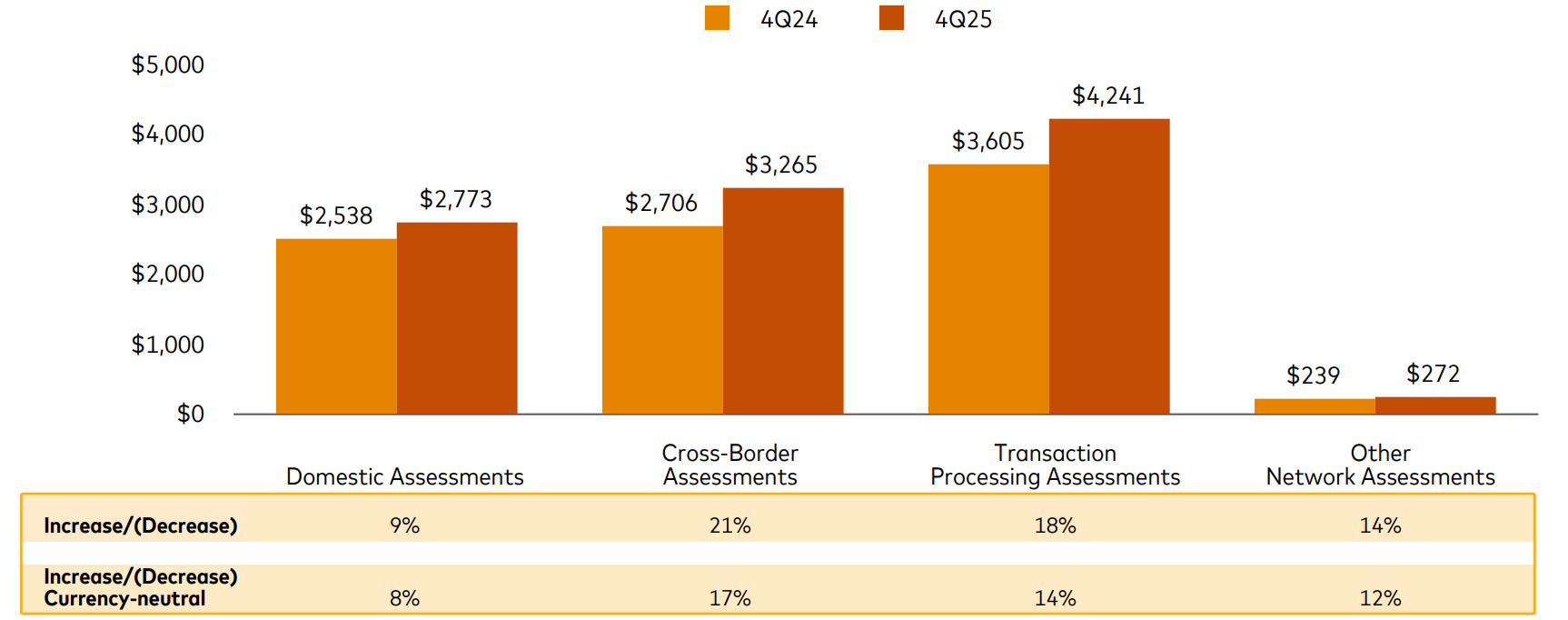
VAS Net Revenue grew 26% year-over-year (or +22% currency-neutral), beating the consensus expectation of +23.32%. Goldman Sachs noted the business outpaced market estimates by 2 percentage points. This is far from the first time VAS has been the brightest spot in a Mastercard earnings release.
4Q25 Net Revenue Breakdown
source: Mastercard
CEO Michael Miebach described the relationship between the payment network and VAS as a "virtuous cycle" on the call. The network processed over 175 billion transactions last year, with more than 70% of global Mastercard transactions now switched through its own network—up 10 percentage points since 2020. That massive data trove forms the foundation for building differentiated VAS solutions. CFO Mehra offered a key figure: 60% of VAS revenue is directly tied to the network, benefiting from underlying drivers like transaction growth and tokenization.
The logic behind VAS growth isn't complicated, but its durability comes from four compounding layers: baseline network-driven growth, rising product attach rates, expanding global client penetration (with high-teens growth across Asia-Pacific, EMEA, and the Americas), and market expansion through acquisitions—such as the move into threat intelligence via Recorded Future.
Worth highlighting: Mastercard also launched two new products this quarter. Mastercard Credit Intelligence leverages proprietary network data and identity capabilities to enable faster credit assessments. Mastercard Agent Suite helps clients design and deploy AI agents for operational efficiency. The latter fits squarely into the company's Agent Commerce playbook—CEO Miebach stated plainly on the call that Agent Commerce "will come fast," and the company's AgentPay framework is already live for U.S. issuers, with global rollout planned by the end of Q1 2026.
For readers familiar with our earlier coverage of Google Cloud's Agent Payments Protocol (AP2), Mastercard's moves here are entirely consistent. Payment networks are pre-positioning for a future where AI agents execute transactions on behalf of humans. Mastercard clearly intends to be at the table.
The Capital One Renewal: A Victory with a Countdown Timer
The other headline the market cheered was Mastercard's successful renewal of its long-term credit card partnership with Capital One. CEO Miebach emphasized that Mastercard would service "a significant portion" of new credit card accounts. Sell-side analysts broadly agreed that this renewal eliminated a key near-term concern about Capital One's credit card business defecting from the network.
But there's another side to this story.
We discussed Mastercard's successful defense of its exclusive Apple Card network partnership in our earlier piece, A Costly Education: Apple's Pivot from Banking Dream to Financial Reality. On this call, the CEO reaffirmed that status—Mastercard will continue as Apple Card's exclusive network provider, with the issuer transitioning to JPMorgan Chase over a 24-month period.
Capital One, however, presents a more complex picture. Both Bank of America and J.P. Morgan flagged that Capital One has announced plans to begin issuing new cards on the Discover network starting mid-2026, with intentions to migrate its credit card portfolio to Discover by early 2027. J.P. Morgan estimates this exposure at roughly 15–20% of Mastercard's volume, or approximately $70 billion in transactions.
So rather than a "win," this looks more like a "buffer"—Mastercard has bought itself time, but the window is finite. As we analyzed in A Tale of Two Headwinds, the competitive landscape is quietly shifting, and the Capital One–Discover integration will exert meaningful pressure on Mastercard's U.S. market share over the medium term.
Transaction Volumes: A Soft Spot at Home, Resilience Abroad
The volume data tells a story of divergence.
4Q25 Gross Dollar Volume (GDV)
source: Mastercard
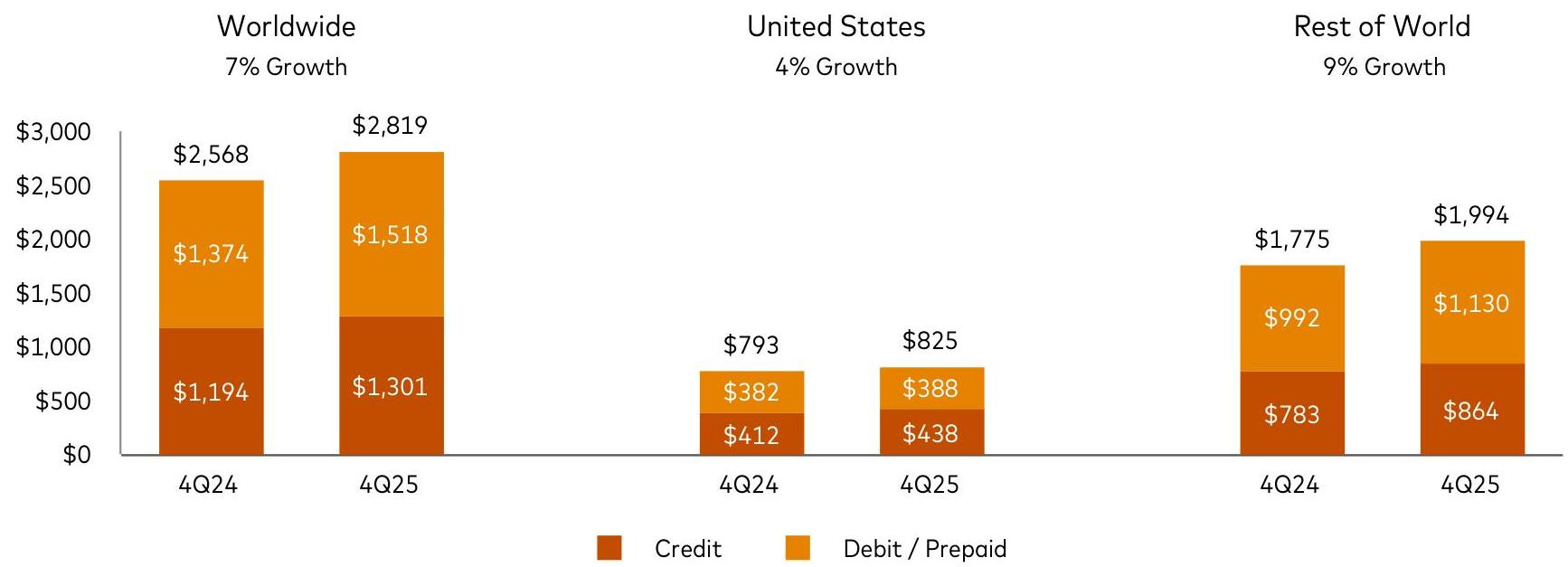
Worldwide GDV grew +7% in local currency terms, missing the consensus estimate of +9.65%. The U.S. stood out as the weak link—GDV rose just +4.1%, with Purchase Volume at +4.7%, both falling short of expectations. Both the CFO and sell-side analysts (notably Citi) confirmed this was directly tied to Capital One's debit card portfolio migration, which ran through the entire fourth quarter.
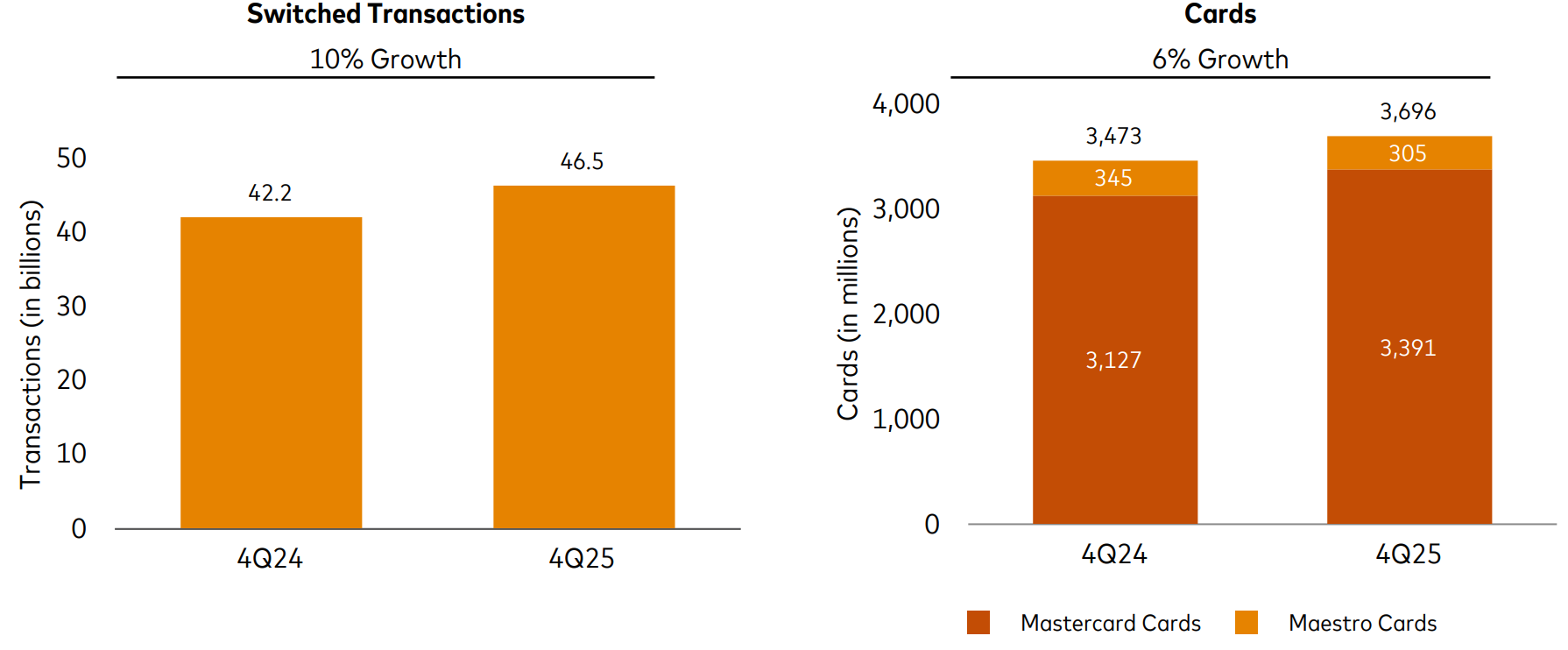
The brighter side: cross-border volume grew +14% in local currency, broadly in line with expectations and confirming the continued recovery in international travel—a high-margin revenue stream for Mastercard. Switched Transactions rose +10% year-over-year, beating the +9.14% consensus, a sign that underlying network activity remains healthy.
4Q25 Payment Network Key Metrics
source: Mastercard
On consumer health, management struck an optimistic tone. CEO Miebach described today's consumer as "savvy and intentional"—while soft data like confidence surveys send mixed signals, actual spending behavior hasn't changed. A strong labor market and the wealth effect continue to underpin consumption across both high-income and lower-income cohorts. This trend persisted through the first three weeks of January 2026.
Forward Guidance: Steady, with a Conservative Lean
Full-year 2026 guidance came in largely as expected: Net Revenue growth (Non-GAAP, currency-neutral, ex-acquisitions) is projected at the "high end of low double digits," with OpEx growth at the "low end of low double digits." Citi reads this combination as implying continued margin expansion year-over-year. Goldman Sachs noted that the market expects second-half 2026 growth to reaccelerate toward the long-term target range of 11–12%, making H2 more representative of the underlying trend.
But the Q1 2026 outlook leaned conservative. Net Revenue growth guidance of "low end of low double digits" fell below the Street's consensus of +14.36%. The CFO attributed this to tougher year-over-year comparisons in the first half, particularly in FX volatility-driven revenue, which was elevated in the prior year's first half.
Alongside the guidance, management announced a restructuring plan affecting approximately 4% of the global workforce, with an expected one-time charge of roughly $200 million to be recorded in Q1 2026. J.P. Morgan noted that this move, combined with the ongoing benefits from the government grant, could push future OpEx growth below expectations—though how much depends on where the freed-up resources are ultimately reinvested.
Full-Year Recap: Mastercard in 2025
Zooming out to the full year, FY2025 delivered a solid set of results: GAAP Net Revenue reached $32.8 billion (up 16% YoY), GAAP Operating Margin expanded to 57.6% (+2.3 percentage points), and Adjusted Diluted EPS hit $17.01 (+17% YoY). Full-year GDV grew +9% in local currency, cross-border volume rose +15%, and Switched Transactions increased +10%.
4Q25 Switched Transactions and Cards
source: Mastercard
The Bottom Line: A Strong Quarter—But Look Beyond the Headlines
At the headline level, Mastercard's 4Q25 earnings were close to impeccable: revenue beat, a significant profit beat, a key partnership renewal, and VAS growth that keeps compounding. But lift the hood, and you'll find a conveniently timed government grant that meaningfully flattered profitability, and a Capital One "renewal" that looks more like a transitional arrangement with an expiration date.
None of this constitutes a bearish case. Mastercard's core competitive moat—the scale economics of a global payment network, the flywheel dynamics of VAS, and forward-looking positioning in cross-border payments, stablecoins, and Agent Commerce—remains fully intact. But for a stock that already trades at a premium valuation, distinguishing between the quality of growth and the quantity of growth remains an essential discipline.
Just as consumers have grown more discerning, the market's expectations for Mastercard keep rising. The question that truly matters isn't how much was won this quarter—but whether, in the quarters ahead, when the government grant no longer flatters the P&L and Capital One begins issuing cards on the Discover network, the growth engine can maintain the same RPM.
Earnings Call Recap
Financial Statements Visualization
I will now share a more detailed analysis on this earnings result behind the paywall:


