
When Numbers Stop Carrying the Story — Mastercard 1Q26 and a Premium Lost to Visa
Mastercard's 1Q26 beat on revenue, EPS, and margin — yet the stock still slid 3–4%. What is the market actually pricing in: a broken compounding machine, or a mid-cycle stumble in an otherwise intact one?


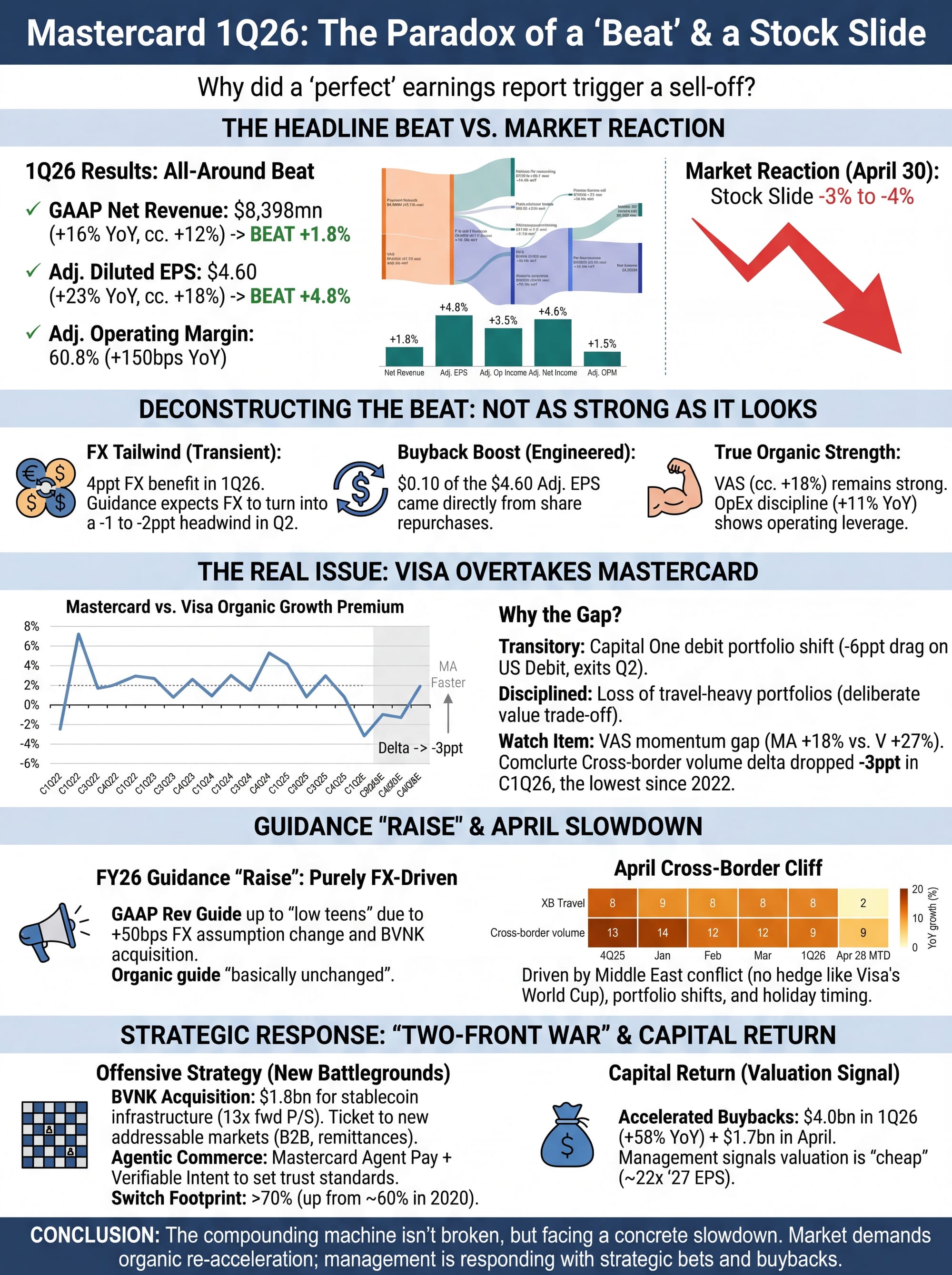
Beat Across the Board, Stock Still Down — What Mastercard's 1Q26 Is Really Telling Us
Why a "Perfect Scorecard" Earned a Sell-Off
Lay Mastercard's 1Q26 print on the table and almost every line reads "Beat." GAAP Net Revenue \$8,398mn, up +16% year-on-year (cc. +12%), beating consensus by +1.8%. Adjusted Diluted EPS \$4.60, up +23% (cc. +18%), +4.8% ahead of the Street. Adjusted Operating Margin expanded to 60.8%, up +150bps year-on-year. On the metrics alone, there is barely anything to nitpick.
Chart: Mastercard 1Q26 GAAP Income Statement Flow
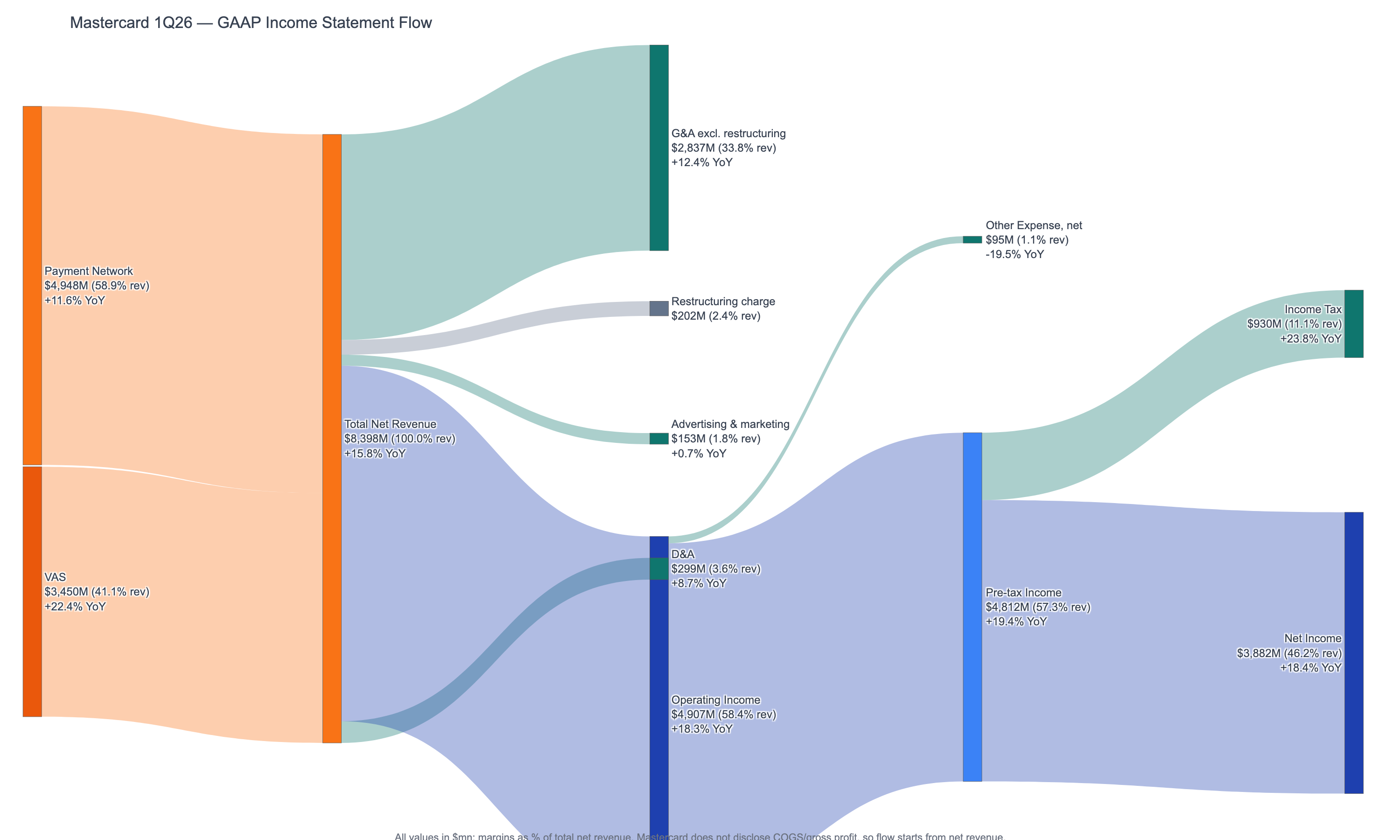
Source: Mastercard 1Q26 Press Release / author's compilation
And yet, on April 30, the day of the release, the stock closed down -3 to -4%. The market clearly was not in the mood to clap.
That is exactly what makes 1Q26 worth pulling apart: when the headline numbers are no longer where the attention sits, where is the attention?
In hindsight, the real questions in this print do not live at the decimal point of any P&L line. They live in three places — the substance behind management's "raise" of guidance, the first meaningful organic-growth reversal between Mastercard and Visa in four years, and the rapid deceleration in cross-border data through April. Get those three things right, and you can judge whether the April 30 sell-off was a fair re-rating or an overreaction.
Cut One: Slicing Open the "Beat"
Don't take that yoy +16% at face value. Currency-neutral growth was +12%, with FX adding roughly +4ppt of tailwind — meaning a softer dollar was a quiet engine behind the topline beat this quarter. CFO Sachin Mehra tightened the full-year currency assumption to -1.5% and explicitly told investors that the FX tailwind will reverse in subsequent quarters. Q2 was guided to a currency impact of -1 to -2%. So the 4ppt of FX tailwind in 1Q flips into a 1–2ppt headwind by Q2. FX doesn't disappear; it switches sides.
The EPS beat was wider than the revenue beat (+4.8% vs. +1.8%). On the call, the CFO did something unusual and broke down the EPS bridge: on a currency-neutral, ex-special-items basis, EPS grew +18%, with \$0.10 coming directly from share repurchases. Buybacks are a perfectly legitimate EPS lever. But once you know that \$0.10 of the +23% headline was "manufactured" by repurchases, the organic content of the rest deserves a small discount.
The genuinely "hard" parts of the beat are in two places:
- Organic momentum in VAS — the CFO clarified that VAS cc. +18% in 1Q26 was entirely organic (no contribution from the Recorded Future and similar acquisitions), versus 4Q25's +22% which included roughly 3ppt of M&A. Underlying growth is essentially flat between the two quarters. VAS now accounts for roughly 40% of the company's revenue and is still growing at twice the rate of the Payment Network.
- OpEx discipline — Adjusted OpEx grew +11% year-on-year (cc. +9%), well below Visa's +17%. In a context where Mastercard is simultaneously funding stablecoin, agentic, and new-geography expansion, holding this line is the most concrete evidence that operating leverage is still functioning.
In other words, the 1Q26 beat is not fake — but the ratio of "fat" to "lean meat" inside the beat is not as flattering as the headline suggests.
Chart: Mastercard 1Q26 Consensus Beat / Miss Summary
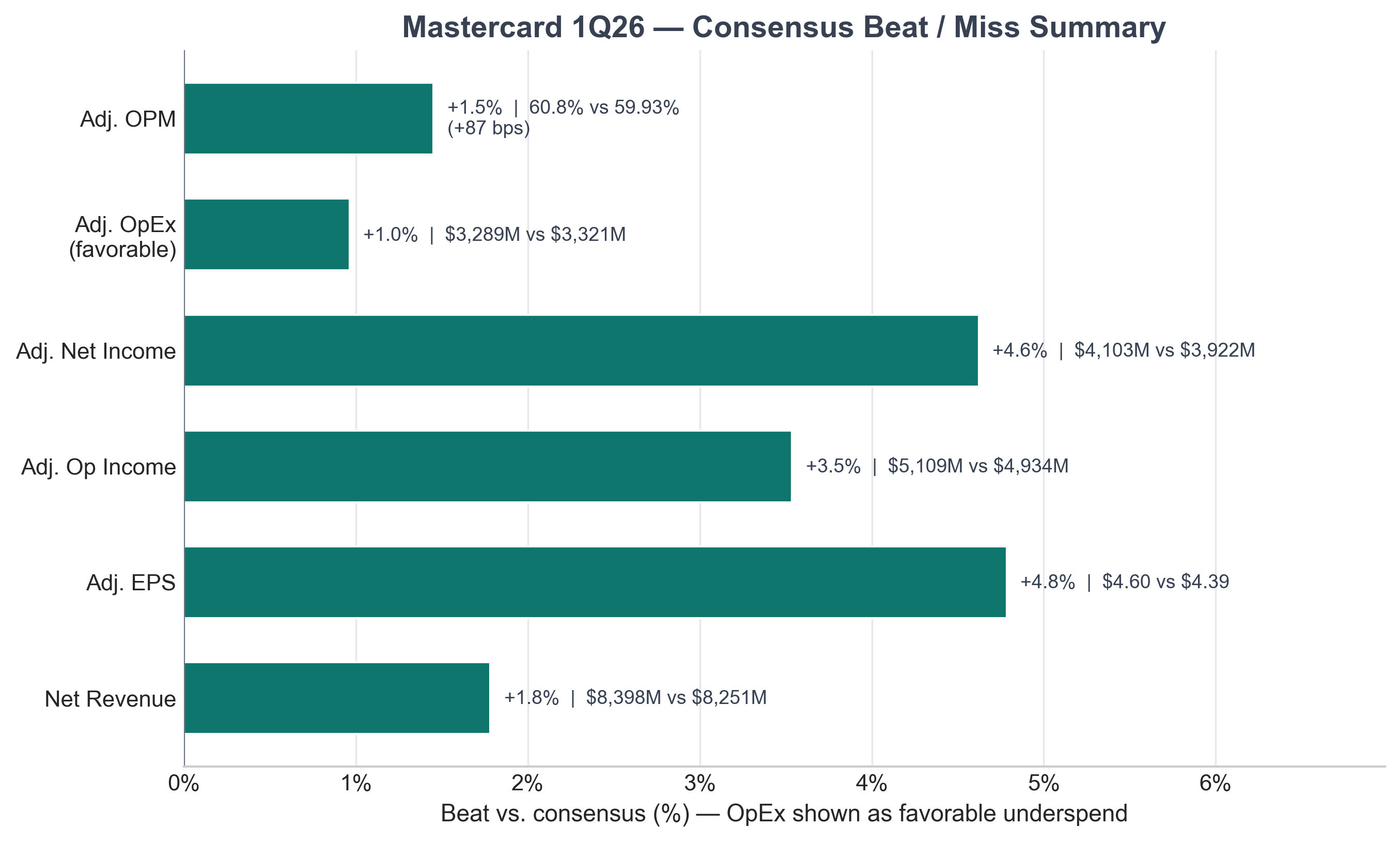
Source: Mastercard 1Q26 Press Release / consensus / author's compilation
Visa Pulls Ahead: The First Time in Four Years
This is the real "story" of 1Q26 — the first meaningful relative shift between these twin engines in over a year.
Mastercard's currency-neutral organic revenue growth came in at 12%; Visa's, at 15%. Mastercard trails by -3ppt. For context, over the past 4 years Mastercard had outpaced Visa by an average of roughly +2ppt. Going from +2ppt to -3ppt is the lowest relative reading since 2022.
Chart: Mastercard's Organic Growth Premium vs. Visa
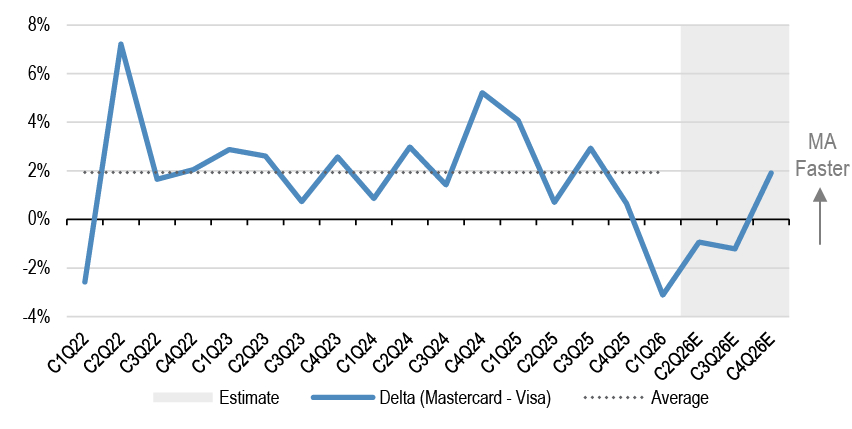
Source: JPM / company disclosure
Pull the -3ppt gap apart and you find three pieces. Their colors are completely different.
Piece one is mechanical — U.S. Debit GDV grew just +0.5% year-on-year. This is the concentrated impact of the Capital One debit portfolio migrating to Discover. Strip that portfolio shift out, and the like-for-like figure given by the CFO is +7%. In other words, the migration imposed roughly -6ppt of drag on the U.S. debit line. The migration was substantially completed in 1Q26, so from 2Q26 onward this drag fades quarter by quarter. This piece of the gap is transitory.
Piece two is deliberate — a side effect of portfolio choices. Visa has won several cross-border / travel-heavy portfolios over the past two quarters (Trip.com being the headline case). Mastercard's cross-border volume grew cc. +13%, slightly ahead of Visa, but that strength was diluted by Visa's wins in the U.S. and travel-heavy segments. Behind this is Mastercard's "value calibration" on renewals and new deals — CEO Michael Miebach was unusually candid on the call: "selective" does not mean "not aggressive," but there are deals Mastercard will not win at any price. The cost is that portfolio losses leave a trail in the cross-border data for several quarters. This piece of the gap is disciplined, but it scars in the short run.
Piece three is the one that deserves real attention — VAS growth is now lagging Visa's. Mastercard VAS cc. +18% vs. Visa +27%, a 9ppt gap. As I wrote in Visa 2Q26 Earnings Review, Visa — in the process of relabeling itself a "hyperscaling bridge layer" — has grown VAS to roughly 30% of total revenue. Mastercard's VAS share is already at ~40%, and the underlying algorithm is intact. But the momentum gap is right there on the page. This piece is neither transitory nor deliberate — it warrants real observation over the next 2–3 quarters.
JPMorgan's framing: in 2Q26 / 3Q26, Visa will continue to grow faster, with relative growth normalizing in 4Q26 and Mastercard reclaiming roughly +2ppt of organic premium. That's a reasonable base case. But "base case" is just an assumption — it requires the Capital One drag to roll off on schedule, the cross-border portfolio mix not to deteriorate further, and VAS momentum not to keep fading. All three conditions need to hold for the relative reversal to itself reverse.
A "Raise" — Where the Fine Print Beats the Headline
FY26 Net Revenue (GAAP) guidance was raised from "High end of low double digits" to "High end of low double digits to low teens." For a print where most sell-side previews expected management to "reaffirm, not raise," this should have been a notable positive surprise.
But the CFO himself put a hand on the brake:
"The increase you're seeing in the full-year guide is primarily being driven by a change in FX assumptions for the year."
Translated: Non-GAAP, currency-neutral, ex-acquisitions organic guidance is "basically unchanged." The prior-vs-updated detail makes this clearer. Currency assumption tightened from "-1 to -1.5%" to -1.5%, adding about ~50bps of FX tailwind. Acquisitions & Dispositions moved from "~0%" to "+0.5 to +1%," reflecting the BVNK contribution. Add the two together and you have, almost exactly, what is pushing the GAAP top end of guidance into "low teens."
This is not a quality-of-growth problem. It is that, in management's eyes, the 2026 organic algorithm has not gotten any better. From an investor standpoint, the valuation multiple on an FX-driven beat ought to be lower than the multiple on an organic-driven one. That is the fundamental reason — after Visa gave more aggressive cc. organic guidance the same week ("low double digits to mid double digits") — that the market has become pickier about Mastercard's relative growth.
OpEx guidance on the cc. ex-acq line was nudged up from "Low end of low double digits" to "Low double digits" — a marginal loosening of +50–100bps. This supports the BVNK integration plus continued reinvestment into agentic and stablecoin. Operating leverage has not been overdrawn, but FY26 will not see the kind of "OpEx grew well below Revenue" margin tailwind Mastercard has historically delivered.
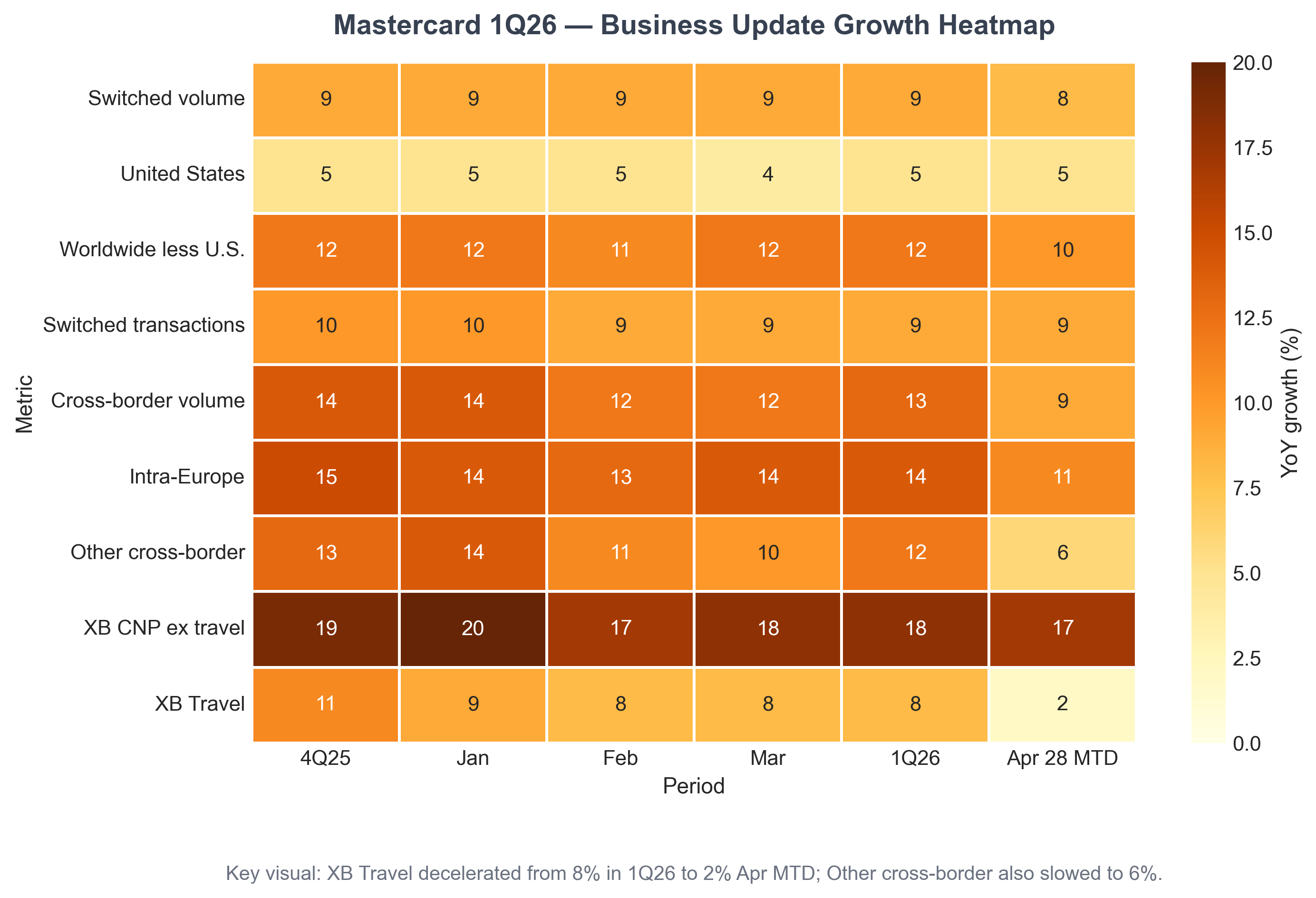
The Cliff in April Cross-Border — A Three-Piece Puzzle
If 1Q's financial numbers still lag-reflect the healthy consumer of late 2025, the April MTD data is the "live thermometer" the market keeps checking.
Chart: Mastercard 1Q26 → April Business Update Heatmap
Source: Mastercard 1Q26 Press Release Business Update / author's compilation
The CFO attributed the slowdown to three factors, ranked by weight:
- Middle East conflict — broke out in late February; began affecting cross-border travel in March;
- Portfolio shifts — the same "value calibration" mentioned earlier; the lost portfolios were travel-heavy, which amplifies the negative move on the travel line;
- Easter and Ramadan timing — March benefited from calendar timing; February and April were on the wrong side of it.
The CFO was particularly emphatic: "don't assume that the conflict is the biggest and then the other two are insignificant." The three are directionally similar in magnitude. That framing itself is worth writing down: it redefines what looks like an alarming "4ppt cross-border deceleration" as the sum of three transitory or definitional events.
Management also disclosed a hard sizing anchor for the first time: GCC + Israel together account for roughly 6% of cross-border volumes (inbound + outbound). By Morgan Stanley's estimate, that translates to about 2% of total revenue exposure. A 2ppt full-year growth drag — incidentally close to the buffer JPMorgan is using in its model.
But Visa's Q2 guide does not assume the conflict ends in Q2 — Visa assumes it persists into its F3Q (the June quarter), and Visa has a FIFA World Cup tailwind on VAS and cross-border to offset it. Mastercard has no such offset. That's the caveat Morgan Stanley pulled out specifically in its preview — and one of the caveats the market was willing to sell on the day of the print.
The +17% resilience in XB CNP ex Travel is the most important counter-piece in the puzzle: cross-border e-commerce did not dive alongside travel, suggesting this round of deceleration looks more event-driven than a structural fracture in the secular cross-border driver.
The "Two-Front War" Is Still Being Fought — and Reinforced
In Mastercard's October 2025 News Flow, I described Mastercard's playbook as "two fronts at once" — defensively, fortifying the existing network with AI / VAS; offensively, using Recorded Future, Commerce Media, and stablecoin moves to claim ground beyond the network. 1Q26 made that framework more concrete.
Offensive front one: BVNK — paying 13x forward P/S to buy stablecoin infrastructure
Mastercard announced its intent to acquire BVNK for \$1.8bn (including \$300mn of contingent payments), with closing expected by year-end 2026. BVNK had only \$35mn in 2024 revenue, putting the implied forward P/S at roughly 13x. That is not a cheap multiple. But the CFO's logic is clean:
"That's all an addressable market which we don't participate in today. That's the accretive part."
Stablecoins have structural advantages in cross-border B2B, payroll / B2B Me2Me, and remittances — speed, 24/7 availability, programmability. Mastercard has an acceptance moat in card-based P2M; in those use cases, it barely participates. BVNK holds "hard-to-get licenses," serves customers like Worldpay, Deel, and Flywire, and processes more than \$30bn in stablecoin volume. The multiple is expensive; the ticket Mastercard is buying into a net-new addressable market is not.
Another number worth recording — JPMorgan's sizing of stablecoin volumes in the "real economy" last year came to less than \$550bn, or under 1% of U.S. ACH's \$93trn. The shape of that curve is the actual variable in the BVNK investment thesis.
Offensive front two: Mastercard Agent Pay + Verifiable Intent
On the agentic-commerce side, Mastercard Agent Pay has been enabled on "virtually every Mastercard card globally"; Verifiable Intent has been adopted by the FIDO Alliance as the foundational security standard for the space; partnership with Crossmint launched first on the OpenClaw platform. CEO Michael Miebach was direct about where things stand:
"in terms of where volumes are, we're still at early stage."
But he also pinpointed the actual missing piece — not transaction throughput, but dispute resolution: "what goes wrong in an agent transaction? How do you prove that?" Verifiable Intent is designed exactly for that missing piece. Mastercard's angle is straightforward: whoever sets the standard at the trust layer effectively shapes the payments rail of the agentic era.
Switch footprint: from ~60% in 2020 to over 70% today
That's a new figure the CFO disclosed proactively. Switch transactions grew +9%, which looks like a deceleration on the surface, but the CFO's structural attribution is: portfolio mix (geography / average ticket size), with a one-off Capital One impact, while new geographies (Japan, Mexico) continue to push the switch share higher. The long-running chain of "switch → data → VAS → incremental revenue" remains intact.
This is the current shape of the flywheel I described in the Mastercard FY2025 Annual Report Visualization — a little slower, but still turning.
Capital Return: Management Says Out Loud, "We Think the Stock Is Cheap"
1Q26 quarterly capital return: \$4.0bn of buybacks (yoy +58%) + \$777mn of dividends. Post quarter-end, through April 27, another \$1.7bn of repurchases. \$11.7bn authorization remaining; the pace has clearly accelerated.
The CFO's wording is worth recording verbatim:
"We accelerated the pace of our share buybacks given current valuation levels and our strong conviction in our long-term growth potential."
That is an unusually explicit "management valuation floor" signal. Combined with Morgan Stanley's note that Mastercard currently trades at ~22x 2027 EPS — below its historical average — it says, at minimum, this: management does not agree with the relatively bearish narrative the market priced in on April 30.
So What Is 1Q26 Actually Telling Us?
The most honest reading is this: Mastercard's compounding machine is not broken, but this year's deceleration is showing up more concretely than the sell-side previewed — and far more sharply than Visa's reverse acceleration in the same window.
Three things are worth watching closely over the next 2–3 quarters:
- After the Capital One drag rolls off, can U.S. debit return to the +7% like-for-like cadence on schedule — this is a mechanical question, but it is the only observable path through which the base case can be validated.
- Whether the VAS momentum gap persists — Mastercard's VAS already accounts for ~40% of revenue, and the underlying algorithm is intact, but a 9ppt momentum gap should not become the new normal.
- BVNK integration execution + agentic volume cadence — neither will show up in the quarterly print quickly, but they determine the odds on the offensive front of the "Two-Front War."
The -3 to -4% reaction on April 30 is not emotional. It looks more like a valuation re-rating: while Visa was relabeling itself as a "hyperscaling bridge layer," Mastercard's narrative still rested on the steady "four pillars" framing. The market paid an architectural premium for the former and is now requiring organic re-acceleration from the latter. 1Q26 did not deliver that, so the stock declined to keep paying the old premium.
But here is the easiest detail to miss in this print — management clearly sees the same picture, which is why three actions arrived simultaneously: an explicit signal that the stock is cheap, paired with an accelerated buyback; the willingness to put both BVNK's "expensive" multiple and the new market it opens onto the table; and the push to make Verifiable Intent the trust standard of the agentic era.
The numbers were overtaken by Visa this quarter. The narrative response, by contrast, is just getting started.
Earnings Call Recap
I will now share a more detailed analysis of this earnings result behind the paywall


