
Visa 2Q26 Earnings Review: When the Bridge Becomes the Road
What does it mean when a payment network's strongest revenue quarter since 2022 lands at the exact moment it stops calling itself a payment network?


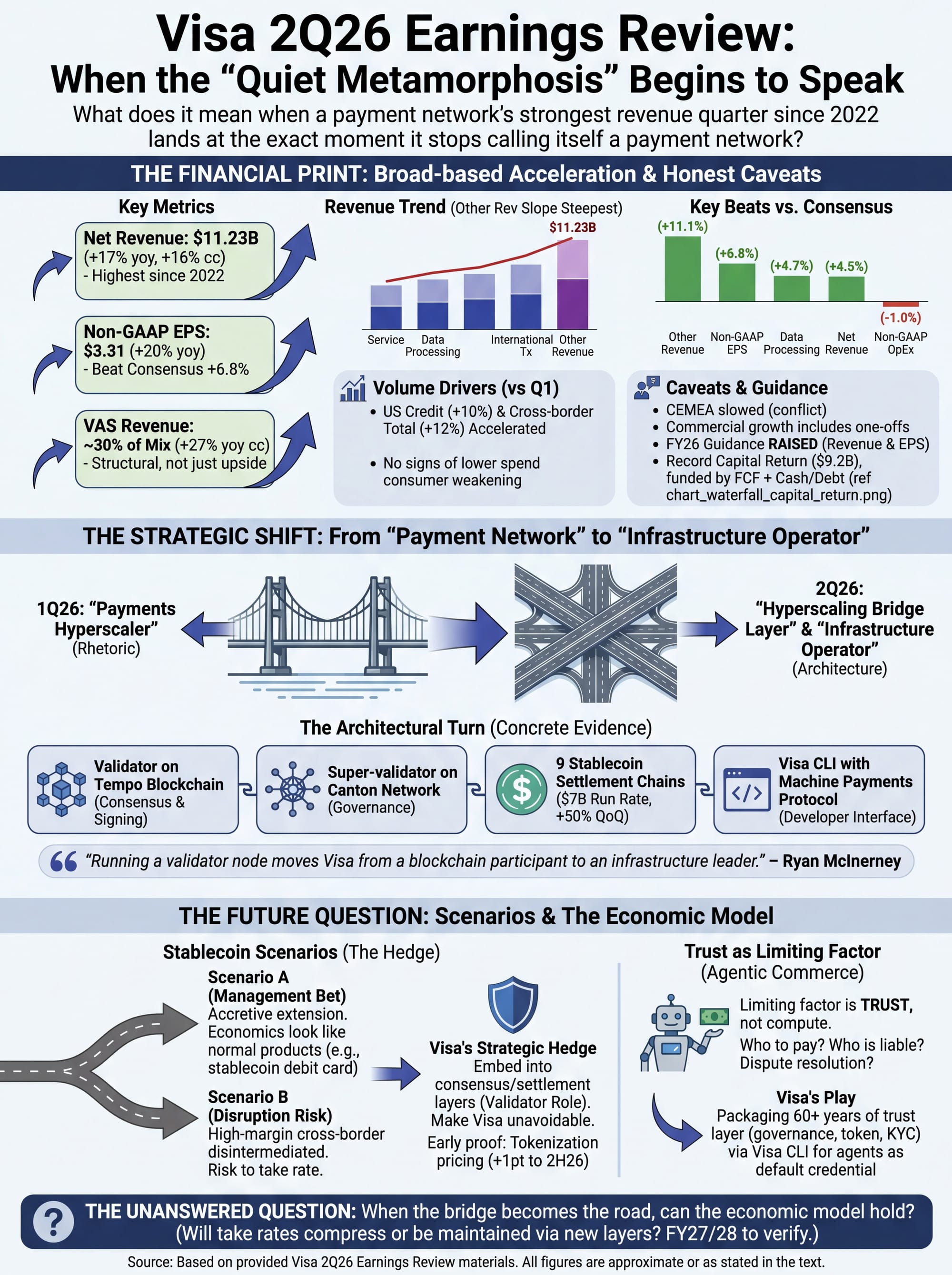
From 1Q26's "Quiet" to 2Q26's "Voice"
Back in January, I titled my Visa 1Q26 review the quiet metamorphosis of a payment network. My read at the time was that management's rhetoric had run ahead of the substance — and that it would take another quarter or two for the substance to catch up. Three months on, with 2Q26 in the books, a fair stretch of that distance has now been closed.
This review tries to do two things. First, read the quarter on its own terms. Then circle back to what I think is the question most worth sitting with: a small, almost off-hand renaming Visa performed during the call — and what it might actually mean.
The Quarter, by the Numbers
If I had one line for 2Q26, it would be a broad-based acceleration paired with one honest caveat.
Net Revenue $11.23bn, yoy +17%, cc +16% — the strongest single-quarter top-line growth since 2022. Non-GAAP EPS $3.31, yoy +20%, beating consensus by +6.8%. Of nine core KPIs, eight beat; only Processed Transactions came in a hair light.
Beat/Miss vs. Consensus across 9 Key Metrics
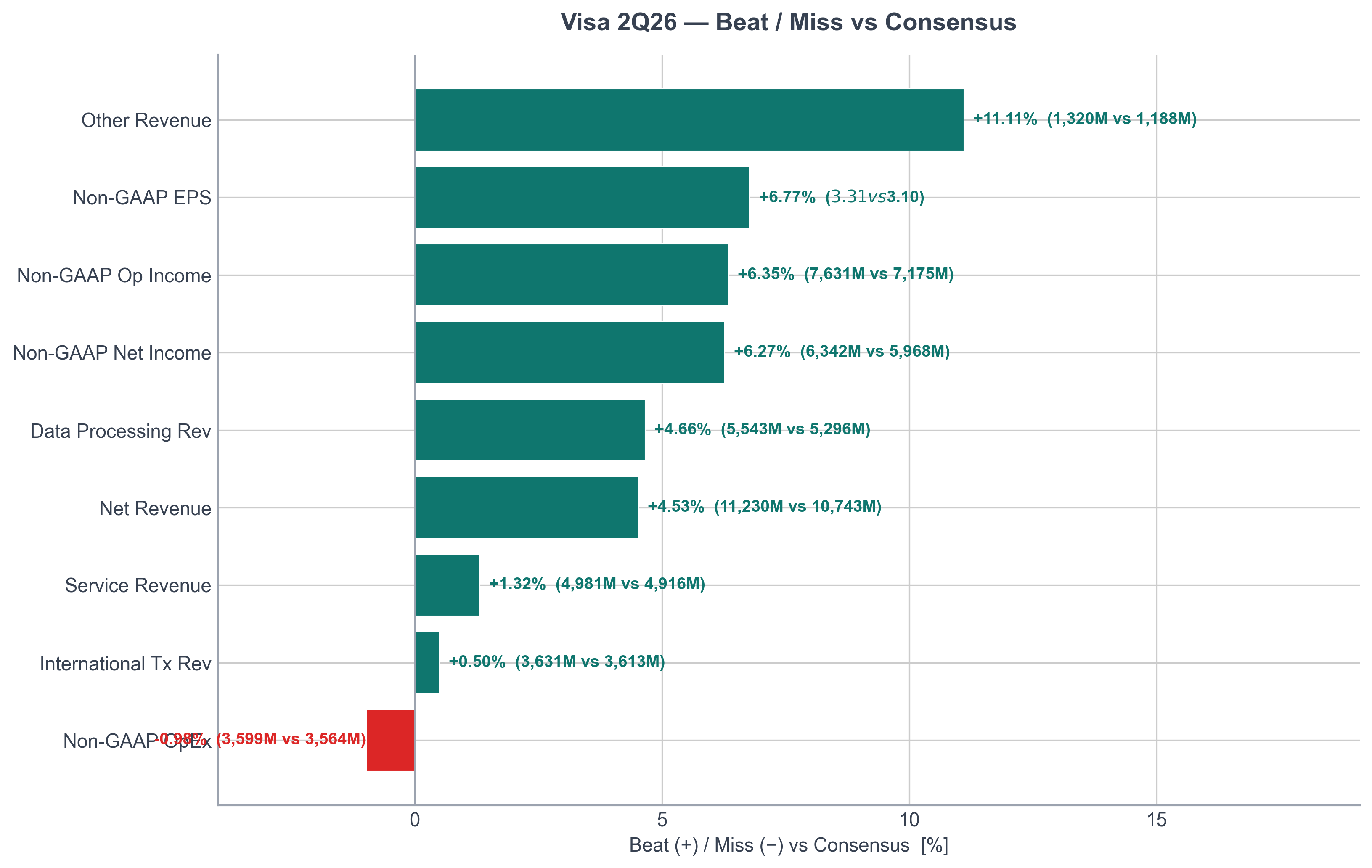
Source: Visa Inc. 2Q26 results; sell-side consensus
CFO Chris Suh broke the beat into three drivers: volatility ramped through the quarter from the lowered base management had set in January, the VAS portfolio outperformed across the board, and Client Incentives grew only +14% yoy — softer than expected.
All four revenue lines moved up in lockstep. Service Revenue (lagged-recognition off last quarter's cc +8% payments volume) grew +13% yoy. Data Processing grew +18% yoy — comfortably ahead of the 9% Processed Transactions growth, with the spread coming from pricing, embedded VAS, and a richer cross-border mix. Other Revenue, the line item where most of VAS lands, was up +41% yoy and was the single largest contributor to the beat.
5-Quarter Trajectory of the 4 Revenue Lines: Other Revenue Has the Steepest Slope
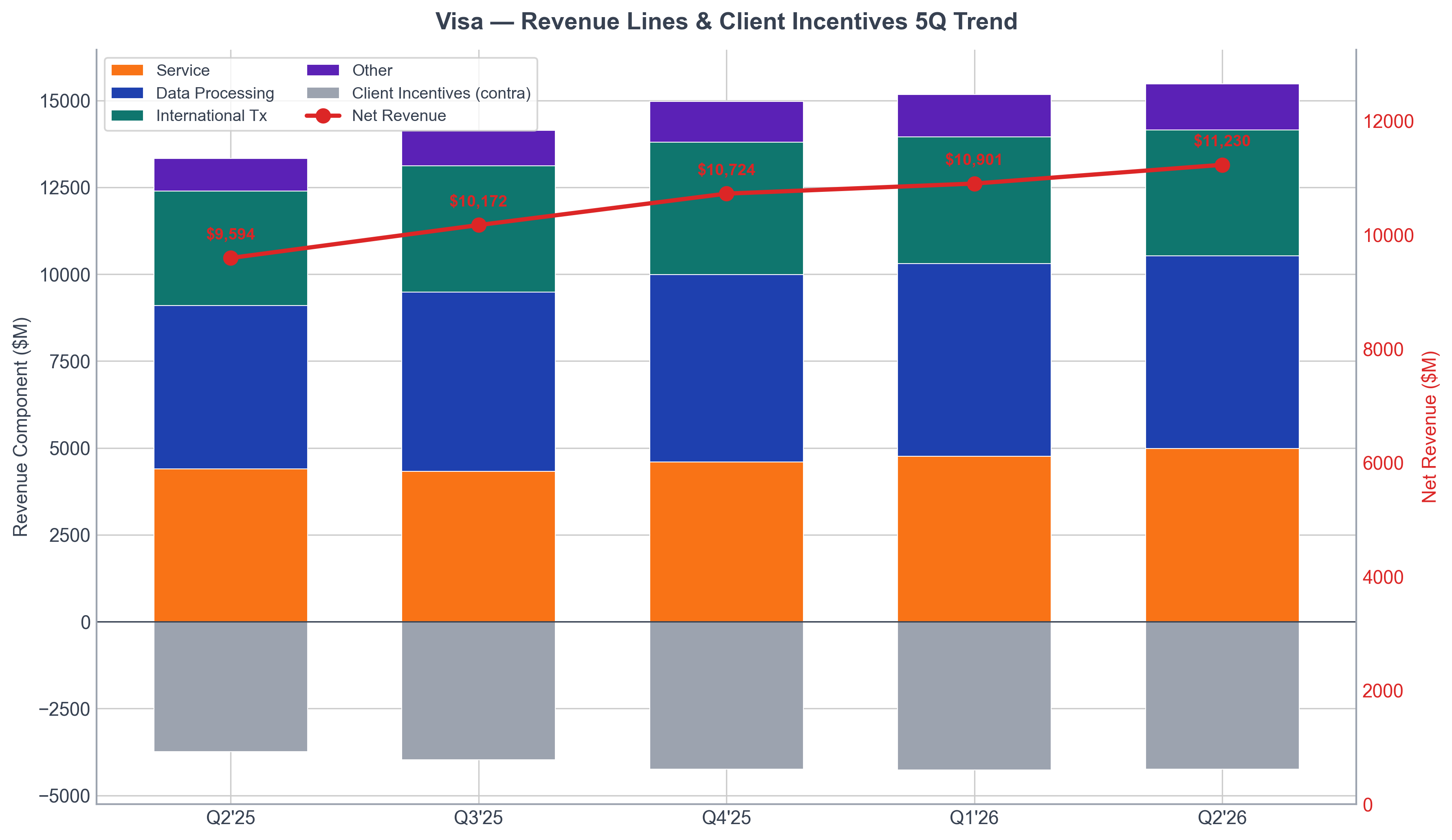
Source: Visa Inc. 2Q26 results
On the volume side, U.S. cc payments volume grew +8% yoy, accelerating 1.5pt from Q1. U.S. Credit was up +10% yoy — the fastest U.S. credit-card payments-volume growth in nearly 3 years. Debit was up +7%. E-commerce ran faster than face-to-face, but credit and debit accelerated together. The most quotable line came from Suh on the call:
"We do not see signs of the lower spend consumer weakening in our volumes."
That sentence sits in interesting tension with what I wrote in January in A Tale of Two Headwinds, where I argued the political momentum behind the Trump CCCA proposal leaned on a "low-end-consumer-stress" narrative. When the hard data on this side fails to corroborate that stress, the political tailwind on the other side tends to fade with it.
Cross-border resilience deserves equal billing. The hard wedge the market had pre-priced — March oil shock plus the Middle East conflict plus dollar volatility — simply did not materialize. Cross-border total cc grew +12%, ex-intra-Europe cc +11%, e-commerce +13% yoy. April month-to-date cross-border ticked down briefly, and the CFO's explanation was Ramadan timing — normalize for it, and you're back to February levels. That kind of facts-first caveat is, frankly, more useful to my model than yet another "we remain confident" boilerplate.
The one drag management acknowledged head-on was CEMEA: cc growth stepped down about 2.5pt from Q1, mostly on the Middle East conflict. That said, CEMEA is roughly 6% of Visa's total payments volume, so the dilution to the consolidated picture is contained.
Volume KPIs, Q1 vs Q2: U.S. Credit and Total Cross-Border Show the Sharpest Acceleration
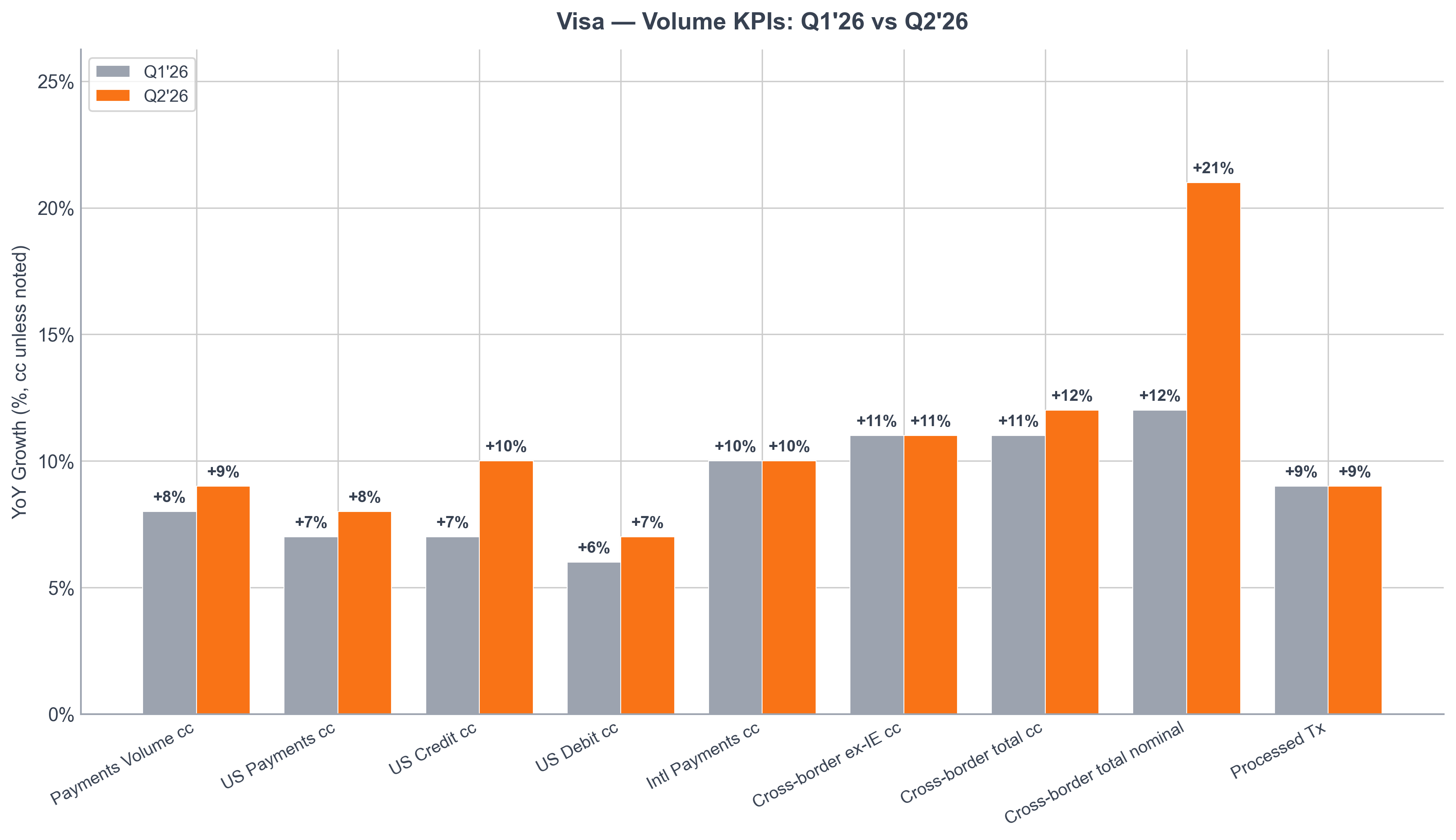
Source: Visa Inc. 2Q26 results
VAS now sits at 30% of net revenue and grew +27% cc yoy — above the upper bound of the mid-to-high-teens medium-term guide range Visa laid out at its 2024 Investor Day. It has stopped being "the source of upside" and become part of the structural baseline. CEO Ryan McInerney attributed the past four quarters of VAS acceleration to the strategy laid out two years ago at Investor Day finally landing — the AI-driven stand-in processing platform on the issuing side, the Visa Account Updater on acceptance, Visa Consumer Authentication Service and Visa Risk Manager on the risk side. Asked whether fraud demand had stepped up, McInerney gave a rare, unhedged yes — and put the early empirical results from Visa's own Visa Large Transaction Model on the table: "can power up to a 5x increase in fraud value capture."
OpEx had two non-linear features worth flagging. Marketing was up +43% yoy and +33% QoQ, reflecting front-loaded spending tied to FIFA World Cup and Olympics. The MDL litigation provision rolled off in cyclical fashion — $329M this quarter versus $992M a year ago — pushing GAAP OpEx into a -4% yoy print, which sits in striking contrast with the underlying Non-GAAP cc +13%. When you read the model, this is one item that has to be backed out cleanly.
The most under-rated piece of management signaling this quarter was the guidance. The full-year FY26 outlook was meaningfully raised — Net Revenue Growth from "low double-digit" to "low double-digit to low teens," and EPS to "low teens" — the second consecutive quarterly raise. Compare this with the "beat-but-don't-raise" posture management held after 1Q26, and it tells you the internal expectation for 2H26 runs hotter than even the +1pt revenue lift the April-effective tokenization pricing alone implies.
But there's an honest qualifier on this side too. The CFO himself flagged that the 24% cc growth in Commercial & Money Movement Solutions this quarter contained one-time pricing and deal-timing items and was not extrapolable. When pressed on whether the medium-term framework laid out at 2024 Investor Day should be recalibrated, he chose to hold — and that restraint, to me, is more trustworthy than another raise would have been.
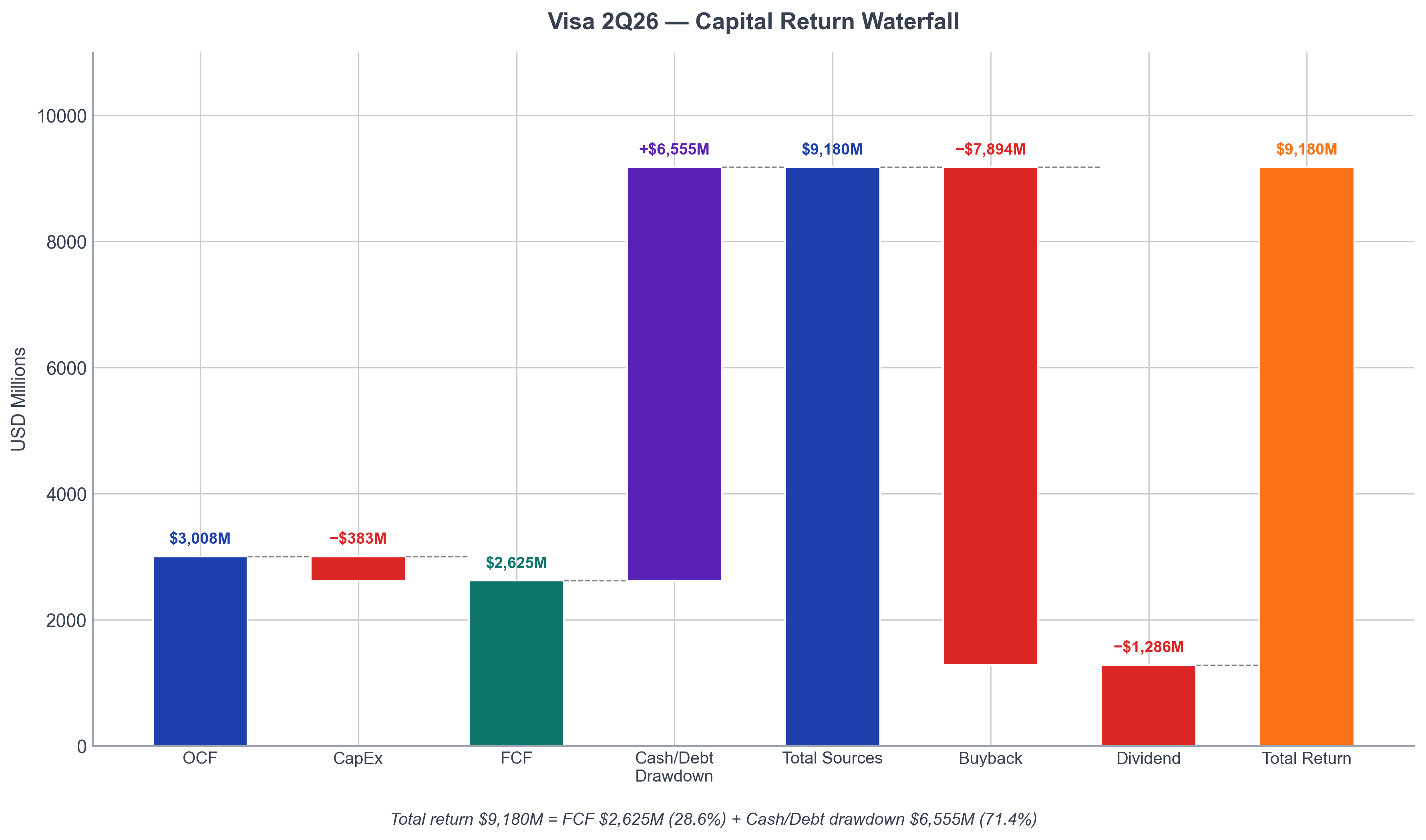
Finally, capital return. Visa repurchased $7.89bn of stock in the quarter — the largest single-quarter buyback in the company's history. Adding $1.29bn of dividends, total capital return came in at $9.18bn. The board separately authorized a new $20bn multi-year repurchase program — stacked with the $13.2bn still available under the existing authorization, total available capacity sits at $33.2bn.
Q2 Capital Return: FCF + Cash Drawdown → $9.2bn Payout
Source: Visa Inc. 2Q26 results
The cadence is worth calibrating: Q2 FCF of $2.63bn covered only 29% of the quarter's capital return; the rest was funded by drawing down cash reserves and a fresh $3bn senior notes issuance. With the valuation multiple sitting at "absolute lows since 2022 and a relative premium to the S&P 500 compressed to its narrowest since the GFC," management is using the balance sheet to support buybacks — voting with capital allocation that the stock isn't expensive here. That's management putting real money where its mouth is, not just words.
So back to the one-line summary: a broad-based acceleration paired with one honest caveat. When a network is genuinely accelerating, willingly caveats its own outperformance, and — in the very same quarter — calls itself an "infrastructure operator" for the first time, the posture you're looking at is confident but not flippant. It deserves a closer look at what it implies for the next 2-3 years.
That brings me to the detail from this print I'd most hate to see buried.
An Almost Imperceptible Re-naming
The keyword in 1Q26 was "payments hyperscaler" — a piece of rhetoric, a piece of positioning. The keyword in 2Q26, used by Ryan McInerney while answering a question on the unit economics of stablecoin and agentic-commerce transactions, was something newer and more engineering-flavored: "hyperscaling bridge layer."
A single preposition's worth of difference, but the meaning shifts. The first describes Visa as "the AWS of payments." The second describes the network position Visa occupies between stablecoin infrastructure and real-world commerce.
A bridge layer, taken literally, is a bridge. But across this quarter, Visa took a sequence of concrete actions that tell the market something more pointed — this bridge isn't a bystander standing on either bank. The bridge itself is the road.
The Architectural Turn
Lay the four moves of this quarter side by side.
First, Visa took on a validator role on the Tempo blockchain — meaning it actually runs nodes on-chain, participates in consensus, signs and finalizes blocks.
Second, on the Canton Network, it became a super-validator, with a seat in network governance.
Third, the number of stablecoin settlement chains expanded from 4 at Q1 to 9. The annualized stablecoin settlement run rate now stands at $7bn, up +50% QoQ. Stablecoin card programs have grown to 160, with payments volume up nearly +200% yoy.
Fourth, Visa CLI shipped as a proof of concept; the Machine Payments Protocol card specification — co-developed with Tempo — is the substrate underneath it.
Read each move on its own and they look like four discrete product announcements. Read together and the gestalt is an identity upgrade: for the first time, Visa is repositioning itself from a user of payments infrastructure to an operator of it. McInerney himself put it in a plain but heavy line:
"Running a validator node moves Visa from a blockchain participant to an infrastructure leader."
Last October, I wrote about Visa Direct's stablecoin pre-funding pilot. The animating question of that piece was: are stablecoins a disruptive threat to Visa, or are they the very tool Visa will use to entrench its dominance? The answer leaned toward the latter then — but it was still a directional thesis, no more.
2Q26 is where that thesis acquires its first set of architectural footprints.
Two Scenarios for the Same Question
This is precisely why this print deserves a careful read rather than a credulous embrace of management's storytelling.
There are, on the question of "what stablecoins and agentic commerce mean for Visa," two genuinely live possibilities right now.
Scenario A (the one management is betting on): stablecoins and agentic commerce don't replace Visa's economic model — they extend it. The Bank of America analyst on the call asked the question directly: are stablecoin and agentic transactions accretive, dilutive, or agnostic to Visa? McInerney didn't dodge. He gave a thesis-level answer: "the economics of those products look just like our normal products." The accompanying use case was an Argentine Visa employee holding stablecoins, then using a stablecoin-funded Visa debit card at the restaurant, the gas station, the grocery store. Issuance, acquiring, interchange, tokenization, brand, dispute resolution — every toll booth on the chain still belongs to Visa. The only thing that changed is the underlying asset, from fiat to stablecoin.
Scenario B (offered by a former Visa Digital Partnerships director on an expert call last December): stablecoins are the single largest long-term disruption risk to Visa's high-margin cross-border business. The logic chain closes cleanly — once merchants accept stablecoins directly at scale, cross-border interchange and FX yield both get disintermediated. Visa might preserve its network effects; it can't preserve its take rate.
I do not feel confident assigning a probability distribution between the two.
But what 2Q26 makes legible is management's chosen hedge against Scenario B: rather than wait for stablecoins to disintermediate Visa out of cross-border, embed Visa itself into stablecoin networks at the consensus and settlement layers — so that stablecoin's expansion has to flow through Visa's validator infrastructure to get where it's going.
This is a strategic move, not a financial one. The marginal revenue from running a validator node on-chain is modest. Its strategic value is to position Visa at one of the points stablecoins can't route around once they grow up.
The April-effective tokenization pricing is the first quantifiable monetization of that hedge. By itself it's not big — about a 1pt revenue lift to 2H26 — but it does demonstrate that take rate can be raised, not only compressed, under the new architecture.
Trust as the Limiting Factor — A Claim Worth Accepting With Calibration
Tucked into McInerney's framing of agentic commerce was a line the market under-priced:
"The limiting factor for agentic commerce is trust."
He deliberately set that against the limiting factors most of the AI industry talks about — compute, power, data centers.
When a sentence like that comes out of an incumbent's mouth, the first instinct should be calibrated skepticism. It's a textbook case of "define the binding constraint where it happens to be most flattering to your own assets." Classic incumbent positioning.
And yet the claim has more substance than that critique gives it credit for. When an AI agent pays on the user's behalf, three questions surface immediately. Who does the agent pay? When the agent pays the wrong party, who do you go after? When losses come from a prompt-injection attack, or from one malicious agent fooling another, where does liability sit?
These problems do not solve themselves once the supply side of compute, power, and data centers is solved. They live in a different layer — transaction-side, liability-side, dispute-side — which happens to be the layer Visa has spent more than 60 years building governance, tokens, KYC, and dispute machinery to handle.
I agree with half the claim. Compute and trust aren't substitutes; they're different layers of bottleneck. But conceding that trust is a real bottleneck is not the same as conceding Visa is the only solution to it.
What Visa CLI as a proof of concept actually means is this: it packages Visa's trust-layer capabilities into a developer-facing surface. If micro-transactions — agents paying for their own data, API calls, and model tokens transaction by transaction — really do mature into a new transaction category, the position Visa is reaching for is not acquirer and not issuer. It is something more interesting: the default payment method an agent picks up the first time its wallet is set up, the way a Visa card is the default in today's e-commerce checkout.
It's a bet that can fail. But it bets on a real bottleneck, not an imagined one.
One Question Still Open
Read 1Q26 and 2Q26 side by side, and what you see is Visa using 6 months to perform a synchronized upgrade of narrative and architecture — from "payment network" to "payments hyperscaler" to "hyperscaling bridge layer with infrastructure-operator role." The language has changed, and the footprint has caught up.
This quarter's financials gave the upgrade a supportive backdrop — broad-based acceleration, no low-end consumer weakness, cross-border resilience, VAS at 30% of mix, a guidance raise, a record-setting capital return. None of these "prove" any thesis. They simply provide management the material conditions to push the narrative further.
But there is a question 2Q26 does not answer — and that no single quarter ever could:
When the bridge becomes the road, can the economics of crossing the bridge stay the same?
McInerney's answer is yes. The validator-and-super-validator architectural commitment is the wager behind that yes. The April tokenization-pricing rollout is the first quantitative evidence in its favor.
But this is a proposition that needs FY27 and FY28 to be verified.
If two years from now we see cross-border take rate compression — or stablecoin settlement reaching the $30bn run-rate range without a positive yield contribution from the mix shift — then it's the former Visa Digital Partnerships director's call that gets printed.
If, instead, the take-rate uplift implied by the architectural upgrade actually holds — and micro-transactions do materialize as a new category, with Visa credentials taking the default slot in agent wallet setup — then it's McInerney's call that gets printed.
My job is to put both scenarios on the table and leave room for each — not to decide on Visa's behalf which one wins.
The 2H26 prints are where this question will get its first early grade.
Earnings Call Recap
I will now share a more detailed analysis of this earnings result behind the paywall:


