
Synopsys 1Q26 Earnings Review: Proved the Margins — Now Prove the Growth
Synopsys delivered margin expansion two years ahead of Wall Street's timeline — so why isn't the market convinced?


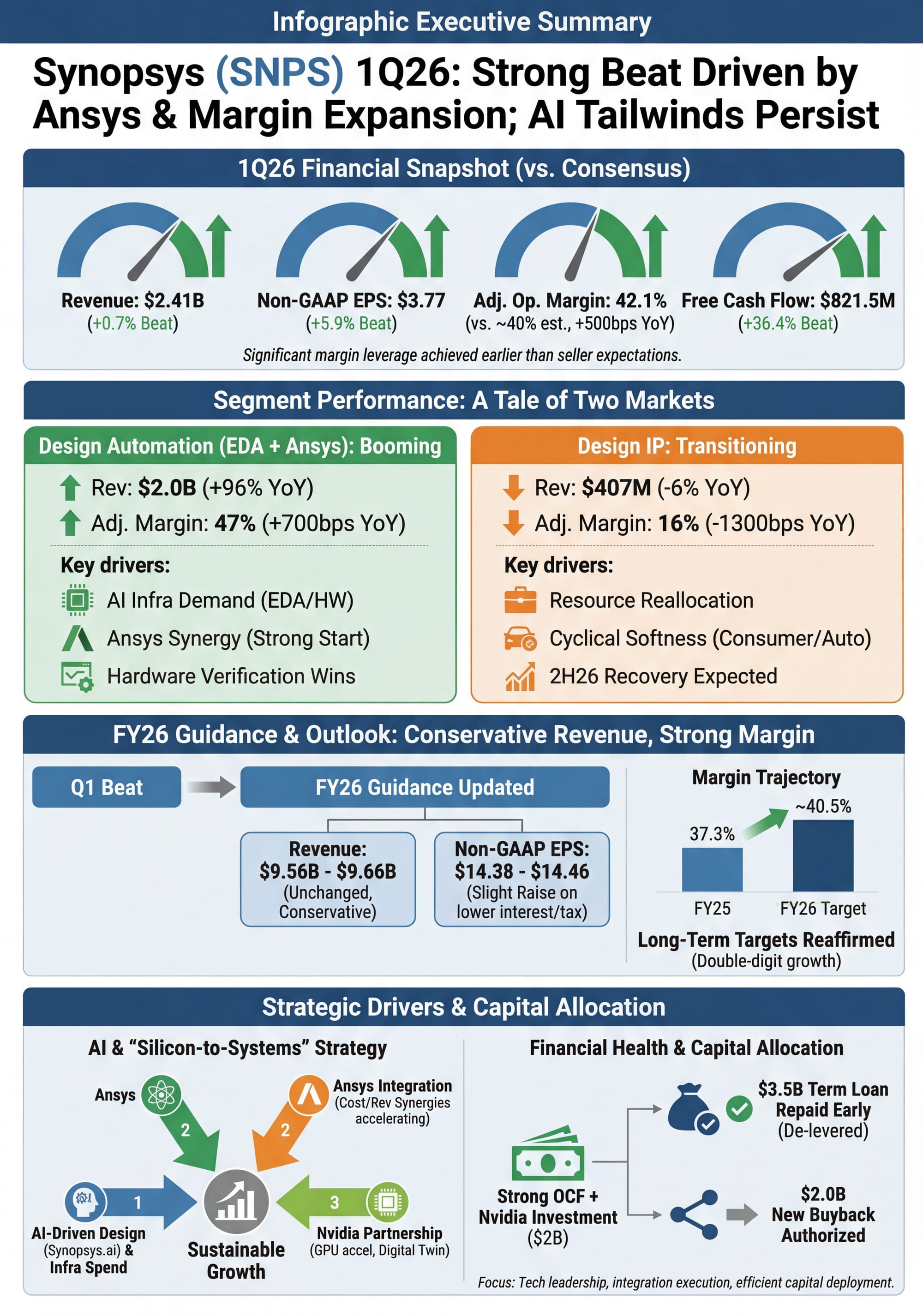
Synopsys 1Q26 Earnings Review: Margins Arrived Ahead of Schedule — What Is the Market Still Waiting For?
In the quarter marking its 40th anniversary, Synopsys delivered a report card the market couldn't quite figure out how to price.
The 1Q26 numbers (for the quarter ending January 31, 2026) were strong by any measure: total revenue of $2,408.8 million, up 66% year-over-year, slightly beating Bloomberg consensus of $2,392.5 million. Non-GAAP EPS came in at $3.77, handily topping the Street's $3.56 estimate by nearly 6%. Adjusted operating margin reached 42.1% — a full 500 basis points above the year-ago 37%, and roughly 200 bps ahead of the 40.3% consensus. Free cash flow hit $821.5 million, beating expectations by 36%.
The implications are hard to dismiss. The prevailing sell-side narrative had been that "Synopsys won't show meaningful margin leverage until 2027." Q1 answered that skepticism head-on — the margin improvement isn't just happening, it's arriving earlier than anyone had modeled.
And yet the stock dipped after hours. Shares had already climbed roughly 7% ahead of the print, and management held full-year revenue guidance steady at $9.56–9.66 billion, nudging Non-GAAP EPS up by a mere $0.06. In a market conditioned to expect the "beat and raise" playbook, Synopsys's restraint read as insufficiently generous.
This tension — between strong execution and conservative guidance — is precisely the entry point for understanding where Synopsys's investment narrative stands today.
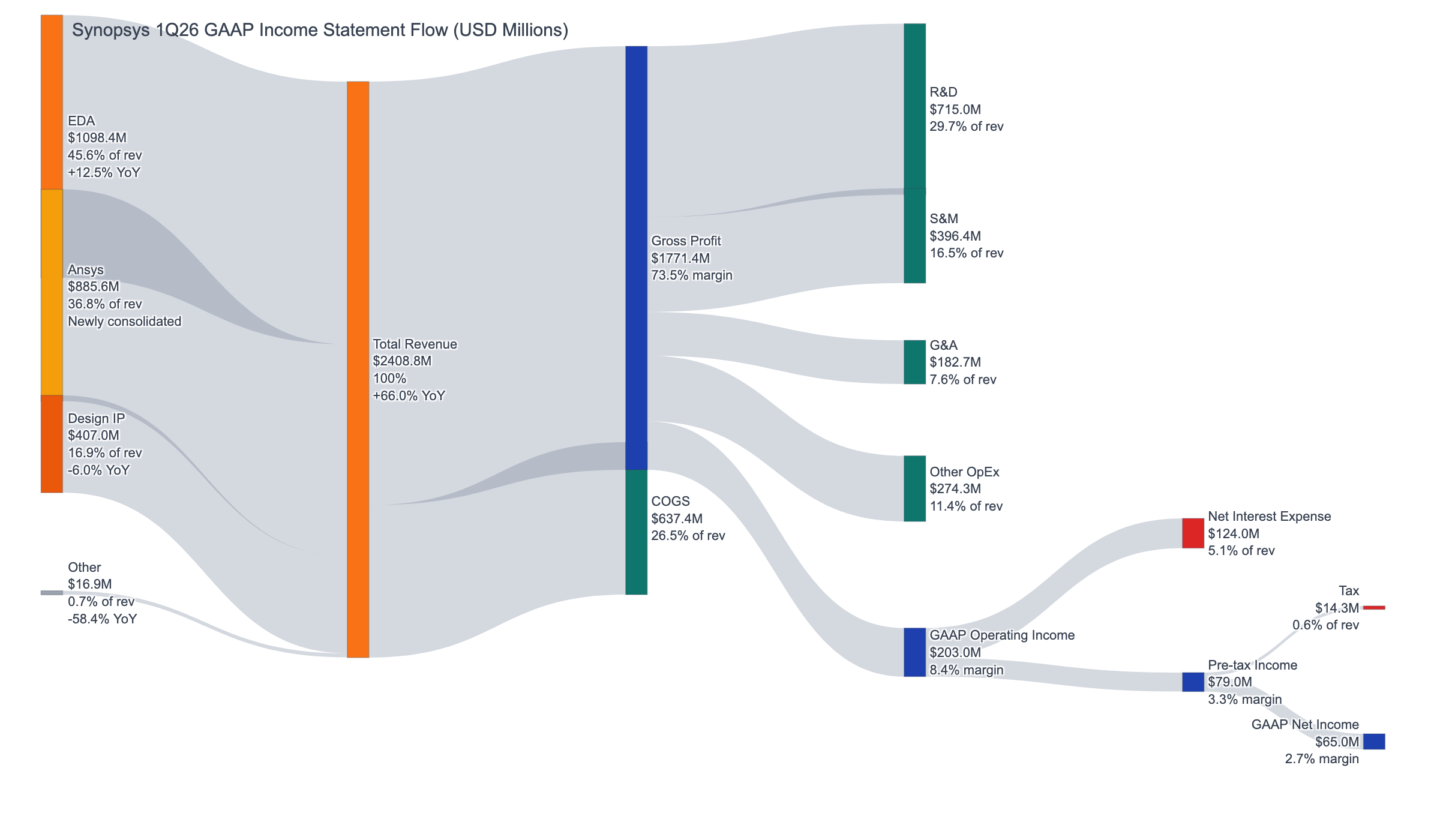
Synopsys 1Q26 GAAP Revenue-to-Net-Income Flow
source: Synopsys 1Q26 Earnings Data, Jason & Jarvis
The Sankey diagram above offers an intuitive view of how 1Q26's profit flowed — or rather, where it got absorbed. The $2,408.8 million in total revenue passed through a healthy 73.5% gross margin, then was progressively consumed by R&D ($715.0 million, 30% of revenue), S&M ($396.4 million), G&A ($182.7 million), and other operating expenses including $118.3 million in restructuring charges, leaving GAAP net income at just $65.0 million — a 2.7% net margin. That is the GAAP cost of a $34.9 billion acquisition. But as we'll explore, this GAAP figure tells only one side of the coin.
The Margin Surprise: Not Just a Beat, But an Early Arrival
If you had to distill this entire earnings report into a single number, 42.1% adjusted operating margin would be it.
Some context. In our earlier Synopsys FY2025 Annual Report Visualization, we documented an uncomfortable reality: FY25 revenue grew 15%, yet operating profit plunged 32%. The $447 million in interest expense and $504 million in intangible amortization from the Ansys acquisition acted as twin beasts devouring profits. The market's central concern was unambiguous: when would this $34.9 billion deal actually start improving the bottom line?
1Q26 provided the first substantive answer.
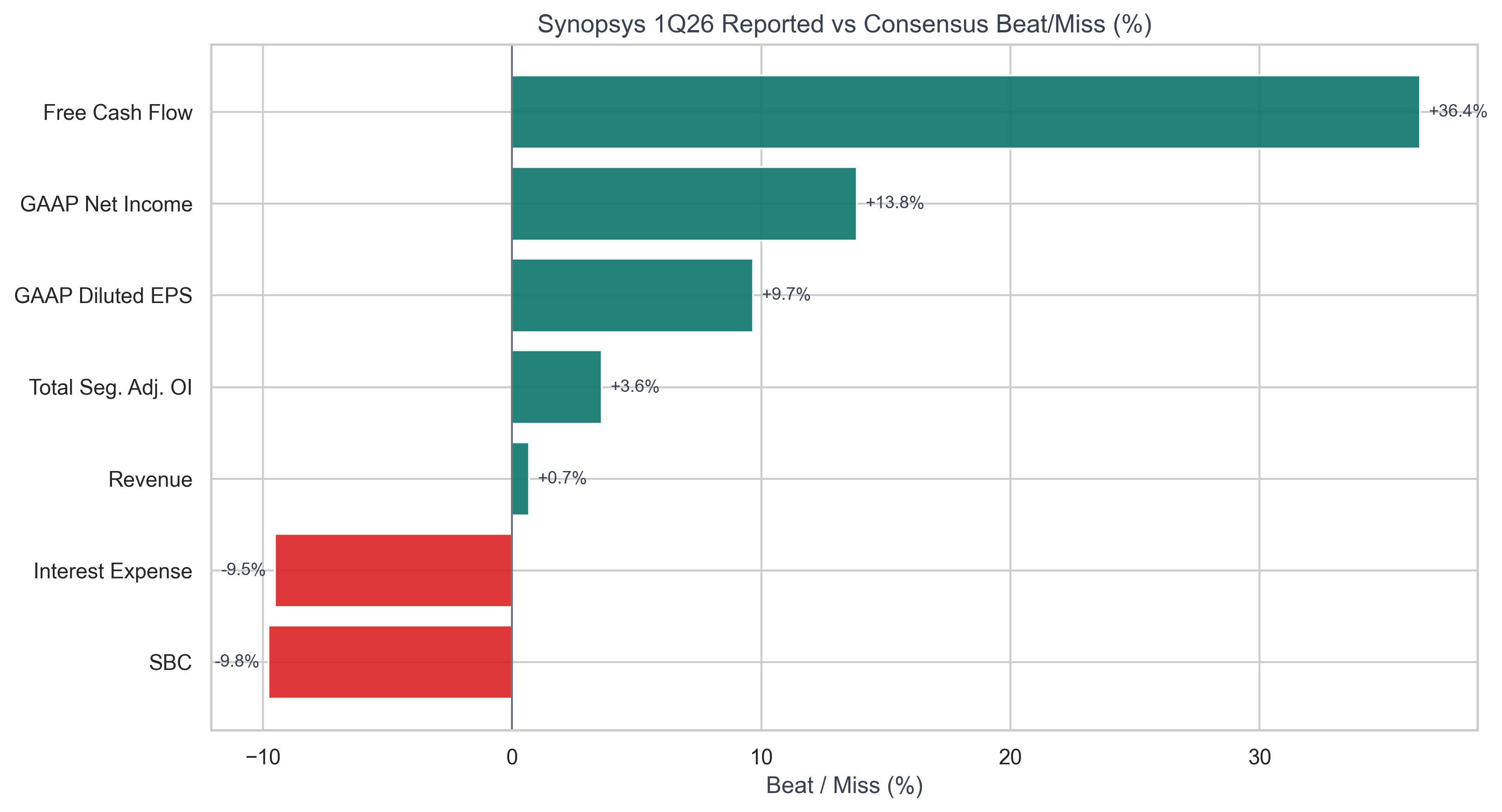
Synopsys 1Q26 Key Financial Metrics: Beat/Miss vs. Consensus
source: Synopsys 1Q26 Earnings Data, Jason & Jarvis
The Design Automation segment — now encompassing both legacy EDA and Ansys products — posted a 47% adjusted margin, up 700 basis points from 40% a year ago. This wasn't accounting sleight of hand. CFO Shelagh Glaser confirmed on the call that non-GAAP total costs and expenses landed at the low end of guidance, driven by expense timing optimization and operational efficiency gains. Non-GAAP EPS of $3.77 beat expectations by 5.9%, aided by a trifecta of improvement across revenue, expenses, and interest costs.
Full-year guidance holds the ~40.5% non-GAAP operating margin target, a roughly 320 bps uplift from FY25's 37.3%. But if Q1 is already running at 42%, it implies management is embedding highly conservative assumptions for the back half — or, perhaps more strategically, banking ammunition for future raises.
Ansys: From Rescuer to Synergy Engine
In our 4Q25 Earnings Review: Ansys to the Rescue, we tracked how Ansys propped up the overall result with $667.7 million in revenue that handily beat expectations, and posed a central question: was Ansys's outperformance masking weakness elsewhere, or was it powering genuine transformation?
The 1Q26 data tilts the answer toward the latter.
Ansys contributed $885.6 million in revenue this quarter, representing 36.8% of the total and exceeding the Street's $865 million estimate. Part of that strength reflects seasonality — Ansys's legacy fiscal year ended in December, concentrating a large revenue bolus into what is now Synopsys's Q1 (November through January under its October fiscal year). The CFO indicated this seasonal pattern will gradually normalize as the sales force aligns with Synopsys's reporting calendar.
But beyond seasonality, the substance of the integration progress deserves closer attention.
The first wave of joint solutions is expected to ship in the first half of 2026. CEO Sassine Ghazi explained the core value proposition: customers designing multi-die systems historically wouldn't discover thermal or structural issues until the sign-off stage, triggering costly iteration loops. The joint solutions aim to pull physics-based analysis forward into the design phase itself, fundamentally shortening those cycles. More product details are expected at the Converge conference on March 11–12.
Synergy targets remain unchanged: a $400 million cost synergy run rate within three years and a $400 million revenue synergy run rate within four. Management indicated the cost side is accelerating, with ambitions to pull forward some targets into the first two years. Cross-selling teams have completed training and begun executing — Synopsys reps selling Ansys products and vice versa — with some revenue already generated this quarter, though specifics were not disclosed.
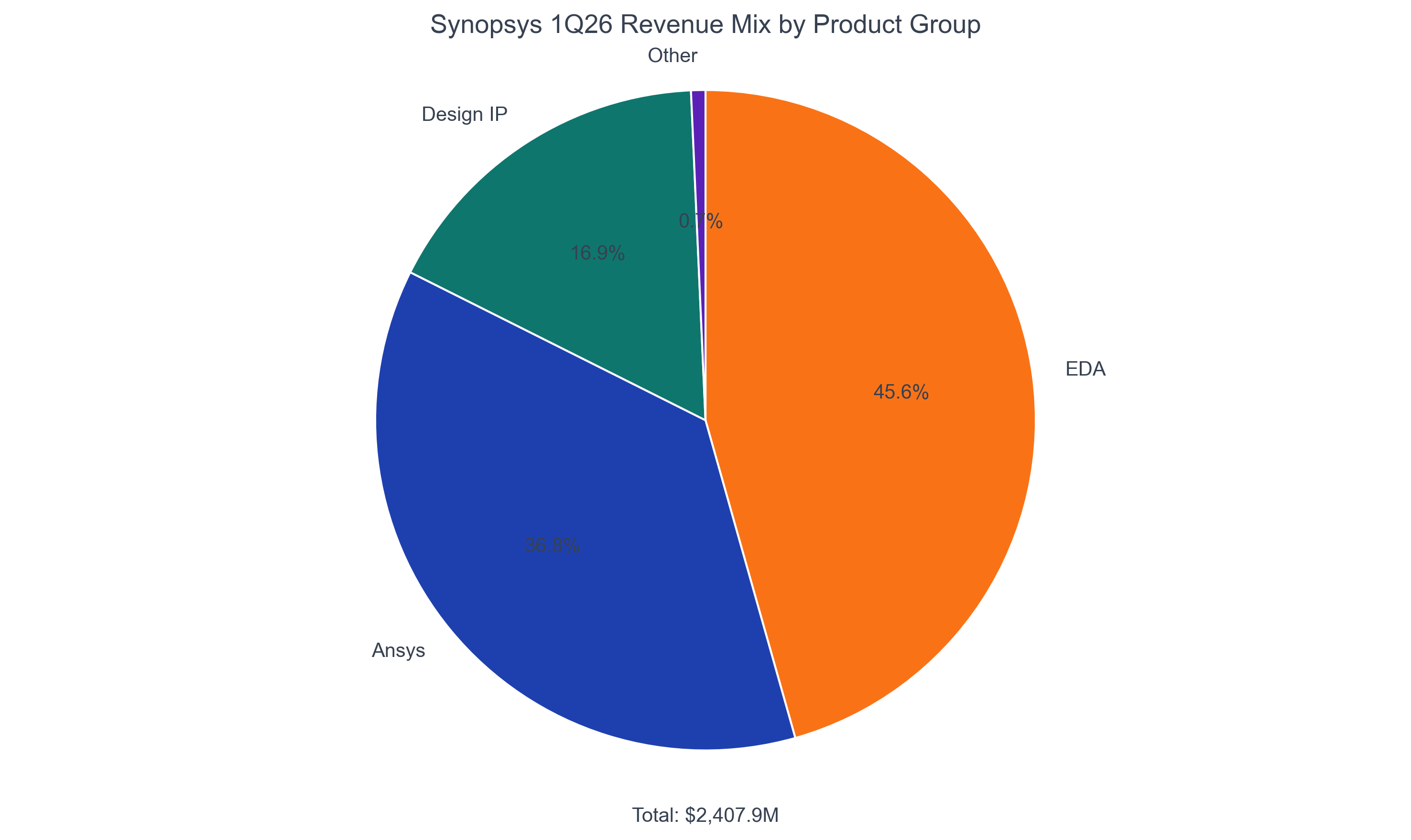
Synopsys 1Q26 Revenue Composition by Product Group
source: Synopsys 1Q26 Earnings Data, Jason & Jarvis
The revenue composition tells its own story. EDA's share dropped from 67.3% to 45.6%. Design IP fell from 29.9% to 16.9%. Ansys now occupies 36.8% of the total. The company's identity shift — from chip design tool vendor to silicon-to-systems engineering solutions platform — is being etched into the financial statements in real time.
The CFO further noted that Ansys's ability to serve multiple end markets is a key source of growth confidence. Simulation and analysis penetration across the total addressable market remains low, offering both expansion within existing accounts and substantial greenfield opportunity. Following the acquisition, Synopsys now serves over 90% of the world's top 100 automotive suppliers. At CES in January, the company showcased how AI-driven simulation is helping customers like Audi reduce physical prototyping and compress development timelines.
Design IP: The Wound That Hasn't Healed
If Design Automation is the highlight reel, Design IP is the wound still bleeding.
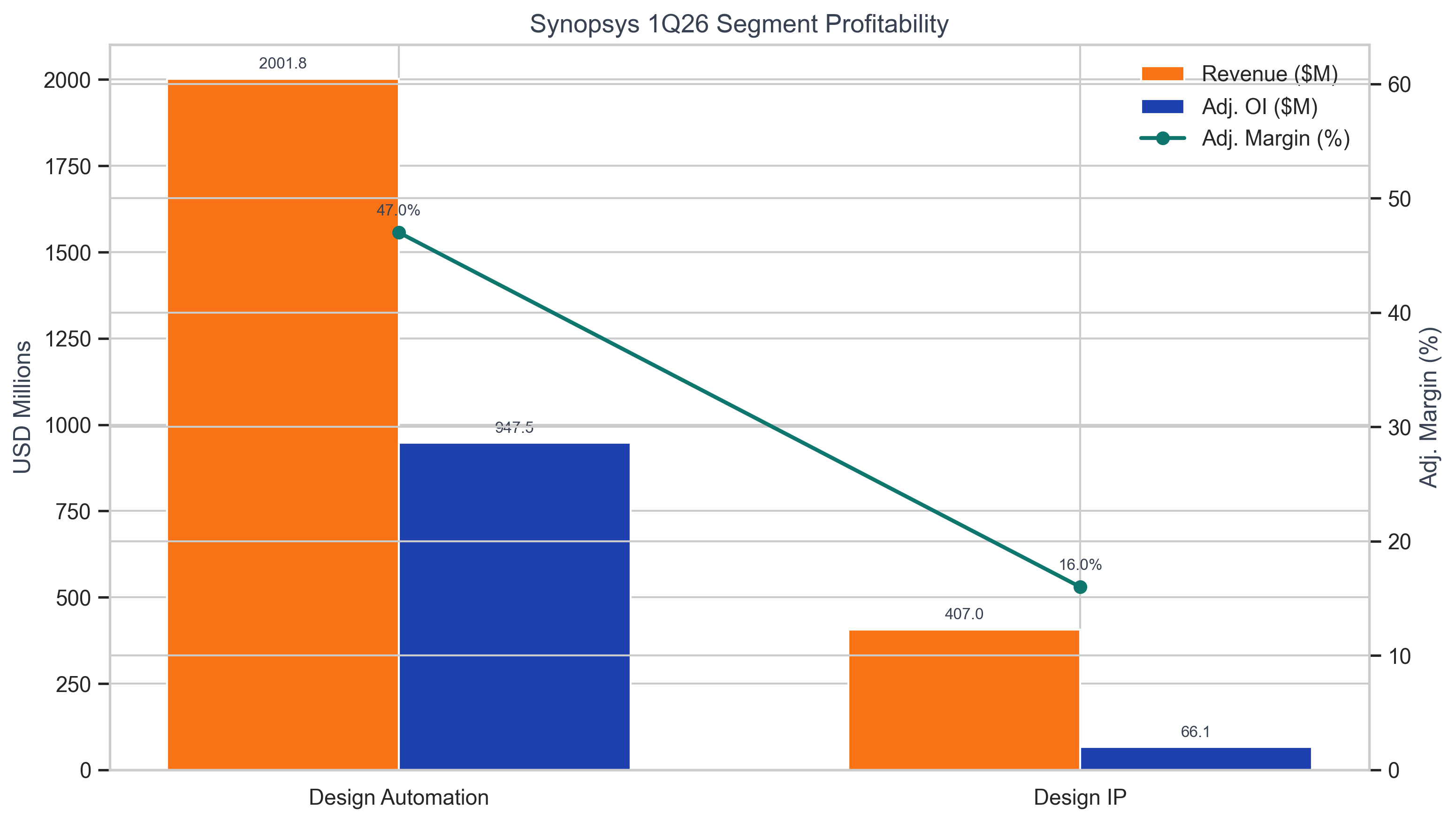
Revenue came in at $407.0 million, down 6% year-over-year and slightly below consensus. This was largely expected — management had already warned that FY26 Design IP growth would remain "muted." The real concern lies in profitability: adjusted operating margin collapsed from 29% to 16%, with adjusted operating income of just $66.1 million missing consensus by nearly 24%.
Synopsys 1Q26 Segment Profitability (Design Automation vs. Design IP)
source: Synopsys 1Q26 Earnings Data, Jason & Jarvis
47% on one side. 16% on the other. The 31-percentage-point chasm between these two segments may be the most revealing metric in the entire earnings release.
Management's confidence in an IP recovery rests on three pillars. First, AI-driven design starts remain robust, creating bundling opportunities across the IP portfolio. Second, interface standard evolution cycles are compressing — the CEO noted that PCIe and similar standards have seen their lifecycles shrink from 3–4 years to roughly half that, implying more frequent IP refresh demand. Third, growing customer appetite for foundry optionality plays to Synopsys's multi-foundry IP coverage.
But the revenue cadence skews heavily toward Q4. The CFO explicitly confirmed that IP title availability is more Q4-weighted, meaning investors need to exercise patience with first-half numbers. Meanwhile, the company signed a definitive agreement in January to sell its Processor IP business to GlobalFoundries, concentrating resources on the faster-growing interface IP segment — a move consistent with the competitive dynamics we analyzed in our Synopsys vs. Cadence IP product line comparison. Synopsys has chosen the "IP supermarket" strategy, but is learning it needs sharper resource allocation within that store.
The China picture adds another layer. Excluding Ansys, Synopsys's China revenue declined modestly year-over-year. The CEO was candid: cumulative export restrictions are "materially impacting customer commitments and demand." Some customers may opt for domestic foundries over external ones, directly hitting IP revenue tied to specific process nodes. Notably, Cadence expects its China business to grow in line with its company average (roughly +12% year-over-year), while Synopsys's organic China business is shrinking. Whether this divergence reflects structural differences in their China exposure or merely timing remains an open question worth monitoring.
The IP segment also faces a structural constraint: it is a more labor-intensive business than EDA. The CFO stated plainly in Q&A that IP operating margins will persistently run below the corporate average. Management's thesis is straightforward: once title delivery returns to a normal cadence, growth and margins will self-correct. But FY25 already demonstrated that these delivery timelines can produce unpredictable revenue swings.
Cash Flow Inflection and Balance Sheet Repair
If the margin improvement answers "can they earn it?", the cash flow data answers "can they collect it?"
Operating cash flow surged from negative $67.5 million in the year-ago quarter to $856.8 million — an improvement exceeding $924 million. Free cash flow of $821.5 million beat consensus by 36.4%, the single largest positive surprise of the quarter.
More critically, the balance sheet actions speak volumes. Synopsys fully repaid its $3.5 billion Term Loan during the quarter — the original plan called for retiring the $2.55 billion remaining balance by the first half of 2026, but execution ran well ahead of schedule. The CFO confirmed on the call: "Fully repaid the $4.3 billion term loan, delivering on our commitment from last quarter." Simultaneously, Nvidia's $2.0 billion private placement closed, with approximately 4.8 million shares issued at $414.79 per share.
With the debt structure now clarified — $10.0 billion in Senior Notes outstanding at fixed rates of 4.55%–5.70%, maturing between 2027 and 2055 — interest expense will continue to decline. The $162.7 million interest charge in 1Q26 already came in below the $179.8 million consensus, a trend set to compound over coming quarters.
The board also authorized a new $2.0 billion share repurchase program. For a company that suspended buybacks mere months ago under acquisition-related cash pressure, this represents a notable shift in posture. Full-year FY26 targets — roughly $2.2 billion in operating cash flow and $1.9 billion in free cash flow — give management meaningful flexibility to allocate across debt service, repurchases, and reinvestment.
Organic Growth: The Elephant in the Room
Behind all the bright spots, one question refuses to go away.
Stripping out Ansys, Synopsys's 1Q26 organic revenue grew approximately 4.7% year-over-year. Sell-side estimates for CY25 and CY26 organic growth sit at +5% and +8%, respectively — meaningfully below Cadence's corresponding +14% and +15%.
This isn't a new concern. Across our coverage over the past several quarters, we've consistently treated the divergence between organic and acquisition-driven growth as a critical barometer for Synopsys's underlying business health. The 1Q26 data confirms the gap persists.
In fairness, Synopsys offers reasons for optimism. The CEO disclosed a marquee emulation win at a leading AI HPC customer — "a marquee emulation win versus the incumbent" — which some analysts interpret as Synopsys's verification hardware defeating Cadence's ASIC-based platform. The hardware-assisted verification business has set records for multiple consecutive years, and management expects continued momentum.
On the EDA software front, customers using Synopsys.ai report knowledge-assisted speed improvements of up to 50%, workflow-assisted gains of up to 70%, and formal test bench generation acceleration of up to 5x. At 2nm and below, Fusion Compiler and PrimeTime have achieved 100% adoption in critical tapeouts. The company also demonstrated an industry-first PCIe 8.0 implementation and secured first-to-market positioning for 224G SerDes at advanced nodes.
These represent genuine technology moats. But the market's focus ultimately narrows to a single question: when do they translate into faster organic growth?
The 2027 Option Value
The CEO has framed 2026 as a "year of delivering on technology commitments." That makes 2027 the harvest year.
Management outlined several parallel value-creation paths on the earnings call.
Ansys joint solutions. The first products ship in the first half of 2026, but revenue contribution is expected to begin in FY2027. The four-year, $400 million revenue synergy target stands.
Nvidia GPU acceleration. As we explored in detail in our NVIDIA-Synopsys Alliance analysis, the two companies are pursuing a two-layer collaboration: at the base layer, migrating EDA and Ansys products to GPU acceleration — the CEO stated on the call that if a product achieves 15–20x speed-up moving from CPU to GPU, there is corresponding pricing upside; at the upper layer, Omniverse-based digital twins — physical AI demands precise simulation and analysis, which is exactly where Ansys's portfolio excels. Multiple GPU-accelerated products are expected to ship within calendar 2026.
Agentic AI roadmap. The CEO provided the first systematic articulation of the AgentEngineer architecture: L1 reinforcement learning applied to individual technologies → L2 task agents → L3 agent orchestration → L4 planning → L5 fully autonomous orchestration. He emphasized one critical constraint: "Our agents cannot hallucinate. They have to be 100% accurate." On monetization, management explicitly put value-based pricing on the table — "when the workflow changes, that's the opportunity to change the monetization model."
These three paths share a common temporal feature: their revenue impact concentrates in FY2027 and beyond. This also explains why, despite a strong Q1, management chose not to raise full-year revenue guidance — the current quarter's outperformance reflects Ansys seasonality and execution optimization more than structural growth acceleration.
Synopsys FY26 Guidance Tracker (Updated vs. Prior vs. Street)
source: Synopsys 1Q26 Earnings Data, Jason & Jarvis
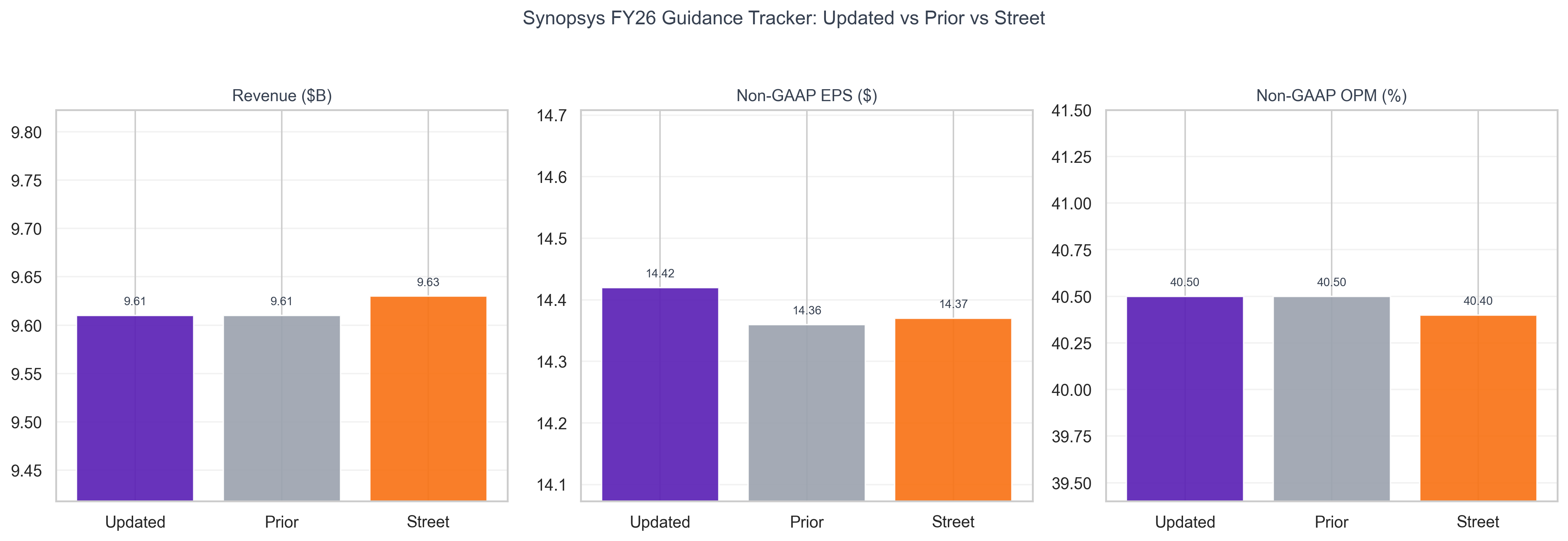
The guidance tracker tells the story plainly. Revenue at $9.61 billion — unmoved. Non-GAAP EPS nudged from $14.36 to $14.42. Non-GAAP operating margin held at 40.5%. This is a deliberately conservative update. Management is clearly banking Q1's outperformance rather than releasing it early.
Three Quarters In: Where Does the Narrative Stand?
Looking back across the past three quarters traces a trajectory of confidence recovery.
3Q25 sounded the alarm — margins missed badly, the IP business flashed an unusually negative signal, and market confidence in the Ansys integration wavered. 4Q25 brought Ansys to the Rescue — Ansys revenue far exceeded expectations, restoring short-term trust. 1Q26 pushed the story further: margin leverage materialized ahead of schedule, cash flow recovered sharply, and the balance sheet underwent rapid repair. The $3.5 billion term loan was fully retired. A $2.0 billion buyback was authorized.
But validation comes in layers.
Margins — validated. Cash flow — validated. What remains unproven is organic growth and IP recovery. CY25 at +5% and CY26 at +8% organic growth, for a company claiming to sit at the epicenter of the AI infrastructure build-out, aren't yet compelling enough. Cadence, at +14%/+15%, constitutes a quiet counterpoint. Management is placing its bets on 2027: joint solutions begin monetizing, GPU-accelerated products reach the market, and AgentEngineer transitions from concept to commercial reality.
The Converge conference on March 11–12 will serve as the next catalyst — the market expects concrete product details, target markets, and early customer feedback for the joint solutions. Long-term growth targets — double-digit for EDA, mid-teens for IP, double-digit for Simulation & Analysis — were repeatedly reaffirmed in Q&A. But the more frequently they are reaffirmed, the shorter the market's patience for delivery becomes.
Synopsys stands at its 40th anniversary with an $11.3 billion backlog, coverage of over 90% of the world's top automotive suppliers, and a silicon-to-systems product matrix backstopped by Nvidia as a strategic investor. These are real strategic assets. But the ultimate measure of this $34.9 billion wager comes down to one thing: whether organic growth can transition from single digits to double digits over the next four to six quarters.
The margins have already delivered the good news.
Now it's growth's turn.
Earnings Call Recap
I will now share a more detailed version of this earnings analysis behind the paywall:


