
The $37 Billion Pivot: The Triumph of Applications, The Rise of Anthropic, and The Widening Enterprise Divide
Is the explosion of enterprise AI spending to $37 billion a speculative bubble, or does the decisive capital shift from infrastructure to the 'Application Layer' signal a new era of pragmatic, product-led growth where 'buying' finally beats 'building'?


 Menlo Ventures
The $37 Billion AI Banquet: Boom or Bubble, and Who’s Really Getting a Slice?
Ever since the debut of ChatGPT, the conversation around generative AI has been relentless. On one side, we see a near-frenzied rush of capital and boundless speculation about the future. On the other, there are whispers of a "bubble" and warnings of high project failure rates. Yet, when we cut through the hype and follow the money—the real dollars enterprises are spending—a clear picture begins to emerge.
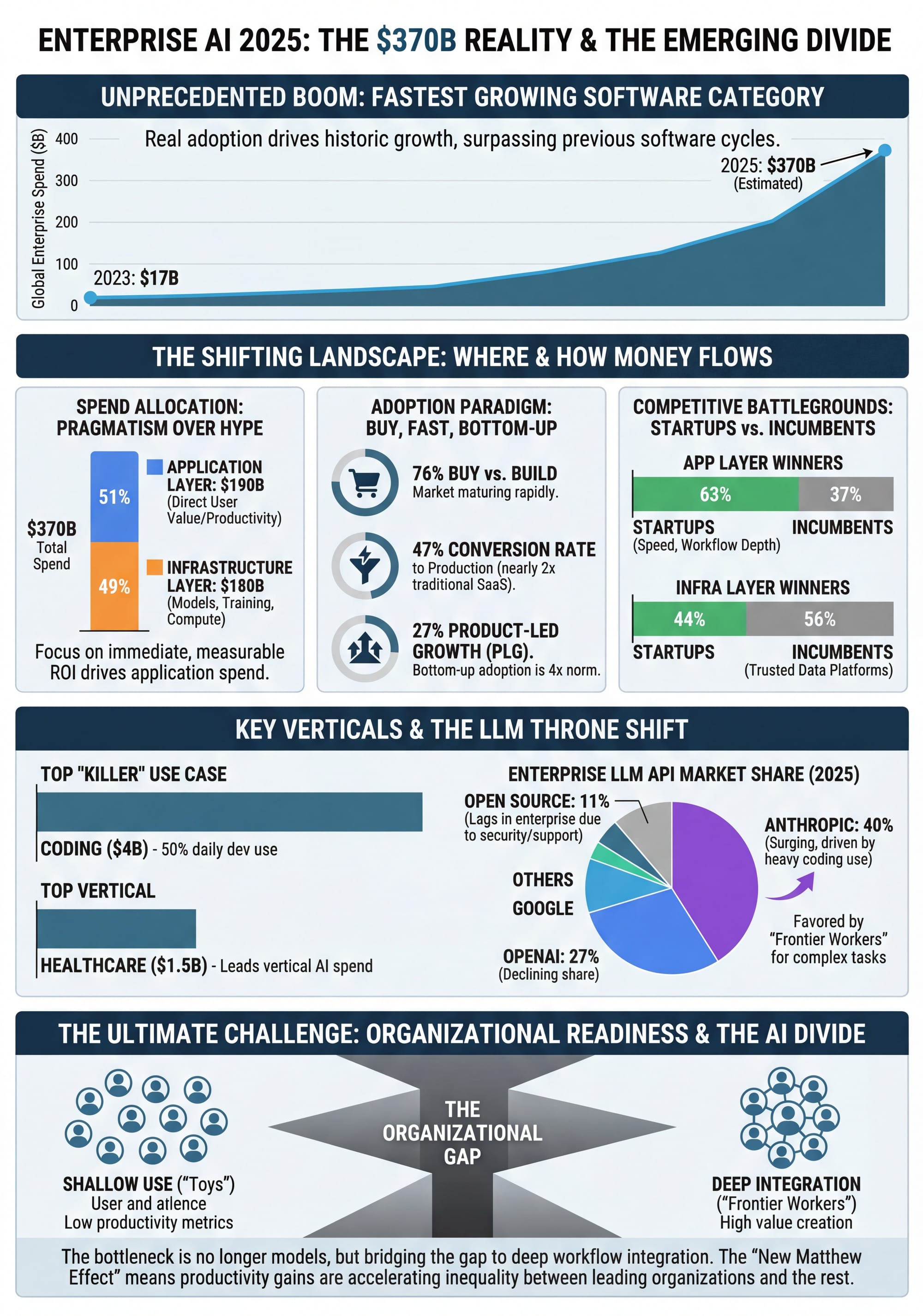
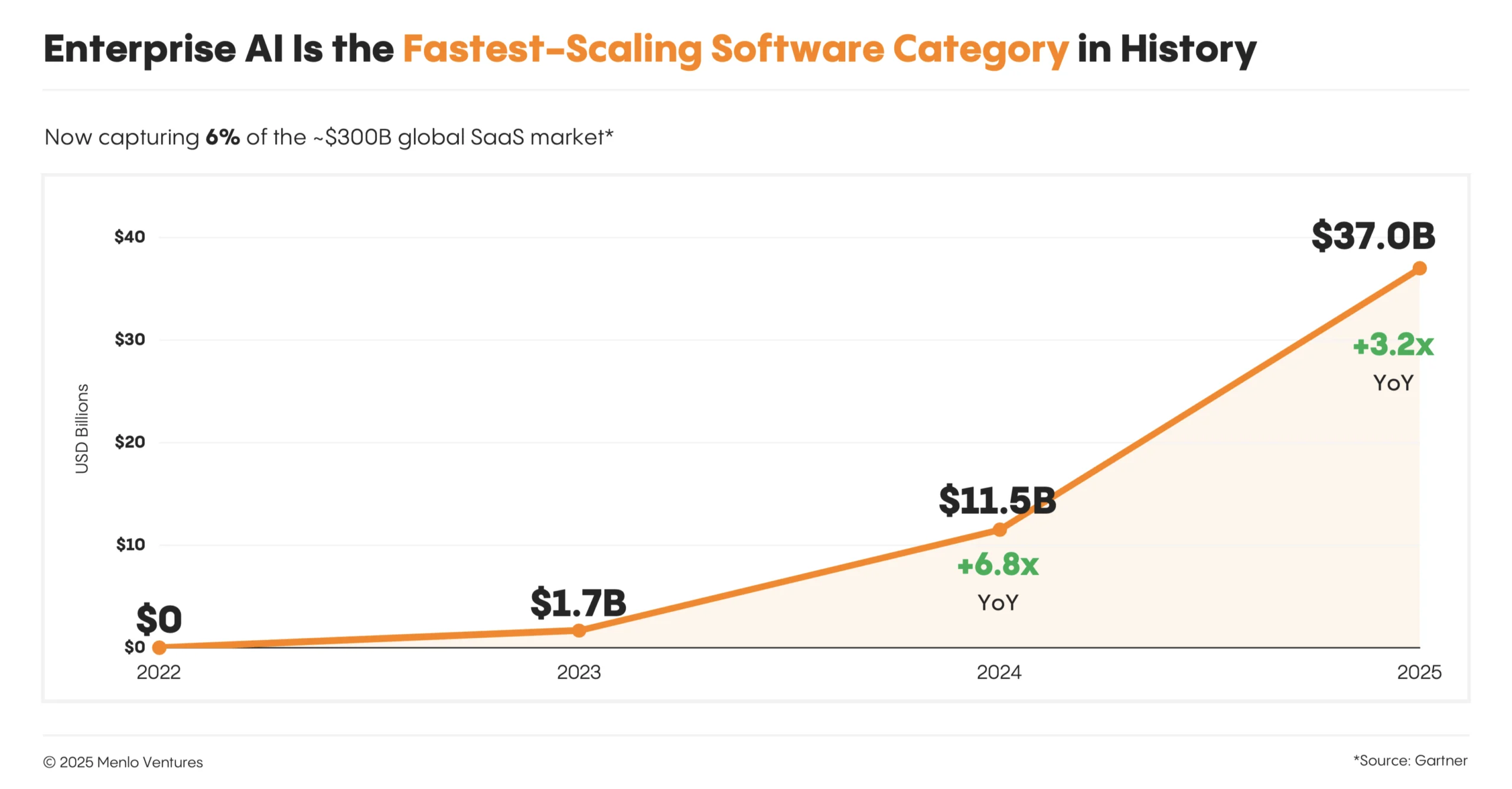
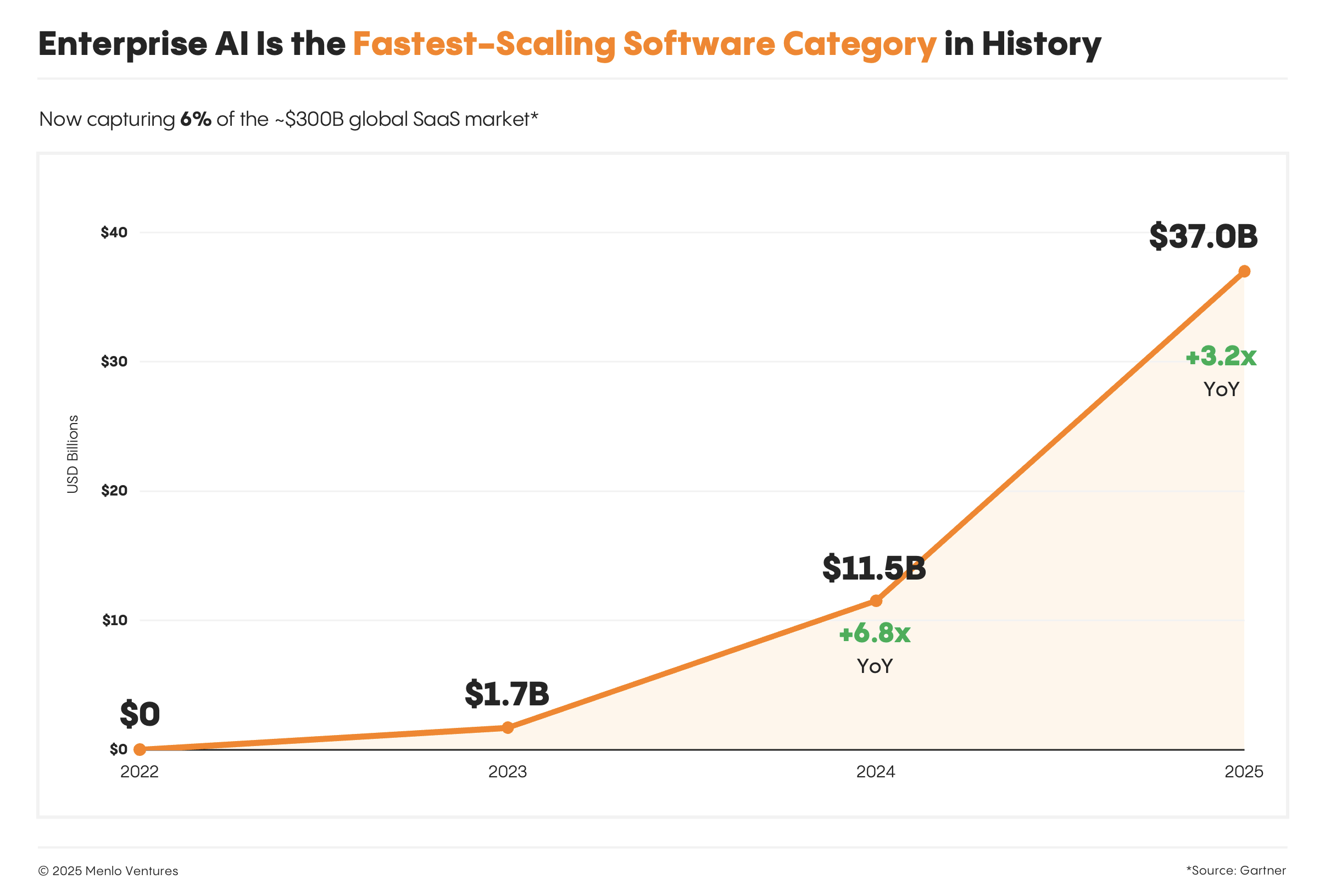
A report from venture capital firm Menlo Ventures, "The State of Enterprise Generative AI in 2025," provides the hard data to argue that this is less of a speculative "Bubble" and more of an unprecedented industry "Boom." By 2025, enterprise spending on generative AI has soared to $37 billion, a staggering leap from just $1.7 billion in 2023. This makes it the fastest-scaling category in software history.
However, as I pointed out in my last blog post, "The New Matthew Effect," a deeper question looms beneath this prosperity: Are the productivity gains from AI being distributed equally? The answer appears to be a resounding no. Invisible "AI divides" are quietly forming and widening, both between companies and among employees within them.
Enterprise AI is the Fastest-Growing Software Category in History
Source: Menlo Ventures
So, where is this massive $37 billion budget actually going? How is it fueling new inequalities? And who is dominating this feast?
Where the Money Flows: The Application Layer, Not Infrastructure
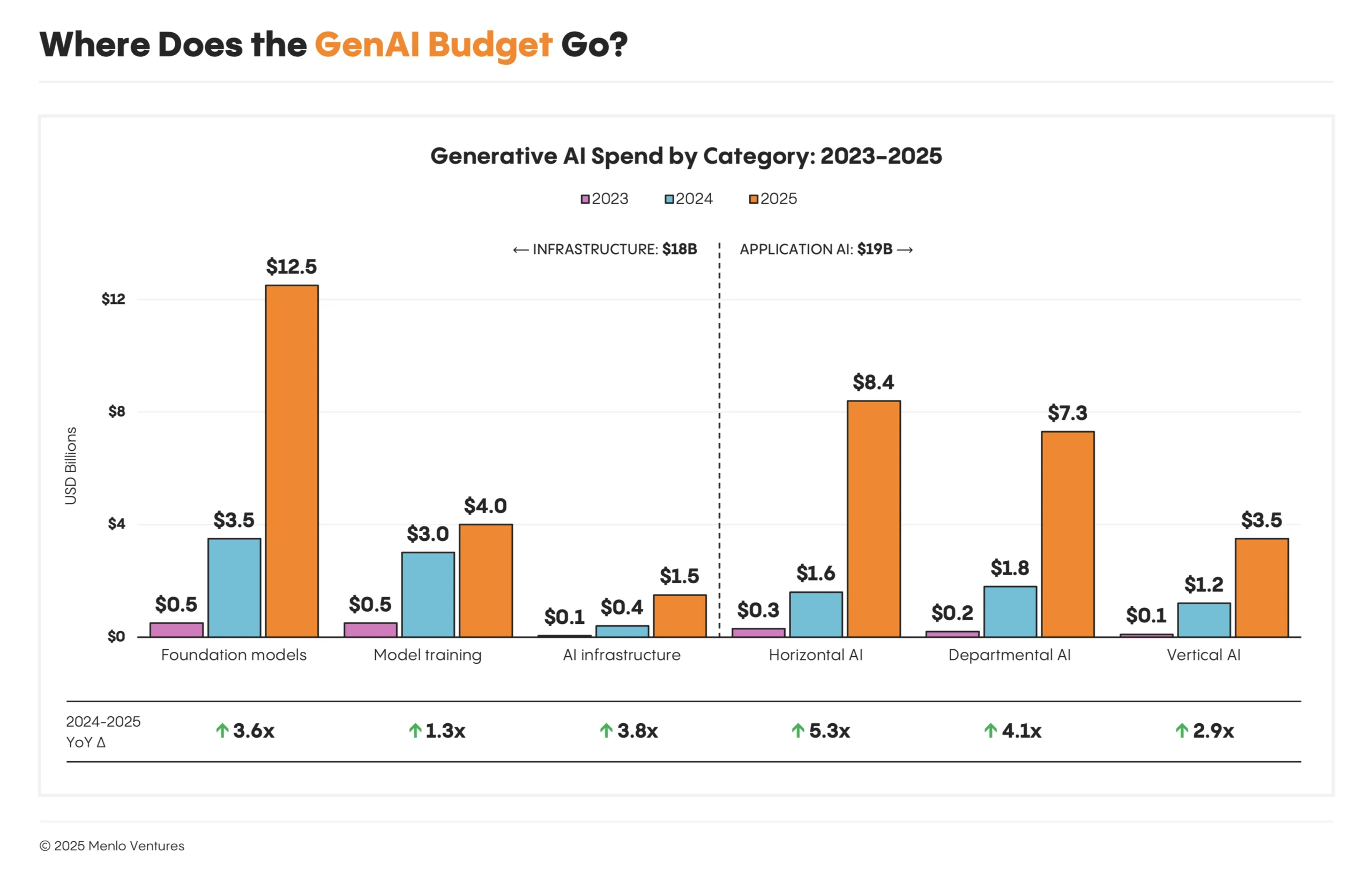
The most striking trend is that over half of the spending ($19 billion) is flowing to the AI "application layer"—the software products that directly face users and solve specific problems. In contrast, the "infrastructure layer," which includes foundation models and training, has captured $18 billion.
Generative AI Spend by Category: 2023 to 2025
Source: Menlo Ventures
This data clearly shows that modern enterprises are demonstrating remarkable pragmatism in their AI adoption. They are prioritizing solutions that deliver immediate productivity boosts and cost savings, rather than making long-term, uncertain bets on infrastructure. This aligns perfectly with a phenomenon revealed in OpenAI's "2025 State of Enterprise AI" report: 75% of surveyed employees stated that AI improved their work speed or quality, with enterprise users saving an average of 40-60 minutes per active day. It is this quantifiable, tangible value that is driving enterprises to tilt their budgets so heavily toward the application layer.
The New Paradigm of Enterprise AI Adoption: Buy, Fast, and Bottom-Up
The way companies are adopting AI also reveals three key shifts that stand in stark contrast to the traditional software era:
- A Preference to "Buy" Over "Build": Not long ago, the prevailing wisdom was that large enterprises would gravitate toward building their own proprietary AI solutions. Reality has proven to be the opposite. By 2025, 76% of enterprise AI use cases are being addressed by purchasing off-the-shelf commercial products. This indicates a rapidly maturing market where specialized AI application companies can offer more efficient and powerful solutions than in-house teams.
- Extremely High Buyer Conversion Rates: The procurement process for AI software is exceptionally efficient. Data shows that once an enterprise begins evaluating an AI solution, the conversion rate to production deployment is a remarkable 47%, nearly double the rate for traditional SaaS software (25%). The driving force behind this is the clear, quantifiable, and immediate value that AI products deliver.
- Product-Led Growth (PLG) as the Core Engine: Individual users and small teams are becoming the vanguards of AI adoption within corporations. Of all AI application spending, 27% is driven by a product-led growth (PLG) model, a figure nearly 4 times that of traditional software. This validates a key finding from the OpenAI report: AI is blurring the lines between traditional roles. 75% of employees report that AI enables them to perform new tasks they were previously unqualified for, such as non-technical staff conducting code reviews and data analysis. This bottom-up adoption, powered by individual capability expansion, is the fundamental reason for PLG's dominance in the AI era.
The Competitive Landscape: Startups Win the Application Layer, Fueling a "New Matthew Effect"
In this new battle, the field is clearly divided.
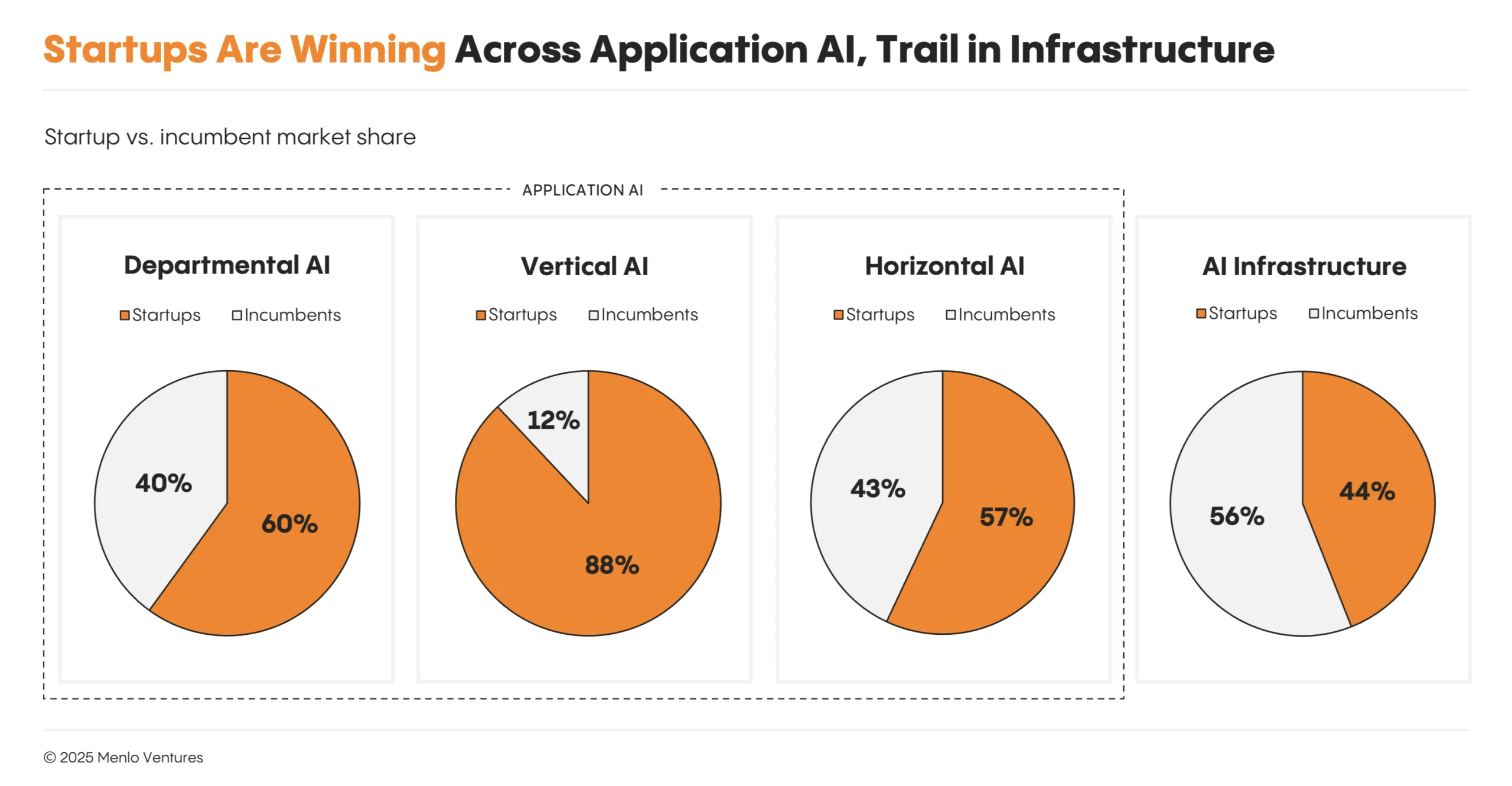
In the customer-facing "application layer," AI-native startups have secured a decisive victory, capturing 63% of the market share. With faster iteration speeds and a deep understanding of specific workflows, they are successfully wrestling market share away from traditional giants.
However, as I’ve previously discussed with the concepts of "deep integration" versus "superficial adoption," the true moat for these successful startups may lie in how effectively they guide users across the chasm from casual use to deep integration. OpenAI's report reveals a startling fact: among active enterprise users, 19% have never used data analysis features, and 14% have never used reasoning capabilities. This implies that a large portion of users are merely treating AI as a "toy." The leading startup applications are precisely those that, through superior product design, guide users to embed AI deeply into their core workflows, transforming them into what are being called "Frontier workers."
In the "infrastructure layer," incumbents remain firmly entrenched, holding 56% of the market. When building AI applications, enterprises still trust the data platforms they have been using for years.
Startups Win in the Application Layer but Lag Incumbents in AI Infrastructure
Source: Menlo Ventures
Looking at specific application domains:
- Coding is the First "Killer Use Case": Among departmental AI tools, coding assistants are in a league of their own, commanding a $4 billion market. Today, 50% of all developers use AI coding tools on a daily basis.
- Healthcare Leads Vertical Industries: In the vertical AI space, healthcare spending has reached $1.5 billion, accounting for nearly half the market. Its expenditure surpasses the next four industries—legal, finance, and others—combined. AI is creating immense value by reducing administrative burdens, such as doctors' paperwork.
A New King of LLMs: Anthropic's Rise and the Choice of "Frontier Workers"
Perhaps the most surprising finding in the report, and the one that resonates most strongly with OpenAI's findings, comes from the competitive landscape of the foundation model (LLM) market.
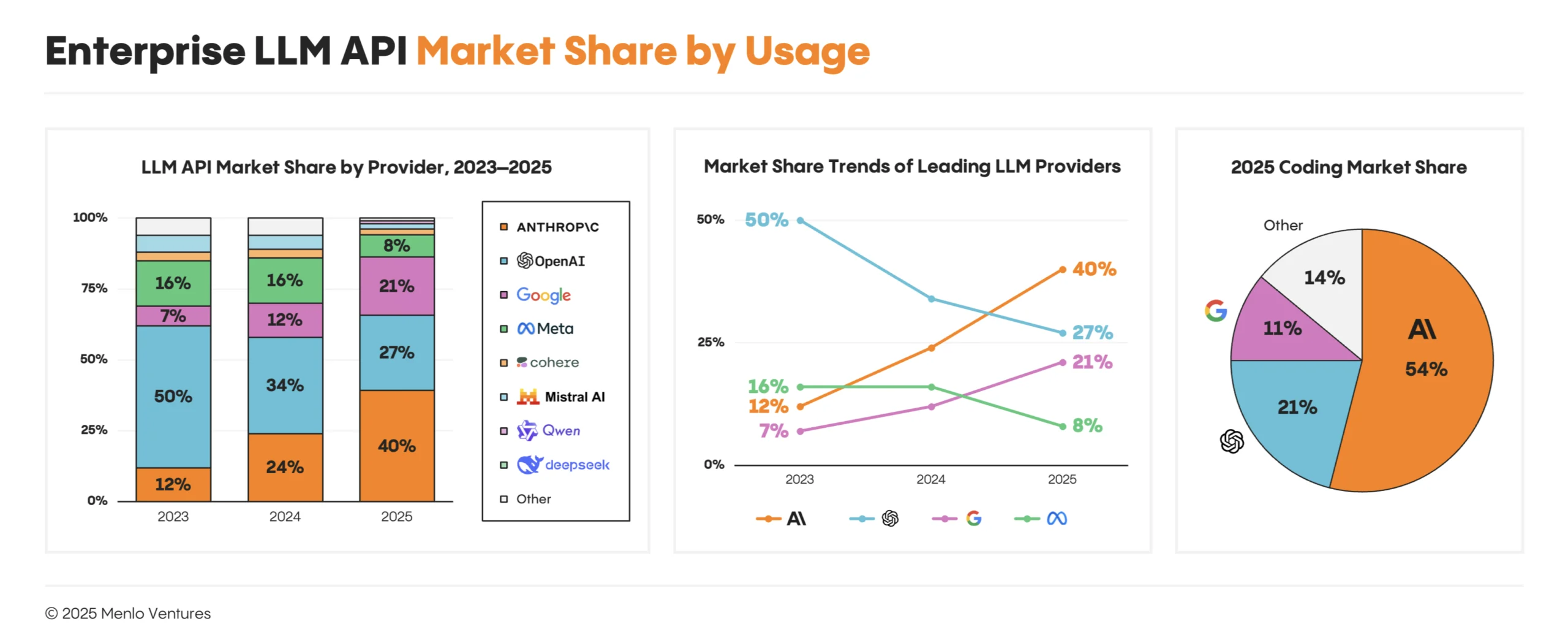
In the enterprise market, the long-reigning king, OpenAI, is being quietly overtaken. The data shows that by 2025, Anthropic has captured 40% of enterprise LLM API spending, with its market share skyrocketing from just 12% in 2023. In contrast, OpenAI's share has fallen from 50% to 27%.
Enterprise LLM API Usage Market Share
Source: Menlo Ventures
Anthropic's ascent is largely attributable to its dominance in the AI coding market. And it is OpenAI's own report that provides the crucial clue to explain this phenomenon: of all task types, coding exhibits the largest usage gap between "Frontier workers" and "median workers"—a staggering 17-fold difference. This seems to suggest that Anthropic's models may be favored by the most elite, core group of "frontier developers." It is this cohort of high-intensity users, creating enormous value and API consumption through "deep integration," that has propelled Anthropic to the throne of the enterprise market in the macroeconomic data.
Meanwhile, a once-promising camp—open-source models—appears to be struggling in the enterprise race. Menlo Ventures' data shows that open-source LLMs hold a mere 11% total share of the enterprise market. This indicates that while open-source models enjoy immense popularity in developer and academic circles, they have failed to challenge the dominance of closed-source giants in corporate environments that demand stability, security, and paid support. Enterprises are particularly cautious about open-source models from China, whose usage rate is only 1%, reflecting deep-seated concerns about data security and supply chain risks. This once again proves that enterprise customers are ultimately choosing a complete, reliable, and deeply integrable platform, not just a model.
Conclusion: The Real Challenge is "Organizational Readiness"
The Menlo Ventures report paints a vibrant and rapidly evolving picture of enterprise AI. It is not a distant future concept but a productivity tool that has already permeated core business workflows and is creating real value.
In summary, the current trends are clear: enterprises prefer to pay for applications that directly boost efficiency, startups are winning the application battle, and in the core LLM arena, the closed-source trinity (Anthropic, OpenAI, Google) holds absolute dominance, while the open-source camp is clearly lagging in the enterprise space.
But as both the Menlo and OpenAI reports collectively reveal, the essence of this transformation is not the universal democratization of technology, but rather an accelerating race of productivity divergence. The competitive landscape at the market level is merely a macro-level reflection of the "new Matthew Effect" at the individual and corporate levels. The primary constraint facing enterprises today is no longer model performance or the tools themselves, but "organizational readiness."
 Jason & Jarvis

How to guide employees across the chasm from "superficial adoption" to "deep integration," and how to systematically embed AI capabilities into core business processes, will be the decisive factors for future winners. After all, the widespread adoption of AI is just the first half of the game. The productivity divergence driven by the depth of adoption is the truly profound and far-reaching second half of this transformation. The divide has already appeared, and it is only getting wider.


