The End of the "SQL Dream" : Encoding Tacit Knowledge as the New Corporate Sovereignty
If the Coase Theorem defined the firm by its ability to reduce internal transaction costs, will the AI era redefine it not by its efficient processes, but by its proprietary 'model weights' that successfully encode the messy, tacit knowledge previously lost in the cracks of SQL databases?


See: Satya Nadella describes how lessons from Microsoft’s history apply to today’s boom
The Triumph of Tacit Knowledge: Satya Nadella on Corporate Sovereignty and New Business Architectures in the AI Era
In the long river of technological history, some echoes sound strikingly familiar, yet are fundamentally different.
When Satya Nadella looks back at the 1990s—the golden age when Bill Gates championed "Information at Your Fingertips"—he sees not just Microsoft's glory, but an obsession with "structure." The Silicon Valley of that time believed that if people, places, and things could be perfectly schematized into SQL databases, the world would fall into orderly line.
Thirty years later, however, Nadella candidly points out the biggest flaw in that vision: "The problem is, people are messy."
Perhaps the greatest distinction between this AI boom and the preceding internet wave lies not in the exponential growth of computing power, but in our final embrace of this "messiness." We are transitioning from an era that pursued the perfect database to a new epoch that captures "tacit knowledge" using deep neural networks. This shift is not only changing the form of software but may also be rewriting the very definition of the firm.
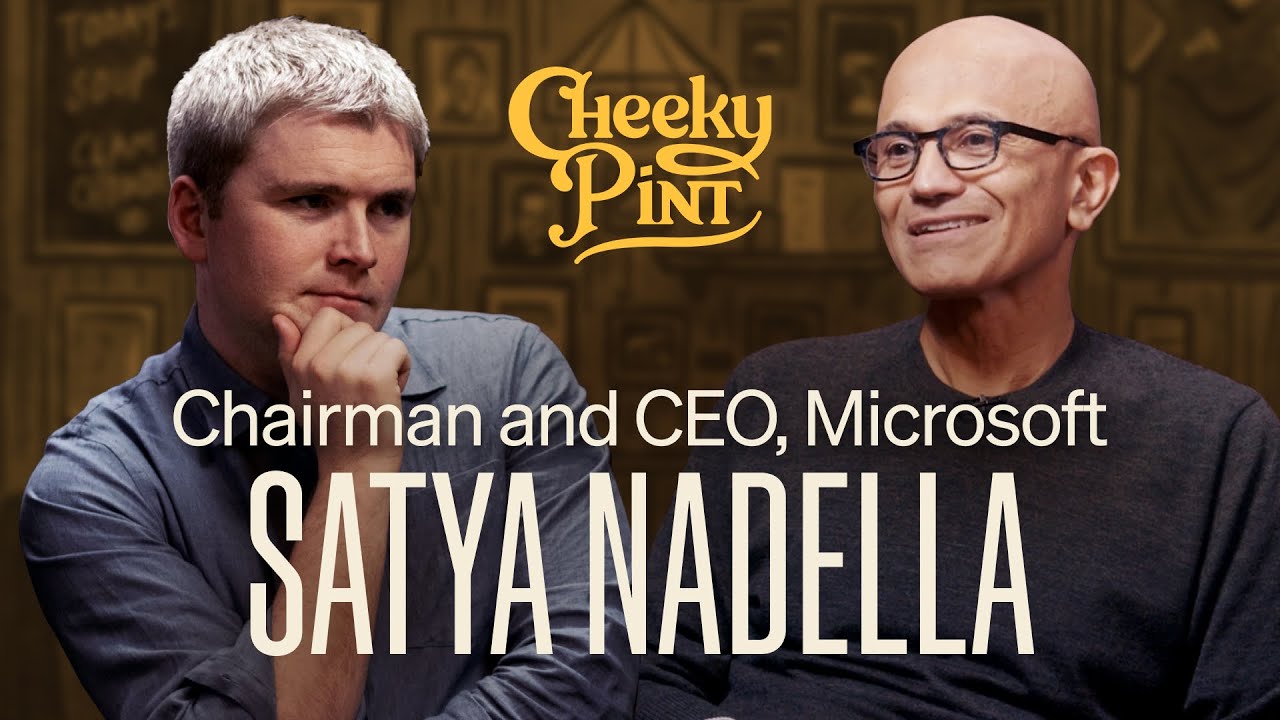
Satya Nadella discussing the AI boom and lessons from Microsoft's history
The Physical Gravity of Infrastructure: This Isn't a "Dark Fiber" Bubble
Every technological leap is met with skepticism about a "bubble." The current AI Capital Expenditure (CapEx) frenzy inevitably draws comparisons to the dot-com bubble of 2000. That was an era of excessive fiber-optic deployment, where thousands of kilometers of "dark fiber" lay dormant underground, waiting years for demand to catch up.
But Nadella's assessment, grounded in firsthand experience, is starkly different. As the CEO overseeing one of the world's largest cloud infrastructures, he isn't facing a scarcity of demand, but the hard constraints of the physical world.
"This time, there is no 'unsold' inventory," Nadella points out. Unlike the fiber laid back then that went unused, today's bottleneck is "powered-up shells"—physical data centers that require complex land permits, power licenses, and lengthy construction cycles.
This inversion of supply and demand reveals a core truth: AI infrastructure build-out is not based on speculative projections of the future, but on an immediate and immense demand for inference. This demand is so intense that it makes a giant like Microsoft nostalgic for the days of unlimited resources on PowerShell. This is a tough battle over energy, land, and compute, not merely a game of capital.
Beyond the Database: From "Information Management" to "Memory Recall"
If the dream of the 90s was to fit the world into tables, the reality of the AI era is to make machines understand human "context."
This transformation is particularly acute within the enterprise. For a long time, corporate data architecture was like trying to connect massive ERP systems and external data sources with "two thin straws," attempting to extract structured insights. But with the architecture of Copilot, Microsoft is trying to solve a more fundamental problem: Semantic Connection.
Most people's daily work doesn't involve handling neatly organized data; it's a navigation through fragments of emails, meeting notes, Teams calls, and documents. The true pulse of a company's operations lies within this unstructured data. Nadella believes AI's real value is in providing a completely new "recall" mechanism. It no longer forces humans to adapt to database fields but instead captures the "connections that are being lost from people's heads" through graphs and vectorization.
This is not just an efficiency gain; it's a democratization of cognitive ability. When Copilot can instantly piece together the timeline of a project spanning several months, like a seasoned researcher, it is effectively bridging the gap between the average employee and "deep research capabilities."
The Return of the IDE: Macro Delegation and Micro Steering
Under this new technological paradigm, our interaction with software is undergoing a subtle, cyclical return. Nadella offers a brilliant insight: the Integrated Development Environment (IDE) is making a comeback, but its users are no longer just programmers.
The accountants, lawyers, and even architects of the future will all have their own "IDE." This doesn't mean they will start writing Python code. Rather, the nature of their workflow is changing. AI can generate first drafts, code, and design proposals, shifting the human role from "creator" to "editor" and "manager."
"Macro delegation, micro steering," is how Nadella describes this future mode of work.
In this world, the resilience of Excel is particularly striking. Nadella even praises Excel as being "Turing-complete," the most accessible programming environment in the world. Why? Because Excel perfectly combines the structured presentation of data (lists and tables) with the plasticity of human thought. The software interfaces of the future, no matter how complex their underlying systems, may ultimately converge into the forms most comfortable for humans: an inbox, a dialogue box, and a canvas with a blinking cursor.
The Future of the Firm: The Coase Theorem and "Tacit Knowledge" Models
Perhaps the most philosophically profound moment of the conversation was the discussion on "data sovereignty" and the "nature of the firm."
According to the Coase Theorem, firms exist to reduce internal transaction costs. But if an omniscient AI model could know and coordinate everything, would the traditional boundaries of the firm dissolve? Would we see countless "billion-dollar, one-person companies"?
Nadella's answer reveals Microsoft's ultimate bet on the future: the company's moat will shift from "process" to "model."
Every organization possesses its unique, ineffable knowledge—its "tacit knowledge." In the past, this knowledge resided in the experience of veteran employees and was passed down through apprenticeships, making it extremely difficult to scale. In the AI era, this knowledge will be encoded into a company's proprietary "foundation model."
Imagine a company like Stripe. Its core competency is not just its payment gateway, but the fraud detection model built upon its vast transaction network. This model contains Stripe's unique memory, tool-use preferences, and action space. Nadella argues that this is where the "sovereignty" of the future enterprise lies—a company will become an intelligence layer with unique weights.
This is not merely a technological stack; it's a digital transformation of organizational assets. Future mergers and acquisitions may no longer be about buying customer lists or patents, but the target company's well-trained "model weights," which contain all its implicit wisdom.
Agentic Commerce: The End of Search, The Beginning of Discovery
This revolution will eventually ripple out to the consumer side, reshaping the internet commerce we know today.
Traditional e-commerce search is based on keyword matching—you type "running shoes," and the system returns products tagged with "running shoes." This is a mechanical retrieval. The "Agentic Commerce" Nadella envisions, however, is a form of reasoning.
When you say to an AI, "I have this much space in the corner of my living room, what furniture would look good and fit?"—this is no longer a search query, but a design consultation. The AI needs to understand aesthetics, spatial relationships, and your personal preferences, then perform a deep search and match across the entire web's "catalog."
This is the ambition behind Microsoft's push for an NLWeb (Natural Language Web). If every merchant's catalog can be "deeply read" and reasoned upon by AI agents, the internet will transform from a list of links dominated by SEO into a customized marketplace mediated by agents. Except for cyclical necessities (like recurring cat food purchases), the vast majority of "discovery-based shopping" will be reconstructed by this new interaction model.
Epilogue: The Eternal DNA of the Software Factory
Despite discussing cutting-edge AI agents and neural networks, Satya Nadella's underlying logic remains deeply rooted in Microsoft's DNA.
From Bill Gates's original vision of building a "software factory" in the 80s to constructing a "token factory" and "agent factory" today, Microsoft's core strategy has never changed: build the platform, and let others plug and play.
At this uncertain technological inflection point, Nadella exhibits a calm pragmatism. He clearly understands that whether it was the bursting of the dot-com bubble or the rise of the AI wave, technology itself is just a tool. The true winners are the organizations that can leverage these tools to transform chaotic data into insight, convert tacit knowledge into assets, and maintain a "growth mindset" amidst the ever-changing tides.
As he puts it: "Social cohesion is not the goal, winning in the marketplace is." And in the age of AI, the key to winning may just be hidden within your company's yet-to-be-modeled tacit knowledge.


