
Apple FY2025 Annual Report Visualization
With sales of Wearables declining by 4% and iPhone growth moderating, can Apple's booming, high-margin Services division—now a record $109 billion business—truly become the company's primary engine for future growth?


Part I
Part II
Part III
Part IV
Apple FY2025 10-K Report: A Deep Dive into the 'Gray Rhinos' Lurking Beneath a Services Boom and a $100B Buyback
Apple's recently released fiscal 2025 Form 10-K report paints a seemingly contradictory picture. On one hand, the company posted steady growth in total net sales to $416.1 billion, with net income rebounding to $112.0 billion. Alongside this, Apple announced a colossal new stock buyback program of up to $100 billion—a veritable feast for investors. Yet, beneath this glittering surface, the engines of growth are revealing new structural shifts, and the "gray rhinos" of regulation, geopolitics, and market headwinds are quietly approaching.
Is the world's most valuable technology giant still on solid ground, or is it standing at a precarious crossroads?
The Engine of Growth and Its Cracks
A closer look at Apple's revenue structure reveals a profound evolution in its growth drivers.
Over the past year, it wasn't just the iPhone powering Apple's ascent. The real star of the show was its Services business, which saw its net sales climb by 14% year-over-year to $109.1 billion. More importantly, it boasts a staggering gross margin of 75.4%. From App Store commissions and iCloud subscriptions to advertising and Apple Pay, this ecosystem built on hundreds of millions of users is becoming Apple's most stable and profitable cash cow. In parallel, the Mac product line also experienced a resurgence, achieving 12% year-over-year growth and shaking off its previous slump.
On the other side of the coin, however, the cornerstone iPhone business managed only modest 4% growth, while the once highly anticipated Wearables, Home and Accessories division even saw its sales decline by 4%.
A more troubling signal comes from Greater China. As one of Apple's most critical global markets, the region's net sales fell for the second consecutive year, dropping 4% this fiscal year—the only reported segment to post negative growth. This undoubtedly casts a shadow over Apple's global strategy.
The 'Gray Rhinos' Under Siege
If weakening growth in some product lines and regional challenges are the visible cracks, then the structural risks lurking beneath the surface are more akin to "gray rhinos," poised to charge at any moment.
First is the unprecedented global regulatory storm. From Europe to the United States, Apple's closed ecosystem is facing its most severe legal challenges to date.
- In Europe, the sword of the Digital Markets Act (DMA) has already fallen. The European Commission has fined Apple €500 million for failing to comply with rules on opening up to third-party payments and steering users, and has launched new investigations. This directly threatens the high-margin commission model of the App Store.
- On its home turf, the Department of Justice (DOJ), along with several states, has filed a comprehensive antitrust lawsuit, accusing Apple of monopolizing the smartphone market through a series of exclusionary practices. Meanwhile, its long-running legal battle with Epic Games also suffered a setback, with a court ruling that Apple cannot restrict developers from steering users to out-of-app purchases.
The core of these legal actions, without exception, targets the lifeblood of Apple's services business: the control and commission structure of the App Store.
Second, geopolitical and supply chain risks are becoming increasingly severe. The report explicitly notes that starting in the second quarter of 2025, the U.S. announced new tariffs on imported goods from several countries and regions, including China, India, and Japan. Given that Apple's manufacturing and assembly are highly concentrated in Asia, any increase in trade barriers will directly translate into cost pressures, eroding the already pressured gross margins of its hardware products.
Finally, an inconspicuous financial note reveals a potential financial landmine. The company's independent auditor, Ernst & Young LLP, listed "Uncertain Tax Positions" as a "Critical Audit Matter" for the year. At the end of the fiscal year, Apple's total unrecognized tax benefits amounted to a substantial $23.2 billion. This reflects a complex game of international tax law; an adverse final ruling could result in billions of dollars in additional tax liabilities.
Cash Fortress and Shareholder Returns: Confidence or Defense?
What is Apple's response to these mounting challenges? The answer lies in its formidable cash flow and aggressive shareholder returns.
As of the fiscal year-end, Apple sits on $132.4 billion in cash, cash equivalents, and marketable securities. The company not only raised its quarterly dividend to $0.26 per share but, after repurchasing $89.3 billion worth of its stock in 2025, announced a new buyback program for up to $100 billion.
Five-Year Cumulative Total Shareholder Return Comparison (Assuming Dividend Reinvestment) Source: Apple Inc. 2025 Form 10-K
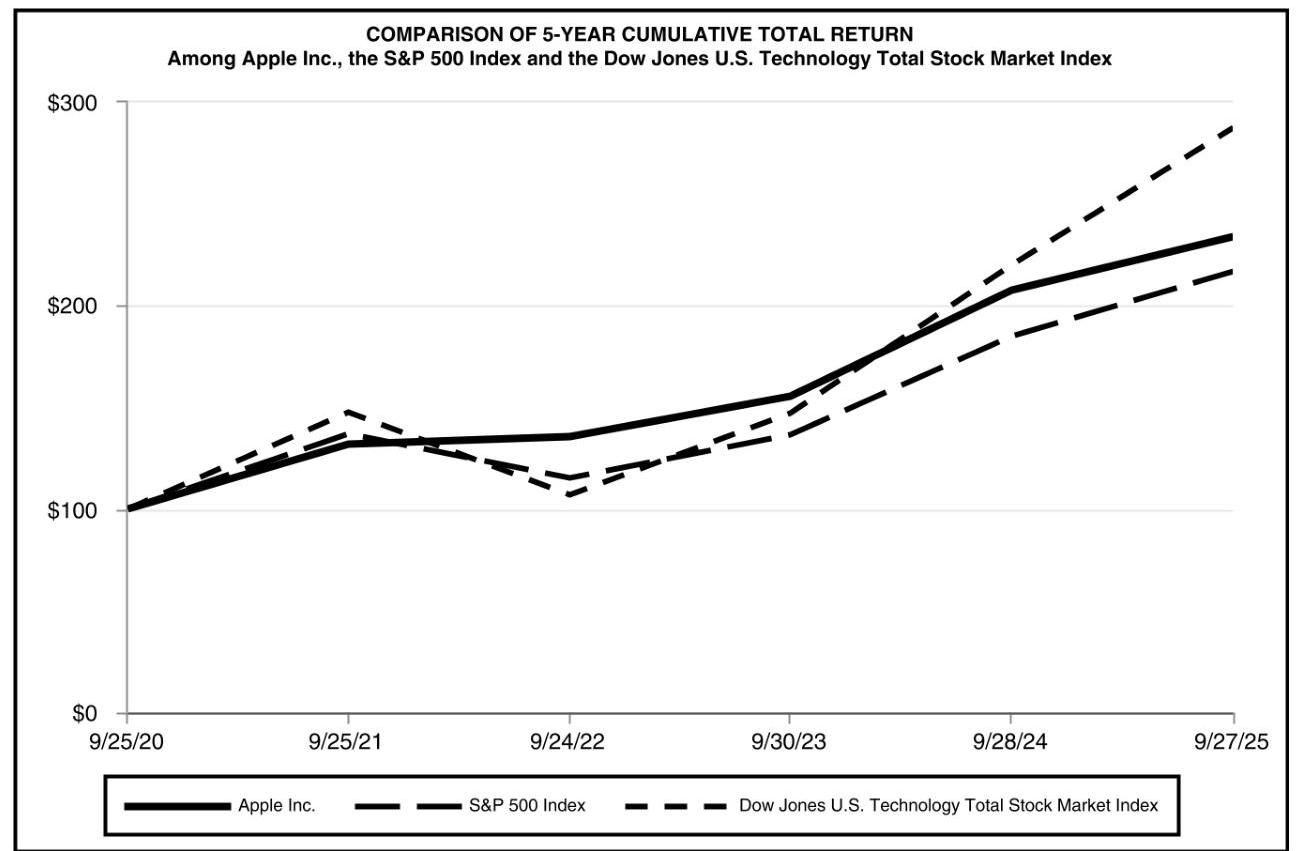
As the chart shows, over the past five years, Apple's total shareholder return ($234) has significantly outperformed the S&P 500 Index ($217), thanks in large part to its consistent capital return strategy. On one hand, such large-scale buybacks can be seen as a sign of management's confidence in the company's future cash flow. On the other, against a backdrop of slowing core business growth and rising external risks, it may also be a defensive posture—a way to boost earnings per share (EPS) by reducing the number of outstanding shares, thereby maintaining its appeal to investors.
Conclusion: A Tech Titan at a Crossroads
Apple's 2025 fiscal report reveals a tech giant at a critical juncture of transformation. It is no longer solely reliant on the explosive growth of its hardware but is increasingly dependent on the deep monetization of its ecosystem services. This model delivers higher profit margins and more stable cash flows, but it also makes clashes with global regulators all but inevitable.
While Apple's cash fortress is formidable, can it withstand the multiple storms of regulation, geopolitics, and market competition? This will not only test the strategic wisdom of its management but will also profoundly define the company's destiny in the years to come. This tech titan is navigating a crossroads of opportunity and crisis.


